You’ve opened a peptide website after hearing a podcast guest talk about faster recovery. Another tab describes a prescription diabetes medicine, while a third sells a vial labeled for research use only. They all use the phrase peptide therapy, but they aren’t offering the same kind of treatment, evidence, or reassurance.
That’s the confusion worth resolving before you compare prices, schedules, or promised benefits. The useful question isn’t whether peptides work as a category. It’s which peptide, for which condition, in which product, supported by what evidence?
Table of Contents
- Why Peptide Therapy Is Suddenly Everywhere
- What Peptides Actually Are and How They Work
- The FDA-Approved Peptide Medicines Most People Use
- Common Research Peptides and What the Evidence Actually Shows
- Why the Vial Matters as Much as the Molecule
- Risks, Side Effects, and Safety Basics to Know Before Starting
- The Role of Qualified Medical Professionals and Planning Tools
- Questions Readers Usually Ask Next
Why Peptide Therapy Is Suddenly Everywhere
A gym recommendation can sound straightforward: someone tried a peptide, felt better, and thinks you should investigate it. Online, that simple suggestion becomes a vocabulary test. You encounter compounds, combinations, injection schedules, and claims about recovery or healthy aging without a clear way to judge them.
Your curiosity is reasonable. So is your skepticism. A personal account may describe a genuine experience, but it doesn’t establish what caused the change, whether another person would benefit, or whether the product being sold matches anything studied.
A familiar word covering very different products
Part of the confusion comes from putting established medicines and experimental products under the same umbrella. Insulin and semaglutide belong in a medical discussion about peptide therapeutics. A research-labeled vial promoted for general wellness requires a different discussion.
The visibility of approved medicines helps explain the wider interest. By 2023, semaglutide was reported as the nineteenth most commonly prescribed medication in the United States, with more than 25 million prescriptions, illustrating how a peptide medicine entered mainstream care, as described in this overview of semaglutide’s market history.
That success doesn’t validate unrelated compounds. Treating every peptide as interchangeable would be like assuming that evidence for one antibiotic proves that every substance with antibacterial activity is a suitable prescription.
Start with the indication: Ask what specific medical problem a proposed treatment is meant to address, not simply what benefits its seller lists.
Turn curiosity into useful questions
Before arranging an appointment, write down the outcome you want. Less pain during rehabilitation is a more useful starting point than optimization. A diagnosis, an objective, and a way to assess progress give the conversation direction.
For help organizing that conversation, Longevity Clinics’ peptide therapy clinic patient guide is an additional patient-facing resource. Use educational guides to prepare questions, rather than treating the presence of a clinic website as proof that a treatment is appropriate.
You don’t have to choose between accepting every promise and dismissing the entire field. You can remain interested while asking for a clear chain connecting the proposed treatment to evidence relevant to you.
What Peptides Actually Are and How They Work
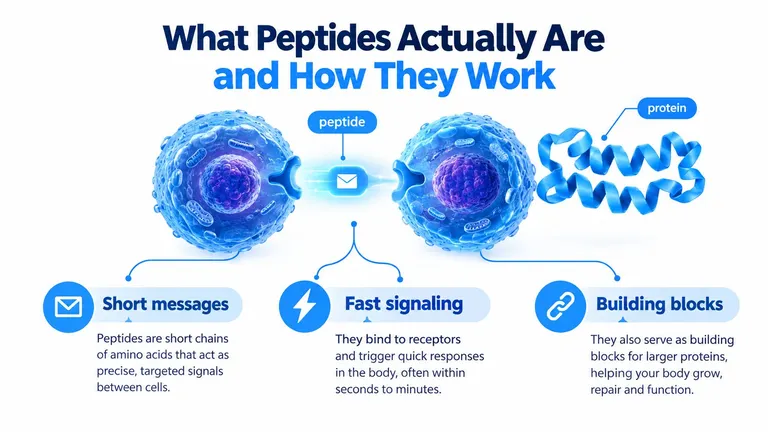
Think of a signaling peptide as a short text message between cells. Its message depends on its precise composition and on whether the receiving cell has the machinery to recognize it. That analogy helps explain why a small molecule can have an important biological effect without implying that every peptide carries the same message.
Peptides are short chains of amino acids, the same building materials used to make proteins. Proteins generally have longer, more elaborate structures, more like extended instructions than short messages.
The messenger analogy is a starting point, not a complete account of every peptide’s function.
Recognition matters more than the label
For a peptide that acts through a receptor, shape matters. A receptor is a cellular structure that recognizes particular molecular features. When an appropriate molecule binds, the cell can change its activity.
A useful analogy is a message addressed to a particular recipient. Sending more messages doesn’t guarantee a better outcome, and a message delivered to the wrong place may not produce the intended response.
- Endogenous peptides are made within the body. Insulin is a familiar example.
- Synthetic peptides are assembled through manufacturing processes rather than collected from the body.
- Recombinant medicines use biotechnology to produce therapeutic molecules.
These descriptions explain origin or production. They don’t establish whether a particular product is clinically effective.
Engineering a medicine is more than copying a message
A therapeutic developer also has to consider how a molecule will be delivered and how long it needs to remain active. Modern peptide medicines illustrate why formulation and engineering matter alongside biological activity.
For a patient-facing example of a treatment category built around peptide signaling, GLP-1 care from Empire Medical provides a place to develop appointment questions. Keep those questions specific to the medicine and condition being considered.
Peptides also are not more precise or safer than all small-molecule drugs. The text-message analogy describes one way to understand their biology, not a ranking of drug classes. A plausible mechanism explains why a treatment might work. Clinical evidence establishes whether it helps people in a defined setting.
The FDA-Approved Peptide Medicines Most People Use
The clearest starting point is a prescribed medicine with a defined purpose, rather than a broad promise of better health. An approved product gives the patient and prescriber something concrete to discuss: an indication, formulation, administration route, and evidence base.
Peptide therapy has a long clinical history. Insulin reached patients in 1922, and recombinant human insulin was introduced in 1982; later, injectable semaglutide received FDA approval for type 2 diabetes in December 2017, oral semaglutide in September 2019, and a higher-dose injectable formulation for chronic weight management in June 2021, according to this reference on FDA-approved peptide medicines. The same reference describes the initial semaglutide authorization’s evidence base as seven clinical trials involving 4,087 people with type 2 diabetes.
Selected FDA-Approved Peptide Medicines and Their Uses
| Peptide Medicine | Primary Approved Use | Evidence Posture |
|---|---|---|
| Insulin medicines | Diabetes treatment and blood-glucose management | Established clinical treatment, with product-specific prescribing requirements |
| Injectable semaglutide for diabetes | Glycemic control in type 2 diabetes | Clinical evidence tied to the approved formulation and indication |
| Oral semaglutide | Treatment of type 2 diabetes | Evidence for a distinct oral formulation, not permission to swallow an injectable product |
| Higher-dose injectable semaglutide | Chronic weight management in eligible patients | Evidence applies to the specified treatment setting and formulation |
The approval history and uses summarized above are documented in the linked reference. For another organized starting point, consult this FDA-approved peptide drugs list, then confirm the details of any proposed prescription with its current prescribing information.
What the evidence actually attaches to
Notice what changes across the semaglutide examples. The molecule’s name remains familiar, but the formulation, route, and intended use matter. Evidence for an oral product isn’t automatically evidence for an injectable preparation sold elsewhere.
Approval also doesn’t mean everyone should take the medicine. A treatment can have a strong evidence base and still be unsuitable for a particular patient. The prescriber’s task includes deciding whether the expected benefit fits that person’s diagnosis, history, and alternatives.
Readers investigating weight management may also encounter XO’s peptide weight loss guide. Use it to identify questions about individual treatments, not to turn peptide weight loss into a single therapeutic category.
The practical standard is specific: a defined product, a defined use, and clinical evidence relevant to both. A shared peptide label isn’t enough.
Common Research Peptides and What the Evidence Actually Shows
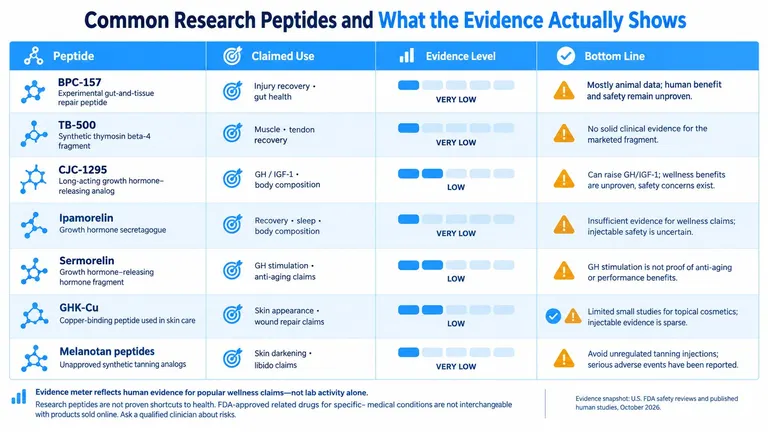
Research peptide discussions often start with an appealing outcome and work backward toward a compound. Someone wants an injury to heal, better sleep, or improved body composition. A seller supplies a molecular name, and the name can make the proposed solution sound more established than it is.
Reverse that process. Begin with the human evidence, then ask whether it supports the claimed outcome.
Separate the marketing question from the clinical question
| Compound or group | Claims readers may encounter | What needs to be demonstrated |
|---|---|---|
| BPC-157 | Injury recovery and tissue repair | Reliable human evidence for the specific injury and treatment |
| TB-500 | Healing and recovery | Human outcomes for the exact substance and formulation |
| CJC-1295, ipamorelin, and sermorelin | Body composition, sleep, or anti-aging | Meaningful benefits and safety for the proposed use |
| GHK-Cu | Skin health and tissue repair | Evidence matching the route, especially when an injectable product is proposed |
| Melanotan peptides | Appearance-related benefits | Product-specific human safety and effectiveness, rather than reassurance from the name |
These are claims to examine, not treatment recommendations. They shouldn’t be read as an evidence ranking or as a declaration that every compound has the same regulatory history.
For BPC-157, human evidence remains very limited, and available reviews haven’t established a basis for routine clinical use. The useful distinction is between a reason to investigate a molecule and a reason to prescribe it.
Read beyond the study title
Laboratory findings can help researchers identify biological activity. Animal experiments can support further investigation. Neither automatically answers whether a person will recover faster, feel better, or avoid important harms.
Harvard Health’s discussion of peptide benefits and safety concerns provides background on that distinction between established medicines and experimental injections.
A change in a biological signal isn’t necessarily a meaningful improvement in a patient’s health.
When someone shares a paper, ask who was studied, what was administered, and what outcome was measured. A study about a related molecule, a topical preparation, or a laboratory marker may be interesting without answering your clinical question.
An honest conclusion can be that a compound deserves further research while the proposed use remains unproven. That isn’t dismissal. It’s the boundary between scientific interest and a justified treatment claim.
Why the Vial Matters as Much as the Molecule
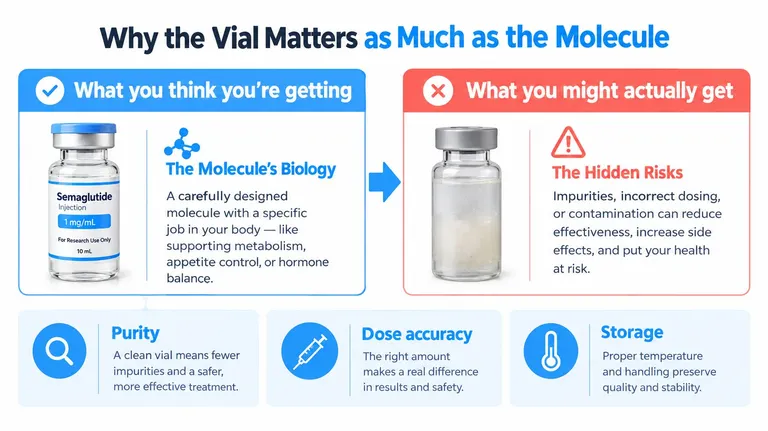
Suppose a paper convincingly establishes that a molecule has useful effects. There’s still another question: does the product someone plans to inject match the material studied?
A label names what a seller says is inside. It doesn’t, by itself, establish identity, concentration, sterility, or stability. Those are separate questions, and each matters before dose calculations become useful.
The distinction is easiest to see by separating the molecule’s proposed biology from the product’s measurable properties.
Different tests answer different questions
- Identity testing asks whether the material is the substance named on the label.
- Potency or concentration testing addresses how much active material is present.
- Purity testing examines what else is present, but doesn’t independently settle sterility.
- Sterility and handling controls address a different set of concerns from molecular identity.
- Stability information supports decisions about storage and usable life under specified conditions.
These aren’t interchangeable assurances. A document showing a peptide-related laboratory result shouldn’t be treated as a universal certificate of suitability for injection.
The product-quality concern isn’t merely hypothetical. A gray-market analysis reported concentration variation, purity as low as 5% in some products, peptide-related impurities, and heavy-metal contamination above limits used for parenteral medicines, as summarized in the AAMC’s questions to ask your doctor about peptides.
Precise arithmetic can’t establish product quality
A calculator works from inputs. If you enter a labeled amount and a preparation volume, the result depends on those inputs being correct. More decimal places won’t resolve uncertainty about the contents.
Practical rule: A carefully calculated dose of an unverified product remains an uncertain exposure.
For terminology to bring into a sourcing discussion, consult this guide to peptide purity testing. Ask which tests apply to the actual batch, what they measured, and what they didn’t establish.
Keep that evidence-versus-product distinction in mind while reviewing the accompanying video.
An FDA-approved medicine, a physician-directed compounded preparation, and an unregulated research chemical shouldn’t be treated as equivalent purchasing options. If compounding is proposed, ask why it’s needed, who prepares it, and which product-specific safeguards apply. Clinical supervision and product verification address related but different responsibilities.
Risks, Side Effects, and Safety Basics to Know Before Starting
There isn’t a universal peptide safety checklist that can replace instructions for a specific medicine. The sensible approach is to use broad safety categories to identify what your prescriber and pharmacist need to explain.
Start with the actual product name and formulation. Avoid asking only whether peptides are safe, because that wording hides the details needed for a useful answer.
Use the following categories to organize the conversation, not to diagnose symptoms yourself.
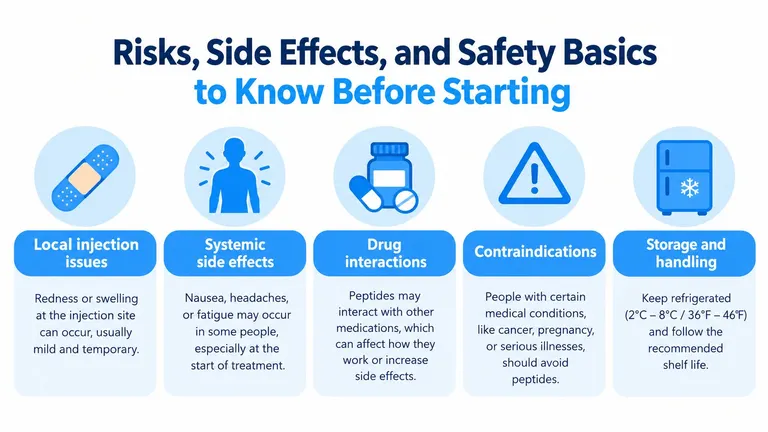
Bring a product-specific checklist
- Administration and local reactions: Ask whether the treatment requires injection, who will teach the technique, and which local changes warrant a call.
- Whole-body effects: Request the medicine’s expected adverse effects and a separate explanation of symptoms requiring urgent attention. Don’t assume another peptide’s tolerability predicts yours.
- Interactions: Provide a complete list of prescriptions, nonprescription medicines, supplements, and other injected products. Ask the pharmacist to review the combination.
- Contraindications: Discuss relevant diagnoses, allergies, pregnancy considerations, and previous treatment reactions before agreeing to a plan.
- Storage and handling: Obtain written instructions for the exact formulation. Don’t borrow preparation or storage rules from an unrelated online protocol.
Agree on monitoring before treatment begins
Ask which baseline assessments are appropriate and whether follow-up testing is needed. The answer should depend on the medicine and your clinical circumstances, rather than a standard panel marketed for everyone.
Monitoring isn’t just about ordering bloodwork. You also need to know what outcome will be assessed, what would prompt a treatment change, and whom to contact between appointments.
For language to help prepare that discussion, this overview of peptide side effects can serve as a question-building resource. Your product’s instructions and your clinician’s assessment should guide the actual plan.
If unexpected symptoms occur, don’t use a forum to decide how to adjust or combine doses. Follow the agreed contact plan, and seek urgent medical care for severe symptoms. A usable safety plan includes actions, not just a list of possible problems.
The Role of Qualified Medical Professionals and Planning Tools
A qualified medical professional and a planning app contribute different things. The clinician decides whether there’s a medical problem to treat and whether a proposed intervention is appropriate. A tool can help organize an agreed plan.
During an assessment, the clinician should clarify your symptoms, review relevant history, consider alternatives, and determine what examination or testing is warranted. If treatment is prescribed, you should understand its purpose and how follow-up decisions will be made.
Give each task the right owner
| Task | Appropriate responsibility |
|---|---|
| Diagnosis and treatment selection | Qualified prescribing clinician |
| Product instructions and medication questions | Prescriber and pharmacist |
| Deciding whether to change treatment | Prescriber, with patient input |
| Recording scheduled and completed doses | Patient, supported by a log or planning tool |
| Checking arithmetic inputs | Patient and clinician or pharmacist, as appropriate |
A paper calendar, phone reminder, or dedicated dosing app can help you keep records. Those options differ in convenience, but none can determine whether a treatment is medically justified.
Precision belongs after the clinical decision
A dosage calculator may translate a prescribed amount into a volume or device-unit measurement. That conversion requires the correct concentration and device information. Device units aren’t a universal substitute for a mass dose.
Scheduling tools can also record prescribed frequencies, start dates, and pauses. They shouldn’t generate a treatment cycle just because a template is available.
Bring your log to follow-up appointments, including missed doses and symptoms you want to discuss. Don’t automatically double a dose after missing one; obtain product-specific instructions. The purpose of organization is to support communication and execution, not to replace clinical judgment.
Questions Readers Usually Ask Next
Is peptide therapy legal everywhere?
Don’t assume a product’s availability online establishes its legal status. Ask a locally licensed prescriber or pharmacist to check the exact medicine, intended use, and supply route in your jurisdiction.
How soon should I expect results?
Request a timeline tied to the prescribed treatment and the outcome being measured. For an experimental use, acknowledge that a dependable timeline may not exist; a seller’s schedule isn’t clinical evidence.
Do lifestyle changes still matter?
Yes. Ask how nutrition, activity, sleep, and rehabilitation fit your goal. Medication shouldn’t become a reason to overlook the rest of your care.
What should I bring to the first appointment?
Bring your medication list, relevant records, your specific goal, and the proposed product’s label or sales page. Ask the clinician to identify the evidence, alternatives, monitoring plan, and reasons to stop before you commit.
PepFlow offers a dosage calculator, schedule planning, reminders, and dose history to help organize a clinician-directed regimen. Visit PepFlow to explore those tools, and have your prescriber or pharmacist confirm the product details and calculation inputs before relying on them.