You’re training hard, sleeping reasonably well, eating what looks like a solid diet, and still not bouncing back the way you used to. The same tendon keeps grumbling. A hard lower-body session lingers into the next one. A “minor” strain turns into a background problem that shapes every workout decision. That’s the point where a lot of people start looking beyond protein, mobility work, and rest days and end up reading about peptides for recovery.
That interest makes sense. Recovery isn’t just about feeling less sore. It’s about whether damaged tissue remodels well enough for you to train, work, or move without the same issue repeating. Peptides entered this conversation because they appear to act on signaling pathways involved in healing, repair, and inflammation. That’s a very different claim from “they make pain disappear.”
The problem is that the market got ahead of the evidence. Recovery peptides are often discussed as if all of them are equally studied, equally reliable, and easy to use well. They aren’t. The smarter conversation is about process: what the peptide is supposed to do, how strong the evidence is, how much product quality matters, and whether your protocol management is disciplined enough to avoid preventable mistakes.
Table of Contents
- When Your Recovery Can’t Keep Up
- How Peptides Signal Your Body to Heal
- Common Peptides Used for Tissue Repair
- Decoding the Evidence on Recovery Peptides
- Navigating Safety and Legal Considerations
- Principles for a Responsible Peptide Protocol
- Using PepFlow to Manage Your Protocol
When Your Recovery Can’t Keep Up
A common pattern looks like this: training is still going well enough that you don’t want to stop, but recovery has subtly become the bottleneck. You’re not fully injured, yet you’re not fully fresh either. The shoulder settles down only if pressing volume stays low. The Achilles loosens up after warm-up but complains again the next morning. You keep modifying around the same issue and calling it “manageable.”
That’s usually when people start searching for a tool that does more than blunt symptoms. They want something that might support actual repair. Peptides for recovery get attention in that moment because they’re framed as compounds that may influence healing pathways rather than just pain perception.
Still, the first move shouldn’t be “pick a peptide.” It should be cleaning up the recovery basics enough that you can tell whether anything else is helping.
- Training load: If tissue irritation is coming from poor programming, no add-on fixes that.
- Sleep consistency: Recovery signaling doesn’t happen in a vacuum.
- Nutrition support: A lot of people under-eat without realizing it, especially in harder training blocks. If that’s you, this guide on effective calorie tracking for athletes is useful because it ties intake to performance and recovery, not just body weight.
- Movement selection: Repeating the same aggravating pattern while hoping biology saves you is a bad plan.
Recovery tools work better when they’re layered onto a decent foundation. They don’t replace one.
The practical reason to keep that perspective is simple. Once you add peptides, you want a clean enough baseline that you can judge whether they’re doing anything at all. If your sleep, calories, and workload are all moving around at the same time, every result becomes harder to interpret.
How Peptides Signal Your Body to Heal
Peptides are easiest to understand as biological text messages. They’re short chains of amino acids that send signals. A cell receives that signal through the right receptor and changes behavior. That might mean shifting inflammatory activity, supporting tissue remodeling, or influencing how repair unfolds after stress or injury.
A second useful analogy is keys and locks. The peptide is the key. The receptor is the lock. If the fit is right, a process gets turned on or adjusted. That doesn’t mean the outcome is always dramatic. It means the body gets a more specific instruction than you’d get from a broad tool like an anti-inflammatory drug.
Here’s the basic concept map to keep in mind before diving deeper.
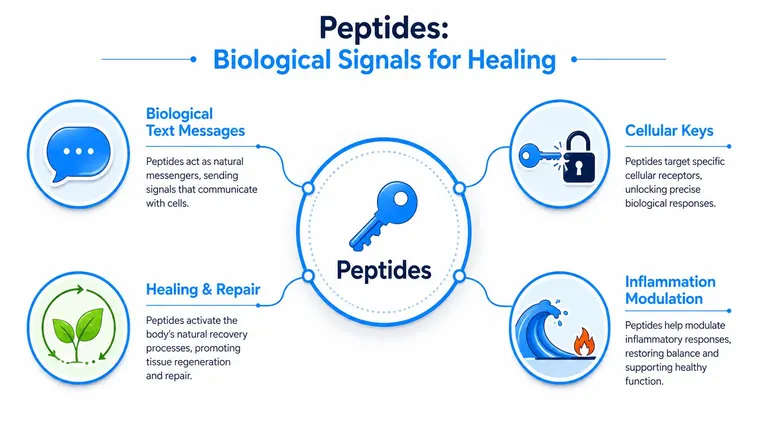
Peptides as biological messages
The reason peptides for recovery are interesting is that healing isn’t one single event. It’s a sequence. Tissue gets stressed or injured. The body mounts an inflammatory response. Blood flow matters. Structural cells have to rebuild and organize tissue. Then remodeling has to progress well enough that the area becomes functional again.
Peptides are discussed in recovery because they may influence parts of that sequence rather than masking the discomfort associated with it.
A few mechanisms come up often:
- Angiogenesis support: New blood vessel formation matters because tissue needs oxygen and nutrients to repair.
- Fibroblast activity: Fibroblasts help lay down and remodel connective tissue.
- Inflammation modulation: The goal isn’t zero inflammation. The goal is a response that helps healing instead of dragging on unproductively.
- Tissue remodeling: Good recovery depends on what gets rebuilt, not just how quickly soreness fades.
The repair pathways people actually care about
A major reason this topic gets confusing is that people talk about “recovery” as if it means one thing. In practice, they usually mean one of three things: they want a soft-tissue injury to calm down, they want between-session recovery to improve, or they want a nagging area to tolerate load again.
Those aren’t identical goals.
If you don’t define the recovery problem clearly, you can’t evaluate whether a peptide matches it.
That’s also why mechanism matters. A peptide that’s relevant to tissue remodeling is conceptually different from something used mainly for energy, appetite, or body composition. The label “peptide” is broad. It doesn’t tell you whether the compound is suitable for tendon irritation, wound healing, or a heavy training block.
For a broader visual explanation of how signaling compounds are discussed in practice, this overview is worth watching before you get too deep into protocol details.
Common Peptides Used for Tissue Repair
When people talk about peptides for recovery, two names dominate the conversation: BPC-157 and thymosin beta-4, often shortened to Tβ4. They’re often grouped together, but they shouldn’t be treated as equally supported. The gap in evidence quality matters.
BPC-157 and why people talk about it
BPC-157 gets discussed constantly in recovery circles because it’s associated with tissue healing, especially in conversations around tendons, ligaments, soft tissue, and sometimes gut-related recovery. Mechanistically, the appeal is straightforward. It’s talked about as something that may support processes tied to healing and tissue repair rather than functioning as a classic pain-management tool.
The challenge is evidence depth. BPC-157 has a lot of interest around it, but much of that interest has been driven by preclinical work and user anecdotes rather than the kind of human evidence that makes protocol decisions easy. That doesn’t mean it’s irrelevant. It means confidence should be modest.
Tβ4 and why its evidence stands out more
Tβ4 is the more interesting option if you’re judging by human data quality. For recovery-oriented peptide use, the strongest human data is generally for thymosin beta-4 rather than BPC-157. Phase II studies in chronic wound settings reported accelerated healing by about one month in patients who healed, and a randomized placebo-controlled dry-eye trial in 72 subjects found a 27% reduction in discomfort scores with no adverse events, as summarized in this review of peptides for recovery and performance.
That doesn’t prove it as a universal sports-recovery solution. It does show something important: meaningful tissue-repair effects can appear in humans when a peptide is studied rigorously.
Stronger human evidence doesn’t mean “guaranteed result.” It means your expectations can be grounded in more than theory.
Comparing common recovery peptides
The clearest way to think about these two is side by side.
| Peptide | Primary Proposed Function | Typical Administration | Level of Human Evidence |
|---|---|---|---|
| BPC-157 | Tissue-healing support, often discussed for soft tissue and localized recovery | Commonly discussed in injection-based protocols | Human evidence is limited compared with Tβ4 |
| Tβ4 | Soft-tissue repair and regeneration support | Commonly discussed in injection-based protocols and clinical research settings | Stronger human evidence relative to BPC-157, including wound-healing and dry-eye trial data |
In practical coaching terms, this is the takeaway: BPC-157 is popular because the theory is appealing and user interest is high. Tβ4 deserves more respect in evidence discussions because it has at least shown clinically meaningful human findings in specific contexts. If someone talks about these peptides as if the research footing is identical, they’re flattening an important distinction.
Decoding the Evidence on Recovery Peptides
The recovery peptide conversation gets messy because anecdotes spread faster than evidence. One person says a compound fixed a stubborn tendon. Another says it did nothing. A clinic markets “healing support.” A forum thread treats preclinical findings like settled sports medicine. Most readers end up trying to judge all of that with no framework.
Start with the hierarchy. Animal work and lab data can be useful. They show biological plausibility. They can reveal mechanisms worth studying. But they don’t tell you whether a protocol translates cleanly to individuals using mixed-quality products in practical settings.
Why preclinical promise isn’t the same as a proven protocol
A major 2024 review on peptide therapies reported that BPC-157 consistently enhanced healing in severe injuries in preclinical models, and that thymosin beta-4 has shown promise for soft-tissue repair. The same review emphasized that the evidence base remains largely preclinical, which is exactly the tension people need to understand when they read peptide claims in the recovery space. You can read that context directly in the 2024 review of local and systemic peptide therapies for soft-tissue regeneration.
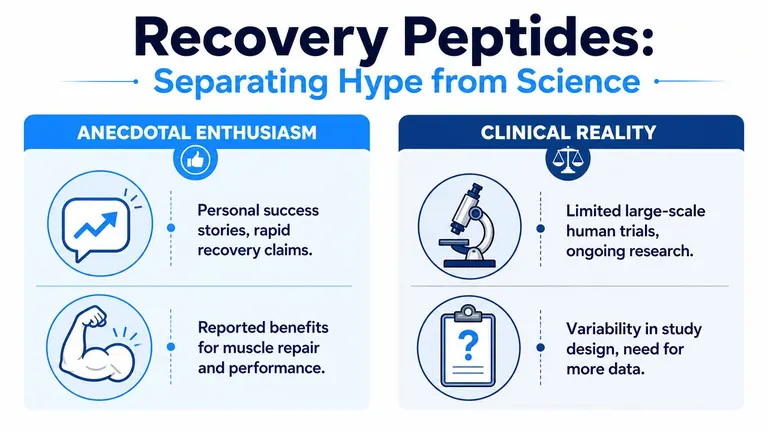
That sentence matters more than most marketing pages. “Promising” and “preclinical” can both be true at the same time. If you want a practical companion piece that goes deeper into one category of healing compounds, PepFlow’s article on peptides for tissue repair is a useful read.
A simple way to judge peptide claims
When assessing peptides for recovery, ask four questions.
-
What kind of evidence is this?
Animal model, mechanism paper, uncontrolled observation, or randomized human trial. Those aren’t interchangeable. -
What outcome was studied? Wound healing, eye discomfort, tendon pain, return to sport, and soreness after training are different endpoints.
-
Does the product being sold match the product studied?
This is often where the discussion falls apart. -
Is the protocol clear enough to reproduce?
If the dosing, timing, and handling are vague, the claim is hard to trust.
- Green flag: The person discussing the peptide admits uncertainty and distinguishes theory from demonstrated human outcomes.
- Yellow flag: The claim leans heavily on mechanisms but skips human context.
- Red flag: The pitch treats every positive anecdote as proof.
Good evaluation starts with humility. The body is complicated, and recovery claims are often more confident than the data.
Navigating Safety and Legal Considerations
A lot of articles treat safety as a short disclaimer after the exciting part. That’s backward. In real-world use, the biggest immediate problem may not be whether a peptide could work in theory. It may be whether the vial contains what the label claims, at the concentration you think it does, stored in the way it should have been stored.
The main risk may be the vial, not the theory
The American Medical Association has reported that there is not enough valuable, statistically significant evidence to recommend many injectable peptides safely, and it highlights extra risks tied to contamination, sourcing, and dosing from unregulated sources. That warning is worth reading in full in the AMA’s article on what doctors want patients to know about injectable peptides.
That’s the practical issue many users underestimate. Precise protocols only matter if the product is real, accurately compounded, and handled correctly. If concentration is off, your actual delivered dose may diverge from the plan before the syringe even touches skin.
This is one reason I tend to be more skeptical of confident protocol talk than of the peptide itself. The protocol on paper may look disciplined. The supply chain may be the weak link.
What research use only should tell you
“Research use only” isn’t a quality badge. It’s a warning about responsibility. It often shifts risk toward the buyer, who may assume far more certainty than the label justifies.
A few practical filters help:
- Supplier transparency: If a seller gives you almost nothing about handling, measurement, or storage, that’s a problem.
- Dose reliability: Microgram-level planning only makes sense if the concentration is trustworthy.
- Sterile technique: Even a well-designed protocol can be undermined by sloppy preparation.
- Expectation control: If the seller talks like every peptide is a polished therapy, step back.
For a wider perspective on how to think about add-on interventions versus basics, this article on insights on supplement benefits is a good reset. It reinforces a point that applies here too: the existence of a product category doesn’t guarantee a meaningful outcome for the individual using it.
If you’re weighing risks more closely, PepFlow also has a practical explainer on peptide side effects that fits well with a conservative decision-making approach.
Principles for a Responsible Peptide Protocol
Most peptide mistakes aren’t glamorous. They’re administrative. Bad math. Inconsistent timing. Weak notes. Vague goals. A user can spend hours reading mechanisms and then ruin the experiment with poor execution.
Build the protocol before you touch the vial
Responsible use starts with writing down the protocol in plain language before you prepare anything.
- Define the target: “General recovery” is too vague. Name the tissue, symptom pattern, or training problem.
- Decide what success looks like: Better morning stiffness, improved tolerance to loading, less aggravation after a session, or another concrete marker.
- Keep variables stable: Don’t overhaul your rehab plan, training split, and peptide use at the same time if you want interpretable feedback.
- Start low and assess: A cautious approach gives you room to monitor response rather than chasing a sensation.
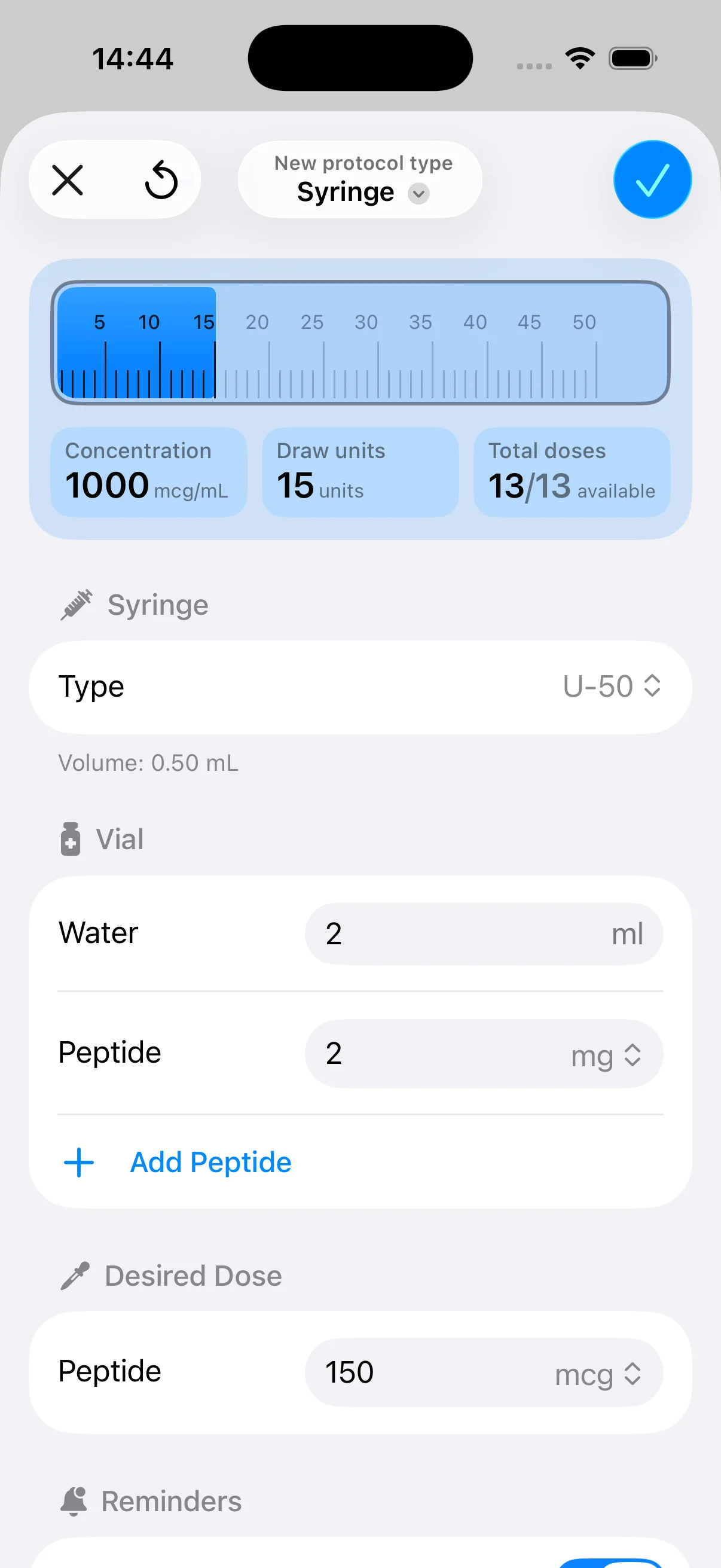
Reconstitution deserves more attention than it usually gets. If you don’t understand how a vial concentration translates into actual syringe units, you’re not ready to administer anything. The math itself isn’t complicated, but it has to be exact. Unit confusion is one of the easiest ways to drift away from the intended protocol.
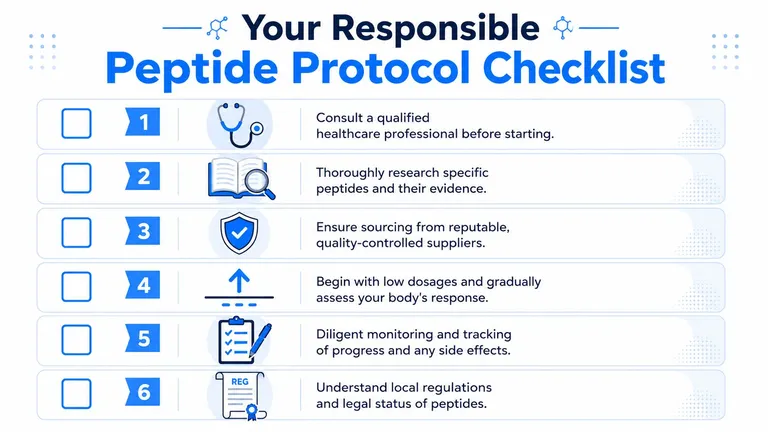
Practical rule: If you can’t explain your own reconstitution math clearly on paper, pause the protocol.
Cycling also matters. Not because every peptide automatically requires a rigid template, but because planned on and off periods help you judge whether changes persist, fade, or never appeared in the first place. Constant, unstructured use tends to create noisy data and false confidence.
Track like the experiment matters
Good tracking is boring. That’s why it’s often skipped.
Use a simple log that records:
- Date and timing: Consistency beats memory.
- Dose details: Write what you intended and what you administered.
- Local response: Injection-site issues, irritation, or anything unexpected.
- Functional outcomes: Range of motion, pain pattern during loading, tissue tolerance the next day.
- Context: Sleep, training stress, and any obvious confounders.
A protocol without tracking turns into storytelling. If you want to know whether peptides for recovery are helping, you need enough structure to separate signal from noise.
Using PepFlow to Manage Your Protocol
Software demonstrates its utility. Not as a replacement for judgment, but as protection against avoidable errors.
A peptide protocol usually breaks down in three places: conversion math, schedule drift, and missing records. If you’re working with microgram-based planning and vial concentrations, manual calculations can go wrong quickly. Then the schedule starts slipping. Then you realize your notes are spread across screenshots, reminders, and memory.
PepFlow is built for that specific problem set. Its peptide protocol management app helps users convert desired microgram amounts into practical unit measurements, organize cycled protocols with start dates and pause periods, set reminders, and keep a dose history. That’s useful when the goal is consistency and traceability rather than guesswork.

The primary value of a tool like this isn’t hype. It’s process control. If you’ve decided to run a structured protocol, you want fewer hand-calculation mistakes, fewer missed doses, and a cleaner history when you look back and ask, “Did this truly help?”
That won’t solve the evidence gap. It won’t fix poor sourcing. It won’t make an unsuitable peptide become suitable. But it does make disciplined execution easier, and in this category that matters a lot.
If you’re running a peptide protocol and want cleaner dose calculations, tighter scheduling, and a reliable log of what you did, PepFlow is a practical tool to keep the process organized.