Cold is not a magic answer for peptide storage temperature. A vial in a freezer can still be the wrong vial, the wrong form, or the wrong handling history, and a refrigerated solution can be perfectly acceptable when the supplier says so. The only sane way to handle peptides is to separate dry powder, reconstituted solution, and biological samples, then follow the product’s own stability data instead of treating one temperature range like a universal law.
If you work with peptides in real life, you already know the pain point. The label says one thing, the freezer dial says another, and the sample itself tells you almost nothing until it’s too late. Good storage practice starts with the certificate of analysis and the manufacturer’s instructions, because peptide storage temperature is a control, not a guarantee.
For a broader consumer-facing overview of peptide use, peptides for skin and weight loss is a useful starting point, but storage still has to follow the vial in front of you.
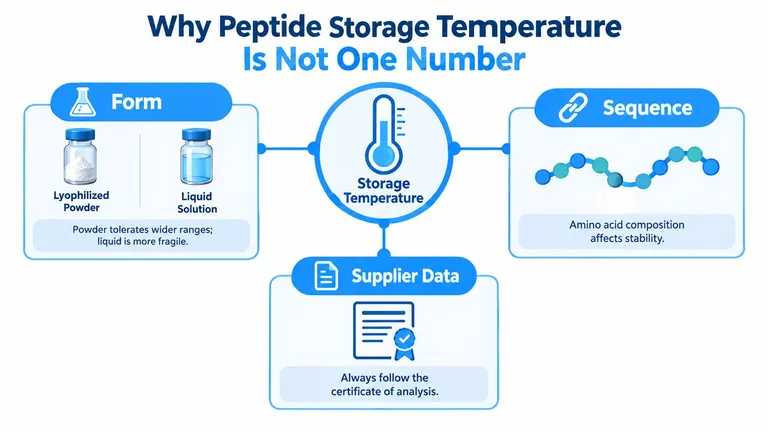
Table of Contents
- Why Peptide Storage Temperature Is Not One Number
- How Stability Guidelines Shape Storage Rules
- Lyophilized Powder vs Reconstituted Solution
- Long-Term Freezer Workflow for Lyophilized Vials
- Reconstitution and the Narrow Handling Window
- Sterile Water vs Bacteriostatic Water After Reconstitution
- Light, Humidity, and Oxygen Exposure Controls
- When Freezing Fails to Protect a Peptide
- Transport, Excursions, and Freeze-Thaw Cycles
- Using PepFlow as a Storage and Schedule Companion
- Quick Reference Table for Peptide Storage
- Frequently Asked Storage Questions
Why Peptide Storage Temperature Is Not One Number
Peptide storage gets mishandled when people treat temperature as the whole story. The key decision starts with the material in front of you, the form, the sequence, and the supplier’s stability data. A lyophilized vial, a mixed solution, and a biological sample do not belong to the same storage rule, and the FDA stability guidance cited above ties storage claims to product-specific testing, with labeled conditions covering temperature, humidity, light exposure, and other environmental controls FDA stability guidance.
Form changes the rule
Dry powder tolerates freezing better because the water-driven degradation pathways are largely out of play. Once a peptide is reconstituted, the handling window shrinks fast. At that point, “keep it cold” is too blunt to be useful. The vial’s state matters more than the habit.
Sequence changes the risk
Amino acid composition drives stability in ways generic storage advice misses. Some peptides hold up better in the cold, while others are exposed to oxidation, deamidation, or aggregation even under refrigeration. Consumer-facing peptide overviews abound, but storage still has to follow the vial in front of you.
Practical rule: if the supplier’s documentation says one thing and a generic blog says another, trust the supplier.
That guidance matters for people using peptides for wellness, recovery, or protocol-based dosing. Educational material like peptides for skin and weight loss can help with background, but it does not replace the label, the certificate of analysis, or the formulation in hand.
The testing logic behind storage claims is just as important. Under the FDA stability guidance cited above, longer-lived products may be checked repeatedly over time, including on a three-month and six-month schedule in the first two years when that approach is used. That is scheduled analytical monitoring, and it is the reason a vial label means something only when it is backed by real stability work.
How Stability Guidelines Shape Storage Rules
FDA stability guidance does more than suggest temperatures. It sets the evidentiary bar for any storage claim a manufacturer puts on the label. Active ingredients and drug preparations are evaluated at 25°C and under accelerated conditions at 37–40°C, with other temperatures used only when the scientific rationale supports them FDA stability guidance. A printed label only carries weight if a real stability program sits behind it.
Labeled storage conditions are part of the evidence
The storage line on a vial should spell out the environmental controls used in the study, including temperature, humidity, light exposure, and other conditions. If those details are absent, the instruction may be useful for handling, but it is not the same as a fully supported stability claim.
For biological products, the standard is tighter. FDA’s ICH Q5C framework emphasizes real-time stability studies at the proposed storage temperature because proteins and polypeptides are sensitive to temperature, oxidation, light, ionic conditions, and mechanical stress. A vial can look unchanged and still be drifting chemically.
What that means in practice
The controlling evidence is the exact formulation, container, concentration, and manufacturing process, so ask the supplier for the stability basis before building a workflow.
A handling recommendation is not a shelf-life claim.
That distinction matters because vendors often compress it. Read the label, check the stability support, and push anything vague back to the supplier before you treat it like a storage rule.
Lyophilized Powder vs Reconstituted Solution
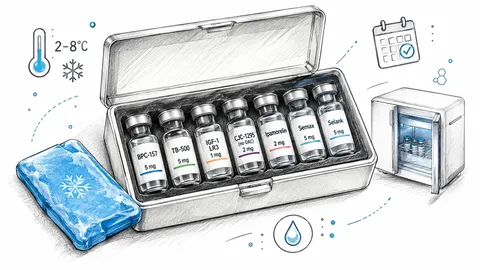
The essential divide in peptide handling is state. Dry powder tolerates more abuse. Solution does not. Storage summaries aimed at compliance commonly point to 2–8°C for many peptide injections, −20°C for longer-term dry storage, and 20–25°C only for short handling unless the product has validated instructions peptide storage compliance summary.
| State | Typical Range | Expected Duration | Key Risk |
|---|---|---|---|
| Lyophilized powder | −20°C or colder | Longer-term storage | Moisture ingress, light, repeated warming |
| Reconstituted solution | 2–8°C | Shorter refrigerated window | Hydrolysis, oxidation, aggregation |
| Short-term room handling | 20–25°C | Brief handling only | Rapid loss of stability without validated instructions |
Dry powder holds up better because it stays out of solution-phase degradation pathways. That means less hydrolysis, less drift, and more tolerance for routine handling mistakes. Once the peptide is in solution, every opening, every warm counter, and every extra draw adds risk.
What changes after reconstitution
After reconstitution, the vial is no longer a reserve stock. It becomes a time-sensitive liquid. Refrigeration becomes the default, freezer storage becomes a separate decision, and the usable window tightens fast. If a reconstituted vial is treated like dry powder, it usually pays the price in stability.
The supplier’s instructions matter here more than generic storage advice. If the product has a different handling limit, follow that over any broad rule.
What temperature labels usually mean
These ranges are a working map, not a promise. Dry lyophilized material can usually tolerate colder storage for much longer, while solutions need tighter timing and stricter tracking. That is the practical difference most handbooks blur peptide storage compliance summary.
For a compliance-oriented view, dry powder is the safest format to store long term, reconstituted solution is the most fragile, and room-temperature handling should stay brief unless the product has validated support. No second table is needed to make that point.
Long-Term Freezer Workflow for Lyophilized Vials
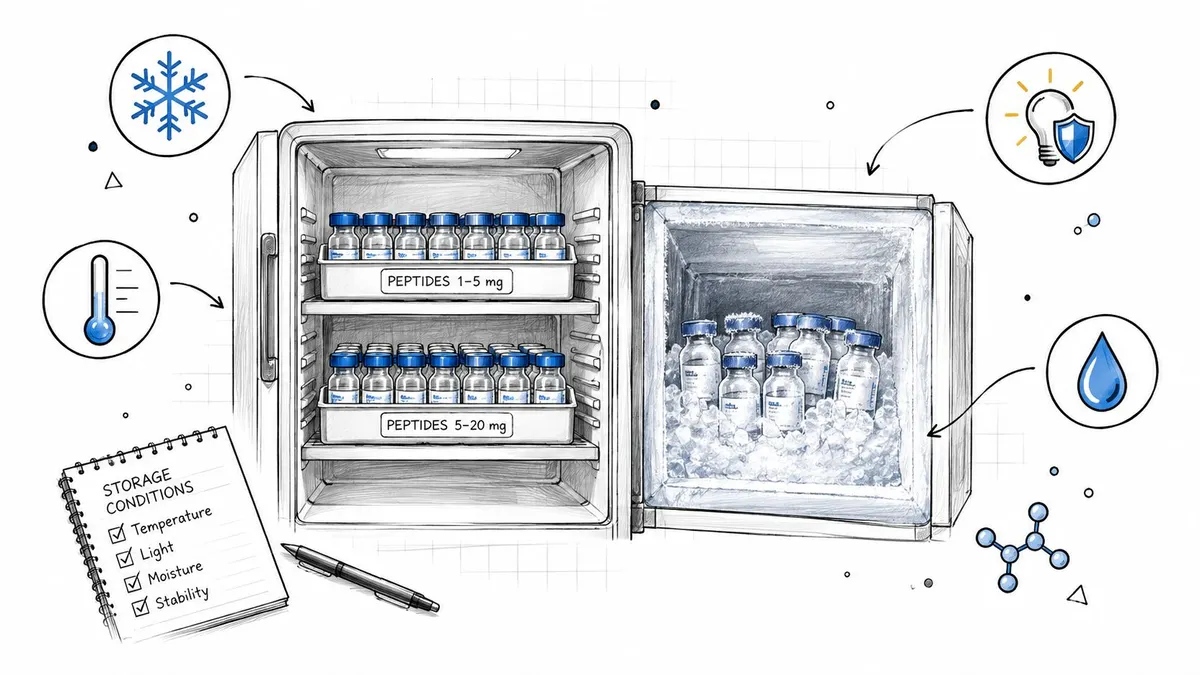
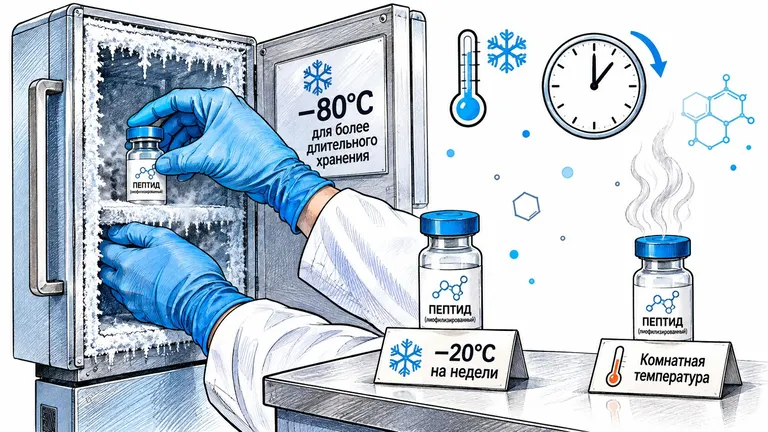
For dry peptides, the workflow matters more than chasing an extreme freezer setting. Keep the vial sealed, keep it dry, and keep warming and cooling to a minimum. Condensation is where avoidable damage starts, so handle the vial like moisture is the threat. A practical benchmark is approximately −20°C for short-term storage of about 1–2 weeks and −80°C for longer-term storage, subject to the product’s validated specification Merck Millipore storage guidance.
Before opening a frozen vial, let it come to room temperature while it is still sealed. Do it in a dry environment, ideally a desiccator, so moisture does not condense onto the cold powder. That habit prevents surface wetting, especially with hygroscopic peptides.
Keep the master vial from becoming a workhorse
If you expect to use portions over time, make clean, sealed aliquots instead of opening the same vial again and again. That matters even more when a vial will be weighed, divided, or used across multiple sessions. Repeated warming and cooling is the mistake to avoid.
Record excursions, don’t hand-wave them
A simple log beats memory. Note when the vial left cold storage, how long it stayed out, and whether the cap remained sealed. If a freezer runs warm or a vial sits out longer than planned, record it instead of pretending it stayed within range.
Keep it dry, sealed, and cold, in that order.
That order matters. Cold alone does not rescue a vial that has been exposed to moisture, repeated cycling, or rough handling. The supplier’s certificate or product-specific stability data still overrides generic ranges, because sequence, purity, counterion, residual water, and formulation can all change the result.
Reconstitution and the Narrow Handling Window
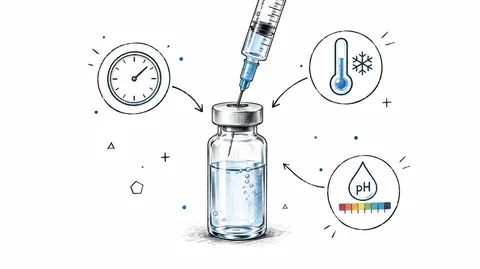
The moment water goes in, the rules change. Choose the correct diluent, keep the transfer sterile, and stop treating the vial like a long-term reserve. Once a peptide is in solution, time tracking and temperature control matter far more.
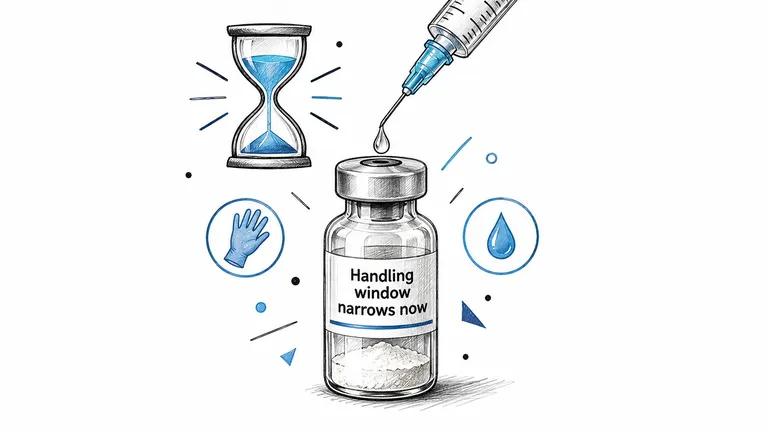
Use the diluent the product calls for, not the one you happen to have on hand. Some peptides dissolve cleanly in sterile water or bacteriostatic water, while others need a different starting medium before dilution. If the manufacturer specifies a reconstitution method, follow it. Guesswork usually costs you stability.
Treat reconstitution as the clock start
Reconstitution is the operational cutoff. From that point on, the vial has a shorter usable life, a narrower handling window, and far less tolerance for sloppy storage. Refrigeration at 2–8°C is the common working range for many reconstituted peptide solutions, as summarized in the storage table above.
Use sterile technique every time you access the vial. Clean the stopper, avoid extra punctures, and do not leave the vial on the bench while you gather supplies. Those habits are the difference between controlled handling and a preventable contamination problem.
For a practical administration overview, peptide therapy from Aspire for Wellness shows how these products are commonly handled in real use, but storage still has to follow the product-specific instructions.
Don’t confuse refrigeration with durability
Cold storage slows decline. It does not restore the peptide to powder-like stability. A reconstituted solution is still more fragile than the original vial, and every handling step matters more now than it did before.
If you need repeated access, make working aliquots and keep the master vial closed as much as possible. That is the practical answer when a solution will be used over several sessions.
The common mistake is simple. A peptide is reconstituted, refrigerated, and then handled as if it still has the same margin of safety it had as a dry powder. It does not.
Sterile Water vs Bacteriostatic Water After Reconstitution
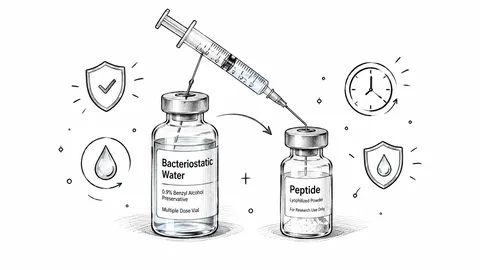
Sterile water and bacteriostatic water are not interchangeable once a peptide is reconstituted. Sterile water is usually the cleaner choice for short refrigerated use, while bacteriostatic water can extend the working window because it contains a preservative. For a quick side-by-side refresher, see the bacteriostatic water vs sterile water comparison. That comparison helps frame the choice, but it does not override the vial’s own instructions.
The duration difference is real, but it is not a free pass. Summary tables often put sterile water at about one to two weeks of refrigerated stability and bacteriostatic water at about four to six weeks peptide storage summary. Those figures are only working ranges. Sequence, concentration, sterility, container closure, and light exposure can shorten them fast.
The trade-off is duration versus formulation
If you need a longer refrigerated hold, bacteriostatic water is often the practical pick. If the product instructions specify sterile water, follow that instruction and stop there. A preserved diluent can buy time, but it also changes the formulation, and that matters for compatibility.
Read the vial, not the internet
The better question is which diluent the specific peptide supports and what the manufacturer says about the finished solution. Some peptides tolerate a preserved diluent, some do not, and the answer depends on the exact vial, not a generic rule.
Longer refrigerated life only helps when the formulation allows it.
That is the part people skip. Use the label, then use the stability data for that exact product.
Light, Humidity, and Oxygen Exposure Controls
Temperature gets the most attention, but light, humidity, and oxygen also cause damage. A vial can be cold and still degrade if it sits in bright light, absorbs moisture, or spends too much time with oxygen-rich headspace. That’s why a decent storage setup includes more than a freezer and a label.
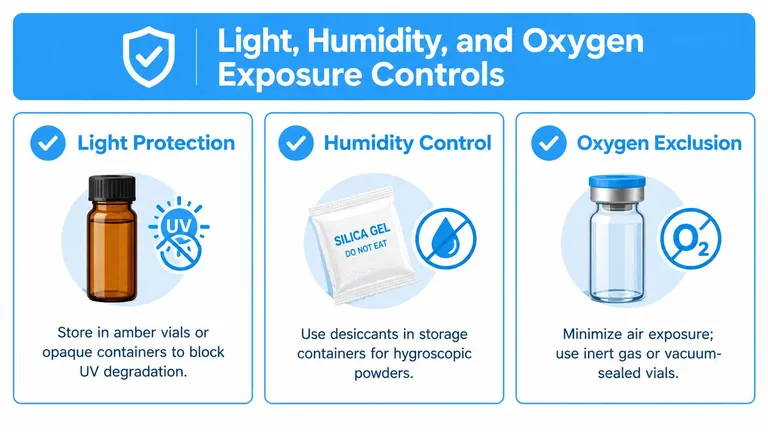
Use amber vials or opaque packaging when the peptide solution is light-sensitive. Light protection matters because exposure can accelerate oxidative reactions, especially for sequences that already have that weakness. If the vial is clear and the product is exposed frequently, wrap or store it so the light source isn’t part of the routine.
Humidity is a bigger problem for powder than people think
Many peptides are hygroscopic, which means they pull moisture from the air. That’s why dry powder should stay in a tightly capped vial and why you should avoid opening it in a humid room if you can help it. A desiccant in the storage container is a simple, practical guardrail.
Oxygen exposure deserves the same respect
Oxidation-prone sequences are vulnerable to air, especially over long holds. Minimizing headspace, using inert gas where appropriate, or keeping the vial sealed as much as possible all help. The point is not to make the setup fancy. The point is to stop giving the molecule extra ways to fail.
A perfectly cold vial can still lose potency if it sits on a sunny counter for an afternoon. That sounds obvious until you watch it happen in a real workflow. Light, humidity, and oxygen controls belong in the same conversation as temperature, not after it.
When Freezing Fails to Protect a Peptide
Cold storage is not a universal rescue plan. ACS plasma-stability data show that some peptides retained more than 95% of their original content after one month at −80°C, while another hydrophobic peptide lost roughly 10% after only 2.6 days and had only about 25% remaining after one month ACS plasma stability study. That spread should end the habit of treating one freezer setting as a blanket fix.
Hydrophobic and oxidation-prone sequences need more respect
Hydrophobic peptides can still misbehave in deep freeze conditions. Sequence features, surface interactions, and local chemistry drive the result, so one storage setting can protect one peptide and barely help another. If a product carries oxidation-prone residues or unusual hydrophobicity, assume the handling window is narrow until the supplier proves otherwise.
Biological samples aren’t the same as vial storage
These data come from peptides in plasma, a different environment from a sealed lyophilized vial, but they still show that colder storage does not automatically eliminate degradation. The practical takeaway is simple. Check the sequence for oxidation-prone residues and confirm the handling window with the supplier before choosing a freezer setting.
A frozen vial can still fail if the chemistry is touchy. Generic “keep it frozen” advice hides that risk instead of managing it.
Transport, Excursions, and Freeze-Thaw Cycles
Cold-chain mistakes happen. Shipments sit on docks, fridges drift, and vials get thawed more than once. Product-specific stability data, not a generic temperature range, should decide whether a peptide survives transport or an excursion Peptide excursion guidance.
For transport, separate dry powder from solution and treat them differently. Dry powder usually tolerates shipping better than a reconstituted vial, but that does not make it immune to abuse. If a package is delayed, record the highest temperature reached and how long it stayed there. That is the information that matters.
Excursions need logs, not guesses
Write down the peak temperature, the time outside range, and whether the vial stayed sealed. That gives the supplier, pharmacist, or clinician something usable when they judge whether the product still qualifies for use. A single excursion does not automatically ruin a vial, but it never deserves a pass based on guesswork.
Freeze-thaw history matters more than people think
As noted in the excursion guidance above, repeated freeze-thaw cycles can damage stability even when the average storage condition looks acceptable. Avoid refreezing a solution unless the product documentation explicitly allows it. A vial that has bounced from cold to warm and back again has a real handling history, and that history should drive the decision.
For logistics-heavy shipments, soluciones de frio en transporte is a useful reference on maintaining temperature control during transit. The same rule applies at the bench. Track the excursion, check the label, and do not let a spreadsheet stand in for potency data.
Using PepFlow as a Storage and Schedule Companion
PepFlow works as an organizational layer, not a substitute for product data. For peptide users who want one place to tag whether a vial is dry or reconstituted, display the supplier’s beyond-use date, and set reminders for handling windows, that kind of structure is practical. It helps users keep the storage state visible instead of relying on memory.
The useful part is the prompt structure. A good companion app can ask the right questions at the right time, especially when a vial changes state or gets moved between refrigerator and freezer. It can also make excursion logging easier by giving you a place to note when a vial left the recommended range and for how long.
If you already use scheduling tools, adherence to schedule is the right mental model here. Storage discipline and dose discipline overlap, because both depend on consistent tracking.
What it should do, and what it should not
PepFlow should reinforce labeled instructions, not override them. It can remind, record, and organize, but it can’t independently determine chemical potency or safety. That limit matters, and users should respect it.
Software can organize the workflow. It can’t validate the molecule.
That’s the cleanest way to use a tool like this. Let the app handle prompts, reminders, and state tracking, while the supplier data remains the source of truth.
Quick Reference Table for Peptide Storage
Keep this table for fast scanning, not for decision-making by itself. Any number here is a starting point, not a guarantee. For more on date handling, see expiration date tracking.
| Situation | Practical Range | Usual Time Frame | Notes |
|---|---|---|---|
| Dry peptide, short hold | Around −20°C | Short-term | Keep sealed and dry |
| Dry peptide, long hold | Around −80°C | Longer-term | Follow product spec |
| Reconstituted solution | 2–8°C | Shorter refrigerated window | Time tracking matters |
| Room handling | 20–25°C | Brief only | Only if product allows |
Use the table as a memory aid, then go back to the vial label. That’s the right order.
Frequently Asked Storage Questions
Can a reconstituted vial be refrozen? Usually, no. Once a peptide is in solution, repeated freeze-thaw cycles can promote degradation, so refreezing should be avoided unless the product documentation explicitly supports it.
How should you store peptides during a short trip? Keep them in insulated, temperature-controlled transport and protect them from heat and light. Don’t leave them in a car, and don’t assume a hotel mini-fridge is stable without checking it.
What if the beyond-use date has passed but the vial still looks normal? Appearance isn’t a potency test. If the labeled date has passed, treat the vial as suspect and follow the supplier or pharmacist’s direction.
How do you verify that a refrigerator or freezer is on target? Use a calibrated thermometer or temperature logger, not the appliance display alone. The display can be wrong while the contents drift.
PepFlow helps you keep peptide workflows organized when the storage rules get messy, and that matters because the vial’s state changes the minute you reconstitute it. If you want reminders, schedule tracking, and a cleaner way to log what’s in your fridge or freezer, visit PepFlow and use it as the planning layer around your supplier’s instructions.