Reconstituted peptides usually live in a 7 to 28 day window depending on the product, but the label or your pharmacy’s beyond-use date wins every time. A clear vial can still be past its usable life, so visible clarity doesn’t prove potency or sterility.
You’ve probably got the vial on the counter, a dose to prep, and that nagging question about whether it’s still good. The answer is simpler and messier than the internet makes it sound, because there isn’t one clock running after mixing, there are three.
Table of Contents
- The Vial on Your Counter
- What Reconstitution Actually Changes
- The Factors That Move the Timeline
- Bacteriostatic Water Versus Sterile Water
- Why the 28-Day Refrigerated Rule Is Misleading
- Handling Habits That Protect Your Vial
- Build Your Vial Event Log
- When to Stop Using a Reconstituted Vial
The Vial on Your Counter
You mix the vial, set it down, and suddenly the whole routine feels more serious. The powder is gone, the liquid looks fine, and yet the question is no longer “Did I mix it?” It’s “What changed the moment water hit the peptide?”
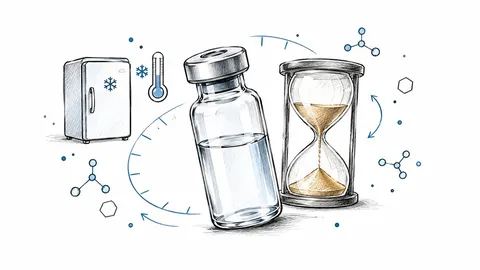
Three clocks start at once
The first clock is chemical potency, which is about whether the peptide molecule still behaves the way you want it to. The second is sterility, which is about whether microbes can get in or grow after the vial is punctured. The third is the label-specific beyond-use date, which is the rule that overrides guesswork and internet folklore.
That’s why two people can ask the same question and get different answers. One peptide might be intended for immediate use after reconstitution, while another can sit for a few days under a specific temperature range, and a compounded preparation may carry its own pharmacy-assigned discard date. A useful starting point for the broader peptide therapy field is this amino acid therapy overview, which helps frame why these compounds are handled with so much care.
Practical rule: if the label, prescriber, or compounding pharmacy gives you a discard date, that date outranks any generic countdown.
The confusion usually comes from treating “reconstituted peptide” like one category. It isn’t. Sequence, diluent, container, and storage conditions all matter, and the mixed solution has its own stability profile. That’s why a vial that looks perfect can still be chemically tired, microbiologically risky, or past its assigned limit.
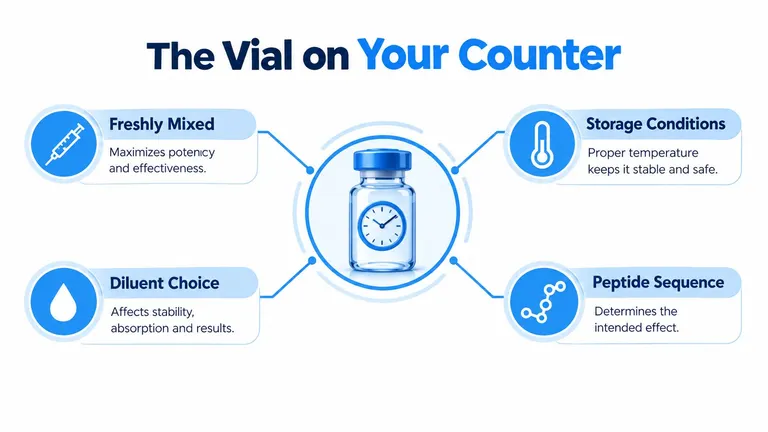
A better way to think about the vial is as a short-lived workspace, not a permanent storage form. Once you understand the three clocks, the rest of the storage advice stops sounding like rules for the sake of rules and starts looking like risk control.
What Reconstitution Actually Changes
Reconstitution is the point where a freeze-dried powder becomes a liquid solution. Before mixing, the peptide sits in a more stable shelf form, like freeze-dried peptides waiting in a sealed vial. Once diluent is added, the peptide enters a chemical environment where time, temperature, and exposure start to matter.
Powder is stable, solution is active
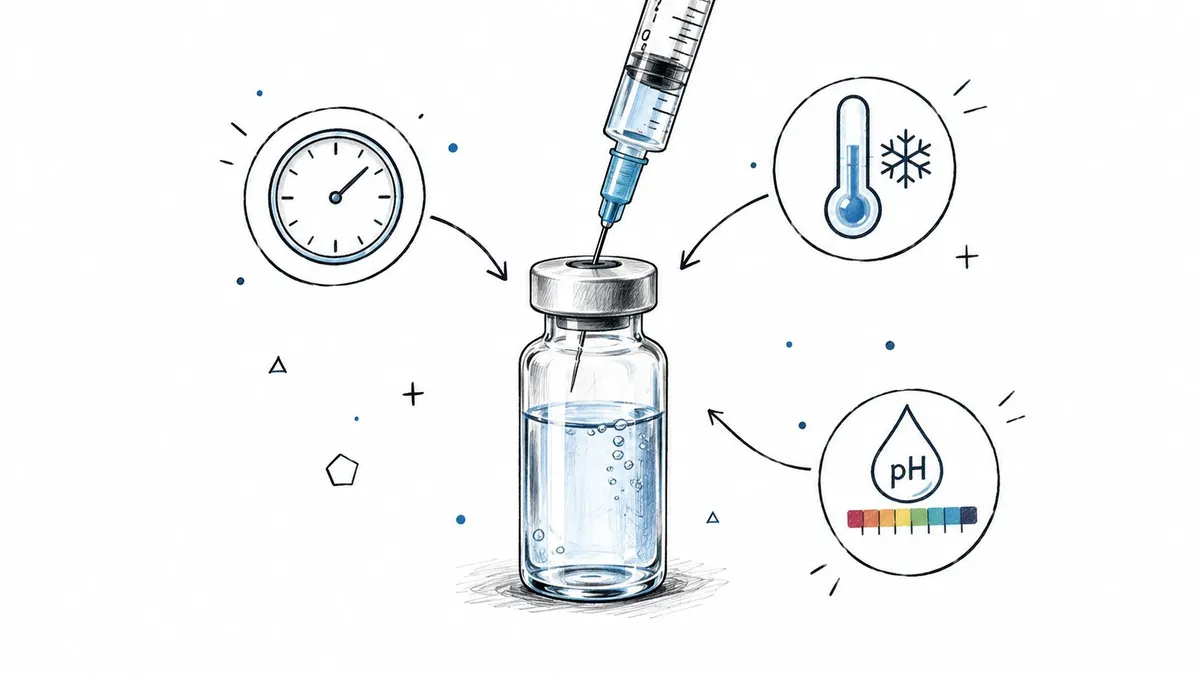
The powder and the solution do not age the same way. In solution, the molecule can be affected by pH, oxygen exposure, temperature, surfaces inside the vial, excipients, and agitation. That is why stability evidence has to look at the mixed vial itself, not just the original lyophilized product.
The amount of diluent you add changes the final concentration, and concentration changes the environment around each molecule. A vial mixed more dilute is not automatically safer or worse, but it does change the conditions the peptide experiences. The exact mix matters, not just the name on the box.
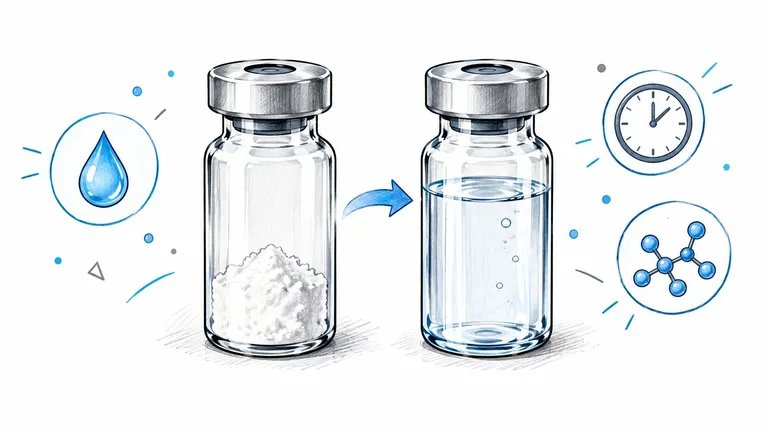
The kitchen analogy helps here. Dry seasoning can sit for a long time, but once you stir it into soup, heat, salt, and air start changing what is in the pot. Once diluent is added, heat, light, and air begin changing the solution in ways the powder never experienced.
What the liquid needs
A reconstituted peptide does better with consistency. Keep the storage temperature steady, avoid shaking the vial, and puncture the stopper only when needed. It also does worse when the wrong solvent is used, because preservative-free water does not give the same handling margin as a validated multidose setup.
Keep your mental model simple. Powder buys you stability on the shelf. Solution forces you to think about the clock.
If you are writing on the label, write the date you mixed it, the diluent, and the planned discard date. That small habit turns a vague vial into a tracked one, which is safer than trying to remember when you probably made it.
The Factors That Move the Timeline
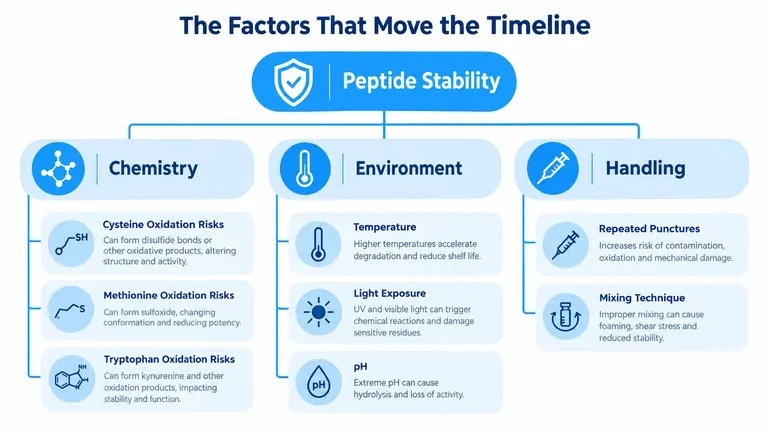
Some variables barely nudge the timeline. Others change it enough that two vials of the same peptide can age very differently. The biggest mistake is assuming storage time is mostly about the calendar, when the peptide sequence and handling history often matter just as much.
Chemistry, environment, handling
Chemistry comes first. Sequences containing cysteine, methionine, tryptophan, aspartate, glutamine, or N-terminal glutamate can be more vulnerable to oxidation, hydrolysis, or rearrangement in solution. That doesn’t mean every peptide with one of those residues fails quickly, but it does mean sequence itself can change how forgiving the vial is.
Environment comes next. Temperature is the obvious one, but light exposure, oxygen, and pH matter too. Refrigeration slows change, it doesn’t erase it. A vial kept cold but repeatedly warmed, exposed to light, or transported carelessly can lose usable life faster than a vial that stays undisturbed.
Handling is the third lever. Every puncture, every draw, every moment the vial sits out on the counter adds small risks. Repeated freeze-thaw cycles are especially hard on solution stability, and a vial handled roughly can age faster than the label would suggest.
A recent in-use study on a specific tislelizumab preparation found no measurable physicochemical change over 31 days at 2–8°C (MDPI), but that finding belongs to that molecule, that container, and those tested conditions. It does not transfer cleanly to every peptide in every diluent.
What matters most in practice
The practical ranking is pretty straightforward. Sequence and formulation set the ceiling, storage temperature sets the pace, and real-world handling decides whether the vial stays close to ideal or drifts away from it. Container material and headspace oxygen matter too, but most users can’t change those after purchase, so they’re secondary to how the vial is mixed and stored.
Bacteriostatic Water Versus Sterile Water
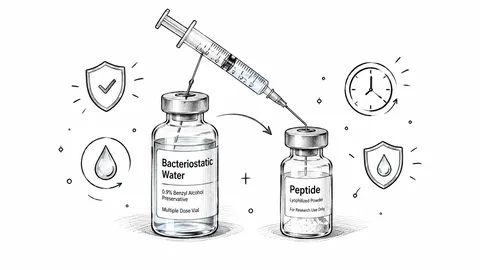
The diluent is where a lot of people accidentally flatten two very different situations into one rule. Bacteriostatic water includes a preservative system that helps suppress bacterial growth after the vial is punctured. Sterile water doesn’t, which changes how long the vial can reasonably sit around after opening.
Why preservative matters
A preservative buys you handling time, not a magic chemical guarantee. That’s why multidose preparations often use bacteriostatic water, and why the commonly cited 28-day benchline exists in the first place for certain refrigerated, multi-dose injectable products. The number is tied to sterility and handling assumptions, not proof that every peptide stays perfectly potent for that long.
Sterile water is a different tool. It’s appropriate for single-dose use or situations where the entire vial is consumed immediately, because there’s no preservative buffer after puncture. If a product is meant to sit in the fridge and be accessed more than once, the solvent choice becomes part of the safety question.
Compare the two at the bench
| Diluent | What it does | Practical use |
|---|---|---|
| Bacteriostatic water | Contains a preservative that inhibits bacterial growth after puncture | Better fit for multidose handling and refrigerated storage windows |
| Sterile water | No preservative system | Better fit for single-use or immediate consumption |
The comparison is not just about microbes. Different diluents can also shift pH and alter how the peptide behaves in solution. That’s why one vial may tolerate a handling pattern that another can’t, even if the peptide name sounds similar.
For a practical walk-through of the solvent choice, this bacteriostatic water vs sterile water guide can help you match the diluent to the way you dose.
A preservative extends the handling window. It doesn’t turn every peptide into a 28-day product.
Some summaries also talk as if refrigeration alone solves the problem, but it doesn’t. Cold storage slows degradation, yet the product still needs the right solvent, the right puncture habits, and the right discard date. That’s the difference between being cooled and being properly managed.
Why the 28-Day Refrigerated Rule Is Misleading
A vial can sit in the fridge and still fall out of spec for different reasons. That is why the 28-day refrigerated rule gets misused so often. The question is not whether a slogan sounds tidy, but what the product label permits.
The same active molecule can carry different after-reconstitution instructions depending on formulation. FDA-approved tesamorelin products show that clearly: EGRIFTA SV is labeled for immediate use after reconstitution, while EGRIFTA WR permits storage of the mixed vial for 7 days at 20–25°C (68–77°F) (The Triton Co.).
Product labels beat forum rules
That label difference matters because it changes the answer to “how long do peptides last once reconstituted.” Even when the active molecule is the same, the handling window can shift when the formulation changes. Some Serostim presentations are used immediately, while a bacteriostatic-water presentation may allow up to 14 refrigerated days (HealthRx).
| Product | Reconstituted storage window | Storage condition |
|---|---|---|
| EGRIFTA SV | Immediate use | After reconstitution |
| EGRIFTA WR | 7 days | 20–25°C (68–77°F) |
| Serostim presentation A | Immediate use | After reconstitution |
| Serostim presentation B | Up to 14 days | Refrigerated |
The common 28-day benchmark still has a place in operations, especially for certain refrigerated multidose preparations made with bacteriostatic water. Product labels, formulation, and storage instructions decide the window, and a catchy internet rule does not.
What people miss when they repeat the number
A clear vial can still be drifting chemically. A refrigerated vial can still be past its allowed dating. A preservative can reduce microbial risk without proving chemical stability. Those are separate clocks, and treating them as one creates false confidence.
For anyone comparing labels, handling, and cleaning habits, the BacteriaFAQ.com disinfection tips are a useful reminder that surface hygiene and vial hygiene are related, but not the same thing.
Stop asking “Is it 28 days?” Start asking “What does this exact product allow?”
That question keeps the focus on the label, the formulation, and the storage instructions. It gives you a better read on the vial than a neat rule that leaves out the details.
Handling Habits That Protect Your Vial
The way you access the vial can preserve or shorten usable life just as much as the diluent. A careful routine protects all three clocks at once, especially the sterility clock, which is the easiest one to damage by accident.
Small habits that matter
Start with the stopper. Wipe it with alcohol and let it dry before puncturing, then use a new sterile needle for each access. That doesn’t just lower contamination risk, it also keeps the puncture history cleaner and more predictable.
Draw from the center of the stopper rather than forcing the needle at a sloppy angle. That lowers the chance of coring and helps the vial stay intact. Once the dose is drawn, put the vial back in the refrigerator promptly and don’t let it sit on the counter while you get distracted.
Keep the vial out of unnecessary stress
Avoid repeated warming and cooling. If you’re dosing daily, don’t leave the vial in your hand longer than needed, don’t leave it near a bright window, and don’t bounce it around during transport. Light exposure and temperature swings are small on their own, but they stack up.
If you’re trying to stretch a dose schedule, withdraw the needed dose without turning the whole vial into a travel passenger. For a more detailed storage workflow, this how to store reconstituted peptides guide lays out the practical side of cold storage and handling.
Here’s the simplest version of the routine:
- Clean the stopper with alcohol and let it dry.
- Use a fresh sterile needle for each puncture.
- Draw quickly and cleanly, without shaking the vial.
- Return the vial to refrigeration immediately.
- Protect it from light and travel stress whenever possible.
For readers who also manage cold-chain products, the vaccine cold chain storage tips are a good model for how seriously temperature stability should be treated.
The goal isn’t perfection. The goal is to avoid avoidable damage every time you handle the vial.
If your routine includes frequent access, the best protection is discipline, not guesswork. The more predictable your handling, the more meaningful the label date becomes.
Build Your Vial Event Log
A single countdown asks the wrong question. A simple event log gives you the information you need, because it separates the chemistry timeline from the sterility timeline and the label timeline.
The four entries that matter
Write down the reconstitution date first. Then record the first puncture date, because sterility risk starts to become a real operational issue once the vial is opened and accessed.
Add any temperature excursion. That includes travel, a fridge problem, or time left on the counter. Finally, note the discard date from the manufacturer label or the compounding pharmacy’s beyond-use date.
If you want this in one place, a planning tool like PepFlow can hold the dose schedule, reminders, and dated notes together, but the system matters more than the app. Paper works too, as long as the log is accurate and visible.
A simple note format you can copy
- Product: exact peptide name and concentration
- Reconstitution date: the day diluent was added
- First puncture: the first time the stopper was accessed after mixing
- Storage condition: refrigerated, room temperature, travel, or excursion
- Discard date: label date or pharmacy date, whichever applies
The point of the log is not bureaucracy. It’s decision support. When you look at the vial, you’re no longer guessing whether it’s “around two weeks old” or “probably fine.” You’re comparing the three clocks and letting the earliest one win.
If the vial warmed up, got punctured repeatedly, and is close to the discard date, don’t talk yourself into extra days.
That mindset prevents the most common error, which is using one clean-looking vial to excuse a messy timeline. Once the event log is in place, every dose day gets easier because the decision is already written down.
When to Stop Using a Reconstituted Vial
Stop using the vial if it turns cloudy, if you see particles or fibers, if the color changes in a way you didn’t expect, if refrigeration was missed for long enough to create doubt, or if the date is past the labeled beyond-use date. Those are clean discard triggers, and they don’t need interpretation.
A clear vial is not a validated potency test. A clear vial is not a sterility test either. It only means the solution still looks clear.
If you’re unsure, the right move is to discard and ask the prescribing clinician or compounding pharmacy about the specific product. PepFlow can help organize the schedule and the log, but it doesn’t replace medical advice or product-specific instructions.
PepFlow helps you record reconstitution dates, dose schedules, and discard reminders so you’re not relying on memory when a vial is on the line. If you’re managing peptides and want a cleaner way to track the three clocks, visit PepFlow and set up a simple log for your next vial.