Most advice on bacteriostatic water vs sterile water starts and ends with one question: which one lasts longer after you open it. That’s too shallow to be useful.
The choice is narrower and more clinical. You’re balancing who will receive the reconstituted product, how many times the vial will be entered, and whether the active product can tolerate that workflow. A preserved multi-dose diluent solves one problem. It does not solve every problem. In some situations, it creates one.
People using peptides at home often focus on convenience first. Pharmacists usually look at it in the opposite order. We start with the patient, then the route, then the handling pattern, then the math.
Table of Contents
- Why This Choice Matters More Than Most Guides Suggest
- What Bacteriostatic Water and Sterile Water Actually Are
- Side-by-Side Comparison of the Two Diluents
- In-Use Stability and the Real Meaning of 28 Days
- Matching the Diluent to Peptide Protocol Scenarios
- Patient Safety Warnings Most Comparisons Overlook
- Which Water to Choose and How to Verify Your Setup
Why This Choice Matters More Than Most Guides Suggest
A lot of peptide users start with the wrong question.
They ask which water lasts longer, as if this is mainly a storage decision. In practice, the first cutoff is safety. Bacteriostatic water contains benzyl alcohol, and that preservative changes whether it is appropriate for a given patient and route before convenience even enters the discussion. Official labeling warns against use in neonates and flags specific routes and use cases that simplified comparison posts often skip.
The decision usually comes down to three variables working together, not one headline difference.
- Patient: Adult self-injection is a different counseling scenario from neonatal exposure, pregnancy, or a household where supplies may be shared or confused.
- Use pattern: A vial entered once and used immediately raises a different contamination risk than a vial accessed repeatedly over days.
- Drug product: The diluent can reduce microbial risk during repeated withdrawals, but it does not make an unstable reconstituted peptide chemically stable.
That third point causes a lot of bad assumptions. I see users treat “multi-dose” as if it means “fine to mix, store, and keep using until the calendar runs out.” It does not. A preservative addresses one handling problem. It does not override product-specific stability limits, nor does it cancel route-specific warnings.
A practical screen works better than a shelf-life debate. Ask whether benzyl alcohol is acceptable for the intended patient and route. If yes, then repeated-use workflow may favor bacteriostatic water. If no, sterile water moves to the front immediately, even though it gives up some in-use convenience.
What Bacteriostatic Water and Sterile Water Actually Are
At the label level, these products are close cousins, but they are not interchangeable by default.
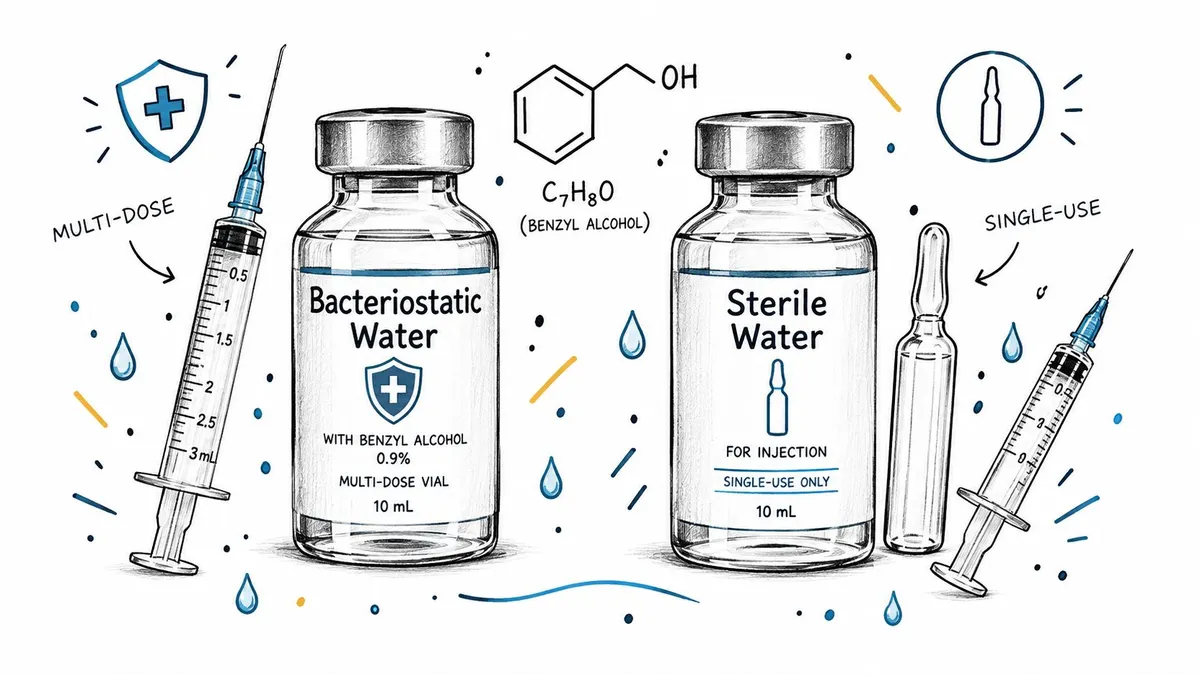
Bacteriostatic water for injection is described in FDA-listed labeling as sterile, nonpyrogenic water for injection containing benzyl alcohol as a bacteriostatic preservative. Current labels include the familiar 0.9% formulation, which is 9 mg/mL, and some also list 1.1% formulations, which are 11 mg/mL (FDA-listed product labeling).
Sterile water for injection is also sterile and nonpyrogenic, but it contains no preservative, antimicrobial agent, or added buffer (Pfizer labeling for sterile water for injection).
The key difference is not the water
In practice, both begin with water intended for injection use. The operational split comes from the additive.
- Bacteriostatic water is built for repeated access from a multi-dose container because the benzyl alcohol suppresses bacterial growth after puncture.
- Sterile water is preservative-free, so it fits single-use handling much better once the container has been entered.
That’s why calling bacteriostatic water “just sterile water with a different label” is wrong. The preservative isn’t cosmetic. It changes how the vial is meant to be used.
Packaging tells you the intended workflow
Bacteriostatic water is commonly distributed in 30 mL multi-dose vials, a format that makes sense when repeated withdrawals are expected. That packaging history also shows up in recall and labeling records tied to the product category, which helps explain why it became the default choice in many repeated-use preparation settings.
Sterile water, by contrast, is typically approached as a use-and-discard diluent after entry. The chemistry may look simpler, but the handling is less forgiving if someone plans to keep coming back to the same container.
A preserved vial is a workflow tool. A preservative-free vial is a cleaner excipient choice, but it gives you less room for repeated access.
Side-by-Side Comparison of the Two Diluents
If you strip away internet shorthand, the comparison becomes much clearer. One product is designed around multi-dose practicality. The other is designed around preservative-free use.
Bacteriostatic Water vs Sterile Water at a Glance
| Criterion | Bacteriostatic Water | Sterile Water |
|---|---|---|
| Preservative content | Contains benzyl alcohol as a bacteriostatic preservative | No preservative, no antimicrobial agent, no added buffer |
| Intended handling model | Multi-dose use with repeated vial access under aseptic technique | Single-use style handling once opened or entered |
| Best fit | Reconstitution workflows needing multiple withdrawals | Short, isolated use where preservative exposure is undesirable |
| Excipient exposure | Includes benzyl alcohol exposure | Avoids preservative exposure |
| Contamination control after puncture | More forgiving for repeated entry because of preservative action | Less forgiving after first entry |
| Patient-specific cautions | Not appropriate where benzyl alcohol warnings apply | Often preferred when preservative avoidance matters |
| Operational burden | Fewer reconstitutions if the same vial is used repeatedly | More frequent vial turnover and more setup repetition |
What works well in practice
For adults doing repeated subcutaneous or intramuscular draws over time, bacteriostatic water usually fits the workflow better. You reconstitute once, label the puncture date, maintain aseptic technique, and work from the same diluent source rather than reopening new sterile units repeatedly.
Sterile water works better when the protocol is short, the product will be used promptly, or the patient-specific safety profile makes preservative avoidance the smarter move. It’s also the cleaner choice when you don’t want benzyl alcohol in the picture at all.
What people get wrong
Users often assume the preserved option is always “better.” It isn’t. It’s better for a certain use pattern.
Here’s where that plays out:
- Repeated withdrawals: Bacteriostatic water is more practical.
- Single reconstitution and near-immediate use: Sterile water is often simpler and cleaner.
- Sensitive populations or prohibited routes: Preservative-free water usually becomes the default.
- Label-driven compatibility: The drug or peptide instructions still control. A diluent only works if the product being mixed permits it.
Another mistake is treating contamination risk and compatibility as the same issue. They’re not. A preservative can reduce microbial growth risk after entry. It does not make every peptide or injectable product compatible with benzyl alcohol.
If the product label or pharmacy instructions specify a diluent, that instruction outranks convenience every time.
In-Use Stability and the Real Meaning of 28 Days
A lot of users treat “28 days” like a usability guarantee for whatever they reconstituted. In practice, it is a handling limit tied to a preserved multi-dose vial under clean technique. It does not extend a peptide beyond its own assigned dating.
That distinction matters in the pharmacy and at home. I have seen patients store a reconstituted vial carefully, keep it refrigerated, and still run past the appropriate use window because they anchored on the diluent instead of the mixed product.
What the 28-day window actually controls
For bacteriostatic water, the post-puncture window is best used as an outer ceiling for the diluent vial after first entry. For sterile water, once opened or entered, the practical expectation is much tighter and usually single-use unless the specific product labeling says otherwise.
After reconstitution, the shortest applicable dating wins:
- Use the mixed product’s label or pharmacy-assigned beyond-use date first
- Apply any manufacturer or protocol-specific reconstitution instructions next
- Use the bacteriostatic water vial’s post-puncture window only as the outside limit for the diluent source
That order keeps people out of trouble. The common error is reversing it.
A separate review of bacteriostatic water shelf life and post-puncture handling explains the vial side of that dating question in more detail.
How this plays out in real use
If an adult patient is drawing from the same reconstituted peptide vial over multiple days, I tell them to label the reconstitution date immediately and follow the peptide’s allowed in-use period, not the full dating horizon of the unopened plan they had in mind. If the peptide should be used sooner, the preservative in the original diluent does not override that.
Sterile water creates less ambiguity because it forces a shorter handling mindset. Bacteriostatic water creates more convenience, but it also creates more room for false confidence if the vial is not labeled clearly or the protocol instructions are vague.
The safest habit is simple. Date the vial at reconstitution, store it exactly as directed, and discard based on the earliest valid deadline.
Matching the Diluent to Peptide Protocol Scenarios
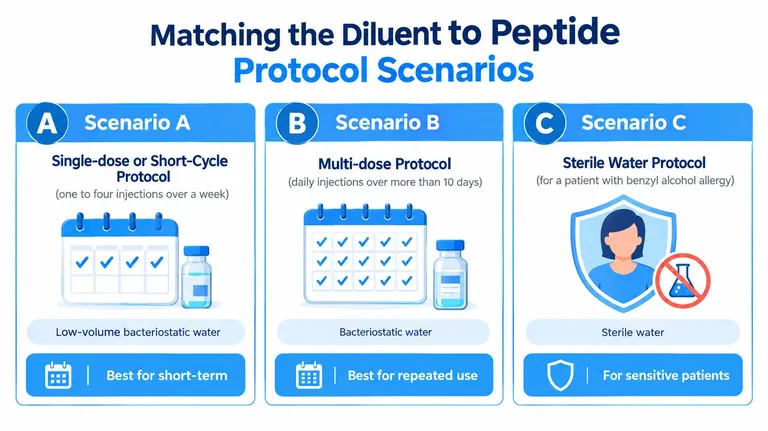
The easiest way to choose between these diluents is to stop thinking abstractly and map them to actual use patterns. The same person may reasonably use sterile water in one protocol and bacteriostatic water in another.
Scenario A with a short cycle
A short protocol with only a few injections over a brief period often favors sterile water. If the entire use window is tight and you don’t need repeated access over an extended stretch, preservative-free handling keeps the formulation simpler.
This is especially sensible when the user wants to avoid benzyl alcohol unless there’s a clear reason to include it. In these short-cycle cases, the burden of using fresh sterile diluent is usually manageable.
A simple dose planner or single-dose tracker works fine here. The workflow is less about preserving a vial and more about getting one clean reconstitution right.
Scenario B with repeated multi-week dosing
For recurring adult subcutaneous protocols that stretch across weeks, bacteriostatic water usually fits the handling pattern better. The benefit isn’t mystical. It’s operational.
Repeated withdrawals from the same preserved vial are easier to manage than opening preservative-free diluent for every reconstitution step. That matters for consistency, especially when the user is trying to keep concentration calculations, puncture dates, and dosing intervals straight.
For users who want a structured setup, a practical guide to bac water reconstitution for peptides can help map water volume, concentration, and draw amounts into one repeatable workflow.
The best diluent is often the one that matches how the protocol is actually being carried out, not the one that sounds cleaner in theory.
Scenario C with travel, interruptions, or imperfect conditions
Travel changes the calculation. Technique gets worse when people are rushed, packing supplies into small kits, or dealing with variable storage conditions.
In that setting, bacteriostatic water gives more contamination margin for repeated-use workflows. But sterile water still has a place for users who are specifically avoiding preservatives and are willing to accept shorter, more controlled handling.
A few practical questions sort this out fast:
- Will the vial be entered multiple times away from a controlled home setup? Preserved diluent often makes more sense.
- Is preservative avoidance a priority? Sterile water may still be the right call.
- Will the user reliably log puncture dates and dose timing? If not, convenience can turn into preventable confusion.
If someone can’t track when a vial was first entered, the theoretical advantage of bacteriostatic water starts to erode.
Patient Safety Warnings Most Comparisons Overlook
The decision point here is patient safety, not convenience. Shelf life gets most of the attention, but the harder question is whether benzyl alcohol belongs in that patient, for that route, in that preparation.
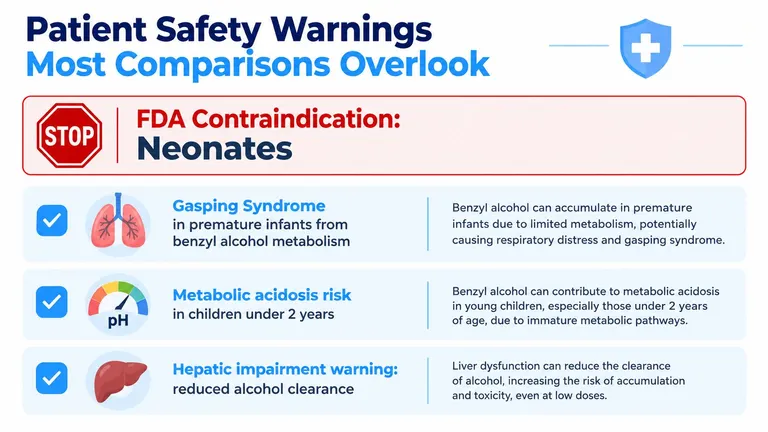
Bacteriostatic water is not a universal swap for sterile water. As noted earlier, official labeling warns against benzyl alcohol exposure in neonates and points clinicians toward preservative-free dilution in neonatal settings.
Who should trigger immediate caution
I treat these cases more conservatively because the trade-off changes:
- Neonates or very young infants: Preservative exposure is a direct safety concern, not a theoretical one.
- Any protocol involving spinal or epidural use: Route restrictions matter. Casual substitution does not belong here.
- Pregnancy-related preservative concerns: The formulation should be reviewed before use, not assumed acceptable.
- Known benzyl alcohol sensitivity or concern about cumulative exposure: Preservative-free planning is usually the cleaner choice.
A common home-use mistake is focusing only on injection volume. Small volume does not cancel a preservative warning. The right question is whether that preservative is appropriate for the patient and intended route at all.
Route and handling errors change the risk
For routine subcutaneous or intramuscular self-injection in healthy adults, the discussion is usually about repeated vial entry, contamination control, and whether the product permits preserved diluent. For neuraxial use or any unusual administration plan, the standard gets stricter fast. That is where simplified online advice causes problems, because route-specific cautions get flattened into generic reassurance.
In practice, I tell patients to separate three issues. What the vial contains. How the protocol is carried out in practice. Where the drug is going.
If a local injection problem starts looking infectious rather than just irritating, home troubleshooting has limits. This overview of when IV antibiotics are needed gives useful context on when escalation moves beyond routine self-care.
A bacteriostatic vial does not make route changes, repeated contamination, or poor patient screening acceptable.
The compounding questions worth asking
Patients using compounded sterile products should ask direct, specific questions. Does the final preparation contain benzyl alcohol. Is a preservative-free option available. What beyond-use dating applies after mixing. Does the pharmacy expect single use or repeated withdrawals.
For people drawing very small volumes, calculation mistakes are often the next avoidable problem after diluent choice. A practical guide to bacteriostatic water and insulin syringe calculations can help reduce dosing errors once the preservative and route questions have been settled.
Which Water to Choose and How to Verify Your Setup
If I had to reduce this to a practical recommendation matrix, it would look like this: use sterile water when preservative avoidance is the priority or when the use case is short and isolated. Use bacteriostatic water when an adult protocol requires repeated withdrawals and the formulation allows it.
Diluent Selection by User Profile and Protocol Shape
| User Profile / Protocol | Recommended Diluent | Primary Rationale |
|---|---|---|
| Adult using a repeated multi-dose subcutaneous protocol | Bacteriostatic Water | Better matched to repeated vial entry and ongoing use |
| Adult doing a very short protocol with near-immediate use | Sterile Water | Avoids preservative when extended multi-dose handling isn’t needed |
| Neonatal or infant-related dilution concern | Sterile Water | Preservative avoidance is the safer default |
| User with benzyl alcohol concern or hypersensitivity question | Sterile Water | Removes the preservative variable |
| Any route involving neuraxial concern or unusual administration planning | Sterile Water pending pharmacist or prescriber review | Needs route-specific review, not convenience-based substitution |
| Home user with inconsistent handling habits but repeated adult dosing | Bacteriostatic Water only if the product permits it and aseptic technique is reliable | Preservative can help with repeated-use workflow, but only if technique is controlled |
Verify the vial before you verify the math
People love concentration calculators. They matter. But first inspect the setup.
- Check the label: Confirm whether the vial is bacteriostatic or preservative-free before mixing anything.
- Inspect the solution: Don’t use a vial with visible particles, cloudiness, or a compromised seal.
- Mark first entry clearly: Add the puncture date and your initials to the vial.
- Protect the workflow: Use fresh sterile supplies and don’t reuse needles.
- Confirm the product-specific instructions: The peptide or compounded preparation may have stricter handling than the diluent itself.
Know when to stop and ask
Some setups need a pharmacist, not another forum thread.
Ask before proceeding if the situation involves compounded sterile preparations, pregnancy-related preservative questions, route uncertainty, or any plan that goes beyond ordinary subcutaneous or intramuscular self-use. Those are not edge cases to guess through.
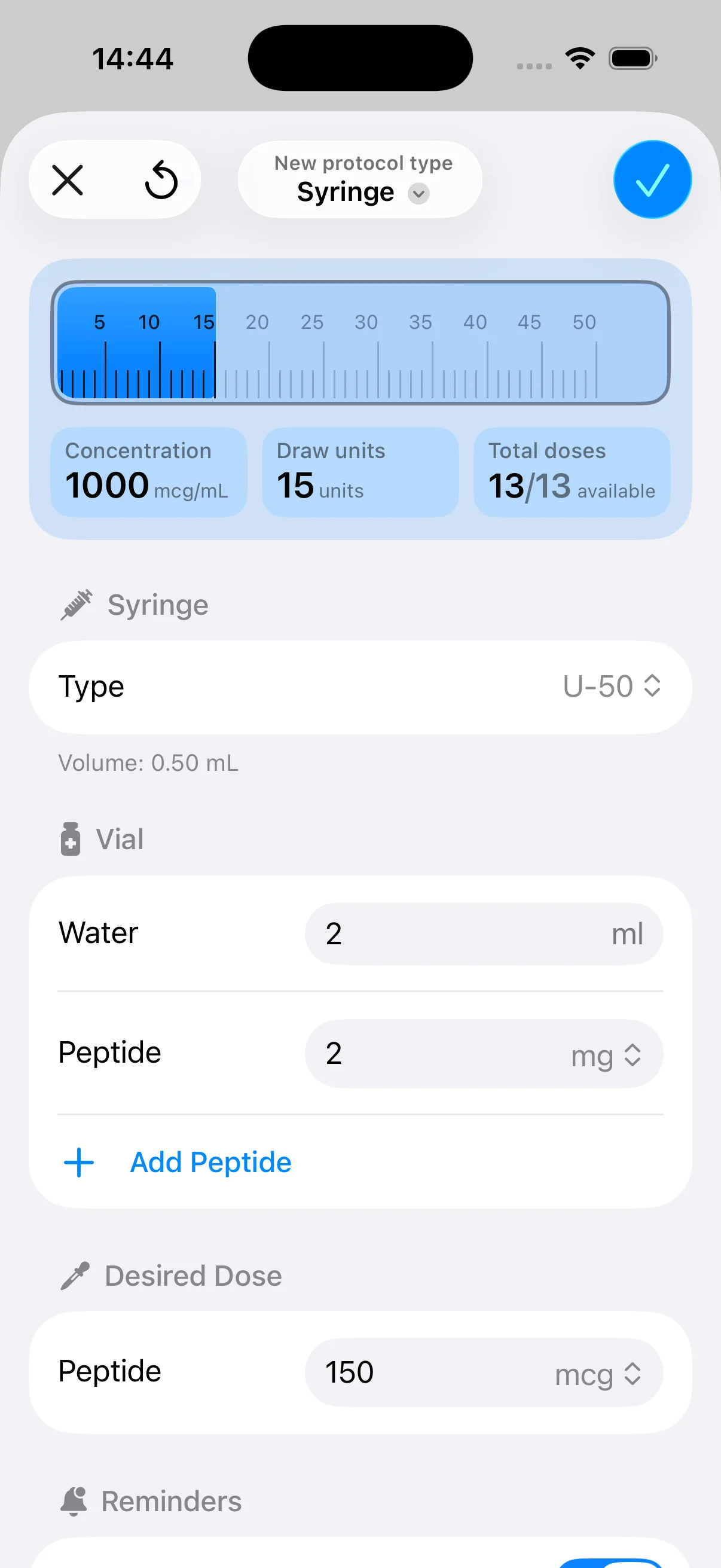
One planning tool that can help with the organizational side is PepFlow, which lets users enter reconstitution volume, calculate concentration, and track dose timing so the handling pattern stays consistent. That’s useful for reducing math errors, but it doesn’t replace product labeling or pharmacist review.
If you’re trying to keep peptide reconstitution organized instead of relying on handwritten notes and mental math, PepFlow gives you a practical way to track water volume, concentration, dosing schedules, and reminders in one place. It’s a useful companion for the workflow side of bacteriostatic water vs sterile water, especially when repeated protocols make timing and consistency harder to manage.