The most popular advice about bacteriostatic water for peptides is too simple. People repeat that it keeps a peptide good for 28 days, then treat the diluent like a universal stability solution. That shortcut misses the actual issue, because bacteriostatic water is a vehicle, not a guarantee that the peptide stays potent, compatible, or safe to use.
What matters is separating three different questions that often get blurred together, Is the water sterile, does the preservative suppress microbial growth after vial entry, and is the specific peptide chemically stable in that diluent. Once you keep those apart, the reconstitution process becomes much clearer, and the rules start coming from the peptide product itself, not from community habit. See the reconstitution guidelines.
Table of Contents
- Why Bacteriostatic Water Is Misunderstood in Peptide Prep
- What Bacteriostatic Water Actually Is
- The Role of Benzyl Alcohol and Its Limits
- When Bacteriostatic Water Is the Right Diluent for a Peptide
- A Practical Reconstitution Walkthrough
- Storage Rules: What 28 Days Covers and Does Not Mean
- Common Misconceptions Worth Retiring
- A Short Pre-Dose Checklist Before You Draw
Why Bacteriostatic Water Is Misunderstood in Peptide Prep
The common shortcut says bacteriostatic water makes a reconstituted peptide “good for 28 days.” That is too broad. Official labeling describes bacteriostatic water as sterile water containing benzyl alcohol, usually 0.9% or 1.1%, for diluting or dissolving injectable drugs, and it also directs users to the drug manufacturer for the correct diluent, volume, and handling instructions. Official labeling summary
The three questions people collapse into one
The confusion starts when three separate questions get blended together. Sterility asks whether the water began clean. Microbial suppression asks whether the preservative slows growth after the vial has been entered. Peptide stability asks whether the reconstituted peptide keeps its intended properties in that particular solution.
Those are different checks. A vial can start sterile, the preservative can help suppress some microbial growth after entry, and the mixture can still be a poor match for a specific peptide. That is why a universal “28-day peptide rule” does not hold up.
Practical rule: the diluent may help with handling, but it cannot override the peptide’s own instructions.
Peptide content online often skips that distinction because a shortcut is easier to repeat than a decision process. A safer approach is more specific. Read the product label, check whether benzyl alcohol is allowed, and follow the storage and beyond-use instructions for that exact drug. For a plain comparison of preservative water and preservative-free water, PepFlow’s bacteriostatic water vs sterile water guide is a useful reference point.
The key shift is simple. Bacteriostatic water is a diluent with a preservative, and its role stops where the drug’s own labeling begins.
What Bacteriostatic Water Actually Is
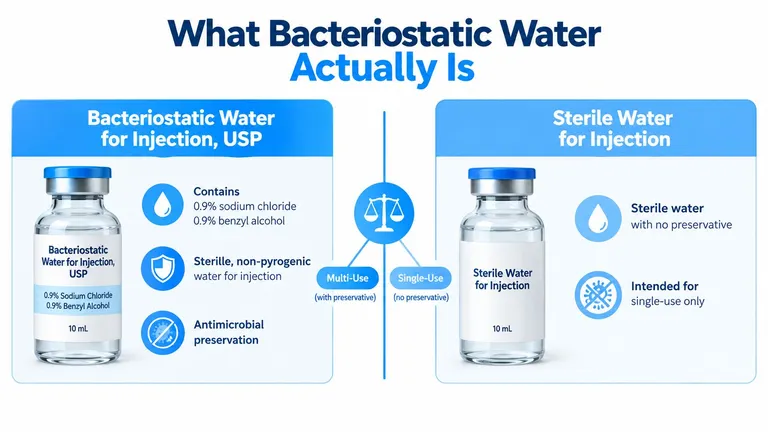
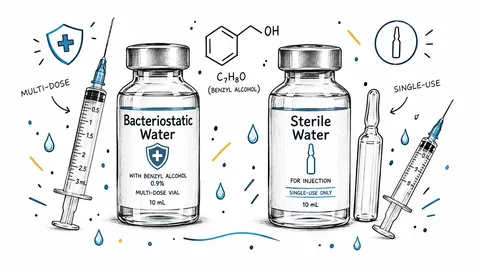
Bacteriostatic Water for Injection, USP is a sterile, nonpyrogenic aqueous vehicle containing benzyl alcohol at 0.9% (9 mg/mL) or, for some labeled products, 1.1% (11 mg/mL). A 30 mL multidose vial at the 0.9% concentration contains about 270 mg of benzyl alcohol in total. FDA labeling data
What the label is really saying
The key word is vehicle. That tells you the product is meant to carry another drug, not act as the drug itself. The preservative is there to support repeated withdrawals, not to make every mixed compound interchangeable.
By contrast, Sterile Water for Injection does not contain a bacteriostatic preservative and is generally supplied for single-dose use. That difference matters more than the name on the vial. The “bacteriostatic” part refers to the preservative effect, not to some universal peptide-protocol feature that works the same way across products.
| Feature | Bacteriostatic Water for Injection, USP | Sterile Water for Injection, USP |
|---|---|---|
| Preservative | Benzyl alcohol | None |
| Container type | Multidose | Usually single-dose |
| Main role | Dilute or dissolve injectable drugs | Dilute or dissolve injectable drugs without preservative |
| Repeated withdrawals | Supported when aseptic technique is maintained | Not the same use pattern |
| Compatibility with every peptide | Not guaranteed | Not guaranteed |
If you’re comparing water options for different medical or lab-style use cases, a practical consumer-friendly resource like check DME Superstore for Alhambra can help you see how product categories differ, but it still won’t tell you what a specific peptide requires.
Why the number on the vial matters
The concentration isn’t just trivia. It changes how much preservative is present in the vial, and the clinically relevant exposure depends on how much you withdraw and how many times you enter the container. That’s why you can’t treat the vial as if every draw is chemically identical to every other draw.
For a peptide prep workflow, the practical takeaway is straightforward, bacteriostatic water is a preservative-enabled multidose diluent, not a universal answer to peptide reconstitution. If a peptide’s instructions call for something else, the label wins.
The Role of Benzyl Alcohol and Its Limits
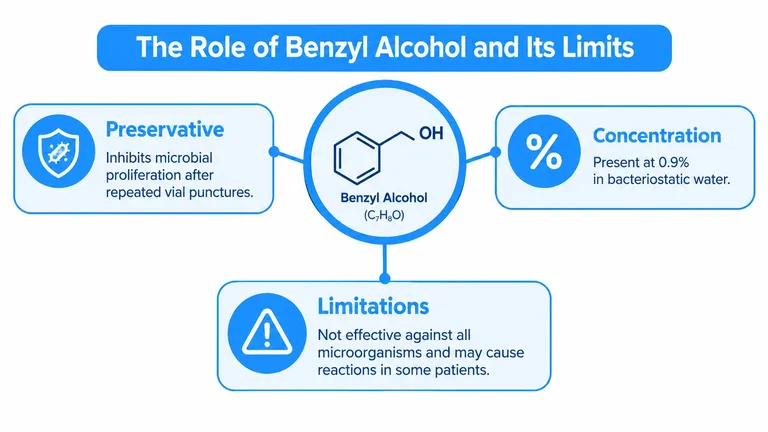
Benzyl alcohol is what gives bacteriostatic water its preservative role. It helps slow microbial growth after repeated entry, which is why the product is made for multidose use. That function is narrow. It does not sterilize a contaminated solution, and it does not tell you whether a peptide will stay stable, potent, or compatible after mixing.
What the preservative cannot do
The label still requires aseptic technique with each entry, warns that benzyl alcohol can be toxic in neonates, and says the solution must be made approximately isotonic before use. DailyMed labeling
That distinction matters because preservative water is often treated like a universal safety fix. It is not. If contamination is already present, benzyl alcohol does not remove it. If the peptide does not hold up in that diluent, the preservative does not solve that either.
A vial entered with a reused syringe can be contaminated on day one, and the benzyl alcohol in the vial will not make that breach safe.
Compatibility is also product-specific. One peptide may tolerate a benzyl-alcohol-containing diluent, another may call for something else, and a third may need a different storage approach entirely. For a practical consumer summary of how people misread storage claims, see PepFlow’s bacteriostatic water shelf life guide.
What to watch every time you draw
Each withdrawal still follows the same basic rules:
- Use aseptic technique. Every puncture adds handling risk, so the stopper and syringe matter.
- Keep the package intact. A damaged vial is no longer the same product.
- Store it correctly. The label on the unopened diluent is not the same thing as the storage rule for the reconstituted peptide.
The simple takeaway is this. Benzyl alcohol can slow microbial growth after entry, but it cannot correct poor handling or validate a peptide that never had stability data for that diluent in the first place.
When Bacteriostatic Water Is the Right Diluent for a Peptide
The right diluent comes from the peptide’s own instructions, not from a forum default. Bacteriostatic water belongs in the conversation only when the specific product allows a benzyl-alcohol-containing diluent, or when a qualified clinician or pharmacist selects it for that use.
A simple decision framework
Start with the label, then work outward.
- Check the peptide’s authorized labeling or pharmacy instructions. If the product specifies a diluent, follow that.
- Confirm whether benzyl alcohol is allowed. Some formulations tolerate it, others do not.
- Match the route and use case. Preserved multidose diluents serve a different purpose than single-use water.
- Treat research-use peptides as higher uncertainty. If identity, sterility, or stability has not been established by a regulator or manufacturer, do not borrow confidence from community lore.
That last point matters because online discussion often collapses very different products into one category. A peptide that seems fine in one setting may not be suitable in another, and the missing piece is usually formulation data, not personal preference.
Where the choice usually points
Bacteriostatic water makes the most sense when a compatible injectable product benefits from repeated withdrawal and fewer handling steps. Sterile water fits better when the product is meant for single-use or immediate preparation. In other cases, a different diluent may be the better match because the formulation needs a specific pH, buffer, or ionic environment.
If you are comparing water quality and diluent choices in related lab or wellness workflows, lab water system selection tips is a useful reminder that “water” is not one generic category. The same principle applies here.
Decision rule: if the peptide’s instructions do not support bacteriostatic water, do not assume it does.
For a biohacker new to reconstitution, that can feel restrictive. It is protective. You are not just mixing ingredients, you are making a formulation choice. That choice belongs to the product label, the clinician, or the pharmacist, not to the loudest online shortcut.
A Practical Reconstitution Walkthrough
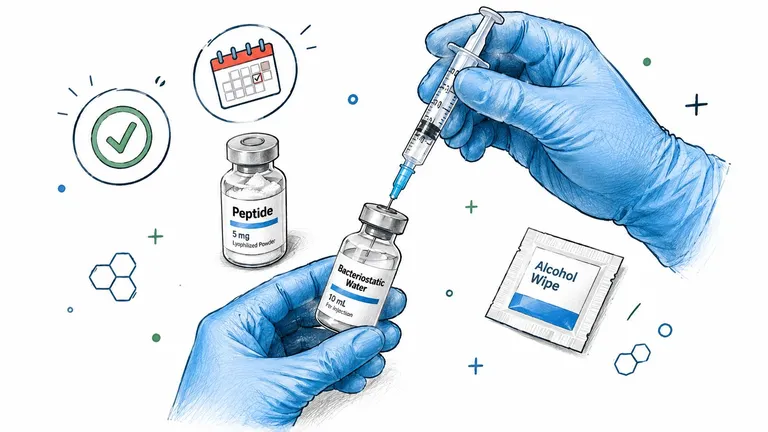
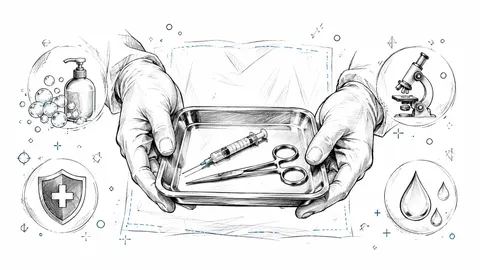
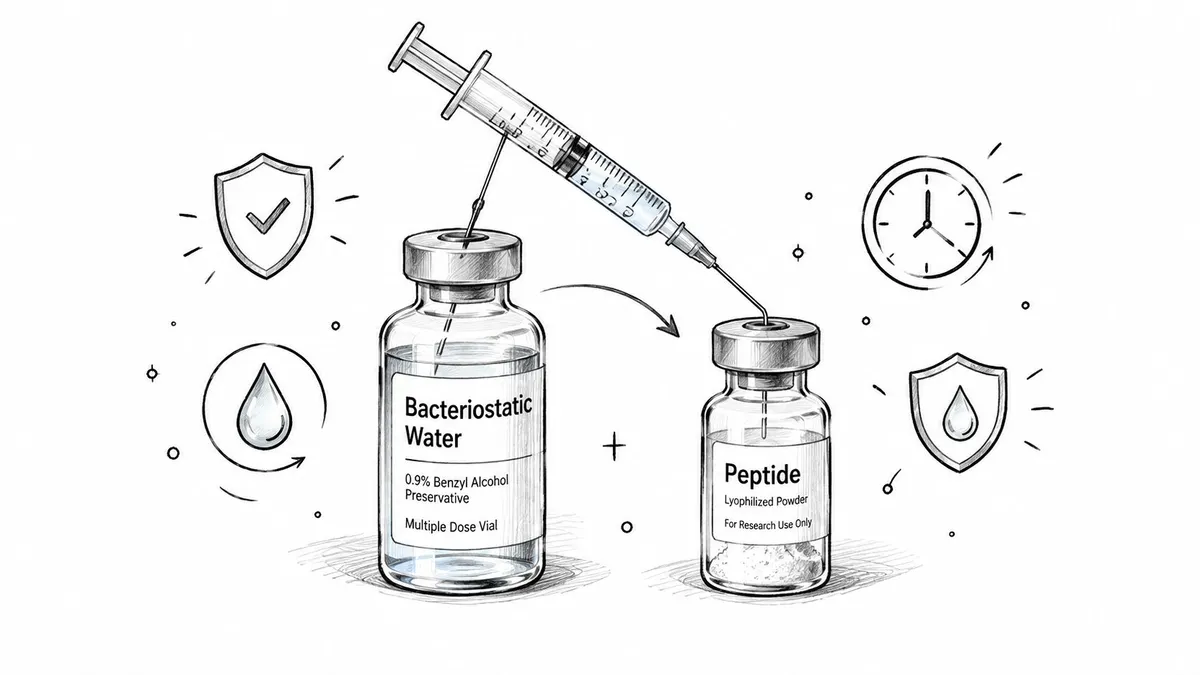
A clean reconstitution starts before the needle ever touches the vial. Confirm the peptide product, read its instructions, and make sure the diluent is allowed for that exact formulation. Then prepare a clean work surface, use a new sterile syringe, and swab the stoppers before each puncture.
The basic flow is simple, but the details matter. Draw the prescribed volume, then inject it slowly down the side of the vial rather than blasting it straight onto the powder. Let the peptide dissolve without shaking the vial hard, because unnecessary agitation can make the mixture harder to inspect and may worsen handling errors.
Practical check: if the solution looks cloudy, discolored, or full of particulates, don’t treat it as automatically usable.
A quick visual inspection is part of the process. The resulting solution should be checked for unexpected precipitation, discoloration, or loss of clarity, and it should be used promptly if the peptide’s instructions say so. The important point is that the final storage conditions belong to the peptide, not to the water vial.
A clean workflow also means managing the math separately from the medicine. A dosage calculator can help with volume arithmetic, and a tool like PepFlow can be useful for planning a reconstitution volume or schedule, but it can’t decide whether a peptide should be mixed with bacteriostatic water in the first place. That choice still comes from the product’s instructions and professional guidance.
Later, when you’re setting up a routine around peptide use, even unrelated wellness examples like B12 shots for fatigue relief show why product-specific instructions matter. Different injectable compounds can look similar at the bench while following very different handling rules.
A reconstitution routine should feel boring. That’s a good sign. Clean technique, exact volumes, and careful inspection are what keep the process under control.
Storage Rules: What 28 Days Covers and Does Not Mean
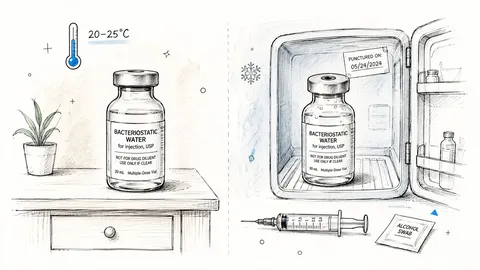
The easiest storage mistake is assuming the diluent label answers every question. It does not. The unopened Bacteriostatic Water for Injection product is labeled for controlled-room-temperature storage at 20–25°C (68–77°F), and the multidose container allows repeated withdrawals when aseptic technique is maintained. Pfizer labeling
What the unopened vial tells you
That temperature range applies to the product as sold. It tells you how to store the diluent before opening, not how to store every peptide after it has been mixed. The storage rules for the reconstituted drug must come from that drug’s own labeling or from a pharmacist or clinician.
The common “28-day” idea causes confusion because it gets treated like a universal shelf life. In practice, it is an in-use convention for the opened multidose diluent, not proof that every peptide stays chemically potent for that long. Microbial growth suppression and chemical stability are different questions, even if people often collapse them into one.
| Item | Who sets the rule | Typical storage |
|---|---|---|
| Unopened bacteriostatic water | The diluent label | Controlled room temperature, per label |
| Opened bacteriostatic water | The product’s in-use handling guidance | Multidose use with aseptic handling |
| Reconstituted peptide | The peptide’s own instructions | Product-specific, not universal |
Why the distinction matters
A vial can still look fine and still be the wrong choice for the mixed drug. That applies to clear solutions as well as cloudy ones. The label may allow repeated withdrawals from the diluent container, but that does not validate a blanket shelf life for whatever you dissolve in it.
For a concise storage reference, PepFlow’s bacteriostatic water storage guide keeps the diluent rules separate from the peptide rules. That separation is the main point to carry into every reconstitution decision.
Storage rule: the water’s storage label is not the peptide’s beyond-use date.
The gray zone gets wider with research-use peptides, because identity, sterility, and stability may not be validated in the first place. In that setting, the safer response is more caution, not more confidence. Label the vial, log the reconstitution date, and follow the product-specific instructions rather than a community habit that treats 28 days like a universal law.
Common Misconceptions Worth Retiring
The first misconception is that bacteriostatic water sterilizes a contaminated vial. It does not. The preservative may slow microbial growth after entry, but it cannot clean up contamination or replace aseptic technique.
The second is that benzyl alcohol preserves the peptide itself. That is not what the label is for. Microbial suppression and peptide stability are separate questions, and they should be treated that way.
The third is that an opened multidose vial is safe forever if it still looks clear. Clear only means clear. A vial can look unchanged and still be outside the handling window that applies to it.
The fourth is that adding more diluent always means more active peptide in each dose. The math goes the other way. More diluent lowers concentration, so the same amount of peptide is spread across a larger volume.
A Short Pre-Dose Checklist Before You Draw
Before you draw anything, slow down and check the basics. Reconstitution fails most often at the point where people assume the diluent makes the decision for them.
- Confirm the peptide instructions: bacteriostatic water may be common, but common does not mean permitted.
- Confirm the diluent is allowed: benzyl alcohol is part of a specific formulation, not a default setting.
- Confirm aseptic technique: clean stopper, sterile syringe, intact vial.
- Inspect the solution: cloudiness, particles, or discoloration mean stop and reassess.
- Log the reconstitution date and time: memory is a weak record.
- Set storage from the drug label: the peptide sets the storage rule, not the water vial.
- Use volume math carefully: a dosage calculator can help with arithmetic, but it cannot decide compatibility.
If you use a tool for dose math and scheduling, keep its role narrow. It can support the numbers, but it cannot tell you whether bacteriostatic water belongs in that vial.