You open the fridge, see three peptide vials, and immediately hit the same questions every serious user eventually hits. Which one was reconstituted first. Which one sat out too long during travel. Which one still has enough potency left to trust for a precise dose.
That’s where most peptide routines drift off course. The problem usually isn’t a dramatic “expired versus safe” moment. It’s slower than that. Labels fade, reconstitution dates get guessed, storage details blur together, and suddenly you’re making dosing decisions from memory instead of records. For compounds where timing, concentration, and handling matter, that’s a bad habit.
Good expiration date tracking fixes that. Not in a corporate inventory-software way. In a personal, practical way that helps you know what’s in the fridge, what needs to be used first, what should be reviewed, and what should be discarded without debate.
Table of Contents
- Why Static Expiration Dates Fail Peptide Users
- The Foundation A Bulletproof Labeling and Storage System
- Creating Your Master Peptide Tracking Log
- Implementing a First-Expire First-Out Workflow
- Automating Your System with Digital Tracking Tools
- From Chore to Strategy A Final Word on Consistency
Why Static Expiration Dates Fail Peptide Users
Static dates make people feel precise, but for peptide users they often create false confidence. A vial doesn’t become perfect one day and worthless the next. Real-world handling matters. Reconstitution matters. Light exposure matters. Time spent warming on a counter matters. Every one of those details changes how useful that printed date is in practice.
That’s why generic expiration advice usually falls short. Most guidance treats the label date like a hard universal boundary, even though the bigger issue for many users is potency drift under ordinary, imperfect storage. If you’re trying to run a structured protocol, “probably still fine” isn’t a satisfying standard.
A useful way to think about it is this. The label gives you a starting reference. Your handling history determines how much trust that reference deserves.
Static dates are clean on paper. Peptide use in the real world never is.
This gap isn’t unique to peptides, but peptides make it more obvious because users care about small dose differences and often work with reconstituted vials over time. A broader review of supplement and medication expiry points out that expiration dates are conservative quality markers based on ideal storage conditions, not your actual environment. It also notes military-funded research found 90% of over 100 medications remained suitable for use 15 years past expiry when stored properly (reviewed here). That doesn’t mean you should stretch your peptide use recklessly. It means the key question is storage history, not blind faith in one printed date.
If you’ve ever looked at a half-used vial and realized you weren’t sure when you mixed it, that’s the problem in one snapshot. You don’t need more guesswork. You need a repeatable system. A practical place to start is understanding how long peptides last under different forms and handling conditions, then tracking your own actual use instead of relying on memory.
The Foundation A Bulletproof Labeling and Storage System
Most expiration date tracking failures start in the physical world, not the digital one. If the vial itself is unclear, the app or spreadsheet won’t save you. You need labels that survive moisture, a fridge layout that reduces mix-ups, and a few fields that answer the only questions that matter when you reach for a vial.

What goes on every vial
For personal peptide use, I wouldn’t overcomplicate the label. But I also wouldn’t run anything with only the peptide name scribbled on top.
Include these fields:
- Product name: Write the full peptide name, not an abbreviation only you understand today.
- Lot number: If there’s ever a quality question, this is the field you’ll wish you had.
- Reconstitution date and time: Date alone is often enough for casual supplements. With peptides, time can matter if you’re managing multiple vials opened close together.
- Diluent used: BAC water versus another diluent shouldn’t live in your memory.
- Final concentration: Write it in a format that’s easy to dose from later, such as mg/mL.
For lyophilized vials that haven’t been mixed, the label can stay simpler. For reconstituted vials, those extra details are essential because that’s when your real handling timeline begins.
Practical rule: If someone else could pick up your vial and understand exactly what it is and when it was prepared, the label is good enough.
Use durable labels or an oil-based fine-tip marker that won’t smear from condensation. If you want something cleaner than strips of tape, bottle date identifiers are useful because they stay readable in damp, repeatedly handled environments.
How to store without creating confusion
Storage systems fail when they look organized but don’t support decisions. A tidy fridge isn’t the same thing as a usable one.
A workable setup usually has three features:
-
Separate by status
Keep unopened lyophilized vials apart from reconstituted vials. Don’t mix “in reserve” with “currently in use.” -
Store by protocol or purpose
If you’re using more than one peptide, group them in a way that matches how you reach for them. The best system is the one that removes hesitation. -
Control light and movement
Use an opaque bin or container inside the fridge so vials aren’t rolling around every time the door opens.
If you’re trying to improve day-to-day handling, detailed guidance on peptide storage best practices is worth reviewing once and then translating into a simple household routine.
A few trade-offs matter here:
- Label maker versus handwriting: A label maker looks better. Handwriting is faster. If handwriting means you’ll label every vial immediately, use handwriting.
- Fridge versus freezer: Long-term preservation may push you toward colder storage, but constant shifting between locations creates its own confusion. Keep your active system simple.
- Minimalism versus completeness: Tiny labels look neat. Tiny labels also invite omissions. If you can’t fit the key fields, your format is too small.
The best physical system is boring. That’s a compliment. It should make the right action automatic and make the wrong action feel inconvenient.
Creating Your Master Peptide Tracking Log
Once the vial is labeled, you need one place that acts as the source of truth. Many people tend to overcomplicate this. They build a complicated tracker, use it for four days, then abandon it. A good peptide log is plain enough that you’ll still update it when you’re tired.
For expiration date tracking, the minimum database fields matter more than fancy dashboards. An effective tracking method should at least capture product ID, lot or batch number, expiration date, and physical location, and it should avoid storing a fixed “Expired” flag because dynamic queries are more accurate in real time (practical database guidance here). That principle translates well to personal use. Don’t hardcode status when time itself changes the answer.
The minimum fields that matter
For peptides, I’d use a short list and stick with it:
- Vial ID for your own internal naming
- Peptide name
- Lot #
- Purchase date
- Reconstitution date
- Concentration
- Review date
- Status
That’s enough to answer the operational questions. What is this. When did it enter the system. When did I mix it. Where am I in its usable life. Am I actively using it or not.
Notice what’s not here. There’s no permanent “expired” checkbox. That’s deliberate. Your log should tell you what needs review based on today’s date, not trap you in stale labels that someone forgot to update.
Peptide Inventory Log Template
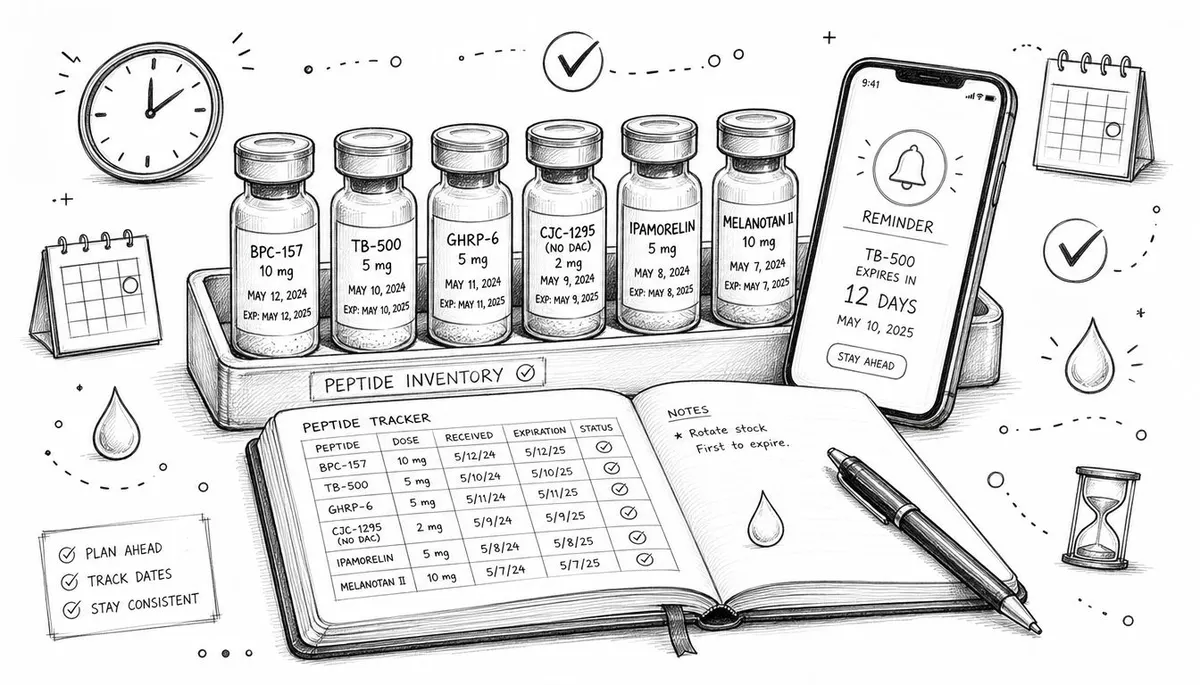
| Vial ID | Peptide Name | Lot # | Purchase Date | Reconstitution Date | Concentration (mg/mL) | Review Date | Status (In Stock/In Use/Finished) |
|---|---|---|---|---|---|---|---|
| P-01 | |||||||
| P-02 | |||||||
| P-03 |
A few notes make this table more useful:
- Vial ID: Give each vial its own identifier even if two vials are the same peptide.
- Purchase date: Helpful when comparing older inventory against newer replacements.
- Review date: Better than pretending you know an exact universal cutoff for every situation.
- Status: Keep it operational. “In Stock,” “In Use,” and “Finished” are generally sufficient.
The log should help you make a decision in seconds. If you need to decode your own system, it’s too complex.
Paper notes versus a sheet
A notebook works if you only manage a few vials at a time and always store them in one place. The upside is speed. The downside is that sorting by review date is clumsy.
A simple spreadsheet is better for most users because you can sort active vials, filter by peptide name, and scan what needs attention. You also get easier edits if concentration or handling notes need correction. Keep the sheet lean. One tab is often enough.
A notes app can work in between those two options. If that’s your style, use one line per vial and keep the format identical every time. Consistency matters more than platform.
What doesn’t work well is a half-system. A label on the vial with no log. A sheet with missing lot numbers. A review date set once and never checked again. Precision in peptides doesn’t come from owning a tracker. It comes from maintaining one.
Implementing a First-Expire First-Out Workflow
A log by itself is passive. First-Expire, First-Out, or FEFO, turns it into action. The idea is simple. Use the vial closest to its review point first, not the one that happens to be easiest to grab.
That sounds obvious, but most personal setups drift into the opposite pattern. People open a fresh vial because it’s visible, cleaner, or mentally easier to trust. Meanwhile, an older vial sits behind it and eventually becomes the one they feel least certain about later.
In broader expiration date tracking systems, FEFO matters because it ensures items closest to expiration are used first, and automated alerts can notify users when products reach a set portion of their shelf life so action happens before waste does (retail and inventory analysis here). The same logic works at the scale of one person with a fridge and a routine.

How FEFO works in a personal setup
FEFO for peptides doesn’t need warehouse-level complexity. It needs a simple rule set.
- Front position means first use: In your container or tray, the next vial to review goes in front.
- New stock goes behind active stock: Never place fresh arrivals in the most visible slot.
- One active vial when possible: If your protocol allows it, don’t open duplicates unnecessarily.
That physical rotation matters because it removes a decision. When the oldest suitable vial is easiest to reach, you’re more likely to use it correctly.
A simple review rhythm
This is the part often skipped. Users build the system, then stop interacting with it until there’s confusion. FEFO works when you review before confusion starts.
Use a recurring check based on how fast your inventory turns. For many personal peptide users, a weekly or every-other-day glance at active items is enough to catch issues without becoming obsessive. In inventory practice more broadly, monitoring frequency should match shelf-life category, with shorter-life items checked more often than long-life items (monitoring guidance here).
A staged alert mindset works well even if your system is manual:
- Soft reminder: A review point that tells you to plan usage and confirm storage history.
- Hard reminder: A nearer point where that vial becomes your default first choice.
- Discard decision: The moment when uncertainty is high enough that saving money isn’t worth the doubt.
If your system only tells you a vial is a problem after it already feels questionable, the alert came too late.
This workflow solves a common biohacker problem. You stop doing fridge archaeology. No more picking up two nearly identical vials and trying to remember which one was mixed first. The decision is already made by the system you set up earlier.
Overkill looks different here than people think. Daily audits of every unopened vial are overkill for most users. Ignoring active reconstituted vials until you “get around to it” is the opposite mistake. FEFO sits in the practical middle. Minimal effort. Clear order. Much less waste.
Automating Your System with Digital Tracking Tools
Manual systems work until they don’t. A notebook is fine until you misplace it. A spreadsheet is fine until you forget to update it after reconstituting a vial late at night. Calendar reminders help, but they’re blunt. They remind you that something exists. They don’t keep the whole system coherent.
That gap is one reason mobile tools have become more attractive for expiration date tracking. In the broader market, the Mobile Applications segment is the fastest-growing product type in expiration tracking, projected to grow at a CAGR of approximately 12.4% through 2034 according to Dataintelo’s market analysis. That makes sense in practice. Phones are already where people check routines, reminders, and daily adherence.

Where manual systems break down
The weak points are predictable:
- You enter data twice: Once on the vial, once in a sheet, then maybe again in a calendar.
- Reminders lose context: “Check peptide vial” doesn’t tell you concentration, protocol status, or sequence.
- Small errors pile up: One missed date entry becomes uncertainty for the entire vial.
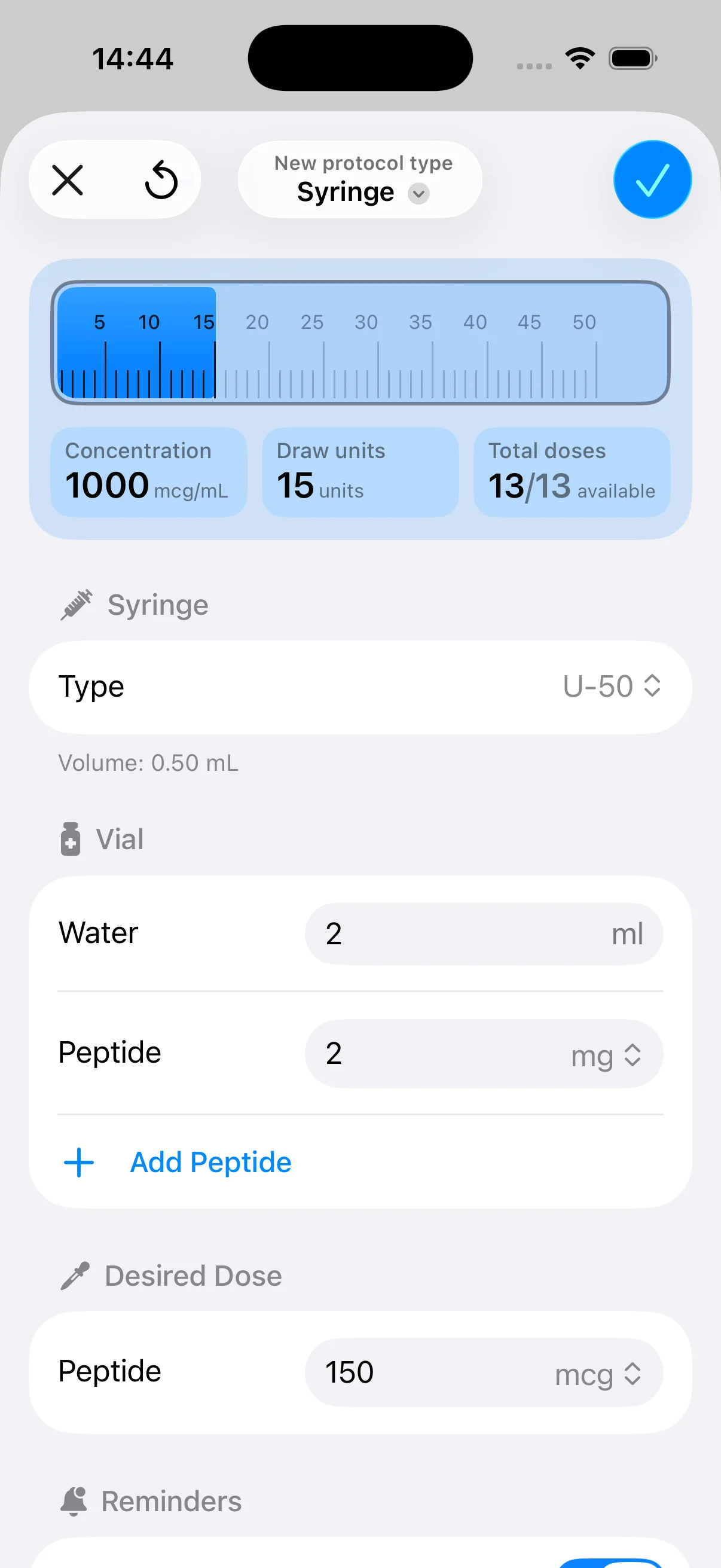
A dedicated tool reduces that friction by keeping inventory, timing, and dose planning in the same environment. That matters more than people think. Good systems don’t just store information. They make the next correct action obvious.
This is true in other inventory-heavy settings too. If you’ve ever looked at operational workflows like automated farm purchase orders, the lesson carries over well. The win isn’t only speed. It’s removing the repeated handoffs where people forget, misread, or postpone decisions.
What a dedicated mobile tool does better
A purpose-built peptide tracker can handle several jobs that spreadsheets handle poorly:
- Concentration math: Especially useful when you don’t want to redo vial math every time.
- Protocol scheduling: Better than stacking separate alarms that don’t understand cycle logic.
- Expiration and review reminders: Stronger than memory, and cleaner than scattered note fields.
- Quick logging: The easier it is to record a dose or update a vial, the more likely you’ll stay consistent.
The biggest advantage isn’t sophistication. It’s compliance with your own system. If a tool lowers friction enough that you use it every day, it beats a theoretically perfect spreadsheet you ignore.
For anyone comparing options, a roundup of peptide tracker apps is a better starting point than searching generic medication reminder tools. Peptide workflows have their own quirks, especially around reconstitution, concentration tracking, cycling, and recurring review points.
The practical trade-off is straightforward. Manual tracking gives you maximum flexibility with maximum responsibility. Digital tracking takes some setup upfront, then repays that effort by carrying the repetitive parts for you. If you manage more than a couple of active vials, or if your routine already includes multiple dosing windows, automation stops being a luxury and starts looking like the simpler option.
From Chore to Strategy A Final Word on Consistency
Expiration date tracking sounds like administrative housekeeping until you’ve had to second-guess a vial mid-protocol. Then it becomes what it really is. A way to protect consistency, confidence, and the money you’ve already put into your setup.
The system doesn’t need to be elaborate. It needs four things that hold up under real life:
- Clear physical labels that survive handling
- One master log with the few fields that matter
- A FEFO rotation habit so older vials get used first
- A reminder system that doesn’t depend on memory
That combination changes the whole feel of a peptide routine. Less rummaging. Less guessing. Less internal negotiation about whether a vial is “probably okay.”
Good tracking isn’t obsessive. It’s what lets you stop obsessing.
If you want perspective from outside the peptide world, operational guides on how teams streamline document tracking make the same core point. The value isn’t the record itself. The value is knowing what needs attention before it becomes a problem.
Start small if that’s what makes the system stick. Label the next vial properly. Add it to a single log. Put the oldest active one in front. You don’t need a perfect setup on day one. You need a system you’ll still follow next month.
If you want a simpler way to stay on top of peptide math, protocols, and reminders in one place, PepFlow is built for exactly that. It helps you calculate doses, organize vial details, track scheduled use, and reduce the kind of small manual mistakes that turn into bigger uncertainty later.