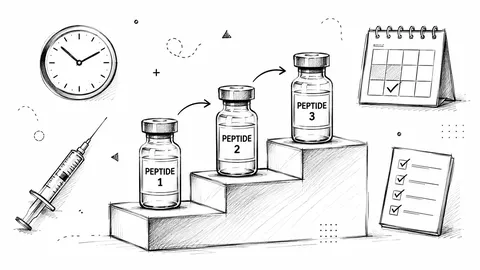
You’ve got three vials on the counter, a syringe in one hand, and two different notes apps open because the units don’t match. That’s exactly where a lot of people end up with a peptide stack, part planning, part guesswork, and one small math error away from a bad dose or a bad decision. The right approach is to treat the stack like a structured protocol, not a shopping list.
A peptide stack is a coordinated set of peptides with clear goals, schedules, doses, and stop conditions. That structure matters because the category is broad, the products are not interchangeable, and the safety questions arrive before the first injection, not after the cycle has started. The FDA has reported more than 130 peptide drug products designated as reference listed drugs, spanning hormone therapies, synthetic peptides, and newer metabolic medicines such as generic liraglutide, which is a reminder that “peptide” covers a lot of ground and not one simple playbook (FDA presentation on peptide drug products). See the peptide stack reference.

If you’re also trying to keep your focus tight while you sort out health routines, find the best focus nootropics is a useful comparison point for how organized planning improves consistency without pretending every compound belongs in the same category.
Table of Contents
- What a Peptide Stack Actually Is and Why Structure Matters
- Filtering Approved, Investigational, and Research-Only Peptides
- Anti-Doping Compliance for Athletes and Tested Individuals
- Evidence Tiers and the Limits of Stacking Under-Studied Compounds
- Concentration Math and Unit Conversion as a Safety Control
- Building Cycled Protocols with Frequencies and Pause Periods
- Tracking Adherence, History, and Symptom Signals
- Safety Boundaries and When a Clinician Must Be Involved
What a Peptide Stack Actually Is and Why Structure Matters
A peptide stack works only when each compound earns its place. People often begin with names and hope the schedule will sort itself out later, but that reverses the logic. Start with the problem, then define the role of each peptide, then set the timing, then decide when the protocol ends.
A peptide stack is a coordinated set of peptides with clear goals, schedules, doses, and stop conditions. That structure matters because similar labels can hide very different uses. One peptide may sit in a medical protocol, another may be tied to a research question, and a third may be inappropriate outside a narrow setting. If you mix those categories, the stack stops being a plan and turns into guesswork.
Start with the problem, not the vial
A structured stack keeps different purposes separate. One peptide may relate to appetite or glucose control, another to tissue repair, and another to a compound with no approved human pathway. If those distinctions are blurred, the schedule becomes noise and the dose math becomes shaky.
Practical rule: if you cannot explain why a peptide is in the stack in one sentence, it probably does not belong there yet.
That is the point of asking for a clear use case before anything else. A sentence like “this peptide is in the stack to support appetite control” says more than a shelf full of vials ever will. A second sentence can clarify a different role, such as “this peptide is included for a separate repair-focused protocol,” which makes it easier to see when two items belong in the same stack and when they do not.
Build the stack like a project file
Treat each peptide as a separate line item with its own identity, source, storage notes, and stop conditions. Do not borrow assumptions from one product and apply them to the next just because they share a delivery route or a weekly schedule.
For a practical comparison of how focus-oriented routines are organized around goals and constraints, find the best focus nootropics shows why category checks come before convenience.
A good stack also keeps the safety questions visible. If a compound has to be checked for testing risk, legal status, or evidence limits, that question belongs beside the name itself, not buried in the notes. A stack that cannot answer those questions cleanly is not structured enough to use with confidence.
Filtering Approved, Investigational, and Research-Only Peptides
FDA approval tells you something specific about a product, and only about that product. It does not validate a self-made combination, a different route, a different formulation, or a compound that only resembles the approved medicine in name or mechanism. That’s the first distinction a responsible peptide stack guide has to make.
Learn the category before you touch the calculator
The FDA’s history with peptide medicines shows a wide range of legitimate products, but also a wide range of product-specific differences. Sequence, formulation, route, manufacturing method, approved indication, and regulatory status can all differ from one peptide to another. A compound can be medically real without being appropriate for a given stack, and a peptide can exist in pharmacy practice without being a green light for every user or every goal.
A quick way to sort what’s in front of you is to ask which bucket it fits into:
- FDA approved medicine. The product has a specific approved use and a defined regulatory path.
- Compounded preparation. It may be dispensed by a pharmacy, but compounded drugs are not FDA-approved and are not reviewed by FDA before marketing for safety or effectiveness.
- Investigational product. It may have research promise, but that doesn’t make it a legitimate human dosing pathway.
- Research-only chemical. The label itself should stop you from translating it into a human stack.
The important habit is simple, even if the details are not. Read the vial name, read the exact status, and do not assume that a familiar peptide family means a shared dosing rule. That applies just as much to concentration and storage as it does to indication.
Don’t generalize from one approved product
The FDA-approved peptide category is broad enough to include older hormone therapies, synthetic peptide products, and newer metabolic medicines. That breadth can trick people into thinking the whole category behaves like a single class. It doesn’t. One approved product says nothing about unapproved combinations or self-directed protocols built from online fragments and forum advice.
For a curated reference list of approved peptide drugs, the internal overview at FDA approved peptide drugs list is useful because it reinforces the central point, approved does not mean interchangeable.
Approved status is a property of a specific medicine, not a permission slip for every stack built around it.
If you can’t clearly place a peptide into one of those buckets, stop there. Don’t move on to a dose calculator until the category is clear. That one habit prevents a lot of confident mistakes.
Anti-Doping Compliance for Athletes and Tested Individuals
A tested athlete can have the right dose, the right vial, and the wrong category. Anti-doping status is decided by the rule book, not by wellness branding or how common a peptide sounds in gym circles.
The World Anti-Doping Agency’s 2020 Prohibited List placed peptide hormones, growth factors, related substances, and mimetics in a dedicated prohibited category. The listed examples include growth hormone, IGF-1, chorionic gonadotrophin, luteinizing hormone and their releasing factors in males, plus multiple growth factors linked to tissue growth, vascularization, or regenerative pathways (WADA 2020 Prohibited List). The 2020 list illustrates the category scope. Always verify against the current WADA Prohibited List for your competition year.
That matters because the category is broad enough to catch products sold in soft language. It also changes over time, so a one-time search is not enough. The exact substance, the exact analogue, and the exact sport rule set all have to match before a protocol is even discussed.
A workable pre-stack check starts before the cycle starts:
- Identify the exact substance. Brand names can hide the molecule, and the molecule is what the rules apply to.
- Check the current WADA list. Last season’s answer may be out of date.
- Review sport-specific rules. Some federations apply stricter standards than the baseline.
- Assess therapeutic-use exemptions. A prescription alone does not settle eligibility.
- Confirm the product source. Third-party verification helps with checking supplements for banned substances, but it does not change the anti-doping category.
Athletes often ask whether timing lowers the risk. Timing can affect detectability, but it does not make a prohibited substance permitted. A peptide that is banned today does not become eligible because it was taken earlier or in a smaller schedule. That is why the category check comes first, and the protocol comes later.
Evidence Tiers and the Limits of Stacking Under-Studied Compounds
Not every peptide deserves the same level of confidence. Some have large human datasets and established use. Others have promising signals but limited human evidence. A few are mostly internet vocabulary attached to very thin data. A serious peptide stack guide has to separate those tiers or it ends up selling certainty where none exists.
| Tier | Example Compound Class | Stack Implication |
|---|---|---|
| Tier 1 | Approved agents with large human datasets | Best starting point for clinical reasoning and side-effect expectations |
| Tier 2 | Compounded or generic versions of approved agents | Requires product-specific caution and dosing clarity |
| Tier 3 | Investigational peptides with limited human evidence | Combination logic is uncertain, so caution rises fast |
| Tier 4 | Research-only chemicals without validated human dosing pathways | Not a responsible foundation for self-directed stacking |
Separate human data from mechanism talk
A recent review notes that non-approved peptides such as BPC-157 and TB-500 lack adequate human clinical trials and long-term safety data, while approved agents like tirzepatide have safety data from more than 7,700 participants, with gastrointestinal events being the most frequent (review of peptide evidence). That contrast matters because it shows how different the evidentiary ground can be even when the molecules are discussed in the same forum thread.
The key limitation is not just that evidence is thinner. It’s that uncertainty compounds when you stack multiple under-studied products together. If each compound has unresolved dosing questions, unknown interaction questions, and no reliable long-term safety map, the stack can become less interpretable than any single peptide alone.
Watch for symptoms that change the plan
If you’re dealing with a tier 3 or tier 4 stack and you notice persistent gastrointestinal symptoms, unusual swelling, a rash, breathing changes, or any symptom that feels out of proportion to the protocol, stop and get medical advice. That’s especially true when the product has no validated human pathway.
For readers trying to organize the evidence before they decide anything else, the safest habit is to ask whether the peptide is approved, investigational, or research-only, then ask what human data exists. If the answer is vague, the stack is too.
Concentration Math and Unit Conversion as a Safety Control
Dose conversion isn’t a convenience feature. It’s a medication-safety step. Most errors happen when people jump from “how much is in the vial” to “how much do I inject” without preserving units at every step.
Use the vial, the volume, and the syringe as one chain
The core math is straightforward:
- Concentration (mcg/mL) = vial content (mcg) ÷ final volume (mL)
- Injection volume (mL) = prescribed dose (mcg) ÷ concentration (mcg/mL)
- On a U-100 insulin syringe, displayed units equal volume in mL multiplied by 100
So if a 2,000-mcg vial is reconstituted to 2 mL, the concentration is 1,000 mcg/mL. A 250-mcg dose then requires 0.25 mL, which is 25 syringe units. The point isn’t just the answer, it’s the chain of reasoning. If any step drops the units, the calculation becomes much easier to get wrong.
The FDA has described errors with compounded injectable semaglutide involving incorrect milligram-to-unit or milligram-to-milliliter conversions, with some patients receiving five to ten times the intended dose, and recommends using an appropriately sized syringe with explicit measurement counseling (FDA compounded semaglutide dosing alert). That’s why ambiguous strength labeling isn’t a minor formatting issue, it’s a safety issue.
Make the calculator show the whole path
A useful workflow shows the vial amount, diluent volume, resulting concentration, target dose, and final syringe marking together. If you only see the final number, you’re more likely to miss a mismatch in units or a bad reconstitution assumption. The FDA also recommends expressing small-volume injectable strength as total quantity per total volume, followed by quantity per milliliter, because that format reduces confusion.
How to calculate final concentration is a solid reference if you want a clean example of the unit trail from vial to syringe.
Practical rule: if the label, the calculator, and the syringe don’t agree, the dose is not ready yet.
That same discipline applies whether you’re handling a prescription peptide or a compounded injectable. The math doesn’t care about the marketing language, only the units.
Building Cycled Protocols with Frequencies and Pause Periods
A cycle is just a schedule with boundaries. It needs a start date, a dosing frequency, a pause period, and a reason for each of those choices. Without those anchors, people tend to drift, double-dose, or combine products because they’re both on hand at the same time.
Schedule the compound, not the category
Each peptide should keep its own cadence. One may be used on a daily rhythm, another on a less frequent rhythm, and a third may have a completely different cycle length. The schedule should reflect the compound’s purpose and the dispensing instructions, not a vague idea that everything in the fridge belongs to one shared routine.
A formulation review identifies pH and buffer selection as among the most practical peptide stabilization strategies, with additional approaches including oxygen exclusion, viscosity enhancement, PEGylation, and polyol excipients to limit hydrolysis, oxidation, and aggregation in aqueous solution (formulation stability review). That matters because stability is product-specific, not stack-specific.
Don’t confuse shared timing with chemical compatibility
Two peptides can share a calendar day without belonging in the same syringe. Mixing can alter pH, ionic strength, adsorption, aggregation, or preservative performance, so co-scheduling is not the same thing as co-formulating. Reconstitution and storage instructions have to come from the pharmacy, manufacturer, or qualified clinician, especially when a compounded drug is involved.
A clean protocol record should include:
- Vial identity
- Reconstitution date
- Diluent used
- Final concentration
- Storage condition
- Beyond-use instruction
- Single-agent or stacked use
That record makes it easier to see where a schedule breaks down. It also helps you pause one product without unintentionally pausing everything else.
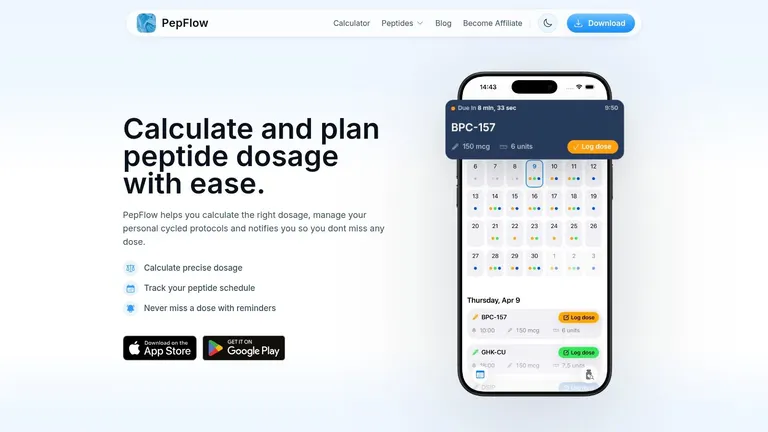
If you’re using a planning tool, PepFlow is one option that organizes cyclical protocols, reminders, and dose calculations in one place without changing the underlying clinical rules. The app can help with scheduling clarity, but it still can’t tell you whether two compounds belong together in the first place.
Tracking Adherence, History, and Symptom Signals
A good schedule is only half the job. Once the cycle starts, the history log becomes more valuable than the original calendar because it shows what happened, not what was supposed to happen. That’s the difference between a clean protocol and a pile of memory fragments.
Record each compound on its own line
Track the same basics every time. Vial identity, reconstitution date, diluent, concentration, storage condition, and beyond-use instruction should all live with the dose record. If you’re stacking, each compound needs its own entry. Otherwise, you lose the ability to see which product caused which change.
PepFlow’s adherence tools are built around reminders, countdowns, log-dose actions, and history tracking, which is exactly the kind of structure that keeps a protocol readable over time (adherence to schedule).
Pay attention to symptom changes, not just missed doses
A dose log is useful, but symptom logs catch the things the schedule can’t explain. Persistent nausea, vomiting, unusual swelling, a rash, shortness of breath, or symptoms that feel sharper after a specific compound are all reasons to stop and speak with a clinician. That caution matters more when the product is investigational or when there’s no solid long-term safety data.
If the log shows a pattern you can’t explain, don’t stack more assumptions on top of it.
A good workflow is simple. Record the dose, record the timing, record how you felt, and share that record with a qualified professional if something changes. Don’t send it to a broad network or a group chat and hope crowd advice replaces clinical judgment.
Safety Boundaries and When a Clinician Must Be Involved
A tracking app can improve consistency. It can’t solve regulatory status, therapeutic justification, or testing risk. Those are separate questions, and they need separate answers.
The three checks never go away
Before any protocol starts, confirm the regulatory status, the anti-doping status, and the evidence tier. Then confirm the units, the syringe type, and the storage instructions for each compound individually. If any one of those pieces is unclear, the stack isn’t ready.
USADA has warned that MOTSc may be marketed by wellness and anti-aging clinics as a weight-loss peptide despite being experimental and not approved for human therapeutic use, which is a good example of why branding doesn’t establish legitimacy (USADA warning context in the 2025 list materials). “Wellness,” “natural,” and “research” are labels, not approvals.
A short decision check
- If you’re tested, re-check the current anti-doping list before starting.
- If the peptide is investigational, don’t assume a human dosing pathway exists.
- If the product is compounded, verify the pharmacy instructions and the measurement format.
- If the compound is research-only, stop and get qualified advice before translating it into a human stack.
One question readers ask often is how often to re-check the WADA list. The practical answer is simple, before a cycle, before a competition season, and whenever the exact substance or brand label changes. Another is whether a research-only peptide can be treated like a wellness product. It can’t, because the label doesn’t create approval or eligibility.
If you’re working with a stack that includes prescription, investigational, or injectable preparations, involve a clinician before the first dose. That’s the boundary that keeps a protocol from becoming a blind experiment.
PepFlow helps you turn a peptide plan into something you can follow, with dose conversion, cycle scheduling, reminders, and history tracking in one place. If you’re building a structured protocol and want the math, timing, and logging to stay organized, visit PepFlow and see how it handles planning without replacing medical judgment.