You’ve got two or three peptide vials on the counter, a spreadsheet full of conflicting forum advice, and no reliable answer to a simple question: which one goes on which day? The problem usually isn’t a lack of motivation. It’s that the proposed stack has no operating system. Different injection frequencies collide, cycle breaks disappear, and every new symptom becomes impossible to trace.
Learning how to stack peptides responsibly means treating the regimen as a structured protocol, not a shopping list. The practical priorities are sequencing, observation, timing, documentation, and medical oversight. A larger stack isn’t automatically a better stack, especially when the available human evidence for many combinations remains limited. Recent medical reviews describe peptide-combination therapy as an emerging field with major challenges in clinical development, safety, and delivery optimization.
Table of Contents
- Why Most Peptide Stacks Fail Before They Start
- Core Rules for Building a Safe Peptide Stack
- Designing Your Cycle Structure and Dose Ranges
- Managing Different Half-Lives and Injection Frequencies
- Real-World Stack Examples for Different Goals
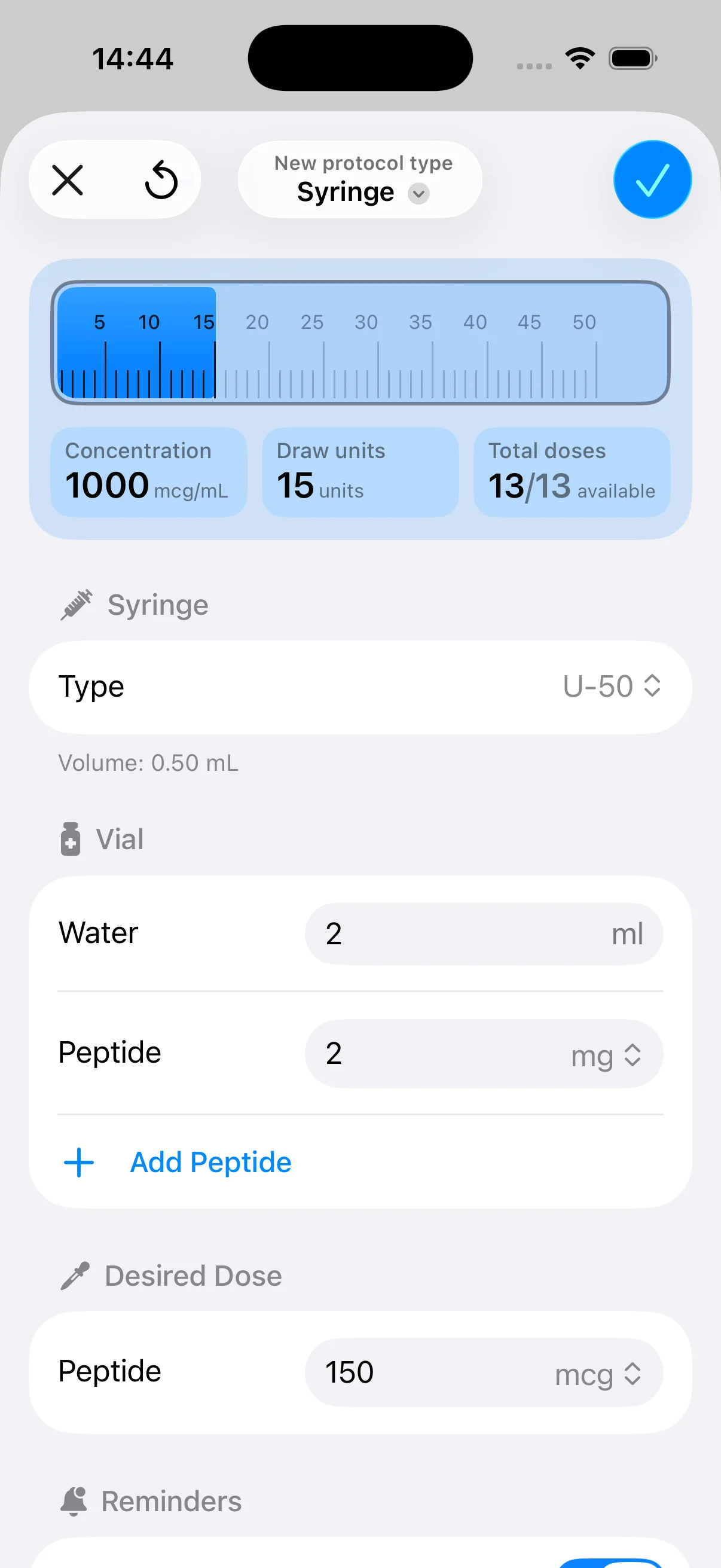
- Using PepFlow to Schedule and Track Your Stack
- Common Stacking Mistakes and When to Simplify
Why Most Peptide Stacks Fail Before They Start
A typical failure starts with an ambitious schedule. Someone begins BPC-157, adds CJC-1295 and Ipamorelin a few days later, then introduces TB-500 after hearing it may support recovery. Injection records become incomplete, workout timing keeps changing, and several new variables enter the protocol before any one response is clear.
Within a short period, headache, disrupted sleep, appetite changes, or an injection-site reaction may appear. The user cannot identify the responsible compound, separate a scheduling problem from a dose response, or decide whether the perceived benefit came from one peptide or the combination. The protocol turns into guesswork.
Stacking is a process, not a pile
Informal experimentation rewards enthusiasm. A workable protocol requires restraint and accurate record-keeping. Effective planning accounts for dose frequency, timing, cycle length, and rest periods. Common clinical protocols are often described as 4–12 weeks on followed by 2–8 weeks off, reflecting limited long-term safety data for indefinite use, as noted in the clinical peptide dosing summary.
The number of vials matters less than whether the schedule can be followed consistently. A plan with daily, alternate-day, and weekly injections may look efficient on paper, yet fail when work, travel, training, or sleep disrupts the routine. Half-lives and cycle overlaps also affect interpretation. A longer-acting peptide can remain active while a shorter-acting compound is being adjusted, making it harder to connect a symptom or benefit to the latest change.
Practical rule: If you cannot explain what each peptide is intended to do, when it is taken, how long it remains active, and what you will monitor, the stack is not ready.
Use a scheduling tool such as PepFlow to map injection days, mark cycle starts and breaks, and record symptoms alongside each change. The tool does not replace clinical oversight, but it can expose missed doses and overlapping adjustments before they distort the protocol.
Choose one primary objective first. Recovery, body composition, and general wellness can overlap, but they do not automatically justify the same compounds. Define a meaningful response before starting, or slow progress will become a reason to add another peptide.
A practical stack fits ordinary workdays, travel days, and training days. More compounds create more variables, not necessarily more value. If the plan only works when life is perfectly organized, simplify it.
Core Rules for Building a Safe Peptide Stack
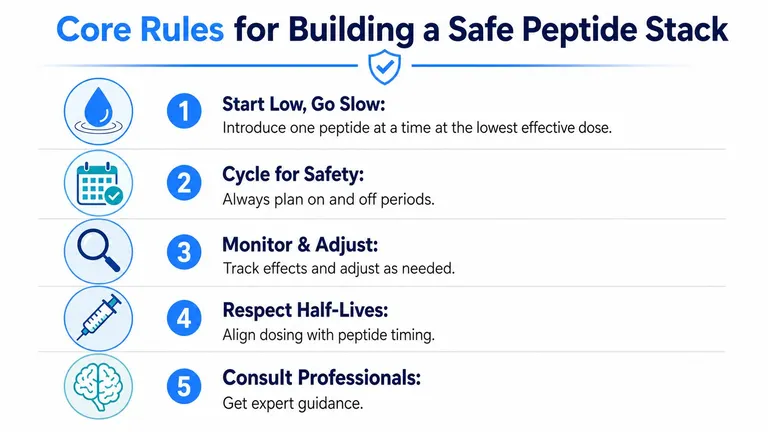
A conservative approach is the safest way to begin stacking peptides. Start with one peptide at a time at the lowest effective dose, then document the protocol before making another change. Record the date, time, amount, route, intended purpose, and immediate symptoms. Pair those notes with baseline and follow-up labs, vitals, body-composition data, and symptom trends where appropriate. Expert guidance also recommends monitoring the initial response for 2–4 weeks before adding a second compound (expert peptide-stacking workflow).
Five rules that protect your signal
-
Document the first variable. The first peptide establishes the reference point for the rest of the stack. Write down the starting schedule, injection site, relevant medications, sleep, training load, and any symptoms that could affect interpretation. A complete record is more useful than relying on memory when later changes overlap.
-
Use an observation window. Avoid adding a compound after only a few days because progress feels slow. A 2–4 week observation period gives you time to review tolerability and trends before changing the protocol. Your clinician may recommend a different interval based on the compound and your health history.
-
Avoid pathway duplication. Compounds that act through overlapping receptor pathways can make both interpretation and risk management harder. Each addition should have a specific purpose, rather than several products targeting the same biological signal.
-
Plan on and off periods. Cycling does not guarantee safety, but it creates a defined point for reassessment when long-term indefinite use lacks strong supporting evidence. Put the rest block in the calendar before the first dose, especially when different cycle lengths may overlap.
-
Track outcomes that don’t depend on mood. Use symptom notes, resting vitals, relevant laboratory monitoring, training performance, sleep quality, and body-composition observations where appropriate. A subjective sense of feeling better can inform the record, but it should not be the only measure.
Scheduling determines whether the plan works in ordinary life. Daily, alternate-day, and weekly injections can collide with work, travel, training, or poor sleep. Use PepFlow to map injection days, mark cycle starts and breaks, and log symptoms beside each change. It can reveal missed doses and overlapping adjustments, but it does not replace clinical oversight.
Medical context matters too. If hormone management is part of the broader plan, discuss it with a qualified clinician instead of assuming peptides address the same needs. Information about testosterone replacement therapy can clarify why prescription hormone treatment requires separate assessment, monitoring, and clinical decisions.
Stop and seek medical advice for concerning symptoms, infection signs, significant changes in glucose-related symptoms, or a severe or unfamiliar reaction. Prescription status, compounding, sourcing, injection technique, and your complete medication history all warrant professional review.
Designing Your Cycle Structure and Dose Ranges
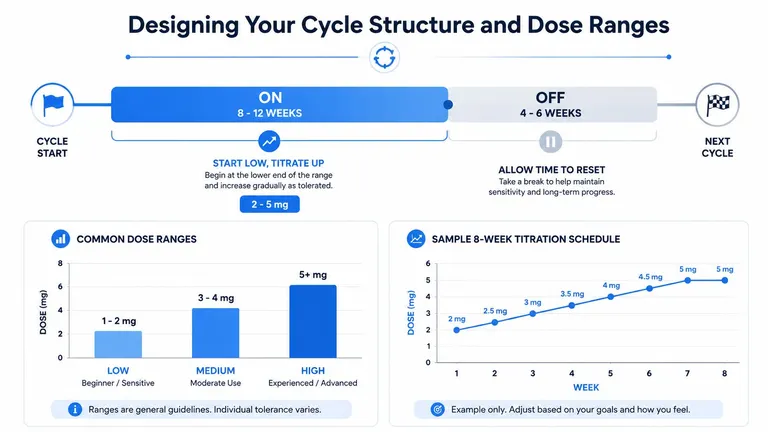
A workable cycle has a review point built in. It gives you time to observe a response while preventing an open-ended protocol from drifting into routine use. One commonly cited framework uses 4–12 weeks on and 2–8 weeks off. Practical guidance also describes blocks of 4–8 weeks on with about 4 weeks off, partly to address desensitization risk (clinical peptide dosing summary).
Treat those ranges as planning boundaries, not prescriptions. A clinician should decide whether a cycle fits your situation, what monitoring belongs around it, and whether the peptide is appropriate. The same applies when a stack includes compounds with different administration schedules. A cycle that looks simple on paper can become difficult to follow once work, travel, training, and missed doses enter the calendar.
Use ranges as guardrails, not targets
The cited framework provides examples of commonly discussed dose ranges:
- BPC-157: 200–500 mcg per dose.
- CJC-1295 and Ipamorelin: 100–300 mcg each.
- TB-500: 2–2.5 mg twice weekly.
These figures are reference points, not instructions for self-prescribing. Keep microgram and milligram amounts clearly separated in your records, and verify concentration and injection volume against pharmacy instructions. A peptide dosage guide can help organize that arithmetic without deciding whether the protocol is medically suitable.
Start with one compound at the lowest clinician-approved dose. Hold the schedule steady long enough to produce a readable response. If a second peptide is appropriate, add it only after the first protocol has shown a clear benefit, a clear problem, or a reason to stop. Changing several doses at once makes side effects and adherence failures difficult to attribute.
Before starting, record four items:
- The start date and intended review date.
- The dose and frequency for every peptide.
- The planned pause or off-cycle period.
- The measurements that will guide continuation, adjustment, or discontinuation.
Enter those dates in PepFlow alongside injection reminders and review points. Seeing the full cycle on one calendar helps expose overlapping changes before they become confusing. It remains a planning and tracking tool, not a substitute for pharmacy instructions or clinician supervision.
Managing Different Half-Lives and Injection Frequencies
A multi-peptide stack can fail in the calendar before it fails in the body. One compound may require frequent administration, another may be scheduled less often, and a third may have timing instructions that conflict with your morning, evening, meals, sleep, or training.
Half-life influences how concentrations change between administrations. Do not estimate that pattern from memory or copy a schedule intended for another formulation. Product instructions, formulation, route, and clinical context all affect the plan. Recent coverage of peptide regimen complexity highlights overlapping timing, changing concentrations, and unintended effects when multiple peptides are used together.
Build the week around real life
Open a blank weekly calendar. Place the least frequent peptide first, then fit more frequent doses around fixed anchors such as waking, bedtime, or a clinician-approved fasting window. If two injections fall on the same day, record them separately unless a qualified professional has confirmed that combining them is appropriate.
Organize the schedule in three layers:
- Fixed doses: injections set for designated days or consistent intervals.
- Timing-sensitive doses: compounds linked to meals, sleep, training, or another physiological window.
- Administrative tasks: reconstitution, vial checks, supply preparation, and dose logging.
A missed administration does not automatically call for a catch-up dose. Follow the prescriber’s instructions, because changing the interval can affect the next scheduled administration and the correct response depends on the compound.
Display the entire week, rather than only the next reminder. That view exposes collisions and shows whether the routine still works during weekends, travel, and recovery days. A schedule that looks tidy on paper but breaks during normal disruptions will not produce reliable tracking.
Add a review point to the calendar. If sleep worsens after a peptide is added, or a symptom appears after a frequency change, record what changed and when before adjusting anything else. Otherwise, another compound may be added to address a problem created by the schedule.
For growth-hormone-related comparisons, this guide to DAC and non-DAC peptides offers a framework for considering duration and timing differences. Keep that comparison separate from individualized medical advice, especially when the product source or formulation is unclear.
Real-World Stack Examples for Different Goals
A useful stack template must show both the intended goal and the work required to follow the schedule. These examples are organizational templates, not personal prescriptions. The dose ranges were covered earlier in the article. A qualified clinician must determine whether a compound, combination, or frequency change is appropriate.
| Goal | Peptides | Dose Range | Cycle Length | Complexity |
|---|---|---|---|---|
| Recovery-focused planning | BPC-157 | 200–500 mcg per dose | Clinician-defined on/off block | Lower |
| Growth-hormone signaling plan | CJC-1295 and Ipamorelin | 100–300 mcg each | Clinician-defined on/off block | Moderate |
| Broader recovery schedule | BPC-157 and TB-500 | BPC-157 at 200–500 mcg per dose, TB-500 at 2–2.5 mg twice weekly | Clinician-defined on/off block | Moderate to high |
The table does not establish efficacy for any goal. It also cannot resolve questions about sourcing, contraindications, interactions, or formulation.
A simpler recovery template
A one-compound recovery plan is easier to audit. You have fewer injection days and fewer possible causes of an adverse response. That makes it easier to compare the protocol with sleep, nutrition, physical therapy, and training changes.
This is usually the more manageable starting point for a beginner. If one peptide already creates missed doses or confusing records, a second peptide adds scheduling burden rather than improving adherence.
A paired signaling template
CJC-1295 and Ipamorelin are often discussed as a paired growth-hormone-related approach. The combination can also create more timing and monitoring work than a single-compound plan. The practical question is whether the clinician has a defined reason for pairing them and whether you can track the relevant response without changing several variables at once.
Different half-lives and injection frequencies can also produce overlapping cycle dates. Map those dates before starting, then check whether meal, sleep, or training timing makes the routine realistic. A theoretical pairing is less useful than a plan you can follow consistently.
A broader recovery template
Adding TB-500 to a BPC-157 plan creates a busier calendar because the earlier dosing framework lists TB-500 at twice-weekly administration. That may suit an experienced user with reliable tracking, but it is harder to interpret and maintain than a single-peptide plan. Keep each compound in a separate schedule so a missed administration does not obscure what happened.
Behavioral support still matters. A structured meal plan for fat loss can make nutrition more consistent, but it does not validate a peptide stack or compensate for poor recovery. For muscle-focused planning, this peptide stack guide for muscle growth can help organize questions for a qualified professional. Use a scheduling tool such as PepFlow to compare injection days, cycle overlaps, and recovery time before adding another compound.
Using PepFlow to Schedule and Track Your Stack
A dosing calculator can prevent arithmetic mistakes, but scheduling is where many protocols break down. PepFlow is designed as an organization tool for configuring vials, concentrations, injection volumes, cycled protocols, start dates, frequencies, pause periods, reminders, countdowns, push notifications, widgets, and dose history. It doesn’t determine whether a peptide is appropriate for you.
Set up the protocol before the first dose
Enter each compound as a separate protocol rather than treating the stack as one blended item. Record the vial information, concentration, intended dose, and schedule exactly as provided by your clinician or pharmacy. Then use the calculator to translate the desired amount into the practical injection volume.
That separation matters. If one peptide uses micrograms and another uses milligrams, individual entries reduce the chance that you’ll transfer the wrong unit or volume from one vial to another.
Next, add the cycle structure. Use the start date, on-period, pause period, and review date supplied by your care team. The app’s countdowns and reminders can show what is due without forcing you to keep a separate spreadsheet.
Log what happened, not just what was planned
Tap the dose log after administration and add a short note when something is unusual. Record missed doses, timing changes, injection-site observations, sleep disruption, or other symptoms that your clinician has asked you to monitor. History tracking gives your follow-up appointment a clearer record than memory alone.
Keep medical decisions outside the app. PepFlow can help you follow a defined routine and reduce manual math, but it can’t assess contraindications, interpret laboratory results, verify product quality, or replace professional advice. If the schedule becomes confusing, pause changes and contact the prescribing clinician rather than improvising.
Common Stacking Mistakes and When to Simplify
The most common mistake is adding several compounds together because the proposed mechanisms sound complementary. That destroys the signal you need to evaluate the stack. Expert guidance specifically warns that multiple new variables can confound both benefits and adverse effects, especially when compounds target overlapping pathways (expert stacking workflow).
Another mistake is assuming that two peptides are compatible because they look clear in the same vial. Peer-reviewed work on a multi-peptide vaccine found that certain single peptides and mixtures remained stable out to 5.5 years post-vialing, using HPLC and mass spectrometry, but that finding supports analytical validation in specific formulations, not casual home mixing (stability and compatibility discussion). Composition, pH, excipients, storage, and preparation conditions can all matter.
Simplify when you’re missing doses, changing timing frequently, adding compounds to chase every new symptom, or unable to identify what caused a reaction. A smaller protocol that you can document and review is often more useful than a complicated one that produces ambiguous results.
Simplification test: If removing one peptide would make the entire protocol impossible to understand, the stack is already too complex.
PepFlow helps turn a clinician-defined peptide regimen into a trackable routine with dose calculations, cycle scheduling, reminders, and history logs. If you’re struggling with missed doses or conflicting injection days, visit PepFlow to organize the schedule before adding another compound.