You can physically mix peptides in the same syringe, but doing so safely requires matching solvent systems, pH windows, and immediate-use timing. Otherwise, the mixture can precipitate, degrade, or lose potency before injection.
The popular forum answer is usually too casual: “They’re both water-soluble, so they’re fine together.” Water solubility only tells you that each peptide can dissolve under a particular set of conditions. It doesn’t prove that the two solutions remain stable after they meet.
That distinction matters whether you’re preparing a research protocol, following a clinician-directed regimen, or evaluating a peptide stack for wellness use. A clear syringe isn’t proof of preserved structure, receptor activity, or potency. The FDA’s peptide-drug guidance treats peptide development as product-specific, requiring detailed pharmacology and characterization, while related regulatory-science work emphasizes thorough characterization when establishing sameness in peptide products (FDA guidance on peptide drug products).
The practical default is conservative: reconstitute peptides separately, store them separately, and only co-draw immediately before use when compatibility has been documented for that exact pair and formulation.
Table of Contents
- Why Mixing Peptides Is Not a Simple Yes or No
- The Chemistry Behind Peptide Compatibility
- A Decision Framework for Combining Peptides
- Same Syringe Versus Separate Injections
- Real Scenarios Where Mixing Succeeds or Fails
- Best Practices for Safe Peptide Scheduling
- Key Takeaways for Your Peptide Protocol
Why Mixing Peptides Is Not a Simple Yes or No
Physically, combining two peptide solutions is easy. Chemically, it can be difficult to know what you’ve created.
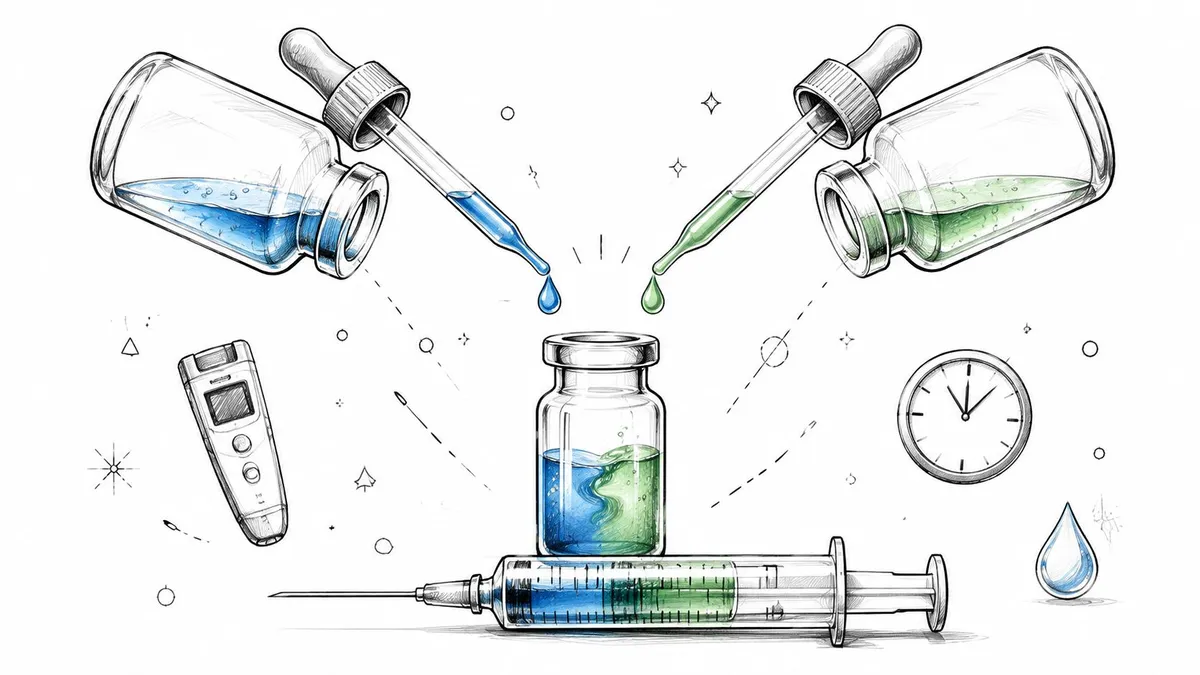
Each reconstituted peptide exists in its own micro-environment. That environment includes a solvent, pH, ionic strength, preservative system, concentration, container surface, and exposure to oxygen. When you draw both solutions into one syringe, you merge those conditions in a narrow space where there’s little opportunity to correct a mismatch.
The common claim that “if it dissolves, it can be mixed” ignores the difference between solubility and compatibility. A peptide can be individually soluble and still become unstable after another peptide solution changes the pH or solvent composition. It may aggregate gradually, adsorb to the container or needle surface, oxidize, or lose functional activity without producing an obvious visual warning.
What the eye can and can’t tell you
A cloudy solution, visible particle, haze, or color change is an immediate reason not to inject. These signs suggest precipitation, aggregation, or chemical degradation. A clear solution, however, only passes a basic visual check. It doesn’t establish that the molecular structure remains intact through the intended use window.
The FDA’s framework is relevant here because it rejects casual assumptions about peptide sameness and behavior. Compatibility needs to be established for the specific ingredients, concentration, pH, solvent, and container system, not inferred from the fact that two products look similar or dissolve separately.
Practical rule: Treat visual clarity as a minimum screen, not a stability study.
The preparation guides collected in practical peptide-handling resources also tend to favor separate reconstitution, slow addition of diluent, and gentle handling unless a standard operating procedure specifically supports combining the products (practical guidance on mixing peptides). That approach isn’t about being overly cautious. It recognizes that the interaction begins as soon as the solutions meet.
Convenience creates a single point of failure
One injection may seem simpler, but a co-draw ties both compounds to the least stable component. If one peptide precipitates or degrades, the entire syringe becomes unusable. Separate administration preserves independent control over dose, timing, route, and storage.
This is why the right question isn’t, “Can you mix peptides together?” It’s, “Do these specific formulations remain chemically and physically acceptable until the moment of administration?”
The Chemistry Behind Peptide Compatibility
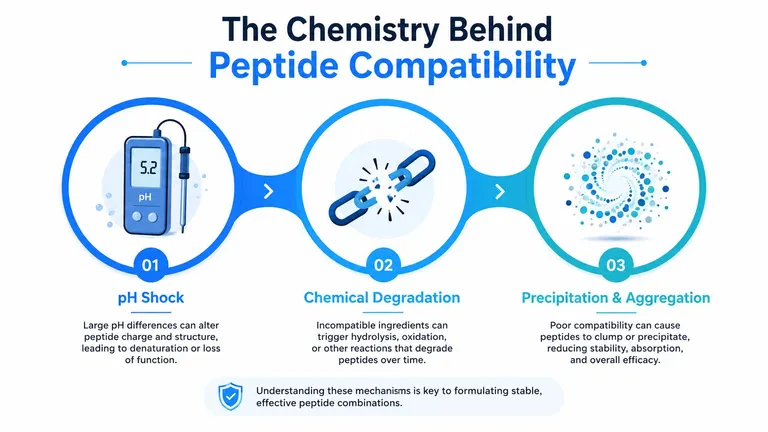
Three mechanisms cause most practical compatibility failures: pH shock, solvent mismatch, and chemical degradation. They can act independently, or they can reinforce one another.
pH shock changes the solubility environment
A peptide’s charge depends partly on the pH around it. Its solubility also changes across that pH range, with the isoelectric point often representing a zone where net charge is reduced and aggregation can become more likely.
If one peptide is reconstituted in an acidic carrier and another is in a near-neutral solution, the first contact creates a local pH gradient. That gradient can temporarily push sensitive molecules outside their preferred solubility window. The result may be immediate cloudiness, delayed particle formation, or a less obvious loss of structural integrity.
The problem isn’t limited to the final average pH. Local pH shock occurs at the mixing interface before the solutions fully equilibrate, so a mixture can experience a chemically hostile transition even when its eventual pH appears acceptable.
Solvent mismatch affects folding and aggregation
Bacteriostatic water, acidic carriers, buffered solutions, and other diluents aren’t interchangeable. Preservatives, co-solvents, ionic strength, and buffer components can alter peptide interactions and change how molecules behave at surfaces.
That’s why a guide to peptide reconstitution solutions should be treated as a starting point for handling, not as proof that separately soluble products can share one syringe. Each peptide’s preparation instructions remain controlling.
A practical formulation review should ask:
- What solvent was used? The two solutions need a compatible carrier system, or documented stability across the resulting blend.
- What is the pH window? Matching or overlapping stability ranges matter more than the appearance of the powder or solution.
- What happens at the intended concentration? Higher combined concentration can increase molecular collisions and promote aggregation.
- How long will the mixture sit? Immediate use is a different problem from storage.
Oxidation can reduce function without obvious precipitation
Peptide sequences can contain residues and structural features that are sensitive to oxidation. When two formulations share air-liquid interfaces, container surfaces, or reactive chemical conditions, degradation pathways may accelerate. A mixture can remain clear while losing functional quality.
Formulation science therefore looks beyond appearance to assays for purity, aggregation, potency, and degradation products. Public users rarely have those tests available, which is another reason individual stability data shouldn’t automatically be transferred to an unvalidated mixture.
For broader context on peptide therapy and the difference between a clinical product and an improvised preparation, ProMD Health Tysons Corner on peptide therapy provides a useful patient-facing overview. It shouldn’t be read as compatibility validation for any specific combination.
A Decision Framework for Combining Peptides
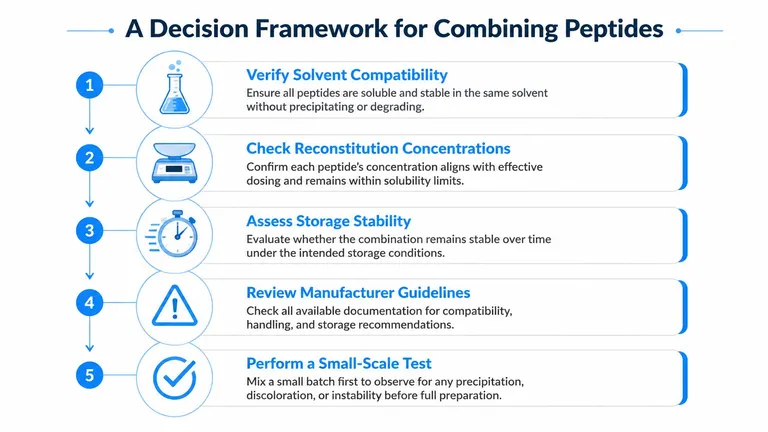
A defensible co-draw decision is a go or no-go assessment, not a popularity contest. If one critical variable is unknown, separate administration is the safer conclusion.
Start with the formulation, not the peptide name
First, verify the solvent system. Identify the diluent used for each vial and whether the final blend has documented compatibility. Don’t assume that bacteriostatic water and an acidic carrier can be combined because both solutions are individually clear.
Next, compare pH requirements. Look for overlapping pH stability windows and consider each peptide’s charge behavior around the proposed mixture pH. If one product requires a distinctly acidic environment and the other is prepared near neutral, that’s a strong reason to keep them separate.
Examine the molecular and operational risks
Review oxidation sensitivity. The sequence composition matters, particularly where oxidation-sensitive residues or metal-related chemistry may be involved. Without formulation data, you won’t be able to predict the precise degradation rate, so uncertainty should push the decision toward separate injections.
Check the combined concentration. Concentration changes the frequency of molecular contact and can affect aggregation, adsorption, and viscosity. Two individually acceptable concentrations may behave differently after they’re combined.
Check timing as part of compatibility. Compatibility for immediate use does not establish that a mixture can be stored. The exact formulation, concentration, and intended storage period need their own validation; individual product stability data cannot fill that gap.
Use this final screen:
- Proceed only when solvent, pH, route, concentration, and timing are aligned.
- Keep separate when any solvent requirement conflicts or remains unknown.
- Discard the mixture when it becomes cloudy, develops particles, changes color, or behaves differently during preparation.
- Never treat individual stability data as mixture validation.
A small-scale visual check can identify an obvious failure, but it cannot prove potency or sterility. Professional validation requires analytical evidence, not just a successful-looking draw.
Same Syringe Versus Separate Injections
The trade-off is straightforward. A same-syringe co-draw may reduce handling and injection fatigue, while separate injections preserve more control over formulation, dosing, and observation.
Co-drawing also creates immediate interaction time. The solutions meet in the syringe, pass through a narrow needle, and experience movement during injection. Even when the interaction lasts only briefly, that exposure doesn’t occur when the peptides remain in separate syringes.
| Dimension | Same Syringe, Co-Draw | Separate Injections |
|---|---|---|
| Molecular stability | Depends on matched solvent, pH, route, concentration, and immediate use | Each peptide remains in its intended formulation until administration |
| Convenience | One preparation and one injection | More handling and potentially more than one injection |
| Dose control | A single mixture can obscure which component caused a problem | Each dose can be adjusted and observed independently |
| Failure consequence | One incompatible component can compromise the full syringe | A problem with one peptide doesn’t automatically affect the other |
| Storage | Pre-mixed storage is generally unsupported without exact compatibility data | Separate storage follows each product’s preparation requirements |
| Troubleshooting | Harder to identify the cause of a reaction or visual change | Easier to isolate formulation or dosing variables |
The guide to taking supplements together illustrates a broader principle that applies here: combining products requires attention to how the ingredients interact, not just whether taking them at the same time is convenient. Peptides demand even more formulation-specific caution because their behavior can change with pH, solvent, concentration, and storage conditions.
Separate injections are less elegant, but they’re often more informative. You preserve the ability to identify what worked, what failed, and what caused a reaction.
Use a co-draw only when the pair has a credible compatibility basis and both products share the same route and timing. Keep injections separate when the solvents differ, the pH requirements conflict, the mixture will sit before use, or either product has unclear handling requirements. If you’re learning the preparation process, separate administration also gives you a cleaner baseline.
For technique, follow a dedicated guide to mixing peptides with bacteriostatic water and the instructions supplied by the prescribing clinician or compounding pharmacy. Convenience should never outrank formulation evidence.
Real Scenarios Where Mixing Succeeds or Fails
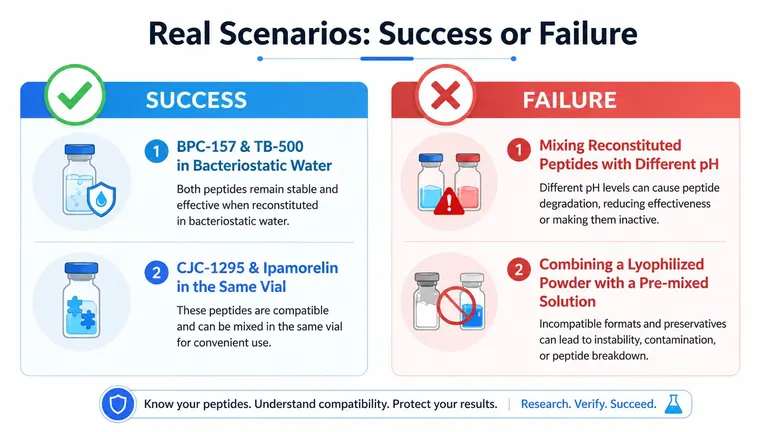
A useful scenario must distinguish between co-drawing immediately before use and pre-mixing for storage. Those are not equivalent procedures, even when the same two peptide names appear on the labels.
A potentially workable situation involves two peptides prepared separately in the same compatible solvent system, with overlapping pH requirements, the same route, and immediate administration. The syringe remains clear, no particles appear, and the mixture isn’t stored for later use. Even then, the absence of visible change is only a basic screen, not proof of preserved potency.
A failure scenario is easier to recognize. An acidic peptide solution meets a neutral formulation, and the syringe develops haze or fine particles. A color shift, unexpected injection discomfort, or a new reaction adds to the concern. The correct response is not to shake the syringe, wait for the cloudiness to settle, or inject a smaller amount. Do not inject a visibly changed mixture.
Why familiar stacks still need narrow conditions
Users often discuss combinations such as BPC-157 with TB-500, or CJC-1295 with Ipamorelin, as if the names alone establish compatibility. They don’t. A pairing may be used under a particular solvent system and immediate-use protocol, yet become unsuitable when someone changes the diluent, concentration, container, or storage plan.
The more serious failure occurs when a co-draw becomes a shared vial. Adding one reconstituted product to another introduces additional contamination and stability concerns, and it removes the ability to track each peptide independently. The FDA’s product-specific approach is important here because it reinforces that compatibility belongs to the exact formulation, not the category label.
Engineered combination products and improvised wellness stacks are different preparations. Dose ratios, chemistry, manufacturing, and testing are part of developing a combination product. Putting separate products into one syringe does not establish the same evidence for that mixture.
Treat cloudiness, particles, color changes, and unusual injection-site responses as stop signals. Don’t try to rescue a failed mixture by adding more diluent or changing the injection time.
Best Practices for Safe Peptide Scheduling
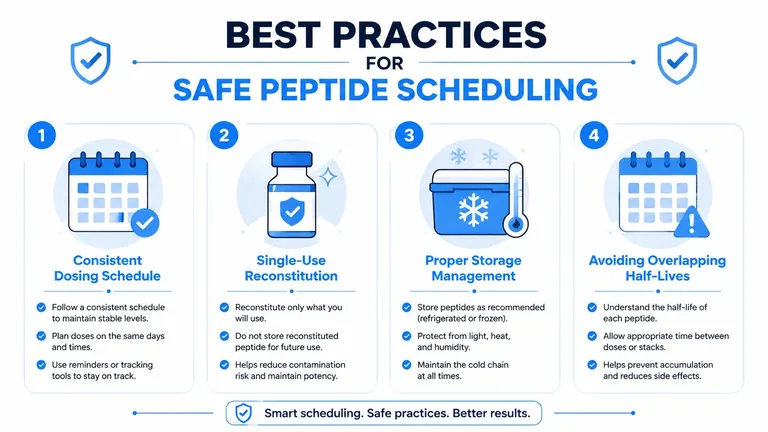
Safe scheduling starts with a separation rule: prepare each peptide independently, then decide whether administration can be combined. Use the specified diluent, label every vial, and treat a same-syringe draw as an exception requiring evidence for the exact products. Compatibility can fail after a pH shock, solvent mismatch, or exposure to oxidation-prone surfaces, even when both solutions look clear.
Build a routine that reduces variables
A short preparation log makes troubleshooting possible. Record:
- Reconstitution details: Write down the date, diluent, concentration, and vial identifier.
- Appearance: Note whether the solution is clear and document any later change.
- Administration timing: Record preparation and use times.
- Response: Track injection-site reactions or other changes without assigning a cause too quickly.
- Protocol changes: Change one variable at a time, so the result remains interpretable.
Schedule peptides in separate administration windows when their solvent or pH requirements do not overlap. Follow the prescribing clinician’s instructions, especially when the compounds affect related physiological pathways or other medicines are involved. Separate timing limits solvent contact and leaves each preparation easier to assess.
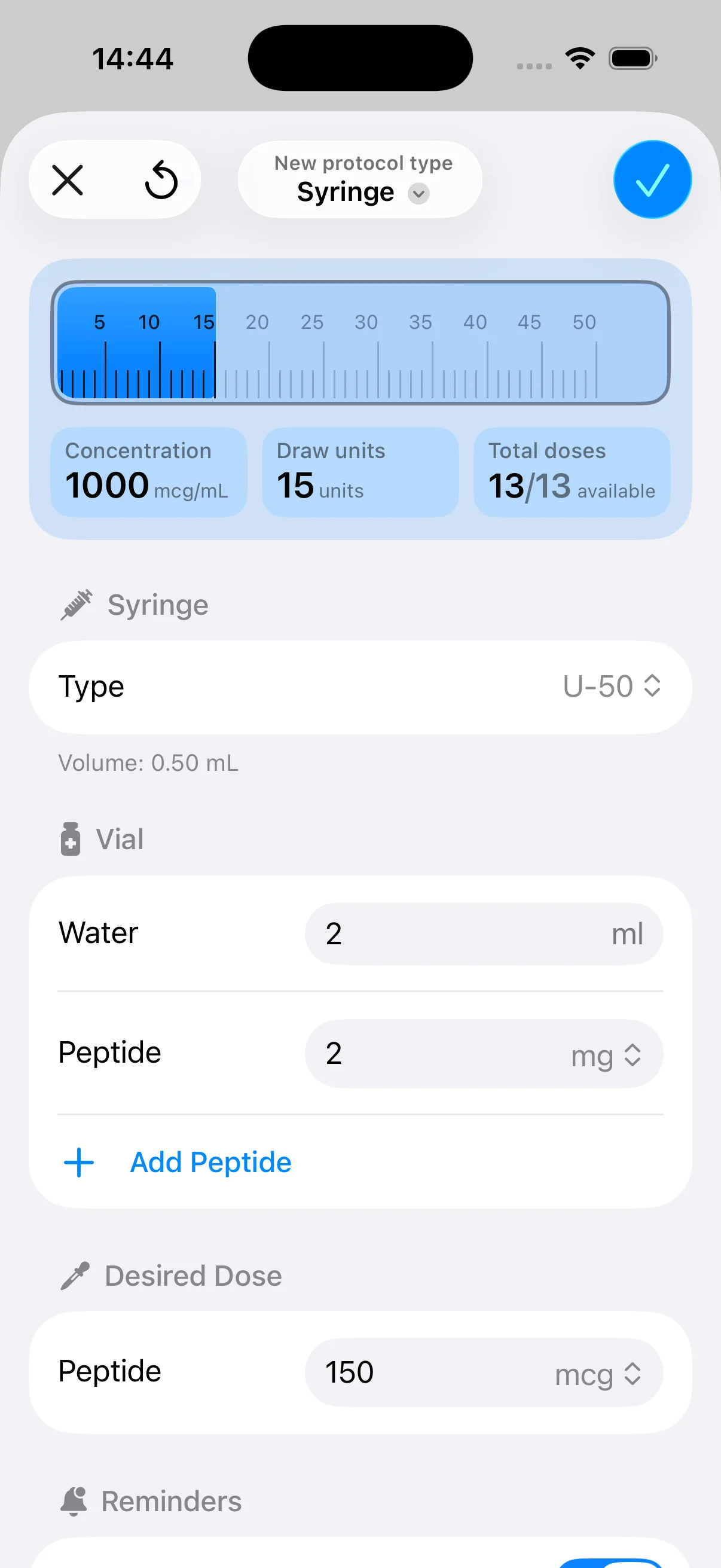
A scheduling tool like PepFlow for managing peptide protocols and reconstitution details can organize separate protocols, reminders, dose history, and preparation records. It can assist with planning and arithmetic, but it cannot confirm chemical compatibility or replace professional preparation instructions.
Storage requires restraint
Do not combine products into one vial for convenience unless a qualified formulation professional has verified the exact pair, concentration, container, and storage conditions. An unvalidated mixture may aggregate, oxidize, or adsorb to the container, and storage can introduce another variable rather than solve the first one.
Use aseptic technique, limit agitation, and do not treat refrigeration as a compatibility fix. Cold storage may slow some degradation, but it does not correct mismatched chemistry.
Escalation rule: If a mixed solution changes in appearance, discard it and return to separate administration.
Before adding a peptide to an established routine, use the single-peptide protocol as your baseline. This helps distinguish a preparation problem from a dose issue, administration-route issue, or individual response. It also preserves a clear record when a new combination produces an unexpected result.
Key Takeaways for Your Peptide Protocol
The safest answer to “can you mix peptides together” is conditional. You can co-draw some peptide solutions, but only when the exact formulations are compatible and the mixture is used immediately.
Three checks carry the most weight:
- Solvent compatibility: The diluents must be compatible, or the final blend must have documented stability.
- Overlapping pH tolerance: A peptide’s preferred pH environment must not conflict with the other solution.
- Immediate-use timing: A short co-draw window is different from storing a combined syringe or vial.
Separate reconstitution is the baseline. It protects independent dosing, preserves each product’s intended environment, and limits the consequences if one peptide fails. A clear mixture can still have unmeasured degradation, so visual inspection should never be mistaken for a potency test.
Precipitation, cloudiness, particles, and color changes are not minor inconveniences. They’re reasons to discard the preparation. If a combination produces unusual injection-site discomfort or an unexpected response, stop using that mixture and consult a qualified clinician or pharmacist.
Keep a protocol log with the peptide names, diluents, concentrations, preparation dates, appearance, timing, and outcome. Over time, that record can help you identify repeatable handling problems, but it still won’t replace validated compatibility data.
Stacking is a formulation decision, not a shortcut. When the chemistry is uncertain, two separate injections are usually the more defensible option.
Use PepFlow to organize separate peptide protocols, calculate reconstituted concentrations and syringe measurements, and track preparation and dose timing. Visit PepFlow before your next protocol change so your schedule and records stay as disciplined as your compatibility decisions.