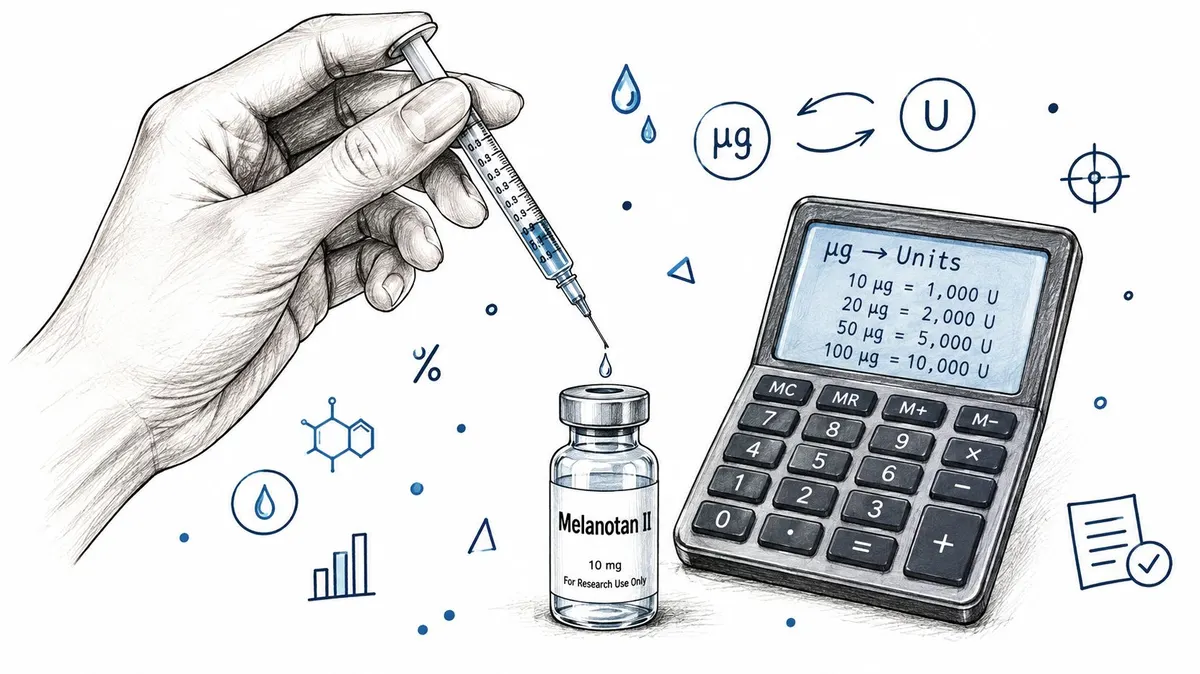
The melanotan 2 dosage calculator converts your desired microgram dose into injection volume by dividing by the vial concentration, but there is no universally approved standard dose, so any calculated number should be treated as arithmetic support rather than medical advice. That matters because the wrong draw volume can happen fast when you’re staring at a reconstituted vial, a tiny syringe scale, and a protocol that may not fit the evidence in the first place.
You can do the math cleanly and still be wrong about the bigger question. A target dose only makes sense if it matches the limited human research, the route you’re using, and the risk you’re willing to accept.
Table of Contents
- Why the Melanotan 2 Dosage Calculator Matters
- Understanding Concentration and Unit Basics
- How to Calculate Your Injection Volume Step by Step
- Common Vial and Concentration Scenarios Explained
- Safety, Storage, and What Dosing Guidance Actually Says
- Using a Dosage Calculator App Like PepFlow
Why the Melanotan 2 Dosage Calculator Matters
A lot of people reach for a melanotan 2 dosage calculator the moment the vial is mixed and the syringe is in hand. The immediate problem looks simple, convert a target dose into a measurable volume, but that tiny arithmetic step is where manual errors usually start.
The practical value is consistency. If you know the target mass dose and the concentration after reconstitution, you can draw the same amount every time instead of guessing between markings. That becomes even more important when a protocol is being repeated, because a small mismatch in volume changes the actual dose you take.
Practical rule: if you can’t explain the dose in milligrams, micrograms, and syringe units without pausing, don’t inject yet.
The deeper issue is that a calculator can only translate numbers, it can’t validate the plan. Melanotan II has limited human dosing evidence, and the source material behind most calculator-style content is still built around research protocols rather than a universally accepted modern regimen. So the tool helps you avoid a math mistake, but it doesn’t tell you whether the protocol is a good idea for your purpose.
A useful guide should do both. It should show you how to convert the dose accurately and also keep the research context visible enough that you don’t mistake convenience for safety.
Understanding Concentration and Unit Basics
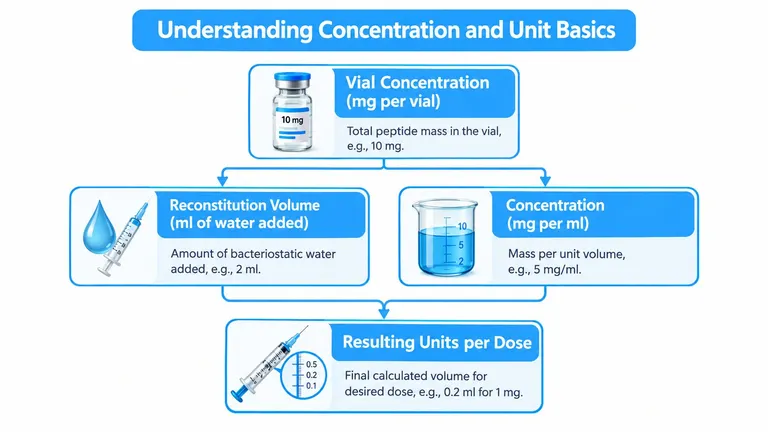
The first thing to get straight is that mass and volume are not the same thing. Milligrams and micrograms tell you how much peptide is in the vial, while milliliters and syringe units tell you how much liquid you draw.
A reconstituted vial only becomes usable once you know its concentration, which is the amount of peptide per milliliter after you add diluent. If you start with a 10 mg vial and add more or less bacteriostatic water, the concentration changes, and so does the volume needed for each dose. That’s why the same target dose can look tiny in one setup and much larger in another.
The body-weight based research matters here too. The early phase I work at the University of Arizona escalated subcutaneous doses from 0.01 mg/kg to 0.03 mg/kg over a two-week schedule of five injections per week, and the study identified 0.025 mg/kg/day as the recommended single dose for further phase I work after a Grade II somnolence event at 0.03 mg/kg in one of two subjects at that level (Bergdorf Bio guide). That’s a reminder that weight-based calculation wasn’t an afterthought in the original work, it was the core safety logic.
For people trying to understand peptide math more broadly, the mechanics are similar to the way how peptides work in skincare are often explained, where the active ingredient’s concentration matters as much as the ingredient name. The difference here is that the injection volume has to be exact enough to trust, not just approximate.
If you want a simple conversion reference, the internal guide at convert mcg to units is useful because it keeps the arithmetic tied to syringe markings instead of abstract dose language.
How to Calculate Your Injection Volume Step by Step
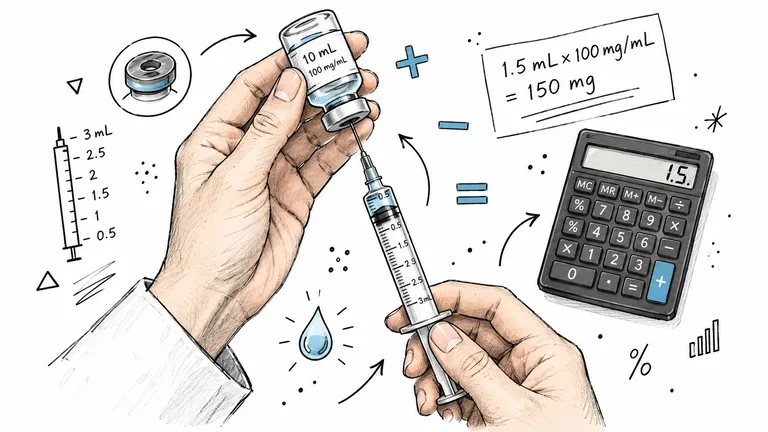
Start with the dose you want to measure. Then convert that target into the concentration of the reconstituted vial, and divide the dose by that concentration to get the injection volume.
A simple way to think about it is this, desired dose ÷ concentration = volume to draw. If the vial is stronger because you used less diluent, the draw volume gets smaller. If the vial is weaker because you used more diluent, the draw volume gets larger.
A few concrete examples
If you have a 10 mg vial and reconstitute it with 1 mL, the concentration is high, so a 250 mcg draw becomes a very small volume. If the same 10 mg vial is reconstituted with 2 mL, the draw volume doubles for the same dose. With 3 mL, it grows again, which is exactly why the reconstitution choice matters before you ever touch the syringe.
The same logic is why independent protocols vary by use case. Published erectile dysfunction protocols used 0.025 mg/kg subcutaneously, which for a 70 to 80 kg adult translates to roughly 1.5 to 2.0 mg per dose (PeptideNerds dosage page). That doesn’t create a universal standard, it shows that dose selection has been tied to indication and body weight, not to a one-size-fits-all community number.
A calculator is only useful after the vial concentration is known. Before that, it’s just a number generator.
The part people skip is rounding. Tiny differences matter when you’re working with a peptide in a concentrated solution, because a casual “close enough” draw can shift the actual delivered amount. If the syringe markings are hard to read, recheck the concentration instead of forcing the math to fit the plunger.
Common Vial and Concentration Scenarios Explained
The same target dose behaves differently depending on how you reconstitute the vial. That’s why a melanotan 2 dosage calculator should always be read alongside the dilution plan, not after it.
Here’s the practical comparison most users need.
| Target Dose | 1 mL Reconstitution | 2 mL Reconstitution | 3 mL Reconstitution |
|---|---|---|---|
| 250 mcg | Smaller draw volume | Medium draw volume | Larger draw volume |
| 0.25 mg | Smaller draw volume | Medium draw volume | Larger draw volume |
| 0.5 mg | Smaller draw volume | Medium draw volume | Larger draw volume |
The table is intentionally simple because the trade-off is simple, too. Less diluent gives you a more concentrated solution, which means a smaller injection volume. More diluent spreads the same total peptide across more liquid, which can make tiny doses easier to read on the syringe.
Independent dosing references usually frame Melanotan II in a two-phase pattern, with about 0.25 mg subcutaneously once daily as a low loading dose, then 0.5 mg daily if tolerated, followed by 0.5 mg once or twice weekly for maintenance (Peptides.org dosage page). That guidance also notes that the exact injection volume depends on vial concentration and dilution math, and that there is no FDA-approved or validated human dose-finding protocol.
The takeaway is simple, and it matters in practice. If you want easier-to-read syringe pulls for smaller doses, choose a reconstitution that gives you a less compressed scale. If you want fewer milliliters to inject, accept that the markings will be tighter and demand more care.
Safety, Storage, and What Dosing Guidance Actually Says
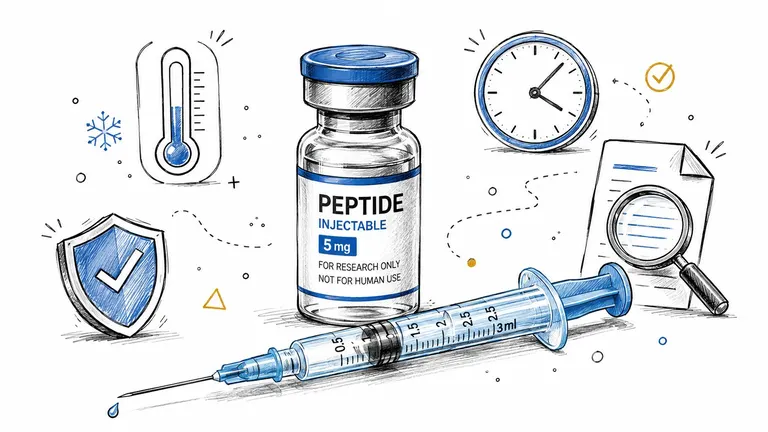
A clean calculation does not make a risky plan safe. Before you trust the number on the syringe, ask whether the dose makes sense for the use you intend.
The published references do not point to one settled human protocol. Peptides.org describes tanning research at about 0.01 mg/kg daily for up to two weeks, while erectile-dysfunction research used about 0.025 mg/kg per dose repeated four times at 48-hour intervals (Peptides.org overview). That gap is exactly why a calculator can mislead if it is detached from the original study context.
Skin monitoring deserves the same attention as the math. Safety-focused reporting has described abnormal mole darkening, changing nevus morphology, priapism, and other serious adverse events linked to Melanotan II, and it notes that Australia reclassified it as Schedule 9 in February 2026 and warned it is not approved for tanning use (ABC News coverage). If a mole changes shape or color, treat that as a stop-and-review moment.
Storage is more forgiving than dosing, but only if you stay disciplined. The guide on peptide storage best practices is useful here, because temperature, handling, and reconstitution hygiene all affect whether the material stays usable. Once mixed, refrigerate the vial and avoid repeated warming and cooling.
A practical stop rule helps more than a vague comfort level. If the skin response looks unusual, side effects are getting worse, or the legal status in your region has changed, pause and reassess before you keep dosing.
Using a Dosage Calculator App Like PepFlow
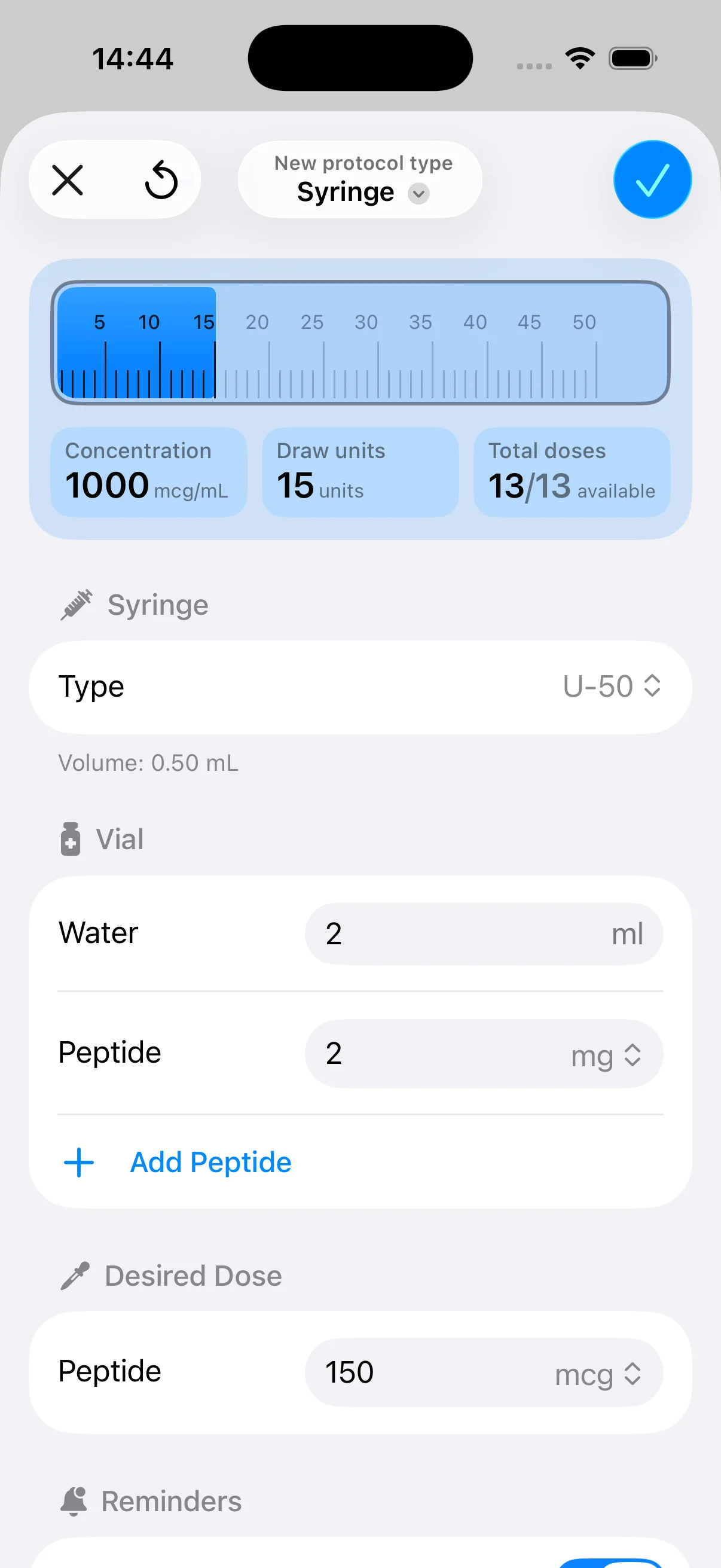
If you are juggling more than one vial, more than one schedule, or a dose you need to repeat consistently, manual math gets brittle fast. An app-based calculator keeps the arithmetic and timing in one place, which reduces the chance of mixing up concentration, volume, or the next dose.
The workflow is simple. Enter the vial amount, the diluent volume, and your target dose, then the app converts that into syringe units and concentration math. PepFlow also supports cycled protocols with start dates, dosing frequency, and pause periods, so you can reuse the same setup instead of rebuilding it after every refill.
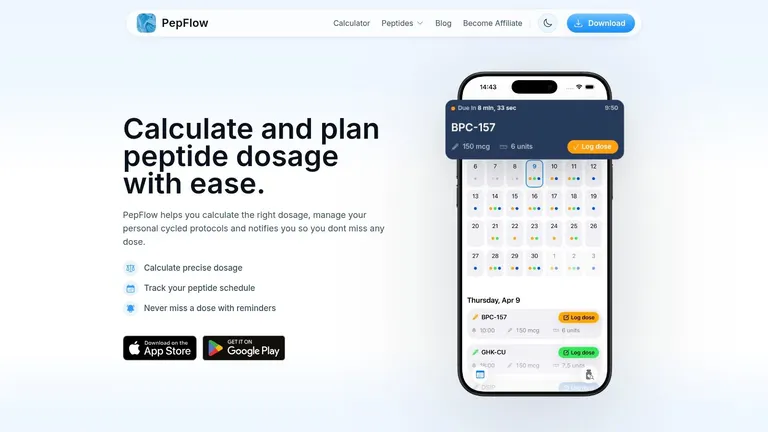
The practical benefit is not just fewer taps. Push notifications, live activities, widgets, and quick log-dose actions help keep the schedule visible when you are busy, which is often where protocol mistakes happen. History tracking also keeps your past entries in one place, so you are not relying on memory.
Keep this boundary clear: an app can organize a protocol, but it cannot tell you whether that protocol is clinically appropriate for your goal.
The internal overview on peptide calculator app fits here because it focuses on the same planning problem, turning peptide math into repeatable actions. That is the right role for software. It removes arithmetic friction while leaving the judgment call with you.
If you want to automate the conversion step and keep your dosing log in one place, use PepFlow to map vial concentration, syringe units, and scheduled dosing without starting from scratch each time.