You’ve got the vial, the syringe, and a dose range that looks simple on paper. Then you sit down to do the math and the whole thing gets less simple fast, because IGF-1 LR3 dosing is where tiny microgram differences turn into real volume mistakes, schedule drift, and avoidable risk. The practical challenge isn’t theory, it’s turning a research peptide into a precise protocol without guessing.
Table of Contents
- From Powder to Protocol An Introduction
- Interpreting Common IGF-1 LR3 Dose Ranges
- The Critical Math of Reconstitution and Volume
- Designing Your Dosing Schedule and Cycle
- Safety First Logging Doses and Monitoring Response
- Essential IGF-1 LR3 Dosing Questions Answered
From Powder to Protocol An Introduction
The first mistake usually happens before the first injection. A user reconstitutes a vial, stares at the syringe markings, and realizes that micrograms, milliliters, and insulin units don’t line up intuitively. That’s where most generic charts fail, because they list a range but skip the mechanics that make the range usable.
IGF-1 LR3 is treated in available dosing references as an investigational peptide, not a compound with a validated human dose-response standard, so practical guidance has to be handled like protocol work, not like a casual supplement choice. The safest way to think about it is simple. Pick a dose range, define the cycle length, calculate the exact volume, and log every dose so you can verify what transpired.
Practical rule: if you can’t convert the target dose into a syringe volume confidently, you’re not ready to administer it.
That’s why the bench-top process matters. The vial size, diluent volume, timing, and schedule all interact. One wrong assumption about concentration can turn a sensible protocol into an underdose, an overdose, or a schedule that’s impossible to repeat consistently.
The rest of this guide keeps the logic practical. It translates the commonly discussed microgram ranges into real protocol decisions, then shows the math and safety checks that reduce human error. For readers who want a broader dosing framework alongside the calculations, the peptide dosage guide gives a useful comparison point, but the core here is precision, not theory.
Interpreting Common IGF-1 LR3 Dose Ranges
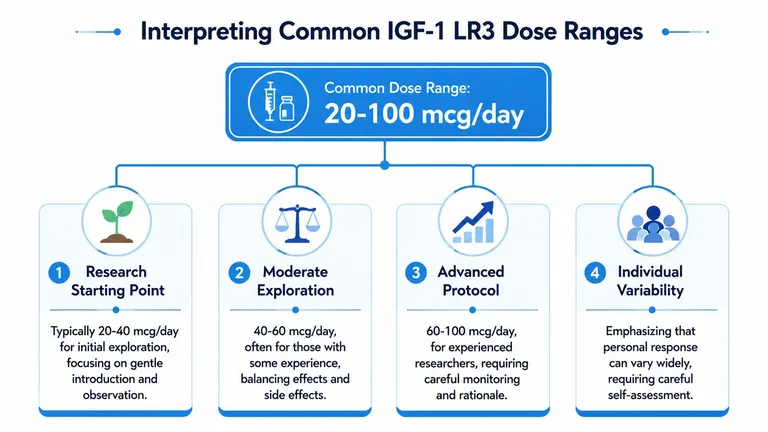
A vial on the bench does not care about the chart label. The pertinent question is whether the stated IGF-1 LR3 dose range can be translated into a repeatable syringe volume without guessing. Common references place the practical range at 20–100 mcg per day, with the middle of that spread usually sitting around 40–60 mcg daily. That range reflects three different use cases, a cautious start, a working protocol, and the higher end of research-oriented use realpeptides.co.
Reading the range as a decision tree
A lower starting point makes sense when the goal is to check tolerance and keep the protocol under tight control. One guide describes 20–40 mcg every other day as a conservative start for 4 weeks, then 50–80 mcg daily or every other day as an intermediate range for 4–6 weeks, with 100–120 mcg daily placed in the upper research range for a maximum of 6 weeks realpeptides.co. The logic is straightforward, begin with less exposure, watch the response, then move only if the dose and schedule still make sense.
For bench-top planning, that matters more than the headline number. Two users can both say they are taking the same microgram dose, yet one is working from a clean dilution and the other is relying on a rough estimate. That difference changes how defensible the protocol is. For readers who want a broader dosing framework alongside the calculations, the peptide dosage guide gives a useful comparison point, but the practical value here is in matching the target dose to a volume you can measure consistently.
What pushes a protocol lower or higher
Lower doses are usually chosen when glucose stability matters, when someone is new to the compound, or when the aim is to observe response without creating a strong systemic push. The higher end is more often discussed when the user already knows how they respond and can handle the added trade-offs that come with stronger growth-pathway signaling.
A clean way to sort the range is simple.
- Lower range use: better for first-pass tolerance checks, smaller adjustments, and conservative pacing.
- Middle range use: better when the goal is a steadier working dose and the user already understands the glucose-management burden.
- Upper range use: reserved for experienced protocol planning, closer monitoring, and a clear reason for increased exposure.
A range is a boundary, not a target. The useful question is not which number sounds strongest, but which dose can be measured cleanly, repeated accurately, and tracked safely. That is where tools like PepFlow matter, because the app removes the manual errors that turn a reasonable microgram target into a bad syringe reading or an inconsistent schedule.
The Critical Math of Reconstitution and Volume
A protocol can look correct on paper and still go wrong at the bench if the reconstitution math is off. With IGF-1 LR3 dosing, the primary risk is not just choosing a microgram target, it is turning that target into a liquid volume that can be drawn consistently and read without guesswork.
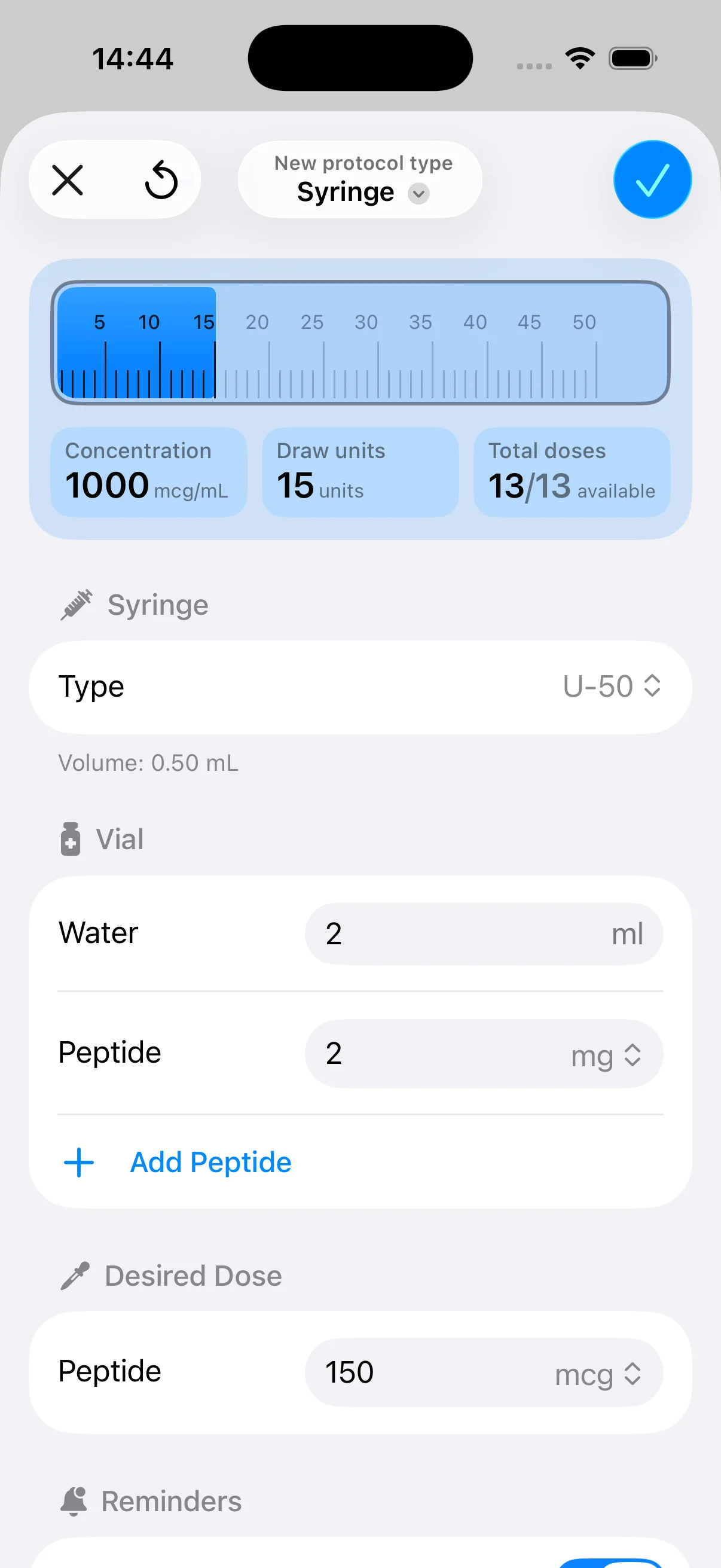
Start with the vial, not the syringe. A 1 mg vial contains 1000 mcg total peptide. If you add 2 mL of bacteriostatic water, the final concentration is 500 mcg per mL. At that strength, each 0.1 mL draw contains 50 mcg. That conversion is the working protocol in practical form.
Converting dose to syringe units
Once the concentration is set, the syringe reading becomes a simple translation. On a standard insulin syringe, 1 mL = 100 units, so 0.1 mL = 10 units. If 0.1 mL holds 50 mcg, then a 50 mcg dose is 10 units on that syringe.
Smaller draws follow the same pattern. If 0.04 mL is required for 20 mcg, that equals 4 units. The syringe measures liquid, not peptide content, so the protocol has to convert the intended dose into the correct volume before anything is drawn.
The errors here are predictable. People confuse total vial content with concentration, ignore the effect of diluent volume on final strength, or misread the barrel under poor lighting. A calculator that converts mcg to units removes that manual step, and the mcg-to-units conversion guide is useful because it keeps the arithmetic explicit instead of asking anyone to do it in their head.
The same logic is easier to handle inside a tool like PepFlow, because it reduces the chance that a correct dose becomes the wrong syringe reading.
Why timing matters less than consistency
Experienced summaries note that IGF-1 LR3 has an approximately 20-hour half-life, so the exact minute you place it around training matters less than keeping the timing consistent from day to day. That does not make timing irrelevant. It means a repeatable daily pattern usually matters more than trying to hit a narrow window.
The same source also points to the main safety concern, pairing the dose with a large carbohydrate or insulin load, which raises hypoglycemia risk. The thepeptidetoolkit.com summary is useful here because it links the half-life and the glucose risk in the same practical frame. A correct volume drawn at the wrong time can still create a bad outcome.
The safest standard is straightforward. Confirm vial strength, confirm diluent volume, confirm concentration, then confirm the draw volume before the syringe leaves the prep area. If any step is unclear, recalculate before proceeding. For readers who want a broader food-side comparison while thinking through the dosing math, you can find your ideal bulking meal plan as a separate planning reference.
Designing Your Dosing Schedule and Cycle
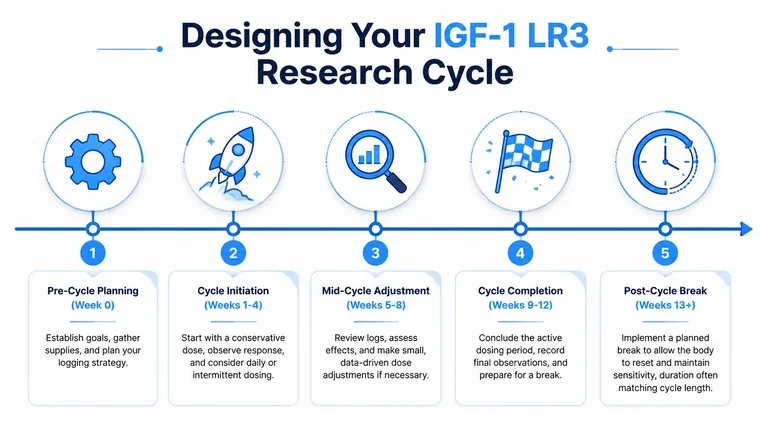
A dose only works inside a schedule, and IGF-1 LR3 is usually treated that way because repeated exposure can reduce responsiveness over time. That makes the cycle part of the protocol, not an afterthought. Practical references commonly describe 4–6 weeks on followed by an equal off-cycle, and some advise 4–6 weeks off to reduce receptor desensitization and preserve responsiveness peptidesinstitute.org.
Why cycling is part of the safety logic
The off-period is not just a pause. It helps limit the drop in response that can show up when the same signal is pushed continuously. More product does not automatically produce more effect if the system has already adapted, so short structured cycles usually make more sense than open-ended use.
A clean cycle also keeps the protocol readable. If the dose changes, the timing changes, and the food pattern changes at the same time, the result becomes hard to interpret. A stable cycle with one planned variable at a time gives cleaner feedback and less guesswork.
For the bench-top side of the plan, the safest workflow is to write the cycle before the first dose and confirm each step before the syringe leaves the prep area. That means checking vial strength, diluent volume, concentration, and draw volume in order, not from memory. Tools such as PepFlow’s injection safety checklist help remove manual error from the sequence, which matters when a small math slip can change the actual dose. For people mapping the schedule around food intake, it also helps to align the plan with meals that are easy to repeat, and a structured resource like find your ideal bulking meal plan can keep the nutrition side more consistent.
A simple 4-week planning template
A workable structure does not need to be complicated. It needs to be repeatable.
| Week | Active plan | What gets recorded |
|---|---|---|
| Week 1 | Conservative start | Dose timing, draw volume, response notes |
| Week 2 | Same dose, same schedule | Tolerance, appetite, training-day context |
| Week 3 | Hold steady unless there is a clear reason to change | Any adjustment and why it happened |
| Week 4 | Final active week | End-of-cycle observations and next-break plan |
This structure works because it prevents reactive dosing. A user who sees one good workout and jumps the dose the next day usually ends up with noise, not signal. A user who follows a planned window gets cleaner feedback and a better basis for the next cycle.
Best practice: write the cycle before the first dose, then follow the written plan instead of improvising day to day.
The strongest protocols are the ones that can be executed the same way twice. That is what makes the data worth keeping.
Safety First Logging Doses and Monitoring Response
A missed note can matter more than a missed workout. With IGF-1 LR3 dosing, the safety logic starts with the fact that there is no validated human dose, no approved label, and no controlled human trial establishing dosing, so most 20–100 mcg/day guidance comes from community practice rather than evidence-based dose-finding aminoscope.com. Once the protocol is built on informal ranges instead of a clinical standard, the person using it has to become the record keeper.
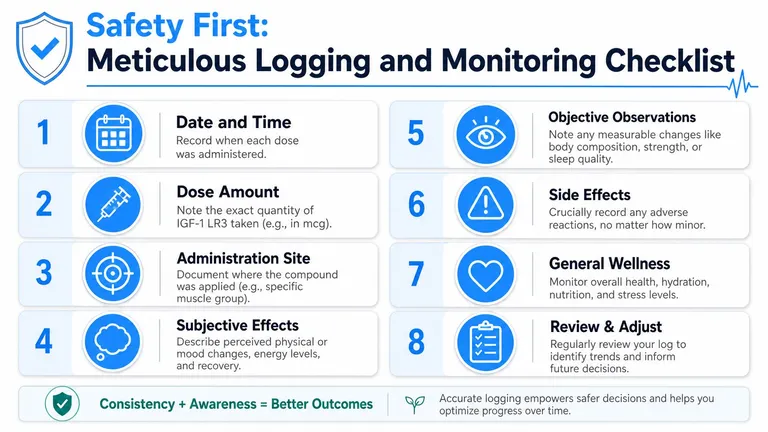
What needs to go in the log
A useful log does not need a fancy format. It needs to capture the details that make later review possible.
Record the dose, the exact time, the injection site, the meal context, and any immediate response. If glucose management is part of the plan, note that too. The point is traceability, not memory.
- Date and time: capture when the dose was taken.
- Dose amount: write the actual microgram amount, not just “small” or “standard.”
- Meal context: note whether the dose was taken near food or training.
- Observed response: include energy, appetite, recovery, or unusual sensations.
- Side effects: log anything that looks off, even if it seems minor at first.
A record like that turns a vague impression into something you can compare. If one timing pattern feels worse, or a certain meal setup seems to create trouble, the log gives you a basis for adjustment instead of guesswork.
Why glucose awareness is a critical part of the protocol
Hypoglycemia is the safety issue that deserves the most attention. Guidance around IGF-1 LR3 consistently warns that blood sugar can be affected, especially when the peptide is combined with a carbohydrate or insulin load. Fasted or careless dosing raises the risk.
The practical response is monitoring. Dosing around a meal, paying attention to how the body feels, and checking glucose when the protocol or personal history makes that sensible all reduce risk. That matters even more for anyone with irregular eating patterns or prediabetes, because the warning signs can be easy to miss if the person is not watching for them.
If the protocol creates uncertainty around glucose, the answer is better tracking.
A dedicated history view helps because the pattern often appears only after several entries. A tool like PepFlow can take the manual math and note-taking out of the routine, and the broader injection safety checklist is useful for keeping the process disciplined. The principle stays the same whether the log lives on paper or in software. Record what happened, not what you hoped happened.
Essential IGF-1 LR3 Dosing Questions Answered
How should reconstituted IGF-1 LR3 be stored? Keep it refrigerated after mixing and protect it from light. The reason is simple, peptides are sensitive to handling once they’re in solution, and stable storage is part of preserving the prepared dose.
Can it be mixed with other compounds in the same syringe? Only if you already know the compatibility of everything involved and you’re following a protocol that explicitly allows it. If there’s any uncertainty, separate the injections. Combining compounds to save time is not worth creating a stability or dosing problem.
Is it legal to buy or use? That depends on local law and how the product is being sold or labeled in your area. IGF-1 LR3 is discussed as a research peptide, so the user needs to verify the rules that apply where they live and work.
If you want to stop relying on hand math and scattered notes, use PepFlow to convert your dose into syringe units, build your cycle, and keep a clean log every day. Open PepFlow before your next protocol decision and let it handle the calculations, reminders, and history tracking so your IGF-1 LR3 dosing stays precise from the first draw to the last.