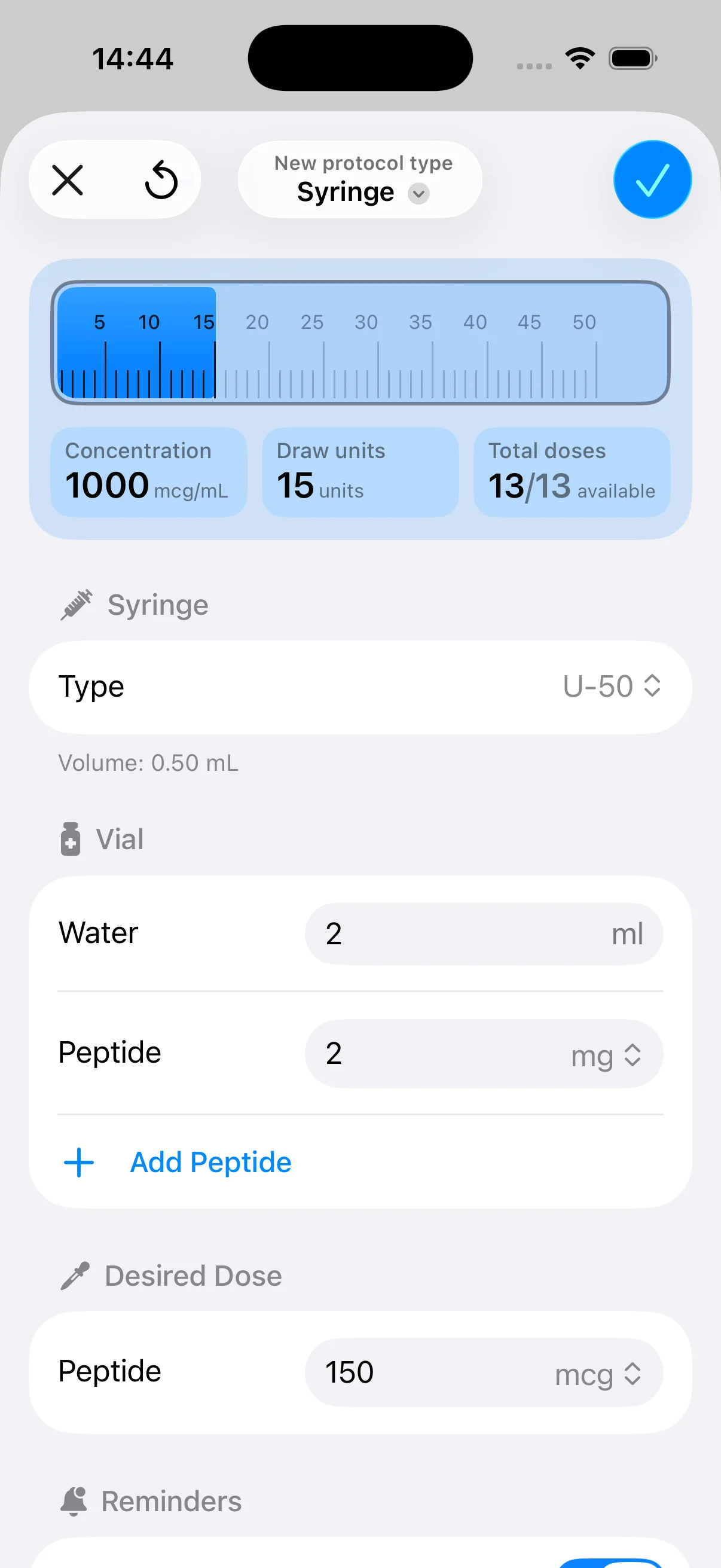
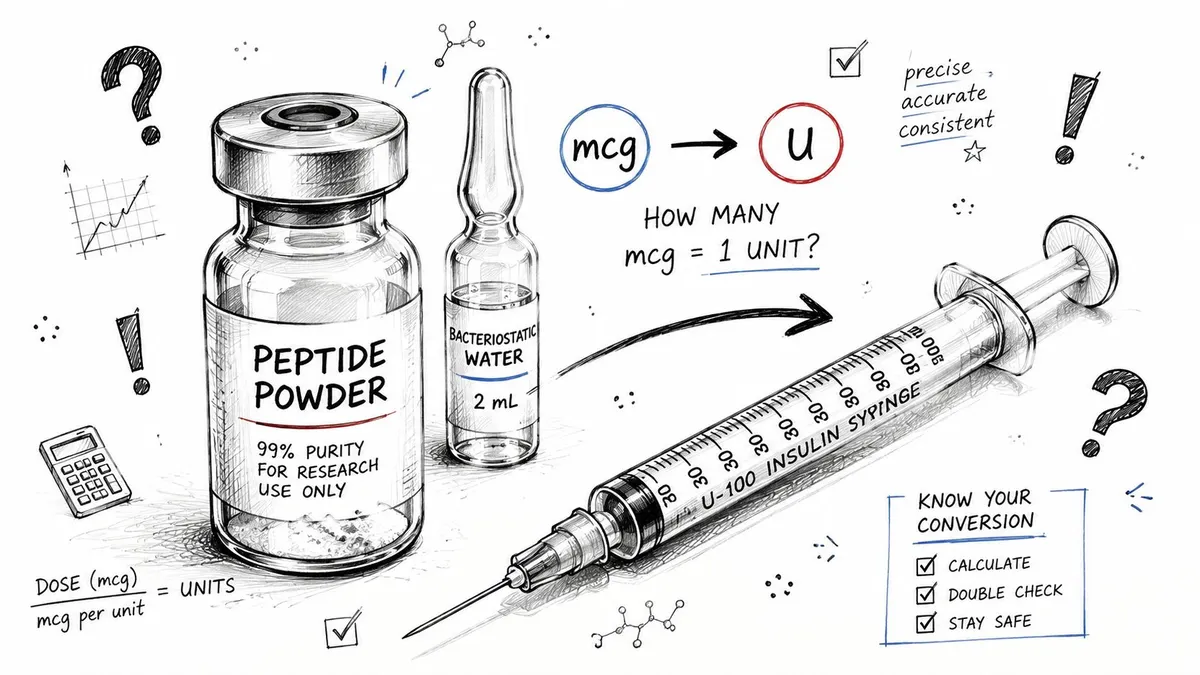
You’re probably staring at three things right now: a peptide vial labeled in mg or mcg, a syringe marked in units, and a bottle of bacteriostatic water. The math feels like it should be simple. It isn’t, unless you separate what each measurement means.
That’s where a common misconception arises. Users often try to convert mcg directly to syringe units as if those are the same type of measurement. They’re not. One is the amount of substance. The other is the amount of liquid drawn into the syringe. If you don’t build the conversion from the full workflow, from reconstitution to final draw, you can get the wrong dose fast.
Table of Contents
- The Real Reason You Cannot Simply Convert mcg to Units
- The Reconstitution Formula From Powder to Precise Concentration
- A Complete Worked Example Dosing a 5mg Vial
- Common Dosing Math Mistakes and How to Avoid Them
- Your Safe and Repeatable Dosing Workflow Checklist
- Eliminate Errors with the PepFlow Dosing Calculator
- Frequently Asked Questions About Peptide Dosing
The Real Reason You Cannot Simply Convert mcg to Units
You can’t safely convert mcg to units until you know whether “units” means International Units, or the volume markings on a syringe. Those are very different things, and people mix them up constantly.
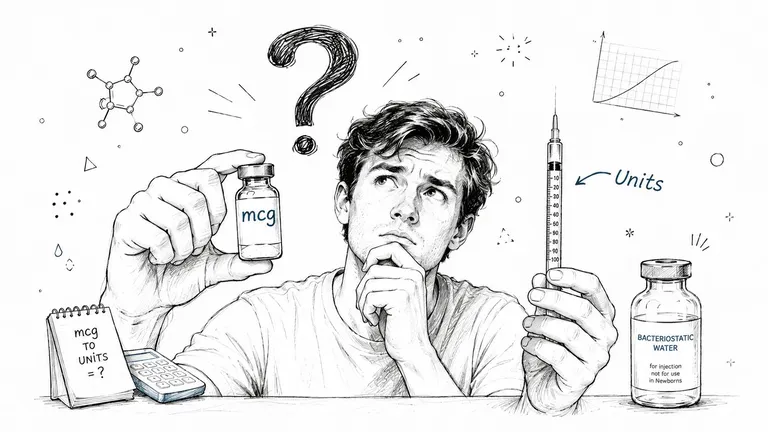
Mass activity and syringe volume are not the same thing
mcg measures mass. It tells you how much material is present.
IU measures biological potency. It tells you how much biological effect a substance is standardized to produce.
Units on an insulin syringe are volume markings. They tell you how much liquid sits in the barrel.
That distinction matters because there is no universal conversion factor between micrograms and International Units. The conversion depends on the substance itself. For example, 1 mcg of Vitamin D equals exactly 40 IU, while 1 mcg of Vitamin A (retinol) equals 3.33 IU, which shows why one all-purpose mcg-to-IU converter doesn’t exist (substance-specific mcg to IU conversion reference).
A peptide user then adds a second layer of confusion by looking at a U-100 insulin syringe and calling those markings “units.” In that context, the word doesn’t mean biological activity at all. It means syringe volume. If you need help separating syringe markings from liquid volume, this guide on mL to syringe units conversion is worth reading.
Practical rule: Never ask “How many units is this mcg dose?” until you first ask, “Units of what?”
What actually works
The correct workflow is simpler than trying to force a direct conversion.
You start with the powder in the vial. Then you add a known amount of diluent. That gives you a concentration, usually expressed as mcg per mL. Once you know concentration, you can determine how much liquid contains your target mcg dose. Only then can you translate that liquid volume into syringe units.
Here’s the mental model that keeps people safe:
- Powder label: tells you how much peptide you have
- Diluent volume: determines how concentrated the final solution becomes
- Target dose in mcg: tells you how much active ingredient you want
- Syringe units: tell you how much liquid to draw to get that dose
When beginners struggle, it usually isn’t because the math is hard. It’s because they’re trying to jump from the first line to the last one without calculating the middle.
The Reconstitution Formula From Powder to Precise Concentration
Once you stop trying to directly convert mcg to units, the process gets clean. The main task is calculating concentration after reconstitution.
Start with concentration not the syringe
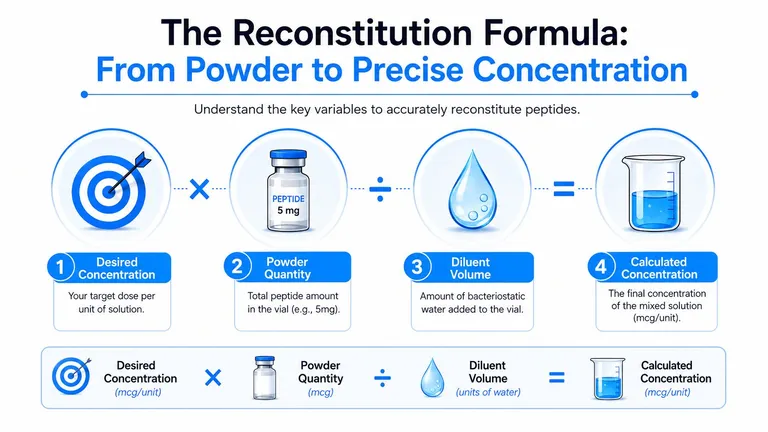
Take the total peptide amount in the vial and divide it by the amount of diluent you add. That gives you the final concentration.
Core formula
Concentration (mcg/mL) = Total peptide in mcg ÷ Total diluent in mL
If your vial label is in milligrams, convert that amount into micrograms before doing anything else. Then keep your units consistent the whole way through.
The point of reconstitution isn’t to change how much peptide you have. It changes how tightly that amount is packed into liquid. More diluent means a less concentrated solution. Less diluent means a more concentrated one.
If you want a deeper walkthrough of the underlying math, this article on final concentration calculation lays it out clearly.
Turn concentration into syringe units
After you know the concentration in mcg/mL, the next question is how much peptide sits in each syringe marking.
With a standard U-100 insulin syringe, the barrel is divided into small volume increments. So the practical conversion is not mcg to IU. It’s mcg to volume, then volume to syringe markings.
Working formula
Volume needed (mL) = Desired dose (mcg) ÷ Concentration (mcg/mL)
Then use that volume to determine your draw on the syringe.
A clean way to understand this:
- First calculation: how strong is the mixed vial?
- Second calculation: how much liquid contains the dose you want?
- Final step: draw that liquid amount accurately
Many experienced users also label the vial itself with the final concentration or with a shorthand like “mcg per syringe unit.” That small habit removes guesswork later, especially when you come back to the vial after a few days.
If you can read the vial label and instantly state the final concentration, you’re in control. If you’re guessing from memory, stop and recalculate.
A Complete Worked Example Dosing a 5mg Vial
Abstract formulas make sense on paper. The process becomes easier when you see the whole chain from powder to syringe.
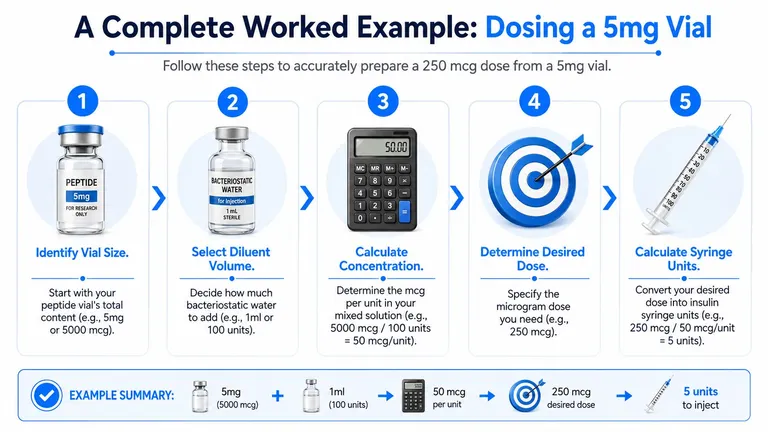
Run the numbers all the way through
Use this scenario:
- Vial size: 5 mg
- Reconstitution volume: 2 mL
- Desired dose: 250 mcg
First convert the vial amount into micrograms.
5 mg = 5000 mcg
Now calculate concentration:
5000 mcg ÷ 2 mL = 2500 mcg/mL
At this point, the vial is no longer a mystery. Every milliliter of solution contains 2500 mcg of peptide.
Now calculate how much liquid contains your target dose:
250 mcg ÷ 2500 mcg/mL = 0.1 mL
That means your 250 mcg dose lives inside 0.1 mL of the mixed solution.
Here’s the same example in a compact table:
| Item | Value |
|---|---|
| Total peptide | 5000 mcg |
| Diluent added | 2 mL |
| Final concentration | 2500 mcg/mL |
| Desired dose | 250 mcg |
| Volume to draw | 0.1 mL |
To see the process explained visually, this walkthrough is useful:
What the syringe draw looks like
On a U-100 syringe, 0.1 mL corresponds to 10 units. So in this example, a 250 mcg dose means drawing to the 10-unit mark.
That’s the workflow people are usually trying to reach when they search for “convert mcg to units.” But the right answer only appears after you build the chain in order:
5 mg vial → 5000 mcg total → mixed with 2 mL → 2500 mcg/mL → 250 mcg dose → 0.1 mL draw → 10 syringe units
The important lesson isn’t the final number. It’s the method. Change the vial size, the reconstitution volume, or the target dose, and the syringe units change too.
Common Dosing Math Mistakes and How to Avoid Them
Most dosing errors aren’t advanced mistakes. They come from rushing, assuming, or using one correct number in the wrong place.
The mistakes that cause the biggest problems
One dangerous mistake is reversing a conversion ratio. In vitamin labeling, users sometimes confuse 0.025 mcg/IU with 40 IU/mcg, and that reciprocal error can create a 1,600x dosing error (ratio-direction dosing error example). The lesson applies directly to peptide math. If you flip a ratio, your draw can be wildly wrong.
Other frequent problems are more ordinary:
- Mixing up mg and mcg: If someone reads a vial in mg but calculates a target in mcg without converting cleanly, the dose math falls apart.
- Confusing syringe units with potency units: The syringe barrel doesn’t know anything about biological activity. It only measures liquid volume.
- Trusting memory instead of labels: People often remember “I usually draw to this line” and forget that the vial concentration changed.
If you already track food closely, the mindset is similar to learning macro tracking. The first hurdle is understanding the units and staying consistent with them. A simple explainer like this beginner’s guide to tracking macros helps because it shows the same discipline: define the measurement correctly before you act on it.
Simple habits that prevent bad draws
Good practice beats cleverness here.
- Write the final concentration on the vial: Include enough detail that you won’t need to recalculate from memory.
- Double-check unit labels before drawing: Confirm whether you’re reading mg, mcg, mL, or syringe units.
- Redo the math if anything changes: A different amount of diluent creates a different concentration.
- Slow down on decimals: A misplaced decimal can turn a small draw into a large one.
Manual math isn’t the enemy. Unchecked manual math is.
Your Safe and Repeatable Dosing Workflow Checklist
A reliable routine matters more than having the formulas memorized. The safest users follow the same sequence every time and don’t improvise halfway through.
Before you mix anything
Run through a short pre-check before the vial is opened.
- Confirm the compound and vial strength. Read the label fully. Don’t dose from a vial with unclear identity or unclear total amount.
- Gather everything first. Keep the vial, diluent, syringe, alcohol swabs, and your written calculation together in one place.
- Decide the reconstitution volume in advance. Don’t add liquid casually and hope the math will work itself out later.
- Write down the target dose. “Small amount” is not a dose. A dose has to be stated in a concrete unit.
Consistency starts with this. If your setup is sloppy, your calculation usually follows.
Before you draw the dose
Once the vial is mixed, switch from prep mode to verification mode.
- Calculate the final concentration. Keep the result in one standard format.
- Check the target dose against that concentration. Make sure the volume to draw makes sense for your syringe.
- Label the vial clearly. Include the date and your concentration shorthand if that’s part of your routine.
- Draw slowly and read the barrel at eye level. Tiny volume errors matter more with concentrated solutions.
- Log what you did. Record the date, dose, and setup so the next draw stays consistent.
A checklist also protects you when you’re tired, distracted, or working from habit. Most real-world mistakes happen on routine days, not when someone is being especially careful.
Consistency is a safety tool. The same workflow repeated cleanly is better than doing fresh math from memory every time.
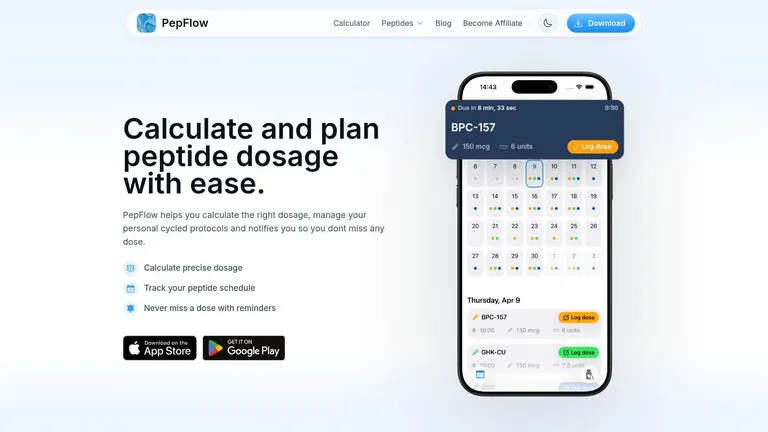
Eliminate Errors with the PepFlow Dosing Calculator
Hand calculations are useful because they teach you what the numbers mean. They’re not always the best way to run an ongoing protocol.
Why calculators beat scratch paper
A dedicated dosing calculator removes the parts of the workflow that people most often mishandle. You enter the vial amount, the reconstitution volume, and the target mcg dose. The calculator then gives you the draw amount in practical syringe terms.
That doesn’t replace understanding. It reinforces it. You still need to know what’s in the vial and how much diluent you added. But you no longer have to trust mental math, old notes, or a half-remembered conversion.
For anyone who values precise prep tools across the board, the same logic applies elsewhere. If you want to maintain precise weight measurements, you calibrate the tool instead of guessing. Dosing math benefits from the same mindset.
Where it fits in a serious routine
The best use of an app-based calculator is inside a repeatable workflow. Mix the vial. Verify the inputs. Run the calculation. Draw the dose. Log it.
If you want a direct tool for that process, the PepFlow peptide calculator is built for exactly this use case. It turns the calculation into a controlled step instead of a handwritten chore, which is a big upgrade when you’re trying to stay accurate over time.
Frequently Asked Questions About Peptide Dosing
Quick answers
Can I use sterile water instead of bacteriostatic water?
That depends on your handling protocol and storage plan. The main point is to use the diluent your protocol calls for and stay consistent.
Can I use a different syringe type?
Only if you understand how that syringe is marked and how it changes your draw interpretation. Don’t assume one syringe’s “units” mean the same thing as another’s.
How should reconstituted peptides be stored?
Follow the handling and storage guidance that applies to the specific product you’re working with. Heat, light, rough handling, and poor labeling all make consistency harder.
If a vial mentions IU, is that the same as syringe units?
No. IU refers to biological activity. Syringe units refer to barrel markings for liquid volume.
Are copper peptides the same as injectable research peptides?
No. The term “peptide” shows up in several product categories. For example, topical skin products such as Supplemynts’ eye care product use copper peptides in a completely different context from reconstituted injection workflows.
If you want a cleaner way to calculate doses, manage protocols, and stay consistent without redoing syringe math every time, PepFlow is built for exactly that. It helps turn a confusing “convert mcg to units” problem into a repeatable workflow you can trust.