Your package just arrived. The vial is cold, the label is tiny, and now you’re standing in the kitchen or lab wondering what matters first. Freeze it now, leave it sealed, let it warm up, mix it today, wait until tomorrow. Most peptide mistakes happen in that gap between delivery and routine.
That’s why peptide storage deserves more attention than dosing charts and forum stacks. If you mishandle a peptide early, the rest of the protocol becomes guesswork. You might still inject the same volume on schedule, but you won’t know whether you’re using a clean, stable, intact compound or something that has already lost integrity through moisture, heat, light, adsorption, or repeated thawing.
The good news is that peptide storage doesn’t need to be complicated. It needs to be disciplined. A small number of essential rules will protect potency, reduce contamination risk, and keep your records clean enough that you can trust what you’re doing from the first vial to the last dose.
Table of Contents
- The Unspoken Rule of Peptide Success
- The First 24 Hours Handling Your New Peptide Vials
- Reconstitution and Liquid Storage Best Practices
- The Art of Aliquoting to Maximize Peptide Lifespan
- Logging and Management for Protocol Consistency
- Recognizing and Preventing Peptide Degradation
The Unspoken Rule of Peptide Success
The hard part is often considered to start with reconstitution, dose math, or injection timing. It usually starts earlier. The moment a peptide arrives, you’re already making decisions that affect whether the material stays usable.
A common pattern looks like this. Someone receives a carefully packed vial, admires how professional the shipment looks, leaves it on the counter while they read forum posts, opens it repeatedly to check the powder, then tosses it into a busy fridge door. Nothing dramatic happens. That’s the problem. Peptide damage often starts subtly, and beginners mistake “nothing obvious went wrong” for “I handled it correctly.”
Peptide storage is what protects both the biological activity of the compound and the money you spent on it. Dry peptide is forgiving compared with liquid peptide, but it still doesn’t like moisture, unnecessary handling, bright light, or sloppy storage habits. Once mixed into solution, the margin for error gets much smaller.
Storage isn’t a side task. It’s the part that makes every later step worth doing.
The practical mindset is simple. Treat each vial like a sensitive lab reagent, not like a supplement bottle. That means deciding where it will live, how often it will be opened, what container it will touch, and how you’ll track it before you ever draw the first dose.
People often chase advanced details too early. They debate syringe brands, timing windows, and protocol tweaks while ignoring the boring fundamentals. In real use, the boring fundamentals decide whether the peptide you’re taking today still resembles the peptide you paid for.
If you want a reliable workflow, think in one direction only. Keep it colder, drier, darker, and handled less often. That principle will solve most peptide storage errors before they start.
The First 24 Hours Handling Your New Peptide Vials
The first day matters because it’s when moisture contamination and avoidable handling mistakes usually happen. If the vial is still lyophilized, your job is preservation, not action. Don’t rush to mix it just because it arrived.
What to do before you open anything
Start with the package, not the powder. Check that the vial label is readable, the cap and stopper are intact, and the contents look like dry lyophilized material rather than a wet or compromised mass. Then decide whether you even need to open it that day. In many cases, the best first move is no move at all.
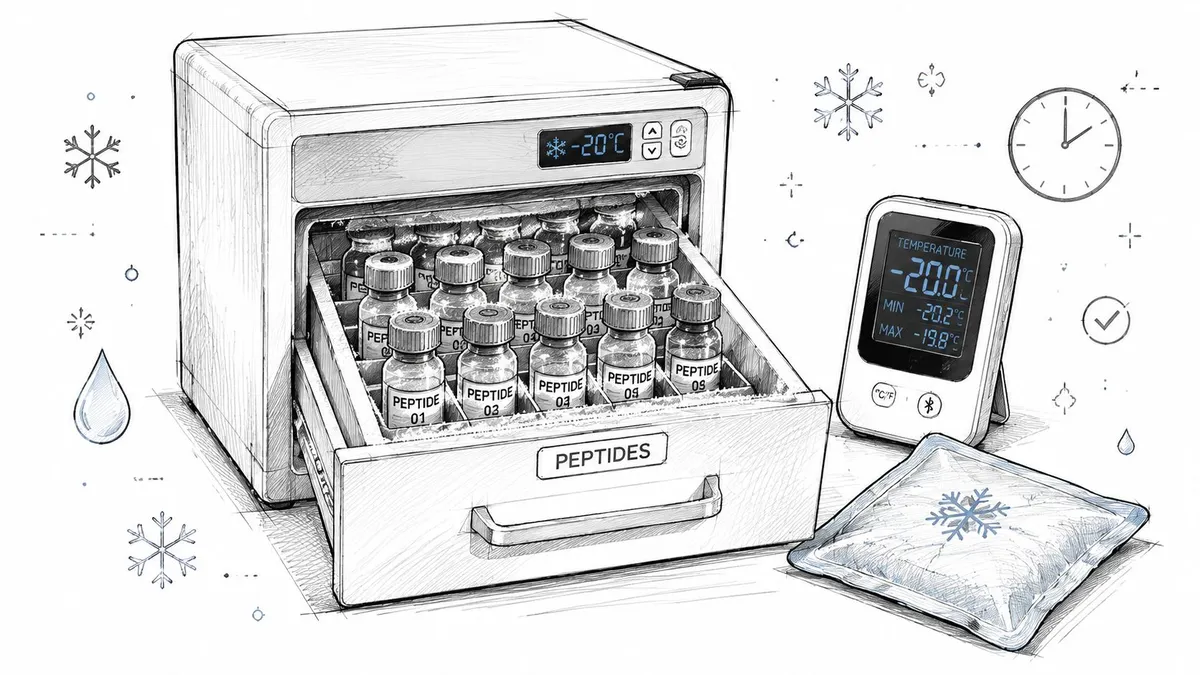
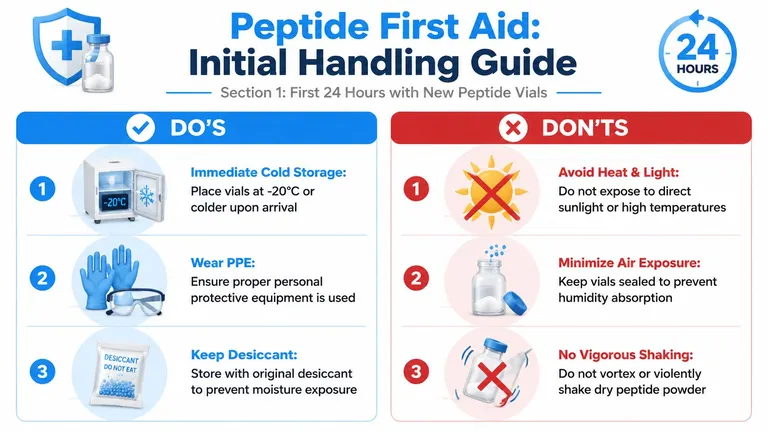
For dry peptide, supplier guidance is consistent on the big points. Keep the vial protected from light and store it at −20°C or colder, with −80°C preferred for long-term preservation, and protect it from moisture because many peptides are hygroscopic according to Bachem’s peptide handling and storage guidance.
Non-negotiable rule: Let a cold vial come to room temperature before opening it, or you risk pulling moisture from the air into the vial.
That one habit prevents a lot of preventable damage. A cold vial exposed to room air can attract condensation. With dry peptide, moisture is the enemy you often can’t see.
If you’re ordering from a supplier and trying to understand what competent cold-chain handling should look like before the vial reaches you, this overview of temperature-controlled pharma logistics helps you evaluate the transport side of the process.
A practical receive-and-store workflow
Use a simple sequence and don’t improvise.
- Inspect first: Look for a sealed vial, intact stopper, and legible identification.
- Keep it closed: If you’re not reconstituting immediately, leave the vial sealed.
- Protect from light: Put it in a box, opaque bag, or a dark part of the freezer.
- Store cold fast: Move it to a freezer at −20°C or colder. If you have access to a colder unit for long-term holding, that’s the better home.
- Keep desiccant with it: If the packaging includes desiccant, that’s useful protection against humidity.
- Open briefly only when needed: If you must handle it, minimize open-air time and reseal promptly.
A few things reliably go wrong in this window:
- Counter drift: People leave the vial out while deciding what to do.
- Curiosity opening: They pop the cap just to “check it.”
- Fridge door storage: The vial gets exposed to repeated temperature swings.
- Moisture exposure: The vial is opened while still cold from shipping or freezer storage.
A dedicated container helps. A small sealed freezer box with labels, desiccant, and a clear separation between unopened dry vials and active mixed vials prevents mix-ups. So does writing down where each vial lives. If your process needs a contamination checklist before first use, this guide on how to prevent contamination is a useful companion to the physical storage routine.
Open dry peptide only when you have a reason, a clean surface, and a next step already decided.
The first day is not where you try to be efficient. It’s where you avoid introducing damage before the protocol even starts.
Reconstitution and Liquid Storage Best Practices
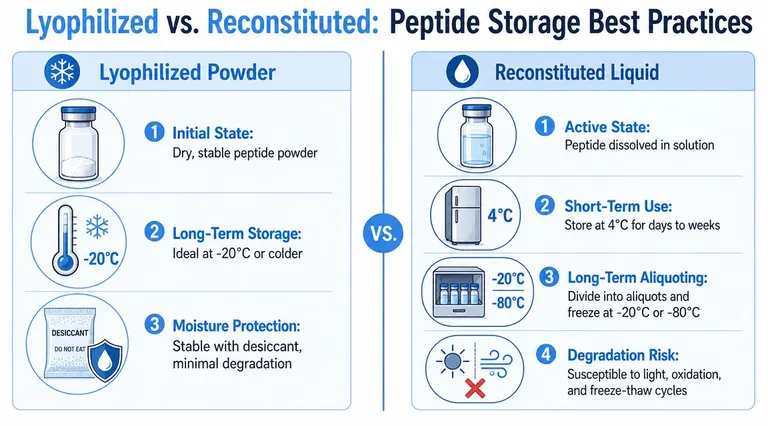
Once a peptide is mixed, the storage strategy changes completely. Dry powder is your stable form. Liquid is your working form. Don’t treat them the same.
Why the risk changes after mixing
Peptides in solution are much less stable than lyophilized peptides. GenScript notes that most lyophilized peptides can remain stable for several years when stored at −20°C and protected from bright light, while peptides in solution have a very limited shelf-life and are especially vulnerable to bacterial degradation in its peptide storage and handling guidance.
That’s the line many forum discussions blur. They talk about “the peptide” as if the same rules apply before and after reconstitution. They don’t. The day you add solvent, you start a different clock.
A working rule for fridge and freezer use
If the peptide is reconstituted for near-term use, keep it sealed, light-protected, and refrigerated at 2–8°C as a rule of thumb. One supplier notes that a refrigerated solution is often used within 2–4 weeks, but that window is highly sequence-dependent and should be treated as an upper bound in this overview of peptide stability and longevity.
That means “it still looks fine” isn’t enough. Refrigeration slows problems. It doesn’t erase them.
A simple decision table works well:
| Situation | Practical move |
|---|---|
| You’ll use the full vial soon | Keep the active vial refrigerated and protected from light |
| You won’t use it steadily | Split into small aliquots and freeze the aliquots |
| You mixed too much | Preserve only what you can protect from repeat handling |
| You’re unsure how long it’s been active | Don’t rely on memory. Check your log before using it |
Working rule: Reconstitute only what you’re prepared to track and use carefully.
For daily practice, the fridge is for active use, not for indefinite storage. The freezer is for preserved aliquots, not for a repeatedly thawed master vial.
pH, solvent choice, and leftover strategy
Chemistry matters here. Multiple sources recommend a low pH buffer around pH 5–6 when compatible, and they also warn that pH greater than 8 should be avoided because degradation pathways can accelerate. That advice is especially useful when a peptide is unstable or you’re troubleshooting why one solution seems to age badly.
Solubility is its own issue. Sigma-Aldrich guidance summarized in the verified material gives a practical sequence for difficult peptides: start with a stock around 1–5 mg/mL in sterile water or dilute acetic acid, then escalate solvent strength stepwise if needed, including 10% acetic acid, then 20% acetonitrile, then DMF or DMSO, and re-lyophilize leftovers to restore stability when appropriate. That isn’t a default recipe for every peptide. It’s a troubleshooting ladder when a sequence won’t dissolve cleanly.
If you need a mixing walkthrough before you ever put a peptide into liquid form, keep the storage logic tied to the preparation step with this guide on how to mix peptides with bacteriostatic water.
A few practical habits matter more than people expect:
- Use compatible solvent choices: Don’t improvise harsh conditions because a forum comment said it worked for one sequence.
- Keep the vial closed between uses: Air exposure and contamination risk rise every time the stopper is handled.
- Protect from light after mixing: If the sequence is light-sensitive, an amber vial is the safer choice.
- Plan leftovers before they exist: Decide whether you’ll refrigerate the active vial or freeze aliquots before you reconstitute.
Most storage failures after reconstitution aren’t dramatic chemistry failures. They’re routine handling failures disguised as convenience.
The Art of Aliquoting to Maximize Peptide Lifespan
You reconstitute a vial on Sunday, pull small doses from it all week, and by the second half of the protocol the results start to drift. For many people, that is not a dosing problem. It is a storage workflow problem. Aliquoting fixes that before it starts.
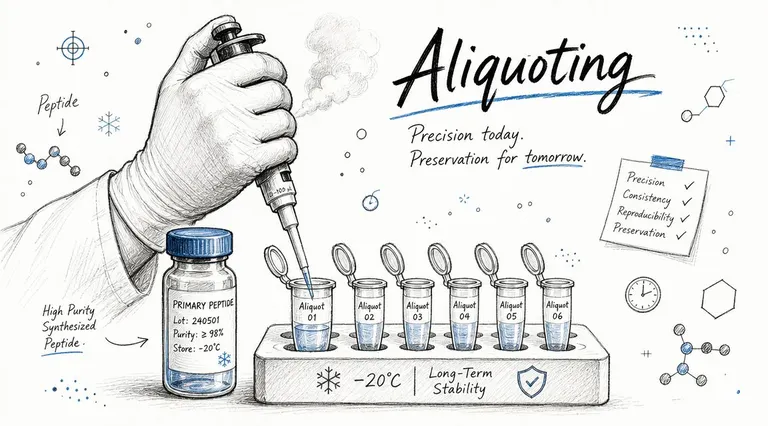
Aliquoting means you portion a freshly mixed peptide into smaller containers sized for one use, or for a very short use window. The goal is simple. Protect the bulk of your material from repeated handling. Every time the same vial gets opened, warmed, exposed to air, and put back, you add another chance for contamination, adsorption loss, and avoidable degradation.
GenScript’s guidance is clear here. Repeated freeze-thaw exposure speeds up peptide breakdown, which is why separate single-use portions are preferred for peptide solutions. In practice, this is one of the few habits that reliably improves consistency without adding much complexity once the system is set up.
Container choice matters too. Some peptides stick to standard plastic more than people expect. That means the amount you draw is not always the amount that remains available in solution after storage. Low-adsorption tubes or glass are often the safer options, especially for small-volume aliquots where wall loss matters more.
How to aliquot without wasting material
Start with the end point. Decide what one aliquot needs to cover before you touch the pipette. For a daily protocol, I prefer true single-use portions when volume allows. If single-use is impractical, make each aliquot small enough to be used within a short refrigerated window after thawing, not stretched across repeated entries.
A clean aliquoting workflow looks like this:
- Set the aliquot size first: Match each tube to one dose or a short, defined block of doses.
- Pick the right tubes: Use low-adsorption tubes when possible, especially for low-volume peptide solutions.
- Label every tube before filling: Include peptide name, concentration, date mixed, and amount in the tube.
- Use sterile tools and a clean surface: Good aliquoting fails fast if the setup is sloppy.
- Work quickly but not carelessly: Long bench time adds unnecessary exposure to room temperature and light.
- Freeze or refrigerate the portions immediately: Put each aliquot into its planned storage condition as soon as it is filled.
The common failure points are boring, which is why they get missed. Aliquots are made too large, labels are too vague, or the tubes are chosen based on what happened to be in a drawer. Then a protocol goes off track and there is no clean way to tell whether the issue came from the peptide, the handling, or the dosing record.
Good aliquoting also makes logging easier. Each tube becomes a defined unit with a clear date, concentration, and use history. That is the part forum advice often skips. The lab habit and the tracking habit need to work together if you want repeatable results from first dose to last. If you need the storage rules that apply after those portions are made, use this guide on how to store reconstituted peptides.
A quick visual demonstration can help if you’re building your aliquoting routine for the first time:
Aliquoting takes an extra few minutes on day one. It saves far more than that by preventing half-used mystery vials, concentration confusion, and potency loss from bad handling.
Logging and Management for Protocol Consistency
A well-stored peptide can still become a messy protocol if your records are weak. Most real-world errors don’t come from exotic chemistry. They come from people forgetting when a vial was mixed, confusing concentrations, grabbing the wrong aliquot, or assuming they’ll remember later.
What to record every time
A useful log is short enough to maintain and detailed enough to trust. You don’t need a lab notebook full of essays. You need the few fields that stop preventable mistakes.
At minimum, log these items:
- Identity: Peptide name and vial label exactly as received.
- State: Lyophilized, reconstituted, or aliquoted.
- Concentration: Record the working concentration immediately after mixing.
- Dates: Delivery date, reconstitution date, and first-use date.
- Storage location: Which freezer, which box, which row, or which tray.
- Aliquot count: How many portions you made and how they’re labeled.
- Use history: Which aliquot was opened, when, and whether any issue was noticed.
That last point matters. If one vial later looks questionable, good logging lets you isolate a single handling problem instead of doubting your whole protocol.
A paper label on the vial is necessary. A real log is better. Labels fall off, handwriting smears, and memory gets confident right before it gets wrong.
If you can’t tell when a peptide was mixed and how it was stored, you can’t judge the result you got from it.
How digital tracking closes the loop
Storage and scheduling cease to be separate jobs. The point of physical protection is consistency over time, and consistency depends on tracking what happened to each vial after it entered your system.
A simple digital setup can do three things paper often fails at. It can timestamp reconstitution, connect a dose to a specific vial or aliquot, and remind you when an active vial has been sitting longer than you intended. Some people build that with notes apps, spreadsheets, calendar reminders, and printed freezer maps. That works if you’re disciplined.
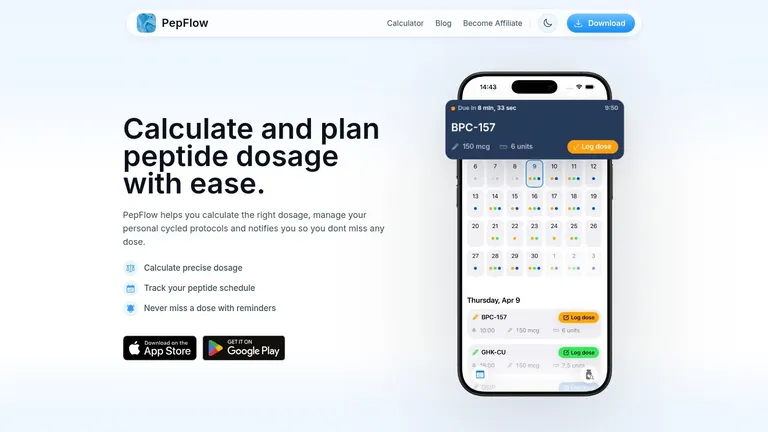
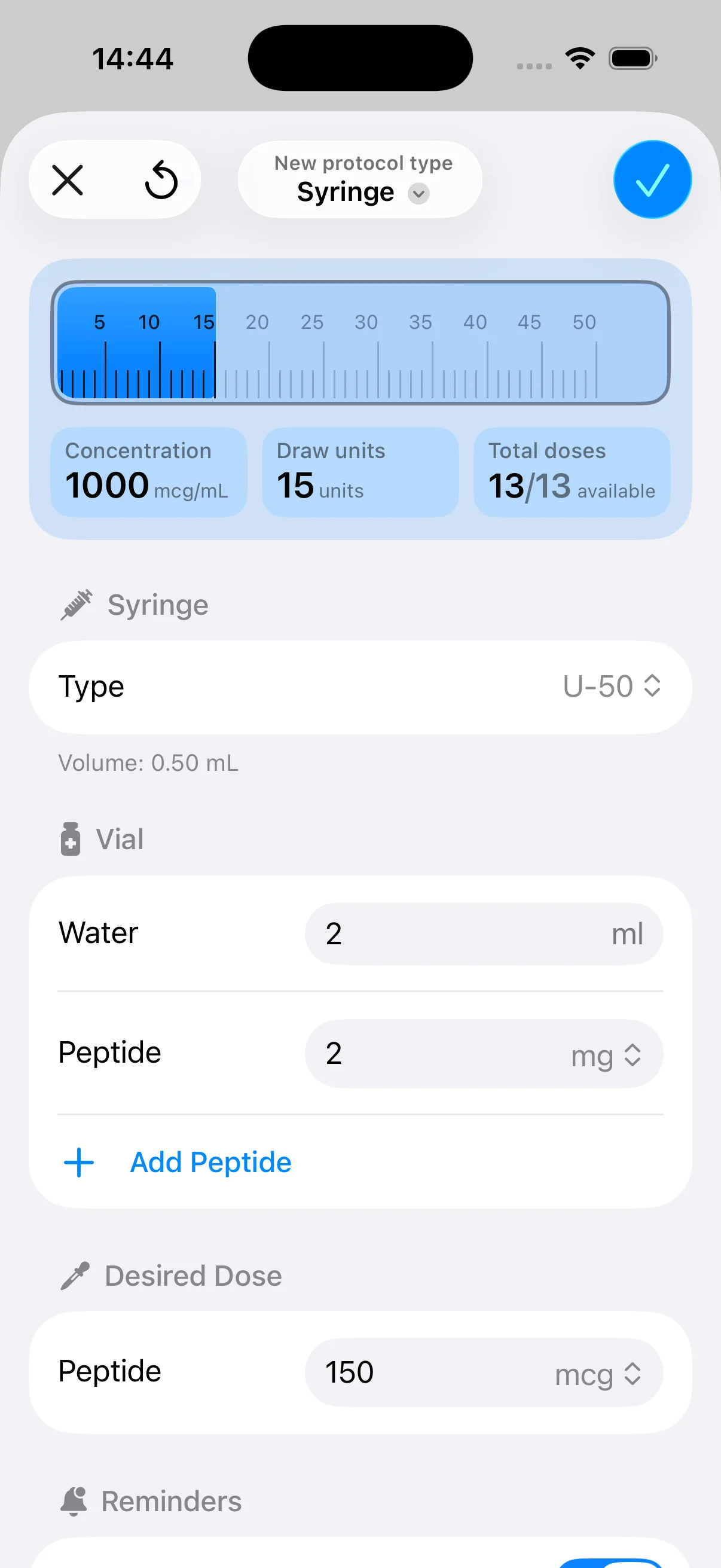
Another option is a purpose-built tracker. PepFlow is an iOS app that handles peptide dose calculation, protocol scheduling, reminders, and history logging, which makes it easier to tie storage events to actual vial use instead of keeping those details in separate places.
A workable management routine looks like this:
| Task | When to log it | Why it matters |
|---|---|---|
| Receive a vial | Same day | Confirms origin and initial storage path |
| Reconstitute | Immediately | Locks in concentration and date |
| Create aliquots | During the process | Prevents unlabeled tubes and count errors |
| Open an aliquot | At first use | Distinguishes frozen reserve from active use |
| Finish or discard a vial | Final entry | Keeps inventory honest |
The deeper benefit is pattern recognition. If one batch performs oddly, your log can reveal whether the issue followed a handling mistake, a long fridge stay, a travel event, or a simple mix-up between concentrations. Without records, people tend to blame the peptide. Often the process was the weak point.
A clean protocol has two halves. The vial is stored correctly, and the handling history is visible. That’s what turns peptide storage from “I think I did this right” into something you can audit.
Recognizing and Preventing Peptide Degradation
You pull a vial from the fridge, recheck your dose, and everything looks normal. A week later the response is inconsistent, or the injection stings more than it should. That is how peptide degradation usually shows up. Subtly, and after the handling mistake is already buried in your routine.
Visual inspection still matters, but it is only the first filter. A reconstituted peptide that turns cloudy, throws particulates, or changes color should be taken out of use. Those changes do not tell you the exact chemistry behind the failure, but they do tell you the vial is no longer reliable enough to trust.
Dry peptide is trickier. You may see clumping or a texture change if moisture got in, but many failures leave no obvious visual clue. In real use, the first red flag is often the storage history. The vial sat open on the counter while supplies were gathered. It made repeated trips between cold storage and room temperature. It spent time in a bright bathroom cabinet, a warm car, or a gym bag. The peptide may still look fine. That does not mean potency is intact.
The pattern is simple. Heat, light, moisture, oxygen, and repeated handling create risk. Preventing degradation means controlling those variables every time, not just on the day the vial arrives.
A practical checklist looks like this:
- Protect from light: Store vials in a dark place, and use amber or opaque secondary storage if the peptide is light-sensitive.
- Keep temperature stable: Avoid warm counters, cars, pockets, and any routine that exposes the vial to repeated temperature swings.
- Handle gently: Do not shake dry or reconstituted peptide aggressively. Rough handling adds stress and can create foaming.
- Limit air exposure: Every time a vial is opened, you add a chance for humidity, oxidation, or contamination.
- Use the right storage vessel: As noted earlier, container material affects peptide recovery. Low-binding options are often a better choice than standard plastic for stored solutions.
What catches people off guard is the delay between mistake and consequence. Adsorption to the container wall does not announce itself. A liquid peptide that was handled carelessly may still be present in the vial, just at a lower effective amount than expected. That is why degradation often gets blamed on the batch, the supplier, or the protocol, when the underlying problem was storage friction built into day-to-day handling.
Travel compresses those risks into a short window. If a peptide has to leave controlled storage, keep transit brief, shield it from light, and use insulation appropriate for the trip. Short trips still count. An hour in a hot car can do more damage than several days of careful refrigeration can fix.
There is also a hygiene side to degradation prevention. Used syringes and sharps go into a proper sharps container or an approved local disposal route. Empty vials and packaging should be cleared out before they get mixed in with active material. Storage mistakes are not always chemical. Sometimes they are labeling and mix-up errors that look like potency problems later.
The gap between papers and forum advice matters. Papers explain the mechanisms. Forums expose the common mistakes. The useful workflow combines both. Watch the vial, but also audit the process around the vial. If the appearance changes, stop. If the handling history is messy, question the material even if it still looks clean.
If you want one place to keep concentration math, protocol timing, reminders, and vial history organized, PepFlow is a practical option. It won’t replace careful handling, but it does make it easier to log reconstitution dates, track active vials and aliquots, and stay consistent enough that your peptide storage habits remain effective over time.