The most popular PEG-MGF dosage advice is often presented with more confidence than the evidence deserves. You’ll see fixed microgram ranges, fixed injection days, and neat cycle templates, but no validated human dosing guideline exists for PEG-MGF. The practical problem isn’t only choosing a research-use convention. It’s converting that convention into an accurate syringe draw, then following the schedule without relying on memory or improvised calculations.
This guide treats PEG-MGF dosage as a calculation and documentation problem, not as established medical treatment. The math below is exact for the stated vial concentrations, while the dosing conventions remain informal and research-oriented. Before handling a vial, review the broader background in what PEG-MGF is and discuss any proposed peptide use with a qualified healthcare professional.
Table of Contents
- Why PEG MGF Dosing Has No Official Standard
- Reconstituting Your Vial Correctly
- Converting Micrograms to Syringe Units
- Planning Your Cycle Length and Injection Schedule
- Automating Calculations and Reminders with PepFlow
- Common Mistakes and Safety Considerations
Why PEG MGF Dosing Has No Official Standard
The first assumption to challenge is that a commonly repeated dose must be a medically established dose. It isn’t. Research-oriented summaries state that human clinical dosing guidelines for PEG-MGF haven’t been validated, and that the compound is used as a research substance rather than an approved therapy. Informal protocols commonly cluster around 200 to 400 mcg per injection, often two to three times per week, with cycles lasting four to six weeks, but these figures come from preclinical extrapolation and anecdotal reporting rather than established human trials (PEG-MGF dosing guidance).
That distinction changes how you should interpret every protocol you find online. A range can describe what communities commonly do without proving what humans should receive. It also can’t tell you whether the same amount is appropriate for different goals, body sizes, health conditions, routes of administration, or product qualities.
Practical rule: Treat a published microgram range as a research-use convention, not a prescription or a validated starting point.
Why the community ranges exist
PEG-MGF schedules developed partly because PEGylation changes the practical handling of MGF. Native MGF is described as having a very short activity window, while attaching polyethylene glycol is intended to reduce renal clearance and enzymatic breakdown, creating a longer exposure period. Independent protocol summaries describe less frequent schedules for PEG-MGF, with cited research-use ranges of 100 to 500 mcg per injection and conventions such as 200 mcg after exercise or 200 to 500 mcg two to three times weekly (protocol summary).
Those conventions solve a scheduling problem, not an evidence problem. PEGylation may make a protocol easier to plan, but no validated human pharmacokinetic or dose-response standard tells you precisely how exposure relates to outcomes.
For readers comparing supplements, hormones, and peptides, the same evidence discipline applies. A general resource such as 2026 menopause vitamin advice can help separate established nutritional guidance from claims that require more scrutiny. With PEG-MGF, that scrutiny is essential because independent summaries report no published human trials, randomized controlled trials, or phase studies establishing a validated dose (research overview).
Reconstituting Your Vial Correctly
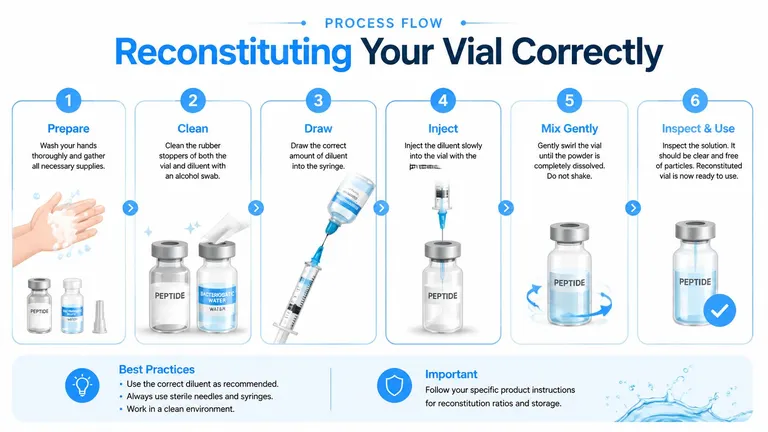
Accurate PEG-MGF dosage starts with concentration, not the syringe. You need the vial’s total peptide content and the exact volume of bacteriostatic water added. If either value is wrong, every later unit conversion will also be wrong.
Use sterile handling practices and follow the supplier’s instructions. Don’t shake a peptide vial aggressively. Add the diluent slowly along the inside wall, let it run down rather than striking the powder directly, then rotate or gently swirl the vial until the solution is clear and evenly mixed. A practical handling reference is this guide to bacteriostatic water reconstitution.
The concentration calculation
Use this formula:
Total peptide in mcg ÷ total liquid volume in mL = concentration in mcg/mL
A 2 mg vial contains 2,000 mcg. If you add 2 mL of bacteriostatic water, the result is:
2,000 mcg ÷ 2 mL = 1,000 mcg/mL
That concentration means each 0.1 mL contains 100 mcg. On a standard U-100 insulin syringe, 0.1 mL equals 10 units, so the same solution contains 100 mcg per 10 syringe units.
The water volume is a practical choice, but it must be recorded. Adding more liquid lowers the concentration and creates a larger draw for the same dose. Adding less liquid raises the concentration and creates a smaller draw, which can make small measurement errors more consequential.
A second worked configuration
A 5 mg vial contains 5,000 mcg. With 2.5 mL of diluent:
5,000 mcg ÷ 2.5 mL = 2,000 mcg/mL
Here, 0.1 mL contains 200 mcg, which corresponds to 10 U-100 syringe units. Write the vial strength, diluent volume, date of reconstitution, and calculated concentration on your protocol record. Don’t trust a memory-based note or a label that doesn’t match your actual mixture.
Converting Micrograms to Syringe Units
The arithmetic is simple. The mistakes come from skipped conversions, confusing milligrams with micrograms, or applying syringe markings from one mixture to another. Calculate from the actual vial and diluent volume every time.
For a U-100 insulin syringe:
mL required = desired dose in mcg ÷ concentration in mcg/mL
Then convert the volume:
U-100 units = mL required × 100
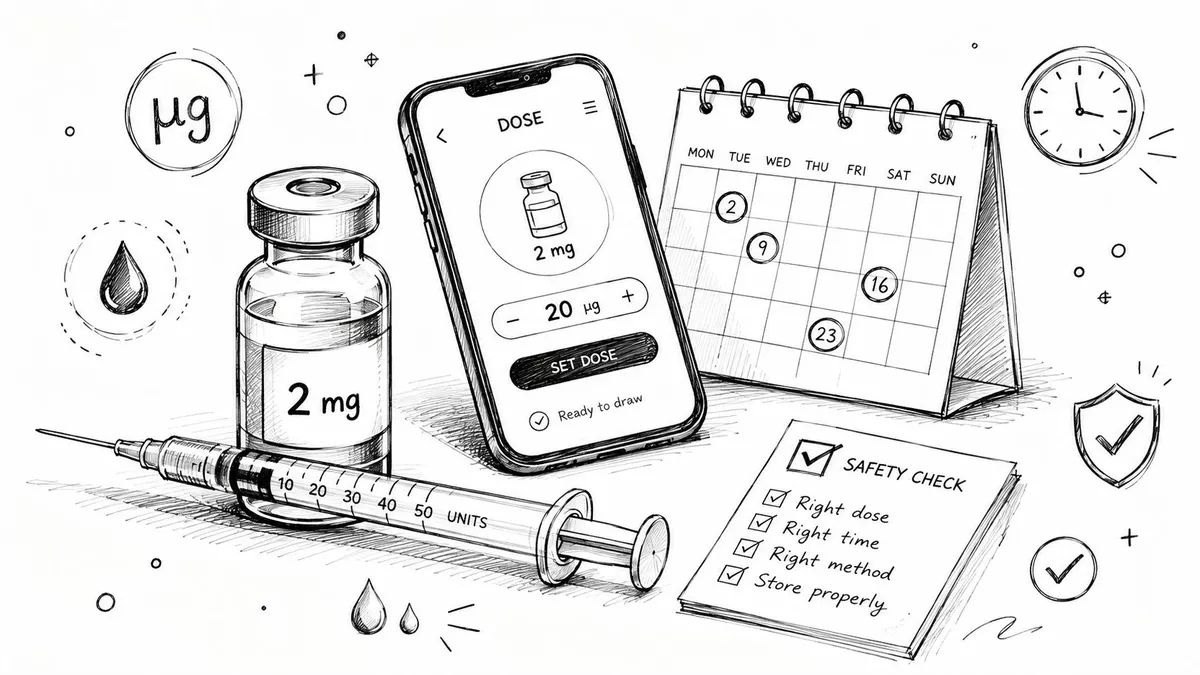
With a 2 mg vial and 2 mL of diluent, the concentration is 1,000 mcg/mL. For a 200 mcg dose:
200 mcg ÷ 1,000 mcg/mL = 0.2 mL
0.2 mL × 100 = 20 units
Under that exact configuration, 200 mcg is a 20-unit draw. Change the vial strength or diluent volume, and the syringe-unit result changes with it.
A peptide dosage calculator can provide a second check, but it cannot correct an incorrect vial strength or reconstitution volume. Enter those values carefully.
PEG-MGF dose to syringe unit conversion
| Dose (mcg) | Units (2 mg / 2 mL) | Units (5 mg / 2.5 mL) |
|---|---|---|
| 100 | 10 | 5 |
| 200 | 20 | 10 |
| 300 | 30 | 15 |
| 400 | 40 | 20 |
| 500 | 50 | 25 |
The table assumes a U-100 syringe and the exact ratios in the headings. The first mixture is 1,000 mcg/mL; the second is 2,000 mcg/mL. The less concentrated mixture therefore requires twice as many syringe units for the same dose.
The check I use before drawing
Record the calculation in three lines:
- Vial content: convert mg to mcg.
- Concentration: divide total mcg by total mL.
- Draw volume: divide the desired mcg by mcg/mL, then multiply mL by 100.
Do not round during intermediate steps. If the final volume is hard to measure accurately, pause and ask a pharmacist or clinician to review the concentration. Do not improvise a new dilution to make the draw easier.
Planning Your Cycle Length and Injection Schedule
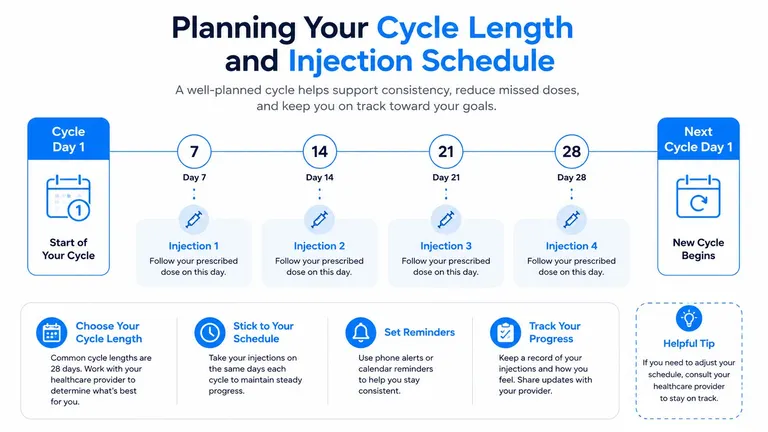
Once the concentration is fixed, scheduling becomes a separate decision. Informal PEG-MGF protocols commonly use four to six week cycles and two to three injections per week, but these are community conventions, not validated human treatment schedules (dosing discussion).
The reason people favor less frequent administration is practical. Pegylation is intended to extend exposure by reducing renal clearance and enzymatic degradation. Secondary summaries describe possible exposure windows of roughly 24 to 72 hours or even longer, depending on the PEG chain, while emphasizing that human half-life, safety, and efficacy haven’t been directly validated in peer-reviewed pharmacokinetic studies (PEG-MGF research summary).
Choosing a practical cadence
A recovery-focused schedule may place an administration after a demanding training session because that timing is a familiar convention in research-use communities. That doesn’t establish that post-exercise timing improves human outcomes, and it shouldn’t be confused with a proven targeting mechanism.
A maintenance-oriented plan may favor consistent spacing across the week rather than tying every administration to the hardest workout. The advantage is organizational: evenly spaced reminders are easier to follow and make missed administrations easier to identify. Neither approach has a clinically validated PEG-MGF dose-response framework behind it.
Use a calendar that records:
- Start date: The first administration date, if a clinician has approved the plan.
- Planned frequency: The selected weekly pattern, without changing it impulsively.
- Pause periods: Any off-cycle interval you’ve deliberately documented.
- Observations: Injection-site reactions, unexpected symptoms, training load, sleep, and recovery.
A pause period shouldn’t be treated as proof that the compound is safe or that a cycle has worked. The absence of immediate problems doesn’t establish long-term safety, especially where human studies are lacking. If symptoms appear, stop and seek medical guidance instead of trying to correct them by changing the dose.
Automating Calculations and Reminders with PepFlow
Manual calculation and memory-based scheduling create two different failure points. A spreadsheet can preserve a formula, but it won’t necessarily prevent you from entering the wrong vial strength. A phone reminder can alert you, but it won’t tell you whether the planned syringe draw matches the concentration in the vial.
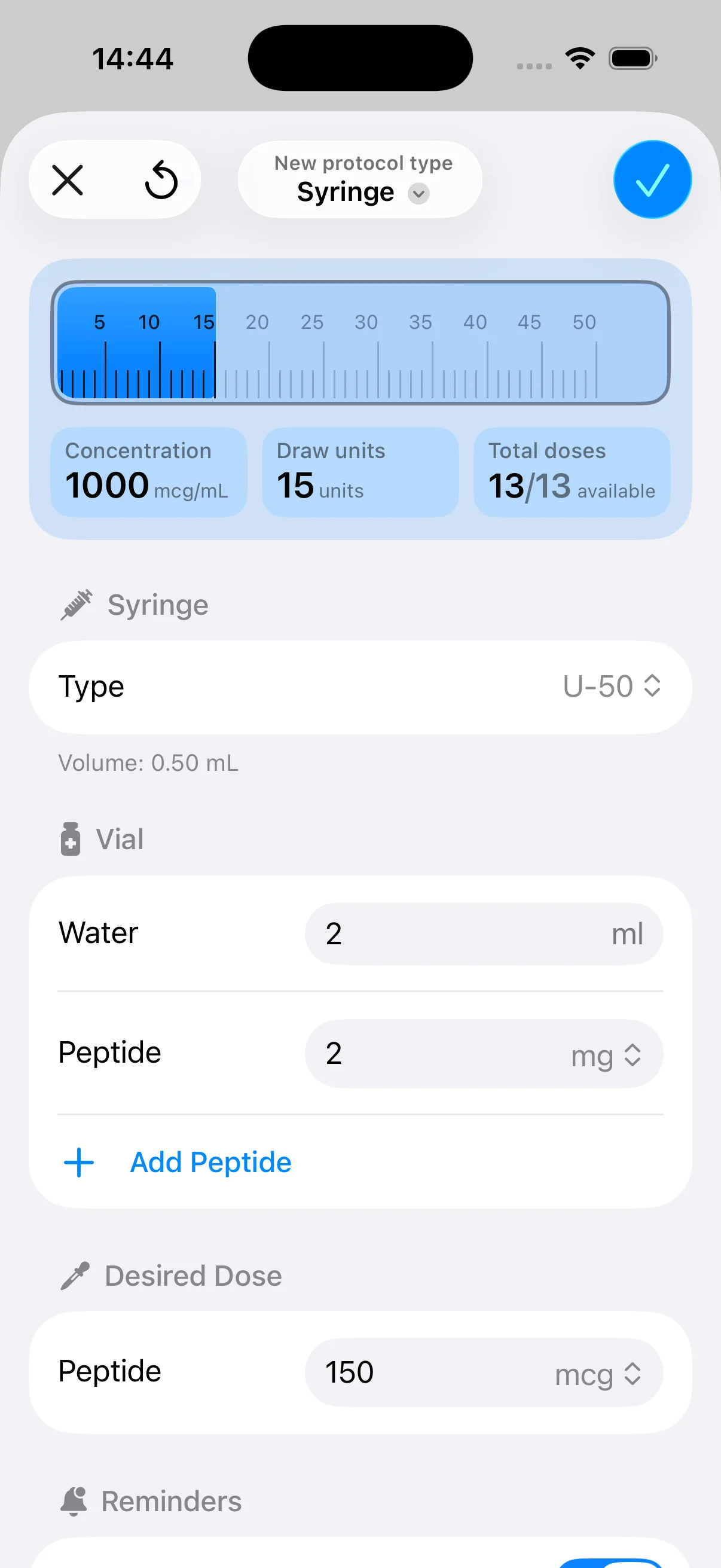
PepFlow is an iOS app designed for peptide calculation and protocol organization. It lets you enter vial configuration, set a desired amount in milligrams or micrograms, and calculate the corresponding injection volume and U-100 syringe units. The app’s role is administrative and mathematical. It doesn’t determine whether PEG-MGF is appropriate for you.
A clean setup workflow
Start with the physical vial in front of you, not with a copied protocol. Record the peptide amount and the actual diluent volume, then confirm the calculated concentration against your handwritten math.
Next, enter the desired microgram amount and review the resulting unit draw. If the displayed number doesn’t match your independent calculation, don’t proceed until you identify the discrepancy. Common causes include entering milligrams where micrograms were intended, selecting the wrong syringe scale, or using a remembered dilution ratio instead of the ratio used.
Create the schedule only after the calculation is verified. You can set a flexible start date, select the intended frequency, and include pause periods. Push notifications, widgets, live activities, countdowns, and dose-log actions help keep the planned routine visible rather than scattered across notes and calendar entries. A practical overview of this workflow appears in the peptide calculator app guide.

Why history matters
A dose history gives you an auditable record of what you planned and what you logged. That can help distinguish a true response from inconsistent administration, forgotten entries, or changes made midway through a cycle. Keep health information private, use the app as an organizational aid, and bring relevant records to a healthcare professional if you develop symptoms or need advice.
The app can reduce arithmetic and adherence friction, but it can’t validate an unvalidated protocol. Technology should make a cautious process more consistent, not make uncertain dosing look medically established.
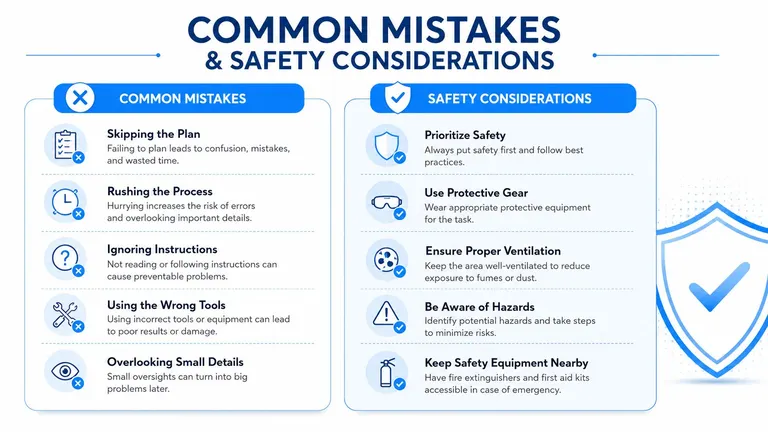
Common Mistakes and Safety Considerations
The most serious practical mistakes are usually basic. People add a different water volume than the one used in their calculation, shake the vial instead of gently mixing it, or read a U-100 syringe as though every vial has the same concentration. Each error changes the amount drawn or can compromise handling.
Before every administration, verify the following:
- Vial identity: Confirm the peptide name and stated quantity.
- Diluent volume: Match the recorded volume to the actual reconstitution.
- Concentration: Recalculate mcg/mL if anything has changed.
- Syringe scale: Confirm that the syringe is U-100 before using the unit table.
- Solution appearance: Don’t use a vial if its appearance has changed unexpectedly or if contamination is suspected.
- Schedule entry: Check the date and dose against your logged protocol.
Rotate injection sites rather than repeatedly using one area. Follow sterile technique, supplier storage instructions, and local medical guidance. Research summaries commonly describe refrigerated storage and caution against contamination, direct sunlight, and repeated freeze-thaw handling, but product stability can depend on formulation and handling, so the supplier’s documentation should take priority.
PEG-MGF remains a research compound without an authoritative, clinically validated human dosing standard. The evidence gap affects not only the amount but also the suitability of the compound for people with endocrine, metabolic, cardiovascular, renal, or other health conditions. A healthcare professional should review your medical history, medications, and intended use before you begin. Seek prompt medical attention for severe or unusual symptoms, and don’t attempt to manage them by increasing, reducing, or spacing doses on your own.
For comparison, readers looking at non-peptide approaches can review this natural performance enhancer dosing guide, but a supplement guide shouldn’t be used to justify a PEG-MGF protocol. The safest workflow is conservative: verify the math, document the schedule, inspect the solution, and ask a qualified clinician when the evidence or your health status raises uncertainty.
PepFlow helps you record vial concentration, convert a selected microgram amount into syringe units, and organize a recurring protocol with reminders and dose history. If you’re trying to eliminate manual calculation and scheduling errors, visit PepFlow and use it as an organizational tool alongside qualified medical guidance.