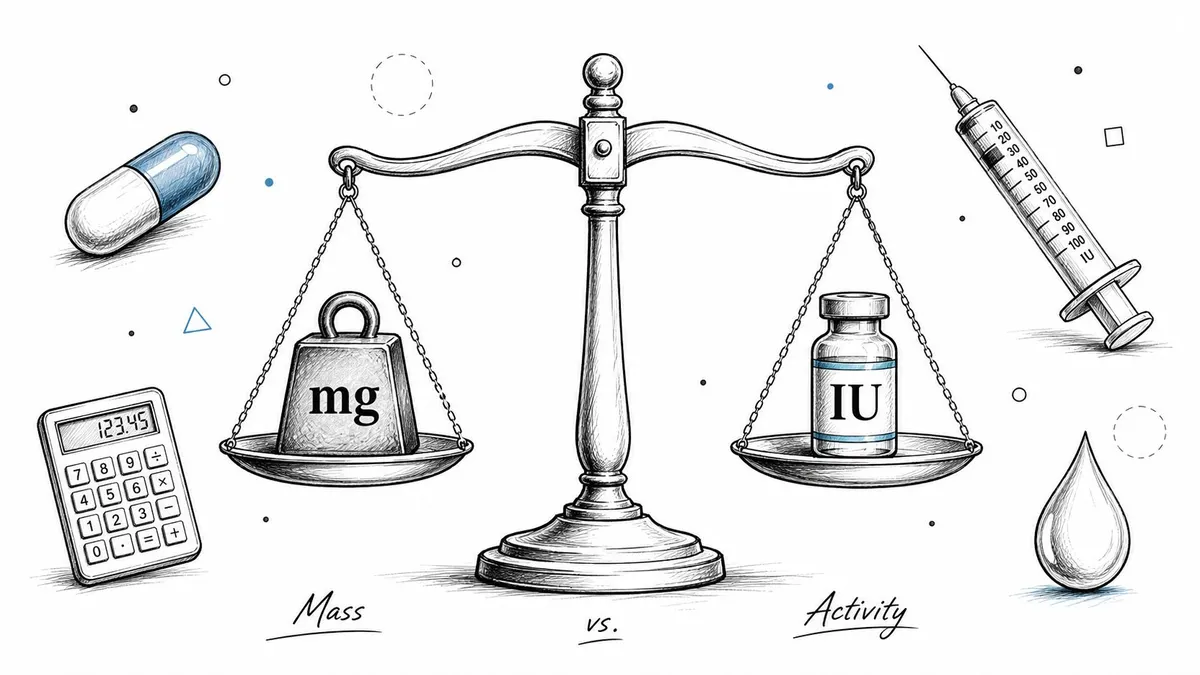
IU and mg are not the same unit, and there isn’t one universal conversion you can use across products. mg measures mass, while IU measures biological activity, so the correct conversion depends on the substance, and for vitamin D, 1 IU equals 0.025 mcg, which means 400 IU equals 10 mcg.
You’re probably looking at a label, a protocol sheet, or a calculator and trying to decide whether two numbers really mean the same dose. That confusion is normal, because supplement labels, legacy bottles, and medical workflows don’t always use the same unit system.
Table of Contents
- Why the IU vs mg Question Trips People Up
- What mg and IU Measure
- Comparing Common IU Conversions Side by Side
- How to Convert IU to mg Step by Step
- Why This Matters for Peptide and Supplement Workflows
- The Case for Keeping IU on the Label
- Safety Checklist Before Any IU Conversion
Why the IU vs mg Question Trips People Up
You’re standing in the supplement aisle with two vitamin D bottles in your hands. One says 400 IU, the other says 10 mcg, and you’re trying to tell whether they match. That is the moment the question is IU the same as mg starts to matter, because the short answer is no, they do not line up one-to-one.
The confusion sticks because the labels look close enough to compare at a glance. IU measures biological activity, while mg measures mass, so the numbers only make sense after you know the ingredient and the form it comes in. For a practical guide to unit reading in another dosing setting, the insulin label-reading guide at How to Read Insulin Syringes is a useful companion read.
Practical rule: if a product says IU, pause before you convert it in your head. Identify the substance first, then do the math.
That same caution shows up in supplements, where labels have shifted toward metric units to reduce confusion. The U.S. NIH Office of Dietary Supplements notes that for vitamin D, 1 mcg equals 40 IU, and the FDA changed supplement labeling so vitamins A and D are declared in mcg, while vitamin E moved to mg alpha-tocopherol on Nutrition Facts labels NIH unit conversions. If you only remember one thing, remember this, IU does not mean the same thing as mg.
The same label problem shows up outside vitamins too. Insulin, heparin, and other injectable products can use unit-based dosing that looks familiar on paper but behaves very differently in practice, which is why reading the device correctly matters before anyone converts anything by hand. If you ever need to choose between Dysport and Botox, the same principle applies, unit labels can only be compared within the product they belong to.
A second reason people get stuck is that old and new labels often sit side by side in one context. One bottle may use legacy IU labeling, another may use metric mass, and a third may mix forms. For a plain-English supplement comparison that keeps the focus on vitamin D, see Maximum Health Products immunity duo, which helps show how unit confusion can happen even when the ingredient is familiar.
What mg and IU Measure
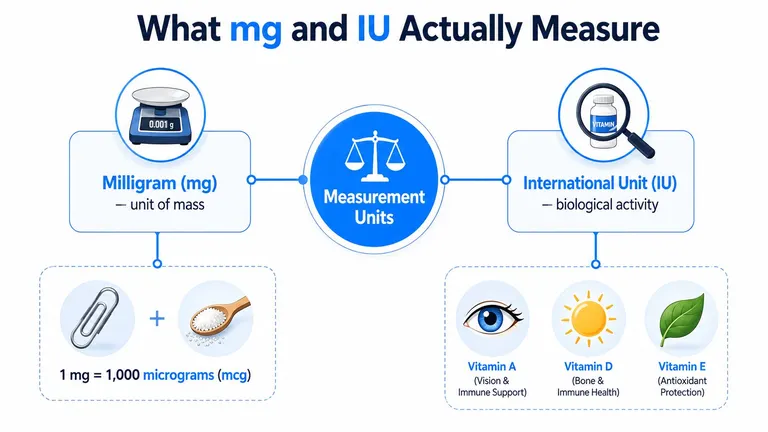
A milligram is a unit of mass. It tells you how much of a substance is present, the same way grams tell you how much flour or salt you have. One milligram equals 1,000 micrograms, so mg and mcg are both mass units, just on different scales.
An International Unit, or IU, works differently. It measures biological activity and potency, which is a very different idea from weight. That means an IU is defined for a specific substance by its effect in a standardized system, so one IU of one nutrient does not weigh the same as one IU of another. The Harvard Foreman lab explains the same point plainly, there is no universal mass equivalent for IU because the unit is tied to activity rather than physical amount Harvard IU to mg.
Paint is a useful analogy. mg is the amount of paint in the can. IU is closer to how much wall that paint can cover, and coverage changes with the surface. A more potent product can produce the same biological effect with less mass, while a less potent form may need more mass to reach the same result.
That is why two bottles can both say 400 IU and still not be comparable by weight. The number looks identical, but the meaning changes with the ingredient. A label reader who treats IU as a direct synonym for mg can end up with the wrong dose, especially when switching between supplements, countries, or legacy packaging.
The same unit confusion appears in other dose conversions too. The microgram to IU conversion guide is useful when you need to move between unit systems without assuming the same rule applies everywhere. The same caution also shows up in Maximum Health Products immunity duo, where a familiar ingredient can still be labeled in a different way.
Practical rule: if the label gives IU, ask “IU of what?” before you ask “how many mg?”
That question matters because the unit itself does not tell you the mass. It tells you the activity standard that product is using.
Comparing Common IU Conversions Side by Side
A label that says 400 IU can point to very different amounts of mass. The number only makes sense after you know which substance it refers to, because IU tracks activity, not a universal weight.
| Substance | 1 IU equals | 400 IU equals | Notes |
|---|---|---|---|
| Vitamin D | 0.025 mcg | 10 mcg, which is 0.01 mg | This is the clearest major-market example, and the conversion is commonly summarized in the NIH unit conversion table. |
| Vitamin E | Product-specific, not one fixed number | Product-specific | One source gives roughly 0.67 mg per IU for natural d-alpha tocopherol and about 0.9 mg per IU for synthetic dl-alpha tocopherol, while another reports about 1.21 to 1.49 IU per mg depending on the carrier Viridian vitamin E conversions. |
| Vitamin A | Product-specific, not one fixed number | Product-specific | Vitamin A also uses IU on older labels, but the mass equivalent depends on the exact form, so retinol and beta-carotene equivalents should not be treated as identical. |
| Insulin | Activity-based dosing | Activity-based dosing | Here IU reflects clinical effect, not nutrient mass, so a nutrition-style shortcut does not apply. |
| Heparin | Activity-based dosing | Activity-based dosing | Like insulin, the unit is tied to therapeutic activity, not a simple weight label. |
Vitamin D is the easiest worked example to check by hand. 1 IU equals 0.025 micrograms, so 400 IU equals 10 micrograms, and because 1 mg equals 1,000 mcg, that same amount is 0.01 mg. A 400 IU vitamin D bottle and a 10 mcg bottle can describe the same amount, which is why a label reader needs the substance name before doing the math.
Vitamin E takes more care. The conversion changes with the specific form, so the product sheet matters more than a generic chart. A label that looks simple can still hide a different mass-to-activity relationship, which is why the same IU number cannot be copied across every vitamin E product. If you want a broader walk-through of unit systems, the mcg to units conversion guide helps show how labels can look different while referring to the same dose.
Bottom line: the mg equivalent of 400 IU varies by substance. You only get a mass amount after you identify the exact ingredient and form.
Insulin and heparin show the same rule in a clinical setting. Their IU labels describe therapeutic activity, not nutrition, so medication workflows need product-specific references rather than a one-size-fits-all calculator.
How to Convert IU to mg Step by Step
A patient may see IU on one label and mg on another, then assume the numbers should line up on their own. They do not. IU and mg measure different things, so the conversion starts with the exact substance, then the form, then the correct factor.
Vitamin D example
Start with 1,000 IU vitamin D. Multiply by 0.025 mcg per IU, which gives 25 mcg. Then divide by 1,000 to move from mcg to mg, and you get 0.025 mg.
That same path works in reverse. If a label shows 10 mcg vitamin D, multiply by 40 IU per mcg, and you get 400 IU. Older IU labels and newer mcg labels can describe the same amount, even though the units look different.
Why vitamin E needs more caution
Vitamin E is more dependent on the exact form. A conversion for one type cannot be copied to every other type and still be reliable. One reference gives about 0.67 mg per IU for natural d-alpha tocopherol and about 0.9 mg per IU for synthetic dl-alpha tocopherol, while another source describes a range of roughly 1.21 to 1.49 IU per mg depending on the carrier Viridian vitamin E conversions.
That is why a vitamin D chart does not solve a vitamin E question. The arithmetic may look tidy, but the ingredient-specific factor does the work.
Keep the units visible at every step, especially when moving between mcg and mg. A unit-by-unit approach, like the one in Convert mcg to Units, helps prevent a common mistake, which is treating the number as more important than the unit beside it.
Practical rule: write the units next to every number. If the units do not make sense on paper, the dose will not make sense in real life.
Three errors come up again and again. People mix up mcg and mg, they use a vitamin E factor on a vitamin D label, and they assume an IU label is outdated just because newer packaging uses different units. A label can still be valid when it is written in IU, but it needs the right substance-specific conversion standard.
When the factor is unclear, use a substance-specific reference instead of a generic shortcut. That is the safer way to check the math for supplements, insulin, heparin, and other activity-based products.
Why This Matters for Peptide and Supplement Workflows
A peptide vial, a supplement label, and an old protocol sheet can all speak different unit languages. One may use micrograms, another may use milligrams of mass, and another may still rely on IU. That is where the confusion starts, because the number on the label can look familiar while the unit system is doing something very different.
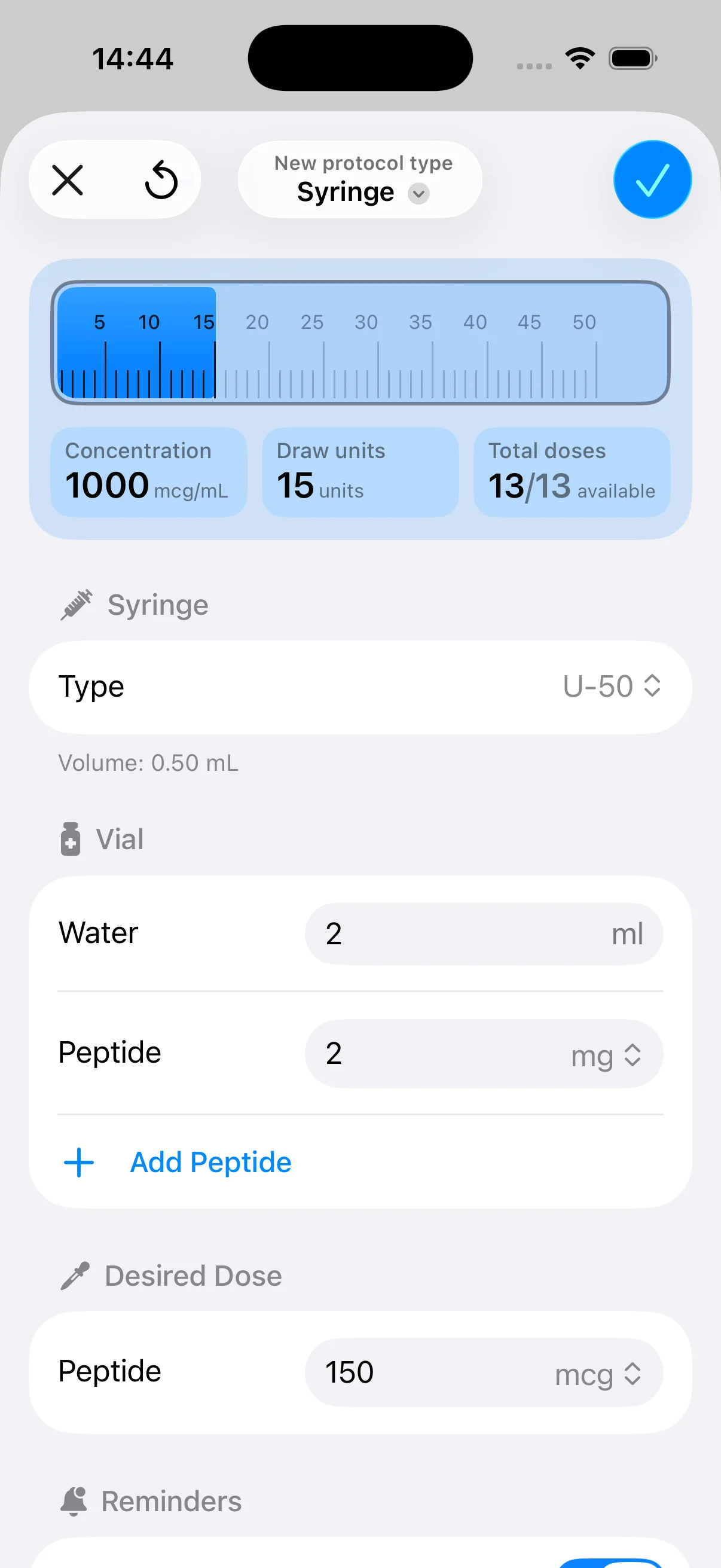
For peptide work, the safe order is simple. Confirm the exact substance and form first, because the same name can behave differently in a different formulation. Then convert any IU figure into micrograms with the correct ingredient-specific factor. After that, enter the mass target into a dose calculator so the syringe markings line up with the vial concentration. That is also where a tool like PepFlow fits, because it helps turn a mass target into practical syringe markings and supports scheduling and dose planning around that number.
The same unit logic shows up in products that are not peptides. Insulin uses activity-based units, heparin does too, and some supplements still appear in IU because biological activity, not weight alone, is the point. Readers who are trying to understand peptides in that broader context can use ProMD Health Easton’s wellness peptide overview as a plain-language primer on what peptides are and why dose planning matters.
A calculator can reduce manual math, but it cannot infer the chemistry from a label. It still depends on the user entering the correct ingredient, the correct form, and the correct concentration. If the source label is ambiguous, the calculator will only carry that ambiguity forward.
Supplement habits and peptide workflows overlap more than they first appear. A bottle label may speak in IU, a vial may speak in mcg, and a syringe may only care about volume and concentration. The person doing the translation has to move through all three without swapping one unit for another.
Practical rule: do not ask the calculator to choose the factor. Give it the factor, then let it do the arithmetic.
That mindset is especially useful for readers who move between products from different countries, older packaging, and peptide protocols that borrow formatting from supplement labels. Once the IU number is converted into mass with the correct standard, the workflow becomes easier to check line by line. The math stops being the main risk point, and label review becomes the safety step that catches mistakes before they reach a syringe or a schedule.
The Case for Keeping IU on the Label
A lot of articles treat IU like a relic that should disappear. That is too simple. The shift toward mcg labeling for vitamins A and D and mg alpha-tocopherol labeling for vitamin E was meant to reduce confusion, not to claim that IU has no value.
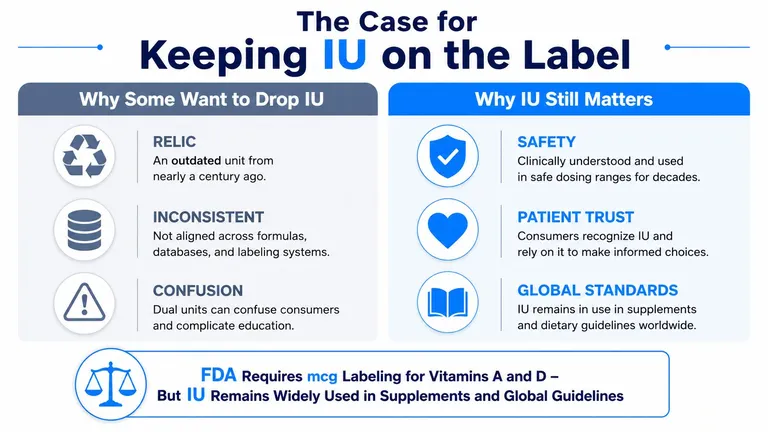
The main reason IU still matters is simple. Some products are judged by biological activity, and mass alone does not always describe that activity. The Harvard reference on IU to mg keeps that distinction visible because different forms can behave differently even when they weigh the same.
That matters when the form changes the effect, not just the weight.
IU is also useful when a product blends forms. Mixed tocopherols, or retinol plus beta-carotene, can be hard to read cleanly by mass alone. In those cases, IU gives a single activity-based frame of reference, which is often more meaningful than weight by itself. Mass tells you what is physically present, but not always how the product behaves in a biological system.
There is also a practical reason labels have not fully abandoned IU. Legacy products still circulate, international labels still use them, and some consumers already know their routine in IU terms. Removing the unit entirely would solve one source of confusion and create another.
The smarter position is to understand both units and use each where it adds value. Read the mass unit when the label gives it to you, read the IU unit when the product uses activity, and convert only with the correct substance-specific standard. That approach is more reliable than trying to force every label into one system.
Safety Checklist Before Any IU Conversion
Before you convert anything, pause and check the label the same way every time. IU can look simple on the page, but the meaning changes with the substance, the form, and the workflow around it.
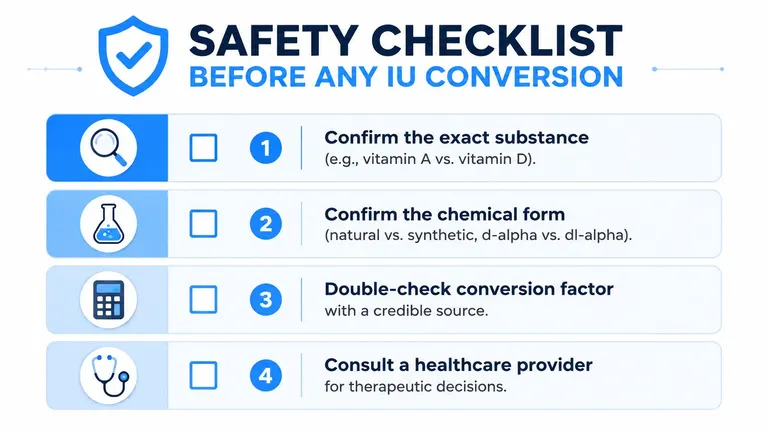
- Confirm the exact substance. Vitamin D, vitamin A, vitamin E, insulin, and heparin do not share one conversion rule.
- Confirm the chemical form. Natural versus synthetic, d-alpha versus dl-alpha, retinol versus beta-carotene, those details change what the label means.
- Check the conversion factor against a reliable source. Use a source that matches the exact substance and form before you write a number into your notes.
- Write the units out in the math. If you cannot see mcg and mg on the page, you are more likely to mix them up.
The safest habit is to treat each conversion like a medication label, not a generic unit swap. A vitamin D label may look similar to a vitamin E label, and an insulin or heparin workflow can make a wrong assumption far more serious than a simple math mistake. That is why the substance comes first, the form comes second, and the arithmetic comes last.
Two warnings matter most in practice. Never use a vitamin E factor on a vitamin D label, and never assume a 1:1 relationship between IU and mg, even within the same vitamin, when the form changes. That is how a small reading error becomes a dose error.
A calculator can help after the source factor is confirmed. In peptide and supplement workflows, PepFlow can take the next step from there by turning a microgram target into a practical dosing plan, including syringe markings and scheduling details, while the person reading the label still has to choose the correct IU standard first.
If you are checking labels right now, start with the source factor and then use the calculator for the arithmetic. PepFlow helps turn a microgram target into a dosing plan and keeps the math consistent when you are working across units, vial concentrations, and schedules. Visit PepFlow if you want a practical way to manage that translation without doing the conversion by hand each time.