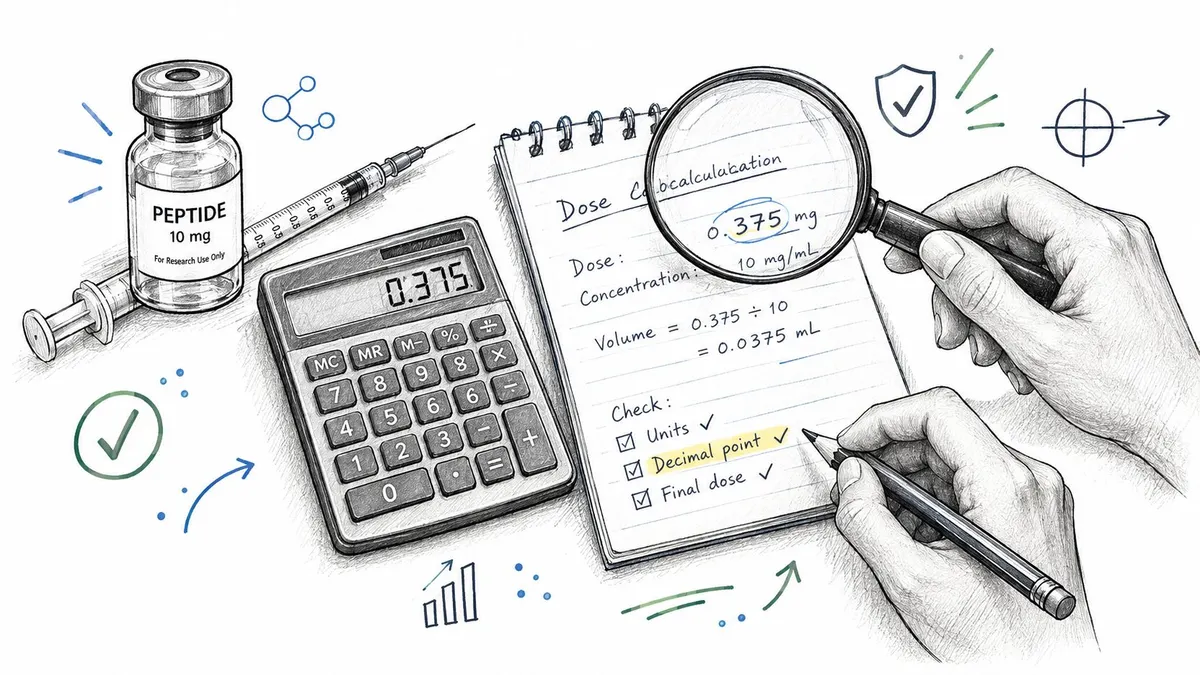
Decimal-point mistakes caused 43.5% of the dose-prescribing errors analyzed in one medication-safety review. Adding an extra zero caused another 31.5%, while omitting a zero caused 25%, according to the published analysis of dose-prescribing errors. In peptide protocols, those aren’t harmless slips. A misplaced decimal or incorrect conversion from milligrams to units or milliliters can turn a carefully planned dose into a tenfold dosing error.
Learning how to reduce math in peptide dosing isn’t about becoming faster at mental arithmetic. It’s about removing fragile calculations from the workflow, displaying units clearly, checking concentration before drawing, and using tools that preserve the same verified setup each time. The safest routine makes the correct action easy and the dangerous shortcut difficult.
Table of Contents
- Why Peptide Dosing Math Errors Cost You More Than Time
- The Three Conversion Paths Every Peptide User Must Master
- Manual Calculations Versus Smart Tools for Safer Dosing
- Building a Verification Routine That Catches Errors Before They Happen
- Designing Protocols That Minimize Repeated Calculation Errors
- Real Peptide Dosing Scenarios Where These Methods Prevent Mistakes
Why Peptide Dosing Math Errors Cost You More Than Time
Manual dosing errors usually begin with a small notation problem. A decimal lands in the wrong place, a zero disappears, or someone reads syringe units as though they were milligrams. The result can look plausible, especially when the final figure is written without the concentration, volume, and unit beside it.
Peptide protocols create several opportunities for this confusion because the same intended dose may be expressed through different measurement systems. A protocol can refer to a mass such as micrograms, a liquid concentration, a drawn volume, or syringe units. Each conversion introduces another point where a user can copy the wrong figure or apply the right formula to the wrong unit.
The risk becomes more serious when the calculation repeats. A user may reconstitute one vial, calculate a dose, adjust the volume for a new concentration, and repeat the process across a schedule. Every fresh calculation creates another chance to transpose a digit or misread a zero. Research on medication-calculation incidents identifies misplaced, omitted, and added decimal points as a common mechanism in tenfold errors, while NHS guidance highlights multi-step calculations and unit conversions as especially risky, as summarized in the peer-reviewed medication-safety research.

Why peptide workflows amplify small mistakes
A one-time arithmetic error is dangerous. A repeated protocol can make the same error recur because the user reuses an incorrect reference value. The practical problem isn’t only the calculation itself. It’s the absence of a stable record showing exactly how the concentration, target dose, syringe scale, and final volume relate.
A pharmacist-driven pediatric dose-rounding protocol illustrates the value of standardization. The published evaluation was designed to reduce rounding and decimal-place errors by moving doses toward standardized values, and it notes that pediatric medication errors involving dose calculation are reported as more likely than comparable errors in adults. The lesson transfers to peptide workflows: fewer improvised calculations mean fewer opportunities for ambiguous decimals.
Practical rule: Never record a final syringe setting without recording the target mass and concentration beside it.
People researching structured wellness routines may also benefit from separating dose safety from broader supplementation choices. A natural performance enhancer guide can provide general context, but it shouldn’t replace professional guidance or a verified dosing calculation. The immediate priority is to make every number traceable from the labeled concentration to the intended measurement.
The Three Conversion Paths Every Peptide User Must Master
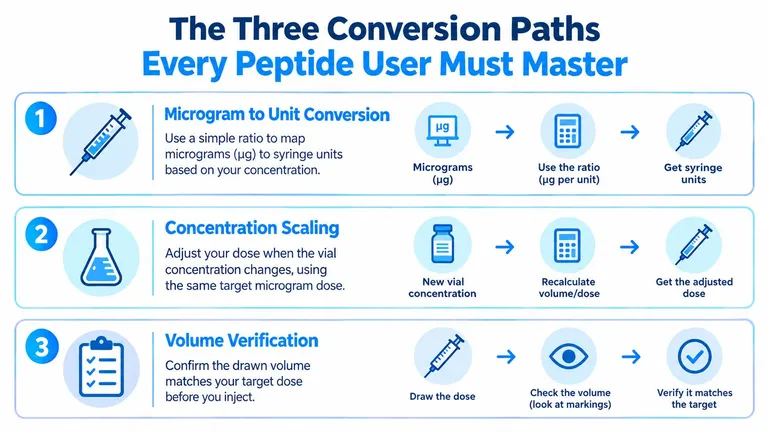
Most peptide dosing math follows three paths. Treat them as separate checks rather than one large equation.
Micrograms to syringe units
Start with the amount of peptide in the prepared liquid, not with the syringe markings. For example, if a vial contains a stated mass dissolved into a stated volume, first determine the mass per milliliter. Then divide the desired mass by that concentration to find the required liquid volume. Finally, translate that volume to the syringe scale being used.
A simple ratio works only when the syringe type and concentration are known. A setting that is correct on one syringe may not represent the same volume on another. Write the units at every stage: target micrograms, micrograms per milliliter, milliliters, and syringe units.
Concentration scaling
Changing the amount of diluent changes the concentration. If the peptide mass stays fixed but the liquid volume changes, the required injection volume must change as well. Don’t carry an old unit setting into a newly mixed vial.
For instance, a target dose calculated from a more concentrated preparation will require a smaller volume than the same target dose from a more diluted preparation. Recalculate from the new label information instead of adjusting the old result by memory. The microgram-to-unit conversion guide is useful for reviewing the relationship between mass, concentration, and syringe units.
Volume verification
The final check asks a different question: does the drawn volume correspond to the target dose? Confirm the vial concentration, syringe scale, and intended volume independently. Then inspect the decimal and zero placement before use.
A safe worksheet should show the full chain:
- Target mass: Write the intended amount with its unit.
- Prepared concentration: Record the peptide mass and final liquid volume.
- Calculated volume: Show the division that produces the required milliliters.
- Syringe setting: Convert the volume using the actual syringe scale.
- Final confirmation: Compare the result with the written protocol and label.
If any step produces an unexpectedly large or small result, stop and resolve the discrepancy with a qualified professional. Don’t correct an unfamiliar result by guessing.
Manual Calculations Versus Smart Tools for Safer Dosing
Manual math has a legitimate place. A simple, one-time calculation with a clearly labeled concentration can be manageable when the user writes every unit and checks the result. The weakness appears when the same calculation must be rebuilt repeatedly, or when a protocol contains several vials, concentrations, pauses, and schedule changes.
A calculator can perform division, but it won’t know whether the user entered milligrams where micrograms were required. Technology reduces risk only when the setup is accurate and the interface keeps the relevant units visible. A tool should support verification, not encourage blind acceptance of a result.
Choosing the right level of automation
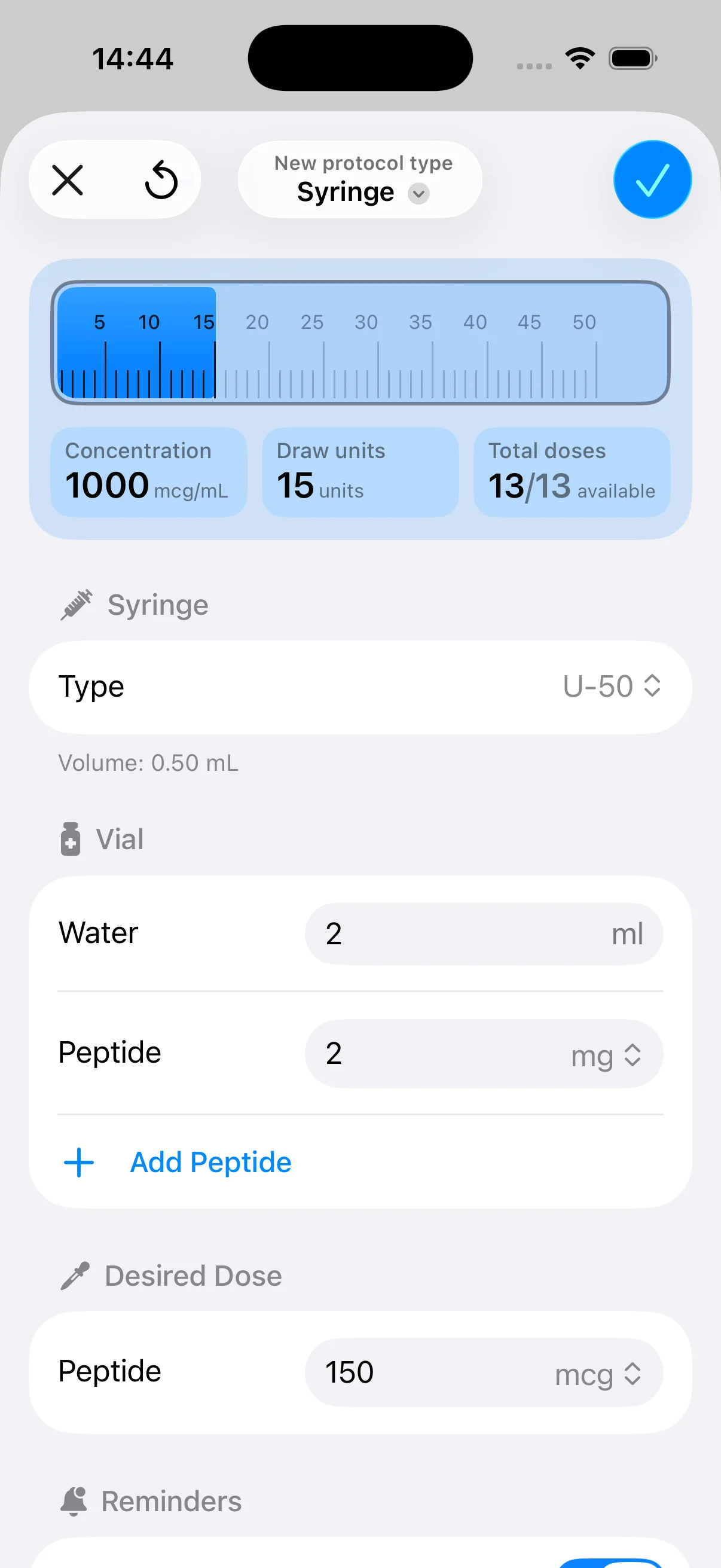
For occasional use, a written calculation sheet may be enough. For recurring protocols, a dedicated calculator can preserve vial details, reconstitution information, syringe type, and the resulting injection amount in one place. PepFlow is one example of an iOS app that calculates peptide dosage from vial and concentration settings, converts the result into syringe units, and supports recurring protocol scheduling and reminders. It should be treated as a planning and organization tool, not a substitute for medical advice.
| Method | Error Risk | Speed | Best For |
|---|---|---|---|
| Written calculation | Depends on unit discipline and independent checking | Moderate | A simple, clearly documented calculation |
| Basic calculator | Reduces arithmetic effort but not input mistakes | Fast | Rechecking a known formula |
| Spreadsheet | Reusable, but formulas and inputs require careful setup | Fast after setup | Structured records with stable inputs |
| Dedicated peptide calculator | Keeps concentration and syringe conversion together | Fast | Repeated protocols with changing vial details |
| Professional review | Adds an independent safety check | Depends on access | Unclear, unusual, or high-risk calculations |
The trade-off is straightforward. Manual methods offer transparency but demand attention every time. Dedicated tools offer consistency but can create false confidence if the vial information, concentration, or syringe selection is wrong.
A short demonstration can help users understand how a digital workflow handles the conversion sequence. Treat any tool demonstration as an explanation of process, not as authorization for a specific dose.
Before using any calculator, verify the source label, the intended dose, the reconstitution details, and the measurement device. Automation is most useful when it removes repeated arithmetic while leaving the critical inputs visible for review.
Building a Verification Routine That Catches Errors Before They Happen
The strongest routine targets the mistakes people make. Since decimal placement and zero handling account for a large share of analyzed prescribing errors, verification should focus on those details rather than relying on a general instruction to “double-check.”
Use the same sequence every time. Consistency matters because a familiar routine reduces the temptation to improvise when you’re tired or rushing.
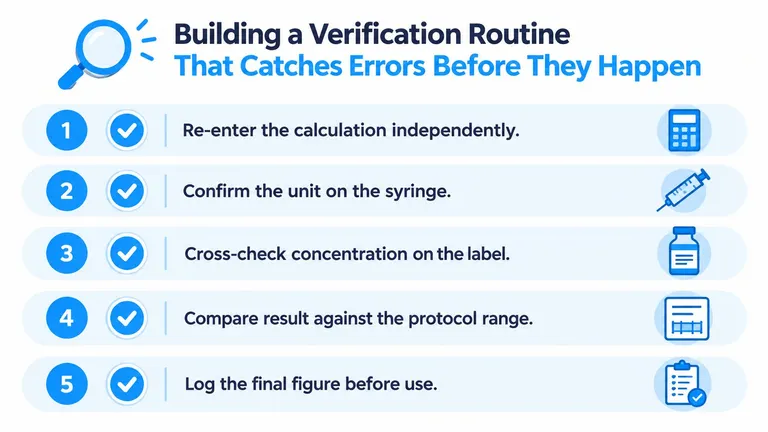
A five-point pre-use check
-
Re-enter the calculation independently. Start from the labeled concentration and target mass rather than copying the first result. If the second calculation differs, don’t average the figures. Find the input or unit mismatch.
-
Confirm the syringe unit. Read the marking on the actual syringe. A volume value and a unit value aren’t interchangeable unless the syringe scale supports that conversion.
-
Cross-check the concentration. Compare the vial label or preparation record with the concentration stored in the calculator or written worksheet. A new dilution requires a new calculation.
-
Compare the result with the protocol range. A result that looks dramatically different from previous entries deserves investigation. This check doesn’t prove that a dose is correct, but it can expose a misplaced zero or decimal.
-
Log the final figure before use. Record the target mass, concentration, volume, and syringe setting together. Don’t rely on a remembered unit mark for the next administration.
The guide to unit-conversion problems can help users recognize why a mathematically correct operation can still produce an unsafe result when the inputs use incompatible units.
Independent check: Ask another qualified person to review the inputs, not just the final number. Agreement is useful only when both people inspect the same concentration and units.
For home routines, a printed worksheet or locked template can prevent silent changes to the formula. A digital log can help with history and reminders, but it should preserve the original inputs so a later reviewer can reconstruct how the final figure was produced.
Designing Protocols That Minimize Repeated Calculation Errors
The safest protocol is the one that doesn’t force you to repeat avoidable math. Set up a single, clearly labeled record for each prepared vial. Include the peptide mass, diluent volume, resulting concentration, syringe type, target dose, and calculated volume. Keep those fields together rather than scattering them across messages, notes, and memory.
Then separate preparation from administration. Calculate and verify the prepared concentration before the first scheduled use. At each later dose, confirm the vial identity and record the administration, but don’t rebuild the entire equation unless the preparation or target has changed.
Reduce the number of decision points
A practical workflow can follow this order:
- Standardize the record: Use the same units and decimal format every time.
- Store the verified setup: Keep the concentration and syringe conversion with the vial record.
- Automate reminders: Let the schedule prompt the user instead of relying on memory.
- Recalculate after changes: Treat a new vial, dilution, syringe, or target as a fresh setup.
- Log immediately: Record what was prepared and used before moving on.
Repeated-step protocols need more than a correct first calculation. Research on medication incidents and NHS safety guidance both point to multi-step calculations and unit conversions as recurring risk points. A workflow that reduces repeated entry, preserves the original setup, and prompts confirmation addresses those risks more effectively than asking the user to concentrate harder each time.
Schedules can also change during titration or planned pauses, so a reliable record should distinguish the protocol plan from the dose logged. For readers following a structured GLP-1 routine, a resource on how to follow the Wegovy dosing plan may help clarify why schedule information and dose calculations should be managed as separate pieces of the workflow. Any medication-specific plan still requires professional guidance.
Real Peptide Dosing Scenarios Where These Methods Prevent Mistakes
Consider a user who has a prepared vial and a target written in micrograms, but the syringe is marked in units. The unsafe approach is to remember a previous unit setting. The safer approach is to calculate from the current concentration, convert the resulting volume using the actual syringe scale, and record all four values together. That process catches a mismatch before the user relies on a familiar-looking mark.
A second scenario involves a new vial mixed with a different amount of diluent. The peptide mass may be unchanged, but the concentration isn’t. Carrying forward the old injection volume can produce the wrong amount even when the arithmetic on the old worksheet was correct. A stored vial profile or dedicated calculator reduces this risk by making the new concentration an explicit input.
Repeated protocols expose workflow weaknesses
A third scenario is a protocol with recurring doses, pauses, and schedule changes. Recalculating every administration creates unnecessary opportunities for decimal and zero errors. A better system verifies the setup once, schedules the intended events, logs each actual dose, and triggers a fresh review whenever the vial, concentration, syringe, or target changes.
These examples share one lesson. Reducing math errors depends less on arithmetic talent than on system design. Clear units, standardized records, independent checks, and appropriate technology work together. No calculator can rescue an incorrect concentration, and no handwritten worksheet prevents every transcription mistake, but a disciplined workflow makes errors easier to detect before administration.
Mental arithmetic research also supports the broader value of checking confidence against actual accuracy. A longitudinal study found that better confidence calibration in Grade 5 predicted larger gains in mental arithmetic accuracy through Grade 8, while poor calibration distinguished children with mathematics learning disability from both low-achieving and typically achieving peers, as reported in the PLOS ONE study on calibration and arithmetic accuracy. In dosing, the adult equivalent is simple: confidence isn’t verification. The written inputs and independent check matter more than how familiar the calculation feels.
PepFlow keeps vial details, concentration math, syringe-unit conversion, protocol scheduling, reminders, and dose logs in one workflow, reducing the need to rebuild calculations from memory. Visit PepFlow to review how it can support a more consistent peptide dosing routine, while confirming every dose and preparation detail with a qualified healthcare professional.