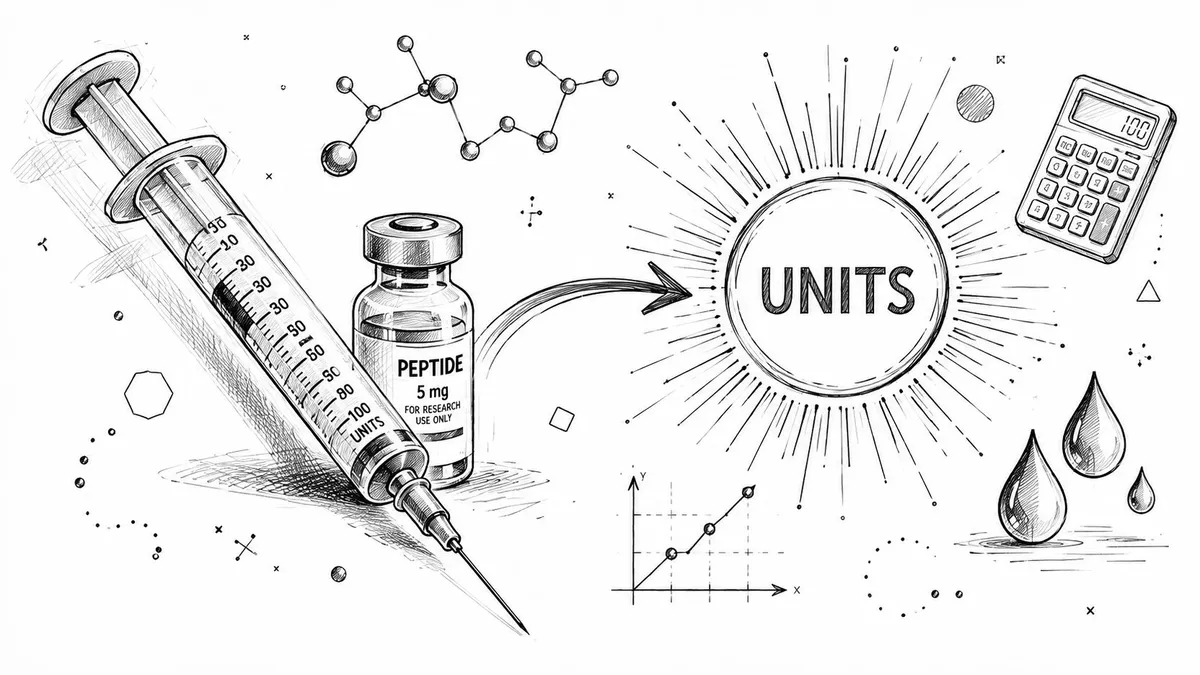
Have you ever seen the same dose written as mcg on one label and IU on another, then assumed there must be one clean, universal conversion? That assumption is where many people get tripped up, because microgram to IU conversion only works when the substance has a defined IU standard. For some vitamins, the math is fixed. For many peptide compounds, it isn’t valid at all.
Table of Contents
- What IU Actually Measures and Why Conversion Is Not Universal
- The Core Formula and How to Apply It Step by Step
- Working Through a Peptide Vial Example From Micrograms to Units
- Common Mistakes That Break the Conversion
- Where to Find Authoritative Conversion Factors
- Comparing Manual Math, Generic Converters, and PepFlow
- Putting It All Together for Accurate Peptide Calculations
What IU Actually Measures and Why Conversion Is Not Universal
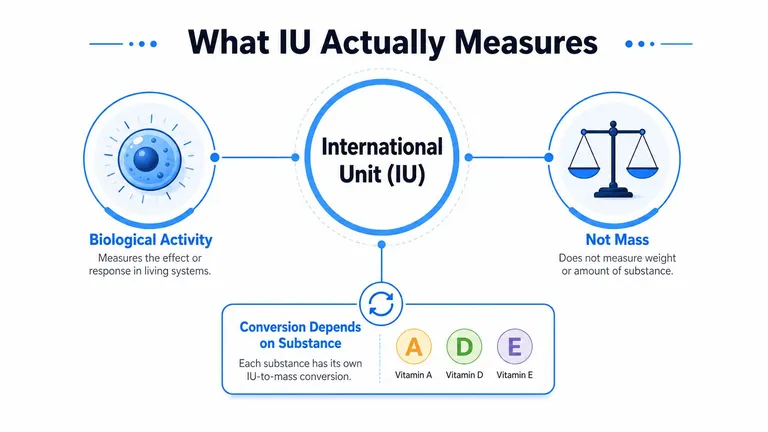
The first thing to clear up is simple, even if the labels make it feel complicated. IU does not measure mass. It measures biological activity, and that activity is defined separately for each substance, which is why one microgram value can map to very different IU values depending on what you’re holding.
Why the same microgram amount can mean different things
A vitamin D dose is the easiest place to see the rule. For vitamin D2 and D3, 1 mcg equals 40 IU, so 10 mcg becomes 400 IU, 20 mcg becomes 800 IU, and 25 mcg becomes 1,000 IU. Vitamin A retinol sits on a very different scale, where 1 mcg is about 3.33 IU, so the same 10 mcg is only about 33 IU. The spread is the point, because it shows that the unit is not doing the same job across substances. at-home vitamin D tests from Repose Healthcare can help people check status before they try to compare supplement labels by eye.
Practical rule: if you don’t know the substance and its official IU factor, you don’t know the conversion yet.
That’s also why reading labels from different eras gets messy. A vitamin label from one country may use mcg, another may use IU, and both may be correct for their own context. FDA labeling policy reflects that distinction for vitamins A and D, where labels must declare amounts in micrograms (mcg) rather than IU, which reduces ambiguity for consumers and manufacturers alike. The broader lesson is the one many newcomers miss, microgram to IU conversion is always compound-specific.
For people trying to interpret injection volumes, that same habit of checking the unit carefully matters in other parts of dosage work too. A practical primer on measuring syringe marks can help when the conversation shifts from labels to draw volumes, and one useful reference is this guide to reading insulin syringes.
The Core Formula and How to Apply It Step by Step
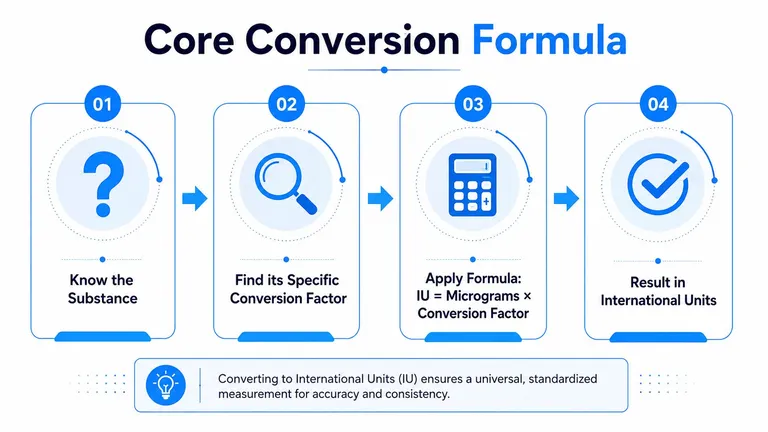
Once you know the substance has a real IU standard, the math is clean. The working formula is IU = micrograms × conversion factor. The factor is the part that matters, because it changes with the compound and the official standard behind it.
Vitamin D is the clearest anchor
For vitamin D, the accepted modern ratio is stable: 2.5 mcg = 100 IU, 5 mcg = 200 IU, 10 mcg = 400 IU, 15 mcg = 600 IU, and 20 mcg = 800 IU Omni Converters. That’s just another way of saying the conversion factor is 40 IU per mcg. If you start with micrograms, multiply by 40. If you start with IU, divide by 40.
Useful shortcut: vitamin D moves in clean steps because its IU system is tied to a fixed ratio, not a guess.
A quick example makes the logic feel less abstract. If a supplement lists 25 mcg of vitamin D, the IU value is 1,000 IU. If an older bottle lists 800 IU, the mass-based amount is 20 mcg. You’re not changing the substance, only the unit used to describe it.
Where the factor comes from
The factor exists because the IU was built around a biological reference standard, not a generic weight conversion. That’s why the factor has to be looked up, not assumed. For vitamin D, the ratio has stayed consistent across clinical review material and nutrition references, which is why the same numbers keep reappearing in labeling and supplement guidance.
If you work with doses frequently, a calculator built around the same arithmetic can save time, especially when you also need to think about concentration and volume. When switching between metric units, write out each conversion step and check the decimal position before calculating concentration or draw volume.
For anyone who likes to see the process visually, this short video mirrors the same math in a simple walkthrough.
A matching concentration guide also helps when the formula has to be carried into vial preparation. If you’re calculating final dose strength after reconstitution, this walkthrough of how to calculate final concentration fits the same logic.
Working Through a Peptide Vial Example From Micrograms to Units
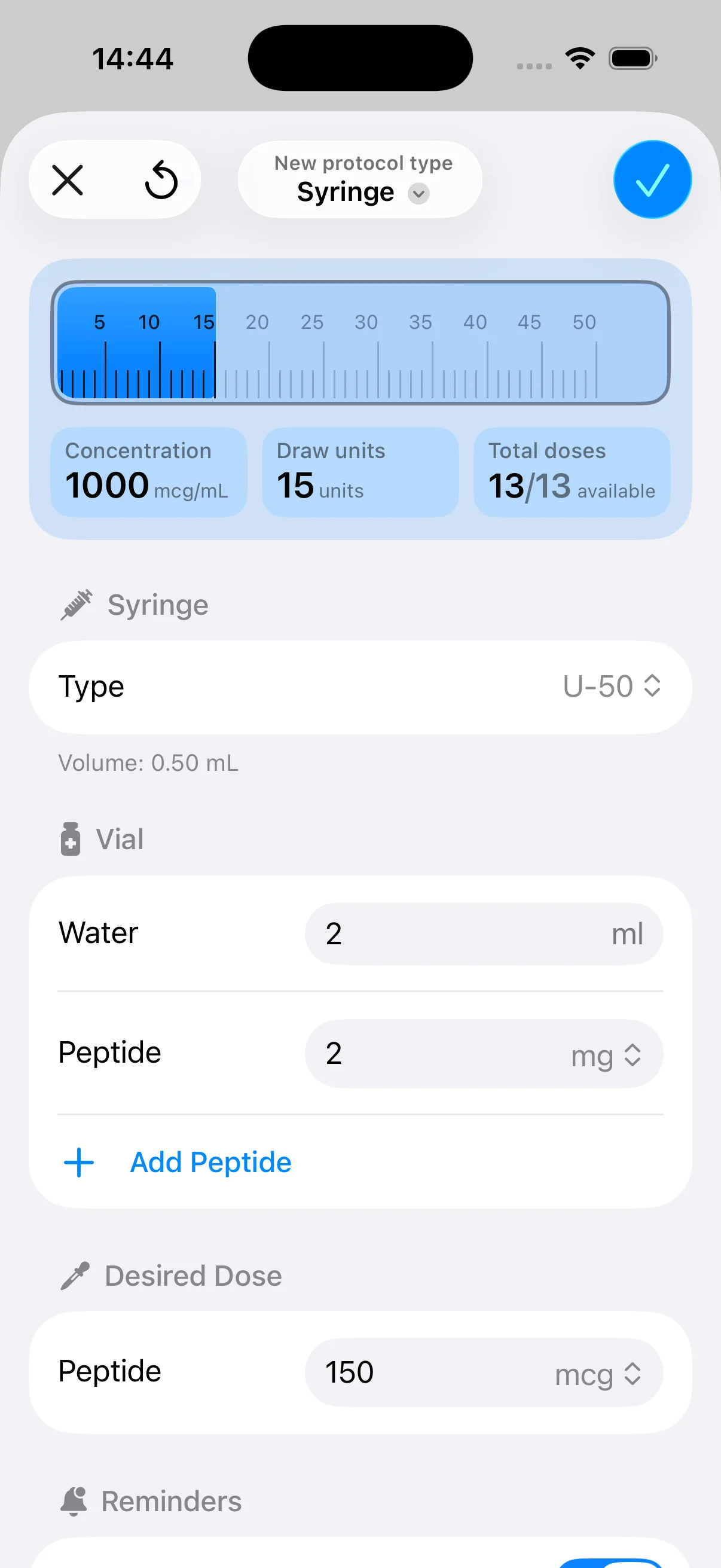
Peptide work often starts with micrograms, but the practical question is usually about volume. Suppose you have a 5 mg vial of lyophilized peptide reconstituted with 2 mL of bacteriostatic water. That gives a concentration of 2,500 mcg per mL. If you want a 250 mcg dose, you divide the desired dose by the concentration, which gives 0.1 mL.
From dose to syringe volume
That 0.1 mL is the number you measure, not an IU value. The syringe marks tell you volume, while the vial label tells you concentration. If your syringe is scaled in smaller unit marks, the point is to match the draw volume to the volume on the barrel, not to hunt for an IU conversion that may not exist.
A reconstitution reference can be useful here because the dose math only works when the concentration is known with confidence. This guide to how to reconstitute peptides gives the setup logic that has to happen before any draw calculation makes sense.
Why peptides usually don’t have a valid IU
Here’s the part that catches people off guard. Most research peptides don’t come with a standardized IU, because there’s no universal biological-activity reference for them the way there is for certain vitamins and hormones. Without that standard, any “mcg to IU” chart for a peptide is usually just a made-up number dressed up as precision.
If a peptide chart gives you an IU factor but doesn’t show a recognized reference standard, treat it as unverified.
So the safe workflow is different from vitamins. With peptides, stay with micrograms, milliliters, and syringe markings unless the compound has a legitimate IU standard from an authoritative source. If it doesn’t, the IU question is meaningless, even if a forum post or spreadsheet says otherwise.
Common Mistakes That Break the Conversion
Most conversion errors come from people trying to force one rule onto the wrong substance. The math itself is usually fine. The bad assumption is the problem.
The four traps that show up most often
- Assuming one universal factor: A vitamin D ratio does not apply to a peptide, and a peptide chart does not apply to vitamin A. If the compound changes, the factor can change too.
- Mixing vitamin A formats: Labels may use RAE or RE instead of IU, and those are not the same thing as a simple mass-to-IU swap. That’s where people end up comparing numbers that were never meant to match.
- Ignoring salt versus free-base form: Some compounds are weighed as a salt form, which changes the mass you’re looking at even when the active ingredient name sounds familiar.
- Trusting unverified peptide charts: A table that floats around social media or a message board can look neat and still be wrong, especially if it invents an IU factor with no biological standard behind it.
How to sanity-check the number
The fastest check is to ask three questions. What is the substance? What standard defines its IU, if any? What source published the factor? If you can’t answer all three, pause before using the number in a dose calculation.
A wrong factor can throw the result off by a wide margin, especially when someone copies a value from the wrong class of compound. That’s why a calm check is better than fast math under pressure.
Sanity test: if the source can’t explain where the factor came from, don’t treat the factor as real.
Where to Find Authoritative Conversion Factors
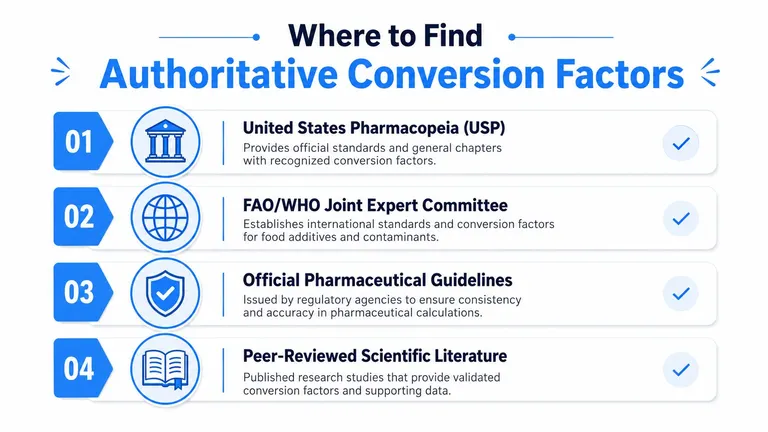
The safest conversion factor is the one you can trace. For nutrition and pharmaceutical work, that usually means the United States Pharmacopeia, FAO/WHO expert committee reports, peer-reviewed bioassay literature, and product certificates of analysis when they’re available and relevant.
What a credible source usually looks like
A reliable source names the substance, defines the standard, and explains the measurement basis. It doesn’t just drop a round number into a table and move on. If you see a factor with no provenance, especially one that claims to work across unrelated compounds, that’s a red flag.
What should make you skeptical
- Round numbers with no context: If the factor appears magically exact but has no reference standard, question it.
- Tables that lump unrelated substances together: IU systems are not interchangeable across compounds, so grouping them together is usually a sign the author didn’t check the standard.
- Numbers that conflict with official labeling: If a factor contradicts a recognized monograph or label requirement, the published chart is the one that should lose the argument.
The point isn’t to memorize every factor. The point is to know where a factor comes from before you rely on it. That habit matters because the internet repeats old tables long after better standards have taken over.
Comparing Manual Math, Generic Converters, and PepFlow
Manual math still has a place. If you’re converting a vitamin D label once, a pocket calculator and the correct factor are enough. The problem starts when the calculation includes vial concentration, reconstitution volume, repeated doses, and schedule tracking.
Three ways people handle the same task
Manual calculation is the most flexible and the easiest to mess up. You can do it on paper, but every step depends on you remembering the right factor and carrying the decimals correctly.
Generic online converters are useful for common vitamins. They’re quick, but they usually stop at simple IU-to-mcg questions and don’t understand a peptide vial, a concentration setup, or a dosing protocol.
A peptide-focused app like PepFlow is built for the workflow where micrograms, vial configuration, and dose planning all need to stay aligned. Its calculator supports micrograms (mcg) and IU as selectable units, and it also handles mg, mcg, mL, and IU in the same planning environment, which helps when a regimen uses multiple unit types.
Choosing the right tool for the job
If you only need a one-time vitamin conversion, a simple calculator is fine. If you’re preparing ongoing peptide protocols, a tool that stores vial settings, reminders, and dose history is more practical than redoing the same arithmetic every time. That’s the line that separates a conversion widget from a dosing workflow.
The best tool is the one that matches the measurement problem you have, not the one with the flashiest interface. When the question is substance-specific and repeated over time, consistency matters more than speed.

Putting It All Together for Accurate Peptide Calculations
Accurate conversion starts with the same three decisions every time. First, identify the compound. Second, confirm whether it has a real IU standard and what factor belongs to it. Third, choose the right tool for the task, whether that’s manual math, a generic converter, or a peptide planning app.
For vitamins like D, the ratio is fixed and the math is straightforward. For most research peptides, IU is usually not a valid unit at all, so the safer move is to stay in micrograms and convert only into the volume you’ll draw.
That’s the habit worth building. Check the substance, check the source, check the factor, then do the calculation. If the factor can’t be verified, the smartest answer is to leave the IU out of it.
If you’re planning peptide doses regularly, PepFlow can help you keep the vial math, concentration settings, and dosing schedule organized in one place. Visit PepFlow to see how its calculator and protocol tools fit a microgram-based workflow without forcing a fake IU conversion.