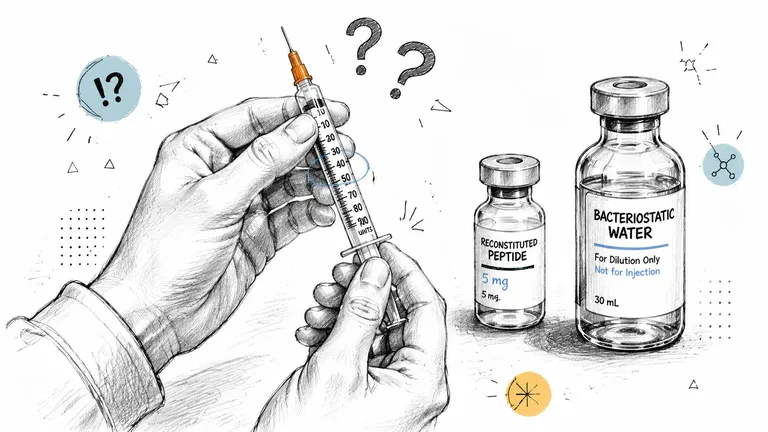
You’ve mixed a peptide vial with bacteriostatic water, checked the target dose, and picked up an insulin syringe. The vial may list the medication in milligrams, the desired dose may be in micrograms, the liquid may be measured in milliliters, and the syringe may be marked in units. The arithmetic may look simple, but the labels don’t speak the same measurement language.
That’s the practical meaning of what is unit conversion: translating a measurement from one unit into another while preserving the actual quantity. A correct conversion changes the representation, not the amount. In dosing, that distinction matters because a mistake between micrograms and milligrams, or between milliliters and syringe markings, can make a calculated draw look reasonable while representing a very different dose.
Table of Contents
- Why Unit Conversion Matters in Everyday Decisions
- The Core Mechanics of Unit Conversion
- Common Conversion Mistakes and Their Real Costs
- Practical Examples for Dosing and Concentrations
- Manual Calculation Versus Conversion Tools
- Building Reliable Conversion Habits
Why Unit Conversion Matters in Everyday Decisions
Suppose a person reconstitutes a peptide vial with 2 mL of bacteriostatic water and wants to draw 250 mcg using an insulin syringe marked in units. The immediate question is not just “what number do I multiply?” It’s whether the vial strength, liquid volume, desired amount, and syringe scale have all been connected correctly.
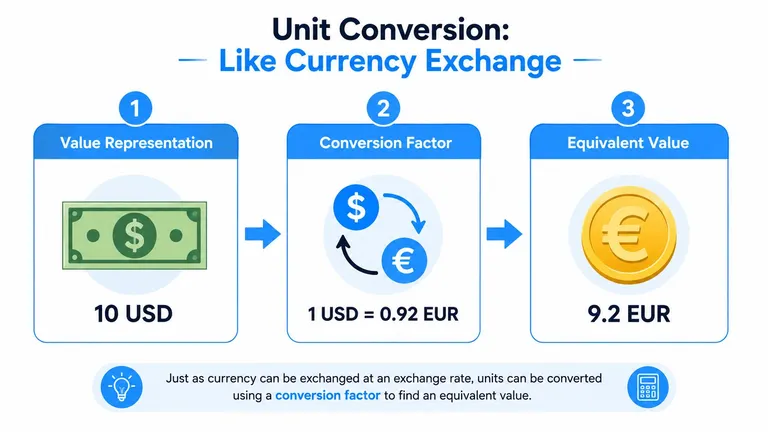
Unit conversion appears whenever two measurements describe the same quantity in different forms. A recipe may use teaspoons while a measuring jug uses milliliters. A travel distance may appear in miles while a map uses kilometers. A laboratory protocol may specify grams while a balance displays milligrams. The conversion preserves the amount while changing the unit used to communicate or measure it.
Every conversion has three parts:
- Starting unit: What you have, such as milligrams or milliliters.
- Target unit: What you need, such as micrograms or syringe units.
- Conversion factor: The bridge that relates the two units.
That bridge must describe equivalent quantities. The metric system made this kind of translation more consistent by replacing many local measures with a decimal framework. France officially adopted the metric system in 1795, and the metre was initially defined in relation to Earth’s meridian, with a practical realization following in 1799. The system later expanded internationally, and the International System of Units, or SI, was created in 1960 with seven base units for global scientific and commercial use. You can review that history in the history of the metric system.
The same standardization supports modern dosing calculations. It lets a person relate a vial labeled in milligrams to a target written in micrograms, then connect that amount to a liquid concentration and a syringe scale.
Safety principle: A conversion should always show where the number started, where it’s going, and which factor connects the two.
An insulin syringe marking isn’t automatically a medication dose. It represents a volume scale. The medication amount inside that volume depends on concentration, so the conversion must account for both the liquid volume and the quantity of compound dissolved in it. If you’re unsure whether international units, milligrams, or another measurement refers to the same thing, review the explanation of IU and mg and confirm the medication-specific instructions with a qualified professional.
The Core Mechanics of Unit Conversion
A dosing label can turn a small reading mistake into a large calculation error. For example, a vial may list a peptide amount in milligrams, while the intended dose uses micrograms and the syringe displays volume. Unit conversion provides the links between those descriptions while keeping the measured quantity equivalent.
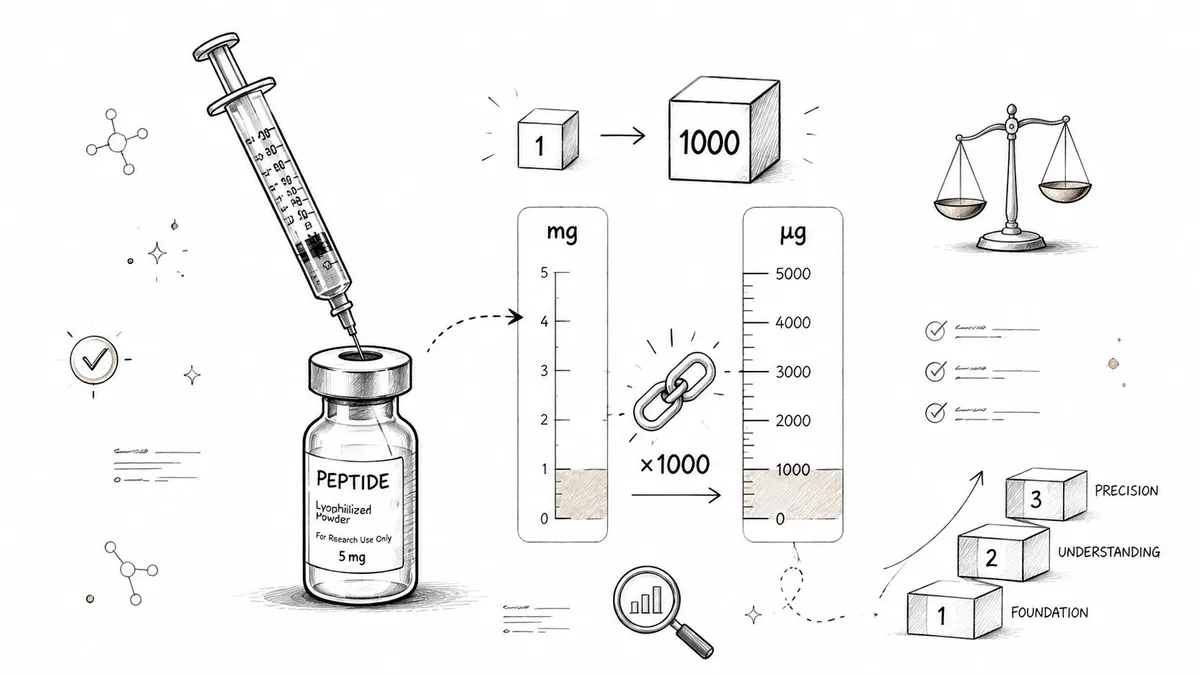
A unit is a standardized way to express measurement. A gram expresses mass, a liter expresses volume, and a meter expresses length. A conversion factor is a ratio that states an equality between units. For mass, 1 mg = 1000 mcg connects milligrams with micrograms.
How dimensional analysis works
Dimensional analysis arranges units so the unwanted label cancels. Write the amount you have, then multiply by a conversion factor with the original unit in the opposite position.
To convert 0.5 mg to micrograms:
0.5 mg × (1000 mcg / 1 mg) = 500 mcg
The two “mg” labels cancel:
0.5 mg × (1000 mcg / 1 mg) = 500 mcg
Only mcg remains, matching the target unit. That cancellation checks the setup. If the units do not cancel cleanly, the factor may face the wrong direction, or the calculation may involve a different category, such as area, temperature, volume, or concentration.
The NIST guide to SI conversion factors supports exact factors where available, algebraic unit cancellation, and a final reasonableness check. These habits become more valuable when a peptide calculation chains several steps, or when a microgram value is mistaken for a milligram value.
Chaining more than one conversion
A dosing calculation may require several bridges:
desired mass → liquid volume → syringe marking
Each step preserves its own units. A mass-to-volume calculation uses concentration, while a volume-to-syringe calculation uses the syringe scale. Temperature and area require their own rules, too. A length factor cannot be transferred directly to square units, and temperature conversions must account for the relationship between scales and their offset.
A reliable calculation should answer four questions:
- What unit is printed on the vial?
- What unit describes the intended dose?
- What unit describes the concentration?
- What unit does the syringe display?
The final concentration calculation guide can help organize the concentration step. Check its units against the actual vial and syringe before using the result. A calculator performs the arithmetic, but it cannot detect a misread label, an incorrect unit category, or a microgram-to-milligram mix-up.
Common Conversion Mistakes and Their Real Costs
Many conversion errors happen because people recognize the numbers but overlook the category. A familiar-looking value invites a shortcut, and the shortcut can produce an answer that appears plausible.
The most serious dosing example is the microgram versus milligram mistake. The prefixes look similar, but they represent different scales. Confusing them can create a major dose discrepancy. The NIST-linked summary of conversion-error cases describes failures across engineering, aviation, and finance, including the Mars Climate Orbiter loss involving pound-force-seconds and newton-seconds, an Air Canada fuel emergency involving pounds and kilograms, and a carbon-offset overpayment involving short tons and metric tons.
Why category mistakes survive quick checking
Length, area, volume, temperature, and concentration each follow different rules. A person who knows how to convert meters to feet may incorrectly apply the same logic to square meters and square feet. But area contains two length dimensions, so the conversion factor must be applied to the squared unit, not treated as a simple length label.
Temperature creates another trap. Celsius and Fahrenheit have both a scale relationship and an offset. A simple multiplication-only approach ignores that offset, so the result can be wrong even when the multiplication itself is flawless.
Concentration creates a different kind of confusion. mg/mL describes mass per volume. It isn’t interchangeable with the total mass in a vial or the total liquid volume after reconstitution. A dose draw requires the relationship between the desired mass and the concentration, not just one of those values alone.
| Mistake Type | Cognitive Shortcut | Potential Consequence |
|---|---|---|
| Micrograms confused with milligrams | Treating similar abbreviations as equivalent | A substantially different dose than intended |
| Length used for area | Applying a one-dimensional factor to a squared measurement | Incorrect surface-area result |
| Length logic used for volume | Converting only one dimension | Incorrect volume result |
| Temperature treated as simple multiplication | Ignoring the offset between scales | Incorrect storage, process, or environmental setting |
| Concentration confused with total amount | Treating mg/mL as the vial’s total mass | Incorrect liquid volume or syringe draw |
| Mixed units left in a formula | Assuming the calculator will interpret labels correctly | A plausible-looking but invalid result |
A disciplined setup catches these problems before arithmetic begins. Write the units beside every value, use a factor that cancels the starting unit, and make sure the final unit matches the action you’re about to take.
A sensible number can still be the wrong answer if it carries the wrong unit.
Practical Examples for Dosing and Concentrations
A vial holds 5 mg of peptide and is reconstituted with 2 mL of liquid. The calculation below demonstrates the path from labeled amount to syringe marking. It does not recommend a dose or replace prescribing instructions.
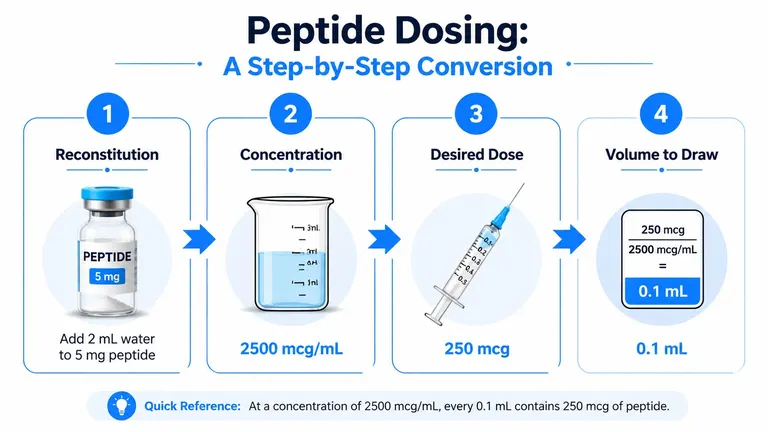
Step one, calculate the concentration
Convert the vial amount into micrograms:
5 mg × (1000 mcg / 1 mg) = 5000 mcg
Divide that amount by the liquid volume:
5000 mcg ÷ 2 mL = 2500 mcg/mL
The concentration is 2500 mcg/mL. Each milliliter of this preparation contains 2500 micrograms, so the unit label gives the number its practical meaning.
Step two, find the volume for the target amount
For a target of 250 mcg:
250 mcg ÷ (2500 mcg/mL) = 0.1 mL
The micrograms cancel, leaving a volume in milliliters. The result still needs to be translated into syringe markings according to the device scale.
Step three, translate volume into syringe units
If the syringe scale defines 100 units per mL:
0.1 mL × (100 units / 1 mL) = 10 units
The milliliters cancel, leaving 10 syringe units. Confirm the actual syringe scale and device instructions first, because markings can differ.
The full calculation can also appear as one visible chain:
250 mcg × (1 mL / 2500 mcg) × (100 units / 1 mL) = 10 units
Both cancellations remain visible, along with the assumptions about concentration and syringe scale.
For a solution labeled 10 mg/mL, a 250 mcg target requires conversion into milligrams first:
250 mcg × (1 mg / 1000 mcg) = 0.25 mg
Then calculate the volume:
0.25 mg ÷ (10 mg/mL) = 0.025 mL
The mcg-to-mL conversion guide shows the same formula structure. Product labeling and professional instructions determine actual administration. Confirm the syringe scale before converting the volume into markings.
Before drawing anything, check the vial label, concentration, reconstitution volume, syringe type, and target amount. Ask: Does the answer end in the unit I need, and did every unwanted unit cancel?
Manual Calculation Versus Conversion Tools
A peptide vial can produce a neat, plausible answer that is still unsafe. The error may begin with micrograms versus milligrams, a mistaken concentration, or a syringe scale treated as a volume. Manual calculation and digital tools address different parts of the problem. Writing the units out exposes the relationship. A tool speeds up arithmetic. Neither can correct a wrong category or a misread label.
Manual work is most useful when setting up a dosing calculation or checking an unfamiliar product. Record the vial amount, liquid volume, concentration, target dose, and syringe scale on separate lines. Follow each unit through the calculation. This can reveal that a target is in micrograms while a calculator expects milligrams, or that a marking has been entered as milliliters. It also helps distinguish length from area. A square measurement cannot use the same factor as a single length, just as a temperature difference cannot be handled like a direct mass conversion.
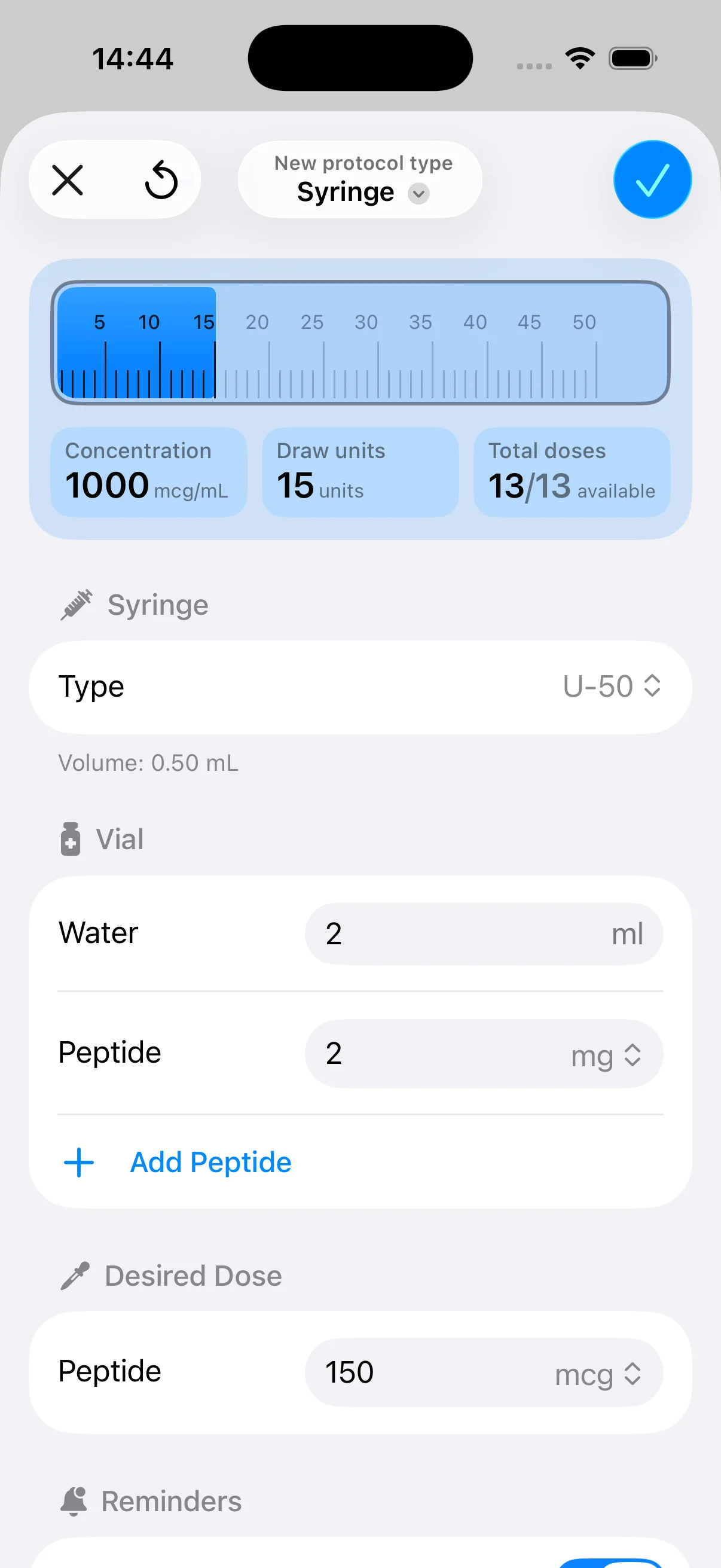
Use a conversion tool after the inputs are clear. It can repeat a formula consistently, compare concentrations, and reduce arithmetic mistakes. PepFlow, for example, provides a peptide dosage calculator that accepts vial amount and bacteriostatic water volume, calculates concentration, and converts a target dose into insulin-syringe units. It also supports switching between milligrams and micrograms. Each entry still needs comparison with the vial label and prescription instructions.
| Approach | Best Use Cases | Risk Factors | Verification Method |
|---|---|---|---|
| Manual calculation | Learning, first-time setup, critical review | Transcription or arithmetic mistakes | Show every unit and cancel factors |
| Calculator or app | Repeated calculations and routine planning | Wrong field, wrong scale, or wrong unit selection | Recalculate one result manually |
| Spreadsheet | Documented protocols and adjustable assumptions | Formula copied into the wrong row or cell | Inspect formulas and test known values |
| Built-in conversion feature | Fast display changes and standard conversions | Hidden defaults or category mismatch | Confirm source and target categories |
A tool can return a polished result when its settings are wrong. Selecting mg instead of mcg may create a number that looks reasonable while changing the dose by a large factor. A length conversion applied to area produces a formatted answer with the wrong meaning. Entering total vial volume where concentration is required can also make an incomplete setup appear finished.
Use software for repetition, then manually verify any high-stakes calculation. Check the input category, concentration, target unit, and syringe scale. Recalculate one result independently, and stop if the magnitude conflicts with the product instructions.
Use the calculator to reduce repetition, not to outsource judgment.
Building Reliable Conversion Habits
A peptide dose can look correct and still be wrong if the unit category or scale changed. Before handling a syringe, write the calculation with the original units visible. This record shows whether an error entered through vial strength, concentration, target dose, or syringe markings.
Keep a personal reference sheet for repeated conversions, but use it only as a check against the current label. Include unit relationships, the concentration formula, and the syringe scale. If the preparation volume, product, or device changes, calculate the draw amount again. An old volume may no longer match the new concentration.
Use this protocol:
- Write it out: Record every value with its unit and show each conversion factor.
- Verify the category: Confirm whether the measurement is length, area, volume, mass, temperature, or concentration. A length factor cannot convert square units, and temperature offsets require more than multiplying by a ratio.
- Check dose prefixes: Distinguish micrograms from milligrams before calculating. A misplaced prefix can change a peptide dose by a large factor.
- Check the final unit: Confirm that the result ends in milliliters or syringe units when that is the required output.
- Review the magnitude: If the result conflicts with the label or prescription instructions, stop and investigate.
- Invite a second check: Have a qualified person review a high-stakes setup before administration.
Carry full precision through intermediate steps and round only at the end. Rounding too early can shift the final liquid-volume result.
PepFlow lets users enter vial strength and liquid volume, calculate concentration, and convert a target microgram amount into syringe markings. Verify every result against the product label and qualified medical guidance.