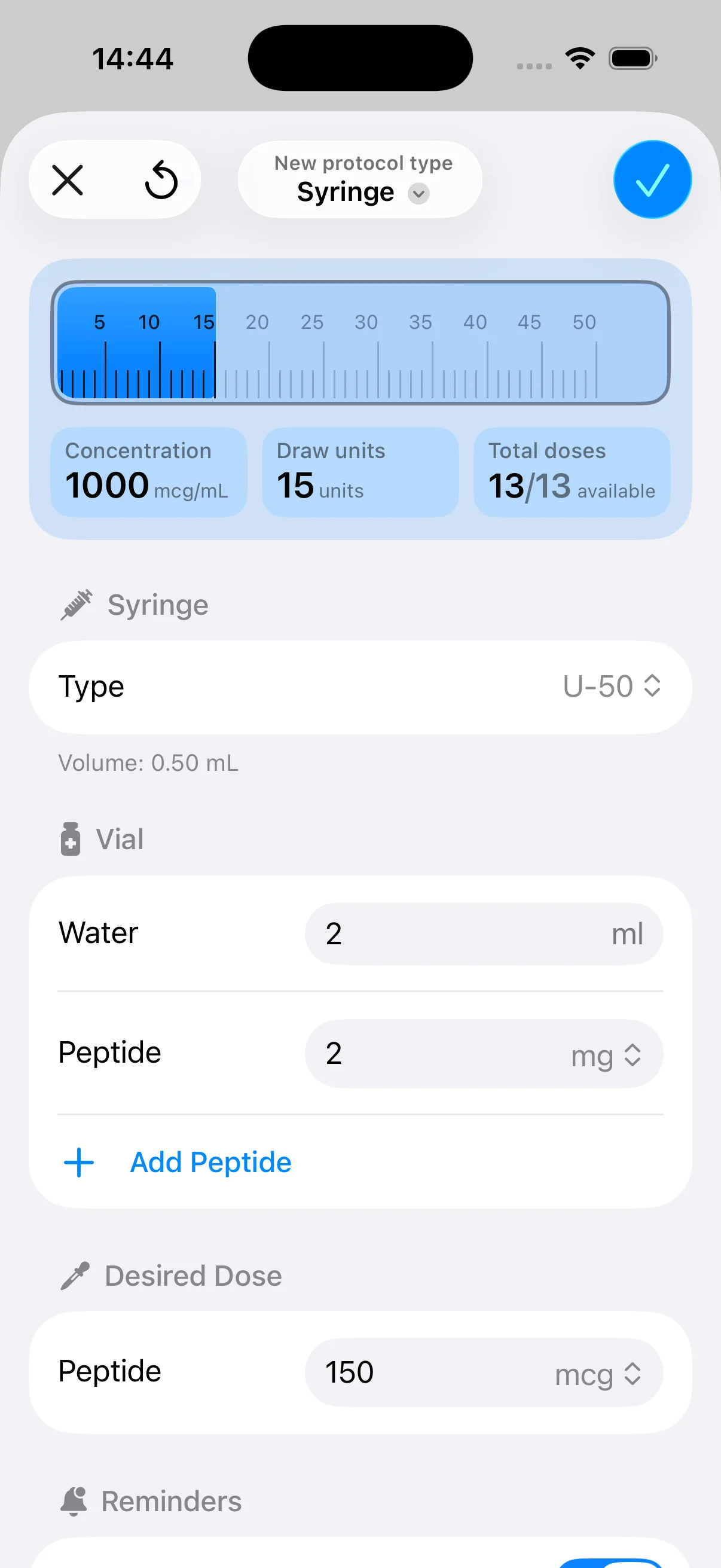
You’re standing there with a tiny vial, a syringe, and a calculator that’s making everything feel more complicated than it should. The math itself isn’t the hard part. The hard part is knowing whether the number you got is safe to draw, or whether it only looks right because you missed one small detail.
Reconstitution med math is the set of calculations that turns a powder and a diluent into a liquid you can measure accurately. In pharmacy references, the core relationship is simple, concentration = mass divided by volume, and dose volume = target dose divided by concentration. That’s the foundation for every draw you make, whether you’re mixing a peptide, reading a vial label, or deciding how many syringe marks to pull.
Table of Contents
- What Reconstitution Med Math Means
- Converting Micrograms, Milligrams, and Syringe Units
- Choosing Diluent Volume and Reading Vial Labels
- Worked Examples for Real Dosing Scenarios
- Sanity Checks That Catch Plausible But Wrong Math
- Keeping Math Accurate Across a Multi-Week Protocol
- Recap and Common Questions About Reconstitution Math
What Reconstitution Med Math Means
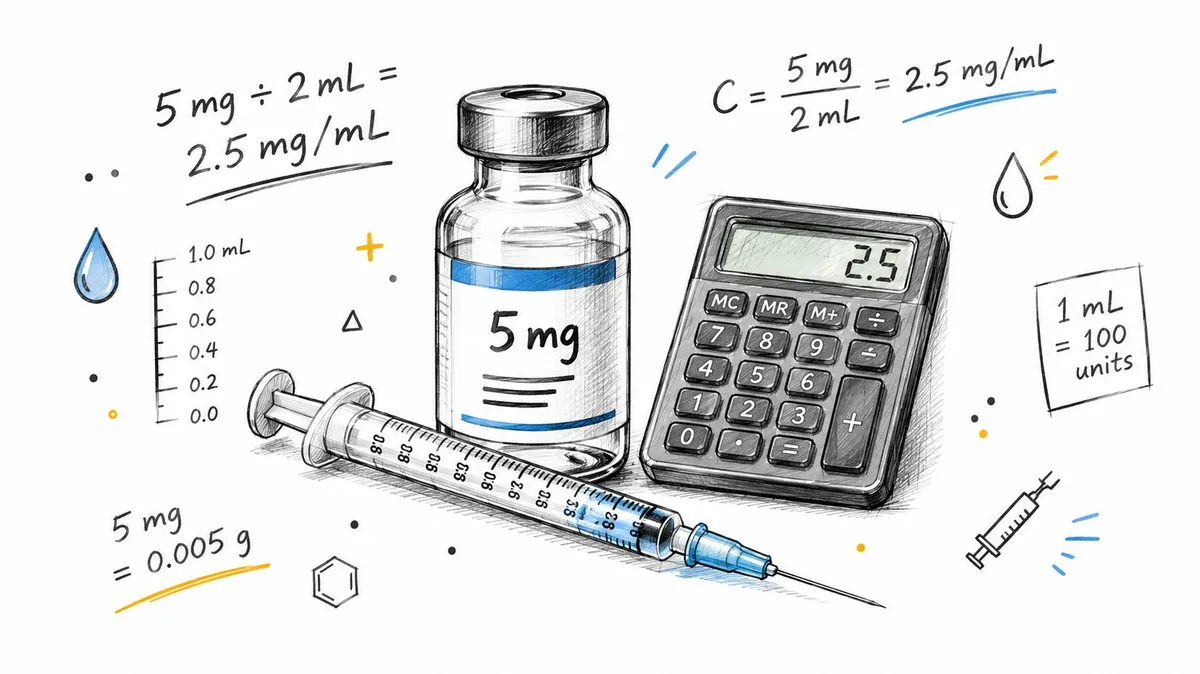
You start with a vial that says 5 mg and a syringe of bacteriostatic water. After the powder is mixed, you need one number before you draw anything, the concentration. If you add 2 mL of diluent, the math is 5 mg ÷ 2 mL = 2.5 mg/mL, which is the same as 2,500 mcg/mL because 1 mg = 1,000 mcg. That conversion matters because peptide doses are often written in micrograms, while the vial label is often in milligrams.
Now use that concentration to find the draw volume. If the target dose is 250 mcg, the formula is 250 mcg ÷ 2,500 mcg/mL = 0.1 mL. On a 1 mL insulin syringe, that is 10 units. The math is straightforward, but the safety step comes right after it, before any needle moves.
Pause here. Check that the number you solved for matches the unit printed on the syringe barrel. If you solved in milliliters, read the syringe in milliliters or convert it cleanly before you draw.
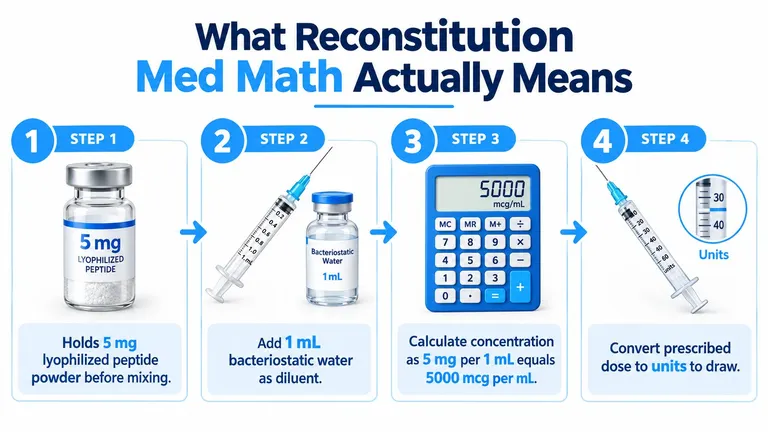
The nursing calculation reference for reconstituted medication uses the same framework, and it shows why the final prepared volume matters, not just the liquid added. A vial can end up with more final volume than diluent alone because the powder occupies space after mixing, so real-world reconstitution math has to follow the prepared solution, not a shortcut guess (OpenRN reconstituted medication calculations/05:_Math_Calculations/5.10:_Reconstituted_Medication)).
The habit to build is simple. Read the vial, compute the concentration, solve for the draw volume, then stop and ask whether the result looks like something you would expect to see on the syringe. That last check catches the plausible-but-wrong answer before it reaches the needle.
Converting Micrograms, Milligrams, and Syringe Units
The cleanest way to reduce math anxiety is to keep the unit ladder visible. 1 mg = 1,000 mcg, and 1 mL = 1,000 microliters. Those conversions let you move between vial labels, dose targets, and syringe markings without guessing. The math doesn’t care which unit you start with, as long as you stay consistent all the way through.
A standard 1 mL insulin syringe is marked as 100 units, and each unit equals 0.01 mL. A 0.5 mL insulin syringe is marked as 50 units, also at 0.01 mL per unit. That’s where people get tripped up, because units are tied to syringe size, not to the drug itself. A draw that makes sense on one barrel can be misleading on another.
Use one full chain for every conversion. If a vial is 5 mg reconstituted in 2 mL, the concentration is 2.5 mg/mL, or 2,500 mcg/mL. A 250 mcg target dose becomes 0.1 mL, which equals 10 units on a 100-unit syringe. Write it like this on paper:
250 mcg ÷ 2,500 mcg/mL = 0.1 mL = 10 units
That line shows the whole path, from dose mass to liquid volume to syringe mark. If any part of that chain feels off, stop and re-check the units before touching the syringe.
Practical rule: mL and units are not interchangeable across every barrel. Always confirm whether you’re holding a 100-unit or 50-unit syringe before you trust the mark.
For a tighter walkthrough of dose-to-barrel conversion, see PepFlow’s mcg-to-units guide.
| Target Dose | Concentration | Volume in mL | Ticks on 100-unit (1 mL) syringe | Ticks on 50-unit (0.5 mL) syringe |
|---|---|---|---|---|
| 250 mcg | 2,500 mcg/mL | 0.1 mL | 10 | 10 |
Choosing Diluent Volume and Reading Vial Labels
A vial does not carry one fixed concentration until you add diluent. The amount of bacteriostatic water you choose sets the math for everything that follows, so the first question is always, “How much did I add?” Then ask, “What concentration does that create?”
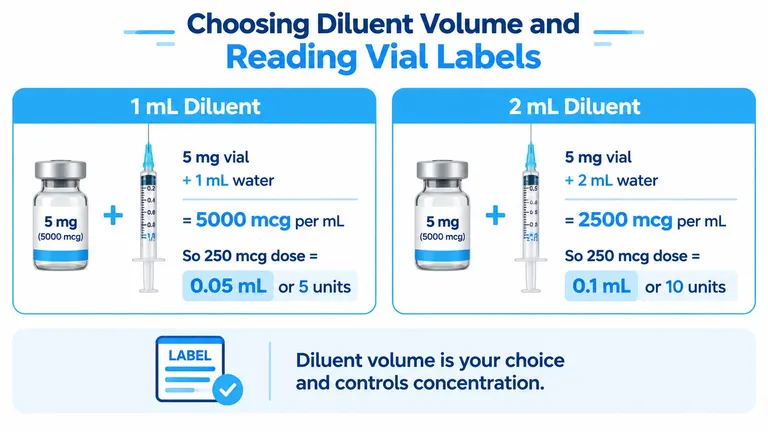
Start with the vial label, then the reconstitution instructions. A 5 mg vial mixed with 2 mL gives 5 mg ÷ 2 mL = 2.5 mg/mL, or 2,500 mcg/mL. A 250 mcg dose from that vial is 0.1 mL, which is 10 units on a 100-unit syringe. If you mix the same vial with 3 mL, the concentration changes to 5 mg ÷ 3 mL = 1.667 mg/mL, or about 1,667 mcg/mL. The same 250 mcg dose then becomes about 0.15 mL, or 15 units.
That is the point where people often pause. The dose stayed the same, but the draw changed because the liquid became more dilute. If you reuse a number from a different diluent volume, you may still get a believable answer, just not the right one.
Reading the label correctly matters just as much as doing the division. Pull the mass from the vial label and the diluent volume from the instructions, not from memory, habit, or the syringe barrel. For help deciding how much diluent to use, see PepFlow’s reconstitution solution guide. That is the moment to stop and double-check before you mix, because the label and the added volume have to match the math you plan to use.
Write the final concentration on the vial as soon as you finish mixing. That small note saves time later when you are comparing strengths or checking a vial after a break in your routine.
For a tighter breakdown of how volume choice affects the final number, see PepFlow’s final concentration guide.
Worked Examples for Real Dosing Scenarios
A dose can look reasonable and still be wrong if you skip the full path from vial to syringe. These examples walk that path end to end, so you can see the number, then pause and ask whether it fits the vial you mixed.
A single 250 mcg morning dose
Start with the same 5 mg vial and 2 mL of bacteriostatic water. The concentration is 2.5 mg/mL, or 2,500 mcg/mL. Now solve the dose: 250 mcg ÷ 2,500 mcg/mL = 0.1 mL. On a 100-unit syringe, that is 10 units.
That is the point to stop and check the answer against the vial label. If you expected a tiny draw and landed on a full line or nearly nothing, the math needs a reset before anything goes into the syringe.
Splitting the dose into two smaller injections
If the same 250 mcg is split into 125 mcg twice daily, the concentration stays the same. The calculation uses a smaller target dose each time. 125 mcg ÷ 2,500 mcg/mL = 0.05 mL, which is 5 units on a 100-unit syringe.
The smaller number can feel off at first. It is still the correct draw if the concentration is unchanged. Check the syringe type, then confirm that the line you are about to draw matches the number you just solved.
When only part of the vial remains
Partial vials require a fresh calculation because the remaining volume changes what is left in the container. If 1.2 mL of a solution made from 5 mg in 2 mL remains, the remaining amount is 3 mg. Using the same concentration logic, a 200 mcg dose is 200 mcg ÷ 2,500 mcg/mL = 0.08 mL, which is 8 units on a 100-unit syringe.
That is the exact moment to pause and double-check. An old draw number can still look familiar even when the vial no longer matches it. If you want a broader protocol example, Aspire for Wellness Together IV protocols shows how structured volume instructions are used in practice.
For a tighter breakdown of how volume choice changes the final number, see PepFlow’s guide to calculating final concentration.
| Scenario | Vial State | Concentration | Target Dose | Draw Volume | Syringe Reading |
|---|---|---|---|---|---|
| Morning dose | 5 mg reconstituted with 2 mL | 2,500 mcg/mL | 250 mcg | 0.1 mL | 10 units |
| Split dose | Same vial and concentration | 2,500 mcg/mL | 125 mcg | 0.05 mL | 5 units |
| Partial vial | 1.2 mL remains, 3 mg available | 2,500 mcg/mL | 200 mcg | 0.08 mL | 8 units |
The useful habit is to use the same order every time, label, concentration, dose, draw, check. That sequence helps keep fatigue from taking over the calculation.
Sanity Checks That Catch Plausible But Wrong Math
The most dangerous mistake is the one that looks tidy. A ten-times error often happens when a decimal slips one place, so 1 unit becomes 10 units, or 10 units becomes 1 unit, and the syringe still seems to contain a believable amount of liquid. That’s why the check has to happen after the math, not only before it.
A fast ratio check helps. Ask whether the volume you’re about to draw feels proportional to the dose you intended, given the concentration you wrote on the vial. If the number feels too large for a tiny dose, or too tiny for a substantial dose, stop and run the calculation again from the beginning.
The other classic failure is the mg and mcg swap. A target of 500 mcg is not 500 mg, and that mistake can turn a routine draw into a wildly wrong one. The cure is boring but effective. Keep the target dose and the vial concentration in the same unit before you divide.
Check the units-per-draw relationship every time the diluent changes. A new reconstitution volume means a new concentration, which means a new syringe reading even when the target dose stays the same.
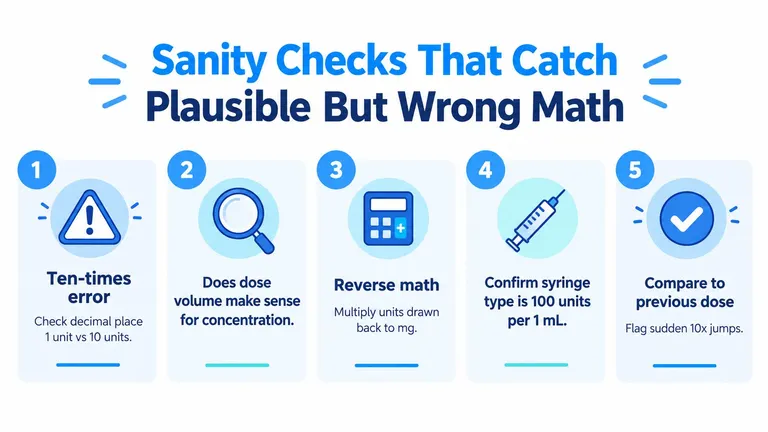
A short pre-injection routine keeps the risk low:
- Confirm the concentration written on the vial.
- Confirm the target dose in the same unit.
- Divide and write the draw volume.
- Verify the syringe type, especially whether it’s a 100-unit or 50-unit barrel.
- Reverse-check the result by asking if the draw looks proportional.
- Pause one breath before drawing.
If you want a calculator that keeps the arithmetic and the log in one place, PepFlow also provides a peptide dosing calculator and protocol tracker. The calculator still depends on you reading the vial correctly, but it can remove a lot of repetitive manual conversion work.
Keeping Math Accurate Across a Multi-Week Protocol
A protocol gets harder to manage when the numbers keep shifting. A refill may arrive in a different vial strength, you may standardize on a new diluent volume, or the schedule may change because the dose is being adjusted. Each of those changes means the old draw number may no longer match the current vial.
That’s why the safest approach is to recalculate only when one of the variables changes, not because you feel uncertain every time you open the box. If the vial strength changes, the concentration changes. If the diluent volume changes, the concentration changes again. If the dose changes, the draw volume changes even if the vial stays the same.
A simple log helps keep the process clean. Write down the date, vial strength, water added, resulting concentration, and the dose volume you used. That record reduces the need to re-derive the same math under pressure, especially when you’re several weeks into a cycle and the steps start to blur together.
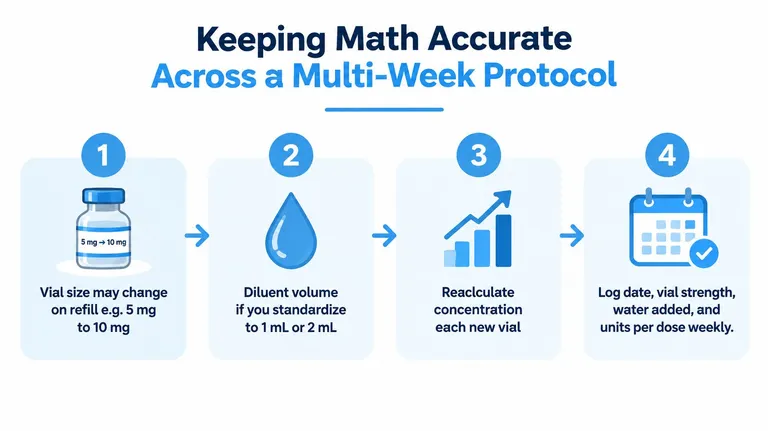
Operational rule: Don’t trust the number from last week unless the vial, the diluent, and the dose are all unchanged.
Tools like PepFlow fit best at transition points, when a vial changes, when the reconstitution volume changes, or when you want the dose history in one place instead of scattered across notes. That kind of tracking doesn’t replace understanding, but it does reduce the chance of redoing math from memory after a long day.
Recap and Common Questions About Reconstitution Math
The workflow should become one repeatable habit. Read the vial mass, choose the diluent, calculate concentration, convert the target dose into the syringe’s unit system, draw the volume, sanity-check the result, and log what you used. That sequence matters more than speed.
A calculator app can help with the arithmetic, but it can’t replace the judgment step where you decide whether the result makes sense. Keep the label in view, not yesterday’s note.
FAQ
Do reconstituted vials need refrigeration right away? Follow the product’s storage instructions. If the label or protocol gives a temperature requirement, that instruction overrides habit.
How long does a partial vial stay accurate? Only as long as the stored solution remains within the product’s handling rules. If the vial changes strength, volume, appearance, or protocol, recalculate before using it again.
What forces a full recalculation? A new vial, a new diluent volume, or any protocol change that alters the dose or concentration.
Every draw should begin the same way, by re-reading the label and checking the concentration, not by trusting last week’s number.
If you want a cleaner way to handle peptide reconstitution math without losing sight of the units, try PepFlow. It helps you convert vial strength and diluent volume into a draw amount you can use, while keeping the protocol details organized in one place.