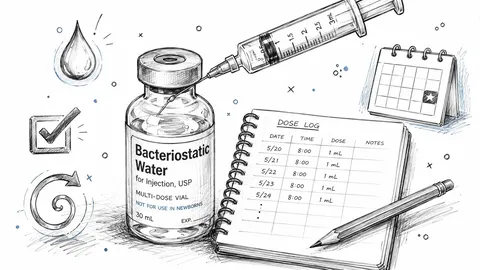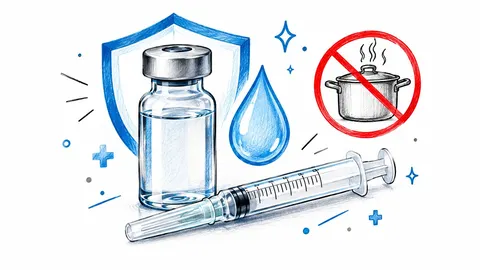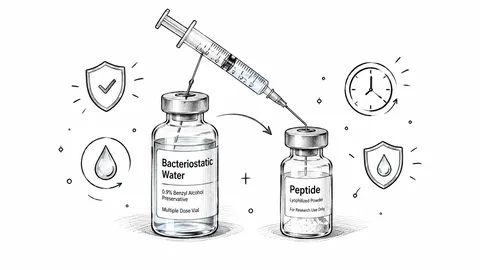
You’re standing at the counter with a lyophilized peptide vial, a syringe, and a small vial labeled Sterile Water for Injection. The math looks easy. Add water, calculate concentration, draw your dose. That framing is exactly where people get into trouble, because dilution math is the least consequential part of the process.
Is this the diluent the product calls for? Is the final solution appropriate for the intended route? Is the container still intact and in date? If you get those wrong, perfect arithmetic doesn’t protect you. This guide covers how to handle sterile water for injection safely, and what you should never try to make or substitute at home.
Table of Contents
- What Sterile Water for Injection Really Is
- Why Home Preparation Cannot Match Pharmaceutical Standards
- The Safe Workflow for Using Licensed SWFI
- Sterile Water vs Bacteriostatic Water vs Saline
- Verifying Product Integrity and Storage Conditions
- Common Misconceptions and Dangerous Shortcuts
- Final Safety Checklist and When to Seek Professional Guidance
What Sterile Water for Injection Really Is
Sterile Water for Injection, or SWFI, isn’t a kitchen product with a medical sounding name. It’s a regulated pharmaceutical diluent used to dissolve or dilute drugs for injection when the drug manufacturer’s directions specify it. For an introduction to how sterile water for injection preparations work in practice, begin here. The product in that sealed vial has passed through validated purification, sterilization, container closure, and quality testing before you ever see it.
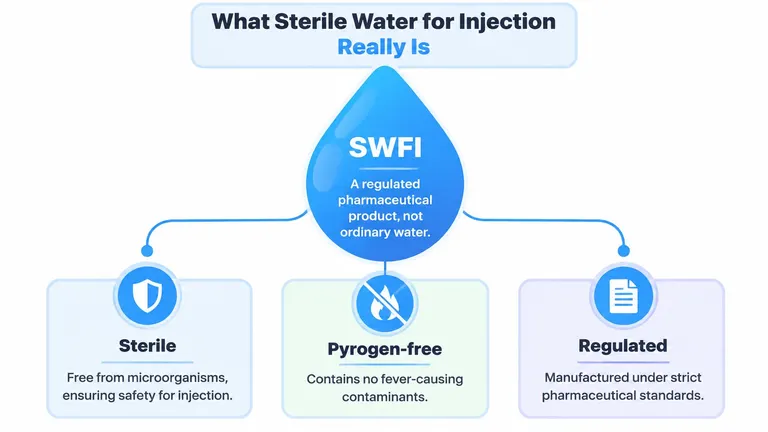
The U.S. product labeling for Sterile Water for Injection describes SWFI as a sterile, nonpyrogenic preparation of Water for Injection containing no bacteriostat, antimicrobial agent, or added buffer, with the labeled chemical composition H2O and a specified pH range of 5.0 to 7.0. Those details matter. There’s nothing in the vial to stop microbial growth once you’ve entered it, and there’s nothing buffering it toward any particular drug’s needs.
The visual below maps the three properties that define the product.
Why Single Dose Means Single Dose
SWFI comes in single-dose containers for a blunt reason. Without a preservative, repeated needle entry gives microorganisms repeated opportunities to contaminate the contents. The first puncture ends the manufacturer’s sterility assurance for that container. Saving the remainder for tomorrow because it looks clear is a gamble you can’t evaluate by eye.
- No preservative: Nothing inhibits growth after opening.
- No buffer: Compatibility depends entirely on the drug you’re adding.
- Nonpyrogenic: It’s tested for endotoxins, not just living organisms.
Sterile Does Not Mean Physiologically Safe
This distinction separates competent handling from dangerous improvisation. Sterility describes the absence of viable microorganisms. It says nothing about whether the liquid is safe to put into a vein. Plain sterile water is hypotonic. Injected intravenously without sufficient solute, it can damage red blood cells and cause hemolysis.
Sterile describes what’s absent from the water. It doesn’t describe what the water will do inside the body.
For intravenous use, the labeling warns that sufficient solute must be added to make the solution approximately isotonic. That’s not a suggestion you can work around with a smaller volume or a slower push. The correct diluent, volume, final concentration, dose, and route all come from the drug manufacturer’s directions or a qualified clinician or pharmacist. If the instructions don’t name SWFI, don’t use SWFI. If the route isn’t specified, stop and ask before you mix anything.
Why Home Preparation Cannot Match Pharmaceutical Standards
The most common shortcut I encounter is the belief that boiling tap water, running it through a household filter, or pressure cooking distilled water produces something close enough. It doesn’t, and the gap isn’t marginal. Pharmaceutical water systems are engineered, qualified, and continuously monitored. Your kitchen offers none of those controls.
What Regulated Production Actually Involves
Manufacturers start with qualified feedwater and purify it through validated systems. The WHO good manufacturing practice guidance on water for pharmaceutical use identifies Bulk Water for Injections as the highest pharmacopoeial quality grade of pharmaceutical water, describes distillation as the preferred final purification technique because the phase change process is effective, and gives examples of microbial control including continuous circulation above 70°C or storage and distribution at no more than 4°C. Water systems also get checked regularly for chemical contamination, biological contamination, and endotoxins.
Note the detail that bulk water is an intermediate material, not a sterile final dosage form. Even inside a pharmaceutical plant, producing high grade water is only one step. The finished product still needs sterilization or aseptic filling, validated container closure, environmental monitoring, and documented release testing.
The process flow below contrasts that control chain with household methods.
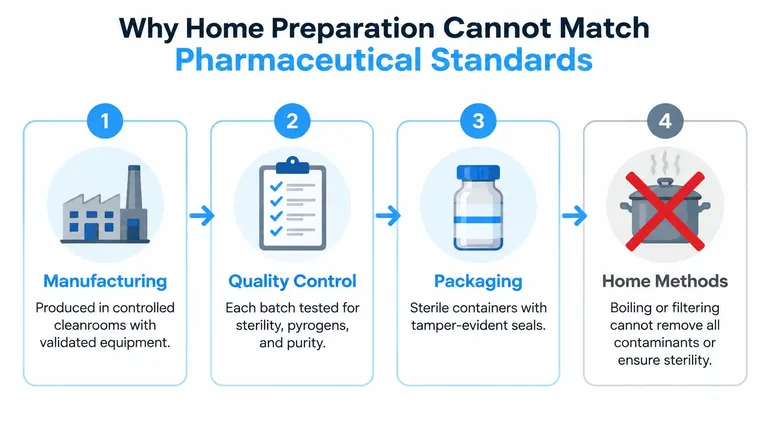
The Endotoxin Problem Boiling Cannot Solve
Killing bacteria and removing endotoxins are two different tasks. Endotoxins are fragments of bacterial cell walls that can provoke fever and serious inflammatory responses. Boiling can kill living organisms while leaving endotoxins behind. Household filtration doesn’t reliably remove them either, and you have no validated test at home to confirm the result either way.
That’s the core failure of every home method. You can’t verify what you’ve made. There’s no endotoxin assay on your counter, no sterility assurance data, no environmental monitoring, and no validated container to store the result in. Turbulent distribution flow to limit biofilm, integrity tested vent filters, controlled hold times. These aren’t bureaucratic decorations. They’re how manufacturers keep a system that produces water humans inject from drifting out of control.
People researching structured home based protocols run into this same wall in other contexts, which is why supervised programs exist. If you’re exploring starting home testosterone therapy in MS, you’ll notice legitimate providers source licensed pharmaceuticals rather than asking patients to prepare injectable materials themselves. That division of labor is deliberate. Patients can learn aseptic handling. They can’t replicate a validated manufacturing plant.
The Safe Workflow for Using Licensed SWFI
Your job isn’t to manufacture SWFI. Your job is to avoid compromising a product that arrived sterile. That sounds simple, and most failures happen through small lapses rather than dramatic errors. Work through the WHO sterile product guidance workflow for licensed sealed SWFI in order. Obtain licensed, sealed product labeled for injection, verify it, use it exactly as the medication manufacturer or clinician directs, and discard anything opened or compromised.
Start your preparation by inspecting the container closely, as shown here.
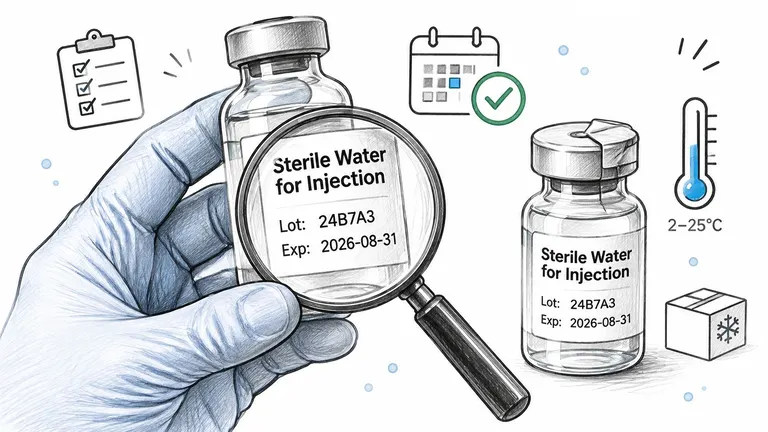
Before You Touch the Vial
Confirm the basics before you open anything sterile. Rushing this stage wastes product at best.
- Check the label: Confirm it says Sterile Water for Injection, not irrigation, not distilled, not purified water.
- Verify lot and expiry: Expired product gets discarded, no exceptions for clear appearance.
- Inspect the container: Look for cracks, leaks, a loose or missing seal, and visible particles or cloudiness.
- Confirm the drug directions: Check required diluent, volume, final concentration, and route against the official instructions.
Drawing and Mixing Aseptically
Wash your hands thoroughly and set up on a clean, uncluttered surface away from drafts, food, and pets. Swab the vial stopper and let the antiseptic dry before puncture. Touching the stopper after swabbing undoes the step. Use a new sterile syringe and needle from intact packaging, and don’t lay them down on the counter between steps.
If you want the underlying principles laid out in more depth, the guide to aseptic sterile technique fundamentals covers hand hygiene, critical sites, and common touch contamination errors. Technique is a transferable clinical skill. The same discipline around diluent accuracy and contamination control applies when clinicians prepare local anesthetic mixtures, which is part of what’s involved in tumescent liposuction anesthesia options, where large volume dilute solutions are prepared under controlled conditions rather than improvised.
Draw the specified volume, add it to the drug vial gently, and mix as the manufacturer directs. Some products need swirling, not shaking. Some need slow addition down the vial wall. Guessing here can foam, denature, or incompletely dissolve the product. Then inspect the final solution before use. Unexpected particles, discoloration, or incomplete dissolution mean you stop and seek guidance, not filter it and proceed.
The demonstration below shows careful vial handling and draw up technique in sequence.
Once you’ve drawn what you need, the SWFI container is finished. Don’t recap it for later, don’t refrigerate the remainder, and don’t share it. Dispose of needles and syringes in a proper sharps container immediately.
Sterile Water vs Bacteriostatic Water vs Saline
These three diluents sit next to each other in supply catalogs and get treated as interchangeable in forum posts. They’re not. Each one changes what happens to the drug, how long the preparation can be kept, and which patients or routes it suits.
The comparison below lays out the defining differences side by side.
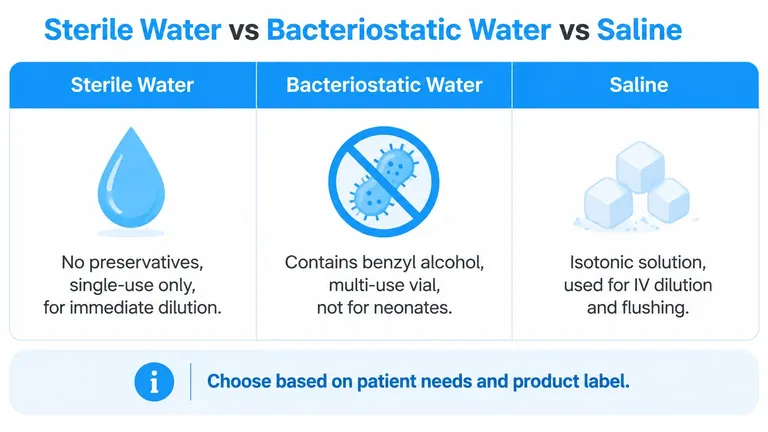
Diluent Comparison at a Glance
| Diluent | Preservative | Typical Use | Key Restriction |
|---|---|---|---|
| Sterile Water for Injection | None | Single dose dilution or reconstitution when specified | Discard after one entry, not for direct IV use alone |
| Bacteriostatic Water | Benzyl alcohol | Multidose preparations where the drug labeling permits it | Not suitable for all drugs, patients, or routes |
| Saline | Varies by product | Dilution where an isotonic sodium chloride vehicle is specified | Wrong choice when the drug is incompatible with sodium chloride |
Bacteriostatic water contains benzyl alcohol as a preservative, which inhibits bacterial growth after repeated entry. That’s a genuine functional difference, not a marketing variation. It also creates restrictions. Some drugs are incompatible with benzyl alcohol, some patient populations shouldn’t receive it, and multidose use is only appropriate when the product and drug directions support it. The detailed breakdown of bacteriostatic water compared with sterile water walks through those suitability limits.
Saline brings sodium chloride and tonicity that plain water lacks, which is why it’s specified for many intravenous preparations. But isotonic doesn’t mean universally compatible. Some drugs precipitate or degrade in chloride containing solutions.
Practical rule: The diluent named in the drug’s official directions is the diluent you use. Availability in your supply drawer isn’t a selection criterion.
Choosing based on what you have on hand, what a forum recommends, or what worked for a different peptide is how people end up with degraded product, painful injections, or worse. When the labeling names a formulation specific diluent supplied with the drug, that overrides all three options above. Use what’s in the kit.
Verifying Product Integrity and Storage Conditions
A sterile product is only sterile until something compromises it, and compromise often happens before the vial reaches your preparation surface. Shipping damage, poor storage, and prior tampering don’t announce themselves. Your inspection is the last checkpoint.
Reading the Container Like a Professional
Hold the vial up to good light and rotate it slowly. You’re looking for hairline cracks in glass or plastic, moisture inside the outer packaging that suggests a leak, and any cloudiness, floating particles, or discoloration in a liquid that should be clear. Check that the flip off cap or seal is present and firmly seated. A cap that spins loosely or lifts without resistance deserves suspicion.
- Seal integrity: Intact, seated, no signs of prior puncture.
- Container walls: No cracks, chips around the neck, or deformation.
- Contents: Clear, with nothing visible floating or settled.
- Label legibility: Product name, lot, and expiry all readable. An illegible label is a discard, since you can’t verify what you can’t read.
Don’t talk yourself out of a questionable finding because the product was expensive or shipping took weeks. Pharmacists discard compromised stock routinely. That discipline is the job, not wastefulness.
Storage Before and After Opening
Store unopened SWFI exactly as the manufacturer’s labeled conditions specify, in the original packaging, protected from damage. Don’t store vials loose in a drawer where they knock against other glassware. Don’t keep them in a hot vehicle, a steamy bathroom, or anywhere conditions swing widely. If you don’t know how a vial was stored before it reached you and the supplier can’t reassure you, treat that uncertainty seriously.
Expiry dates assume labeled storage conditions. A vial that’s technically in date but spent months in uncontrolled heat hasn’t been kept the way the manufacturer validated. When storage history is unknown or clearly poor, the conservative choice is replacement.
After opening, there’s no storage question to debate. SWFI has no preservative, so the opened container gets used for that single preparation and discarded. Refrigeration doesn’t restore sterility, freezing doesn’t help, and resealing with tape or a cap is meaningless. The same logic applies to your reconstituted drug. Its beyond use period and storage conditions come from the drug manufacturer or your clinician, not from general internet guidance, because stability and microbial risk vary by formulation.
Keep a simple habit. Note the lot number of what you used, check expiry when stock arrives rather than on preparation day, and rotate older stock forward. Those three habits prevent most integrity surprises.
Common Misconceptions and Dangerous Shortcuts
Certain shortcuts circulate constantly because they sound plausible. Each one fails for a specific, understandable reason.
Shortcuts That Sound Reasonable and Are Not
Boiled or distilled water is sterile enough. Boiling addresses living organisms at that moment. It doesn’t remove endotoxins reliably, doesn’t produce a validated sterile container, and doesn’t protect the water during cooling and storage. Distilled water from a store jug was never manufactured, tested, or packaged for injection.
Adding preservative upgrades a single dose vial. It doesn’t. A multidose product is a validated formulation in a validated container with tested preservative effectiveness. Squirting benzyl alcohol into SWFI creates an untested mixture, not bacteriostatic water, and introduces contamination and dosing errors of its own.
A passed sterility test proves every vial is sterile. Finished product sterility testing samples only some units. The FDA guidance on sterile drug products produced by aseptic processing states that sterilization, aseptic filling, and container closing must be validated, with a sterility assurance level of 10^-6 or better, and lists failure modes including inadequate cycle validation, filter integrity failures, poorly controlled hold times, and contamination during vial puncture. Assurance comes from the validated process, not from testing a sample and hoping.
Reusing equipment after rinsing is fine. Syringes and needles are single use devices. Rinsing doesn’t sterilize, alcohol doesn’t sterilize, and a needle that’s entered one vial carries whatever it touched into the next. The guidance on preventing contamination during preparation covers how these small reuse decisions compound.
Re-sterilizing fixes old product. Running an opened or expired vial through heat at home can’t restore validated sterility, can’t verify endotoxin levels, and can damage the container closure. You’re left with the same unknowns plus new ones.
Notice the pattern. Every shortcut replaces a verified control with an assumption you cannot test. In compounding, assumptions you can’t test are where patients get hurt.
Final Safety Checklist and When to Seek Professional Guidance
Before any preparation, run this sequence mentally. Any failed item stops the process.
- Product confirmed: Licensed SWFI, correct name on the label, in date, seal and container intact.
- Diluent match: The drug’s official instructions name this diluent, this volume, and this route.
- Route checked: Intravenous use only with sufficient solute for approximate isotonicity, per professional direction.
- Technique ready: Hands washed, surface clean, new sterile syringe and needle, stopper swabbed and dried.
- Disposal planned: Sharps container within reach, opened SWFI discarded after single use.
Calculation tools sit downstream of those decisions. PepFlow offers a dosage calculator that converts vial mass, solvent volume, and target dose into syringe units, which helps with arithmetic after you’ve confirmed the diluent and route. No calculator can confirm sterility, compatibility, or clinical appropriateness. Treat the math as the final step, never the first.
Seek a qualified clinician or pharmacist whenever the manufacturer’s instructions are unclear, the route is intravenous, the drug’s compatibility with your diluent is uncertain, or the solution looks wrong after mixing. Questions about who may legally administer intravenous preparations also deserve professional answers, and the ProMD Health Bethesda IV therapy guidance outlines how administration is regulated in clinical practice. Unusual pain, redness spreading from an injection site, fever, or feeling unwell after an injection warrant prompt medical attention, not watchful waiting. The FDA labeling for Sterile Water for Injection reinforces that sterile doesn’t mean physiologically safe, and that diluent, concentration, route, storage, and beyond use period must come from official instructions or a qualified professional.
Once you’ve confirmed the right licensed diluent and route with your product’s official directions, PepFlow can handle the concentration and syringe unit math for your preparation and keep your dosing schedule on track with reminders and dose logging. Visit PepFlow to set up your vial configuration, check your calculations before you draw, and build a consistent routine around preparations you’ve already verified are appropriate.