You’ve opened your first peptide vial, placed a syringe on the table, and now you’re staring at two liquids that look almost identical: sterile water and bacteriostatic water. The label matters more than the appearance. Choosing the wrong diluent, adding it carelessly, or calculating a dose from memory can turn a simple preparation into an avoidable safety problem.
This guide focuses on bacteriostatic water injection, but not as a shortcut for self-treatment. It explains what the product is, why its preservative changes vial handling, how to approach reconstitution cleanly, how to calculate concentration, and where official labeling places important limits. Any injectable medication or peptide should be used only with appropriate professional guidance and product-specific instructions.
Table of Contents
- What Bacteriostatic Water Actually Is
- Why the Preservative Changes How You Handle the Vial
- Preparing Your Workspace and Reconstituting a Vial
- Getting the Dose Math Right After Mixing
- Precautions Most Guides Skip Over
- Logging Doses and Staying Consistent Over Time
What Bacteriostatic Water Actually Is
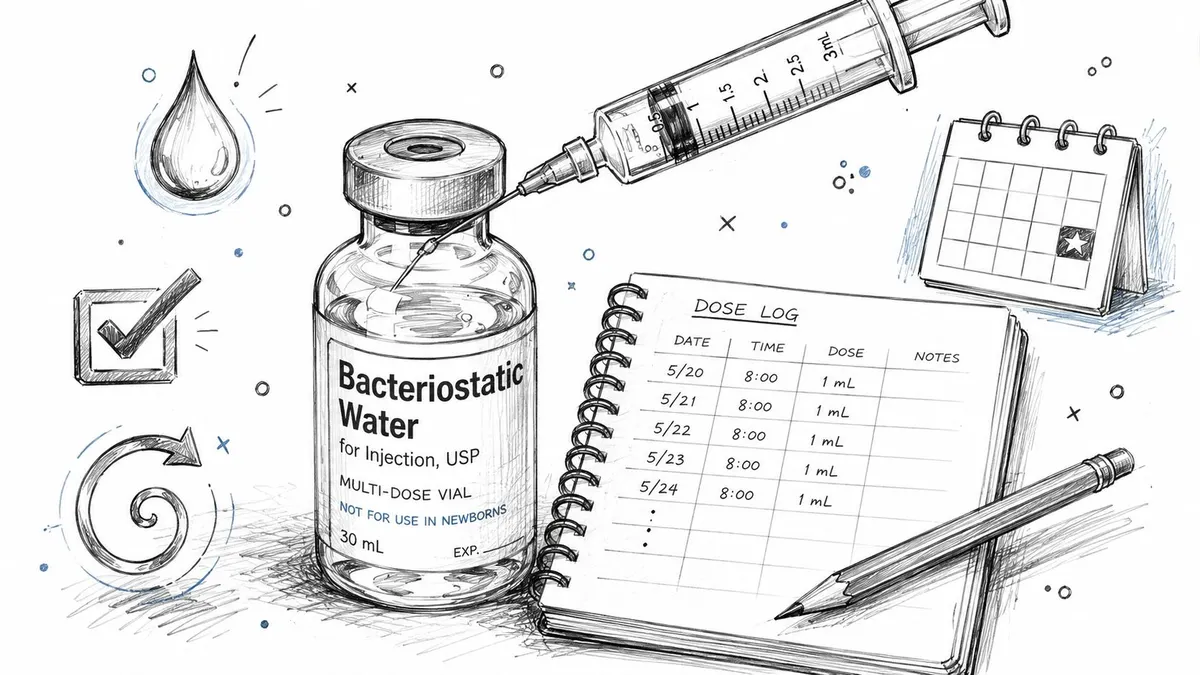
Bacteriostatic water for injection is sterile, nonpyrogenic water preserved with benzyl alcohol. The standard formulation repeatedly reflected in U.S. labeling is 0.9% benzyl alcohol, or 9 mg/mL, although some marketed versions list 1.1%, or 11 mg/mL. One FDA-labeled presentation is a 30 mL multi-dose vial. These formulation details appear in the DailyMed product information for bacteriostatic water.
The preservative is the feature that separates it from plain sterile water. A preserved multi-dose vial is designed for repeated withdrawals when the product labeling and the medication’s instructions permit that use. It isn’t “clean water,” and it isn’t interchangeable with every diluent used in medicine.

Identify the liquid before preparing anything
Sterile water for injection contains no antimicrobial preservative. Bacteriostatic water contains benzyl alcohol. Saline is a sodium chloride solution, not bacteriostatic water. Distilled water, tap water, and other household liquids aren’t substitutes for an injection product.
Read the full label, not just the word “water.” Confirm that the vial is specifically intended for injection, check the preservative information, and compare the diluent with the instructions for the medication or peptide. The product’s intended role is usually reconstitution or dilution, not injection as a treatment by itself.
Readers looking for a broader orientation can review what bacteriostatic water is used for, while a peptide-focused overview of all about BAC water for peptides can help clarify terminology.
Practical rule: Don’t calculate a volume until you’ve confirmed the exact diluent, the final route, and the product instructions.
Why the Preservative Changes How You Handle the Vial
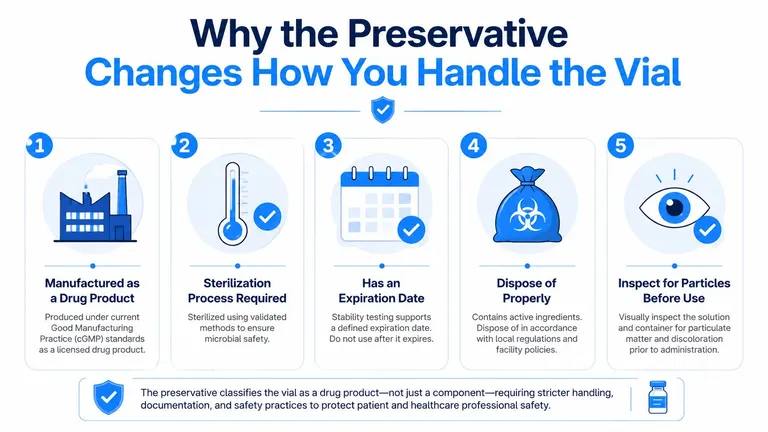
Benzyl alcohol gives bacteriostatic water a role in multi-dose handling, but it doesn’t make careless technique safe. The vial remains a regulated injectable drug product, so sterilization controls, lot identification, expiration information, container integrity, and preservative concentration all matter.
The FDA’s record of a voluntary nationwide recall makes that point concrete. Hospira recalled a 30 mL multi-dose bacteriostatic water lot, W20308, because sterilization couldn’t be confirmed for some vials. The FDA warned that patients exposed to affected product could face serious complications, including invasive bacterial infection, meningitis, septicemia, fever, chills, malaise, and cutaneous abscesses. The FDA recall notice for the Hospira lot shows why a preservative doesn’t replace manufacturing oversight.
Inspect the vial every time
Before use, examine the vial and its label under good lighting. Don’t use it if the stopper is damaged, the seal appears compromised, the liquid is cloudy, or you see particles, discoloration, or unexpected material. Also compare the lot information with any pharmacy, clinic, or manufacturer communication you received.
An opened multi-dose vial still has a product-specific handling window. Don’t assume that every vial remains suitable for the same length of time after puncture. Follow the label, pharmacy instructions, and clinical protocol, and discard the vial when the stated period ends or sooner if contamination is suspected.
The same judgment applies to the mixed medication. A clear appearance doesn’t prove sterility, compatibility, or potency. If the solution looks unusual or the powder doesn’t dissolve as directed, stop rather than trying to rescue it by shaking, filtering, or repeated needle entries.
The preservative is an aid to controlled multi-dose use, not a guarantee against contamination. Each puncture introduces an opportunity for handling errors, which is why a clean workspace, a new sterile needle, and careful vial storage matter.
Preparing Your Workspace and Reconstituting a Vial
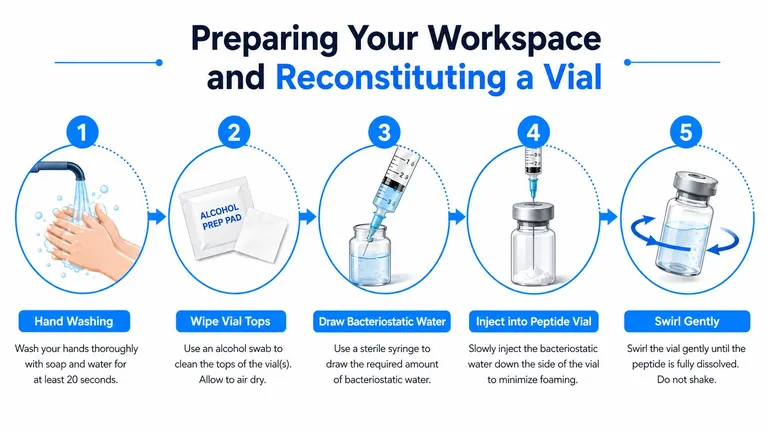
Set up before opening anything. Use a clean, uncluttered surface with enough room for the vial, syringe, alcohol swabs, disposal container, and your written dose record. A crowded desk creates practical errors: caps get misplaced, syringes touch surfaces, and the wrong vial can end up in your hand.
Wash and dry your hands thoroughly. Inspect both vial tops, then clean each stopper with a fresh alcohol swab according to your supplied instructions. Let the surface dry. Touching a cleaned stopper or setting a sterile needle on the desk defeats the purpose of cleaning it.
Add the diluent gently
Use a new sterile syringe and needle for the withdrawal. Draw the prescribed amount of bacteriostatic water slowly, keeping the syringe steady. When you enter the peptide vial, aim the liquid toward the inside wall rather than blasting the powder directly. A forceful stream can create foaming, turbulence, or unnecessary stress on a delicate preparation.
The small pop of a fresh vial stopper can make the process feel more dramatic than it is. Stay slow and deliberate. After adding the diluent, allow it to contact the powder, then gently swirl the vial until the contents dissolve as directed. Don’t shake it aggressively. If the product instructions specify a different technique, follow those instructions instead.
Wait for the solution to become fully dissolved before drawing a dose. Do not use a preparation that remains unexpectedly cloudy or contains particles. The guide to preventing contamination offers additional technique reminders for maintaining a cleaner workflow.
Keep syringe selection practical
A 1 mL insulin syringe is often easier to read for small volumes than a 3 mL syringe because its markings are more tightly matched to low-volume work. The exact syringe type, needle, and unit scale must still match the prescribed procedure.
“Units” on an insulin syringe represent volume markings, not peptide mass. The syringe doesn’t know whether the vial contains milligrams, micrograms, or another substance. You have to calculate the concentration first, then convert the desired dose into a volume.
Bubbles can make a draw inaccurate. After drawing, inspect the barrel, tap gently if appropriate for the supplied device, and remove visible air according to professional instruction. Don’t repeatedly push medication back into a vial just to chase a bubble, since extra entries increase handling exposure.
A related example of why preparation planning matters appears in clinical settings where treatment quantities vary, such as discussions of Sculptra vial count per session. The exact product and procedure differ, but the planning principle is the same: confirm the product, volume, and instructions before drawing.
Getting the Dose Math Right After Mixing
Reconstitution changes the concentration. The amount of powder in the vial stays the same, but the added liquid determines how much active material is present in each milliliter.
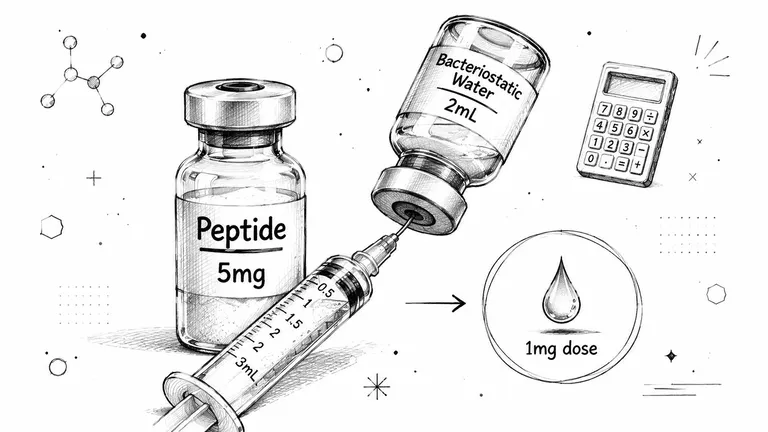
Suppose a vial contains 5 mg of peptide and you add 2 mL of bacteriostatic water. The concentration is:
5 mg ÷ 2 mL = 2.5 mg/mL
To convert that into micrograms, remember that 1 mg equals 1,000 micrograms. The resulting concentration is 2,500 micrograms/mL. A desired dose in micrograms can then be divided by 2,500 to find the required milliliters.
For example, a 250 microgram dose would equal:
250 mcg ÷ 2,500 mcg/mL = 0.1 mL
On a U-100 insulin syringe, 0.1 mL corresponds to 10 units, provided the syringe uses that standard scale. Verify the device markings before relying on the conversion.
Use one repeatable formula
The general sequence is:
- Concentration: total peptide in micrograms ÷ total liquid in milliliters.
- Dose volume: desired micrograms ÷ concentration in micrograms per milliliter.
- Syringe units: dose volume in milliliters × 100, when using a U-100 syringe.
The same pattern works with a different mix. A 10 mg vial mixed with 2 mL produces 5 mg/mL, or 5,000 mcg/mL. A 10 mg vial mixed with 5 mL produces 2 mg/mL, or 2,000 mcg/mL. The final draw changes because the concentration changes.
Write the mix date, total diluent volume, calculated concentration, and intended dose on the vial record. If a second vial enters rotation, memory becomes unreliable. A calculator such as PepFlow’s final concentration guide can support the arithmetic, but it can’t confirm whether your chosen diluent or dose is clinically appropriate.
Precautions Most Guides Skip Over
The phrase “bacteriostatic water is safe” is too broad. The more accurate question is whether the specific diluent, final mixture, route, and patient profile are appropriate together.
Official labeling states that bacteriostatic water isn’t a stand-alone injectable solution. Intravenous administration of water without a solute may cause hemolysis, meaning damage to red blood cells. That warning matters because a sterile appearance doesn’t make plain preserved water suitable for every route or purpose. Review the official labeling information for bacteriostatic water before treating it as a generic diluent.
Age and route change the decision
The same labeling warns about benzyl alcohol preservatives and neonatal toxicity. It also states that safety and effectiveness aren’t established in pediatric patients. That makes age a required part of the decision, not an afterthought.
The route is equally important. Published case literature has documented severe neurologic injury after bacteriostatic water containing benzyl alcohol was used intrathecally. Intrathecal administration is a specialized route, and this example reinforces a central rule: a diluent suitable for one route may be dangerous for another.
Can bacteriostatic water be injected by itself? The label’s answer is effectively no as a stand-alone injection. It’s intended to prepare or dilute a compatible medication, and the final product must be suitable for the intended route.
When is sterile water required instead? Use sterile water when the medication instructions or professional guidance specifically require a preservative-free diluent. Don’t substitute bacteriostatic water because it’s more convenient, and don’t substitute sterile water because the labels look similar. If the instructions are unclear, pause and ask a pharmacist or prescribing clinician.
Logging Doses and Staying Consistent Over Time
Correct preparation doesn’t end when the needle leaves the vial. You also need a reliable record of what you mixed, what concentration it produced, when you drew a dose, and where you administered it if site rotation forms part of your plan.
At minimum, record:
- Mix date: Note when the vial was reconstituted.
- Concentration: Write the total peptide amount, added liquid, and resulting concentration.
- Dose time: Record each administration immediately, not later from memory.
- Injection site: Track the location when rotation is part of your instructions.
- Vial status: Mark which vial is active and when it should be discarded under its applicable instructions.
This record prevents two common mistakes: repeating a dose because you can’t remember taking it, and using an old concentration after changing the amount of diluent. A vial label and a dedicated log are often enough. Digital tools can also combine dosage calculations, protocol schedules, reminders, countdowns, and dose history in one place.
Build a final check into the routine
Use this compact review before drawing:
| Phase | What to Verify |
|---|---|
| Diluent selection | The vial is labeled for injection and matches the medication instructions. |
| Vial inspection | Label, lot information, expiration, stopper, clarity, and particles are acceptable. |
| Workspace setup | Hands are clean, the surface is organized, and sterile supplies are ready. |
| Reconstitution | The diluent was added gently, the vial was mixed as directed, and the solution dissolved appropriately. |
| Dose calculation | Total amount, added volume, concentration, syringe scale, and intended dose agree. |
| Dose logging | Mix date, concentration, dose time, and any required site information are recorded. |
| Follow-up | Storage and discard instructions are followed, and questions go to a qualified professional. |
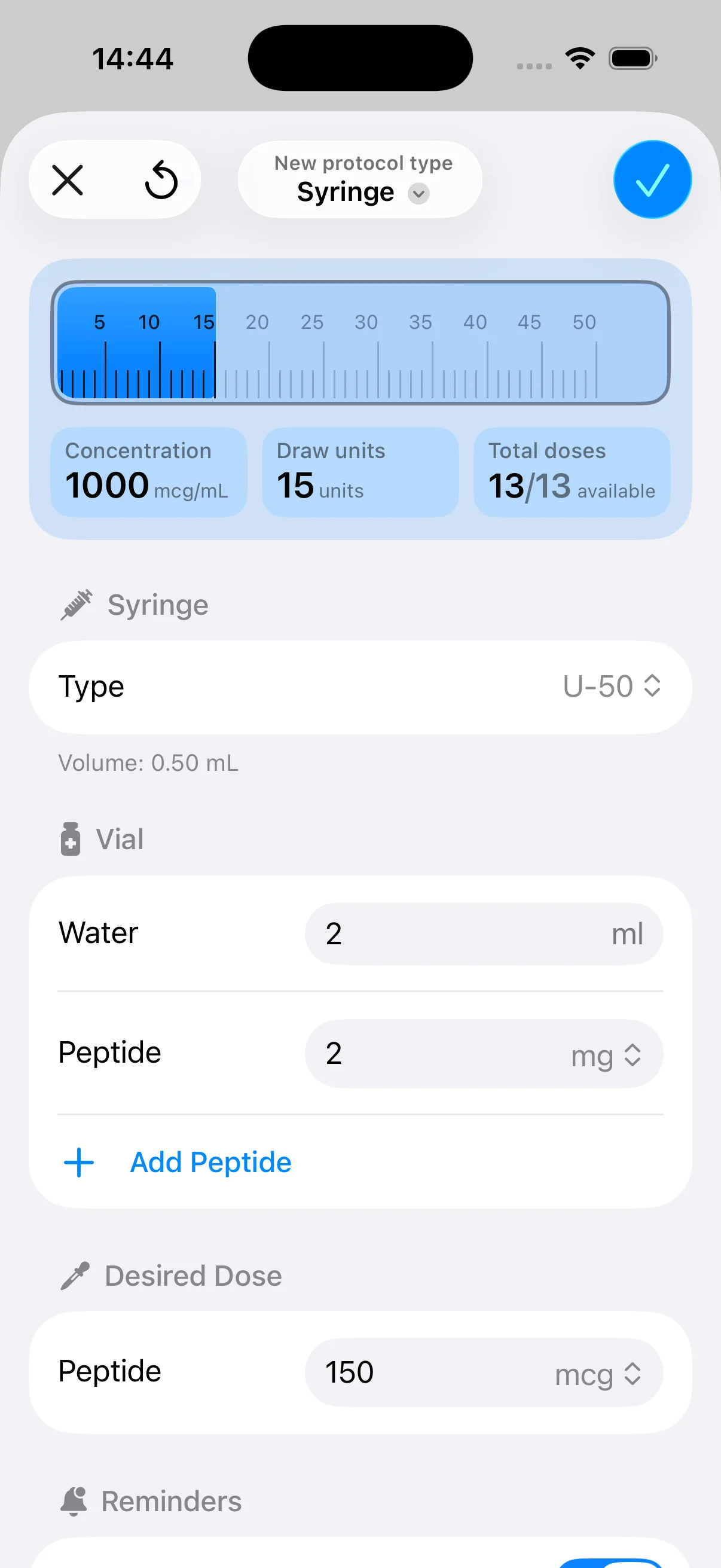
PepFlow can be used as one organizational option for entering vial volume, calculating draw amounts and syringe units, scheduling a protocol, and recording completed doses. It’s a planning and tracking tool, not a substitute for medical advice or product-specific instructions.
Before you inject, verify the diluent and the math. After you inject, record what happened.
Use this checklist every time until the workflow becomes familiar, and don’t improvise when a label, route, age-related warning, or product instruction conflicts with your plan.
If you want a single place to organize bacteriostatic-water calculations, protocol timing, reminders, and dose history, visit PepFlow. Set up the vial concentration before your first draw, then use the logging tools to reduce missed or duplicated doses while keeping professional guidance at the center of your routine.