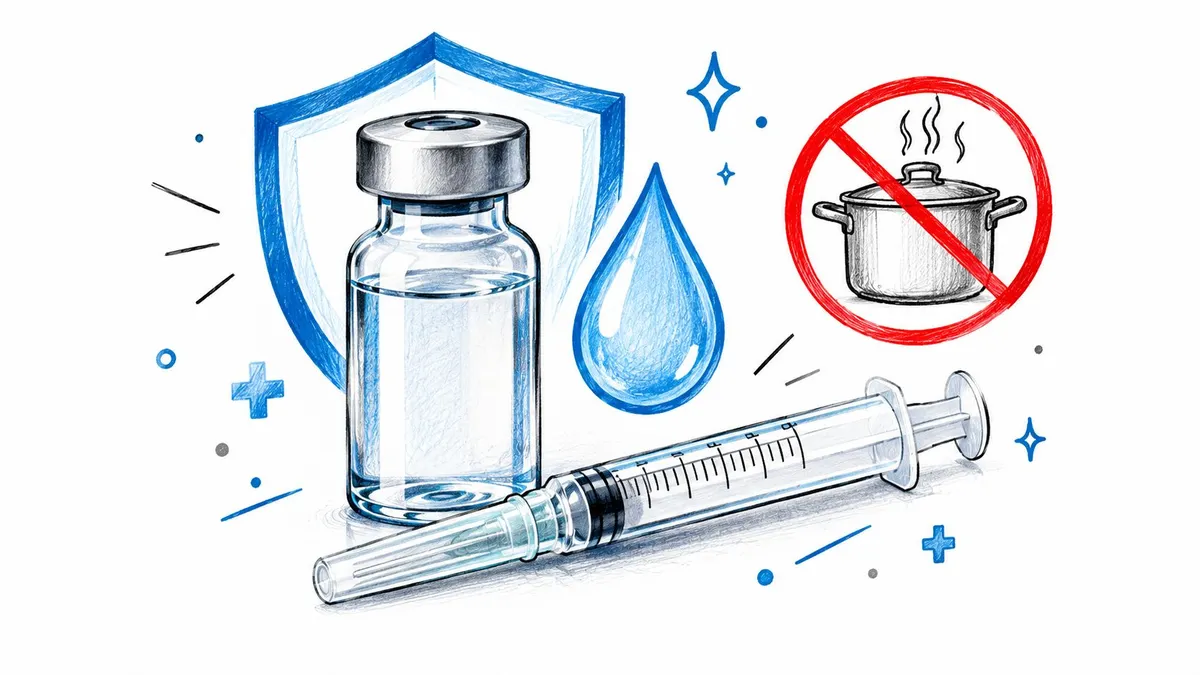
Boiling or filtering water is not a reliable way to make an injectable diluent. If you searched “how to sterile water” because you’re preparing a peptide vial, don’t follow a kitchen recipe. Use the commercially manufactured diluent specified for the medication, and ask a pharmacist or qualified clinician to confirm the product and preparation instructions before you mix anything.
Table of Contents
- Why Clear Water Is Not Sterile Water
- How Sterile Water Differs from Everyday Water
- Why Home Methods Cannot Prove Sterility
- Handling Commercial Sterile Water Safely
- What Changes After You Open the Container
- Plan the Dose Only After the Diluent Is Right
Why Clear Water Is Not Sterile Water
A clear liquid can still be unsuitable for injection. When you look at boiled or filtered water, you’re checking its appearance, not verifying its sterility, manufacturing controls, or suitability for a medication.
That distinction matters when you’re standing beside a peptide vial with a syringe ready. The water may look indistinguishable from a commercial product, but visual clarity is not proof of safety. FDA labeling identifies Sterile Water for Injection as a manufactured diluent and requires rejection of compromised containers or unclear solutions, not acceptance of every liquid that looks transparent. See the Sterile Water for Injection labeling and inspection warnings.
The safest response to a request for an injection-water recipe is procurement of the correct manufactured product, not a kitchen procedure.
Appearance Is Only a Rejection Check
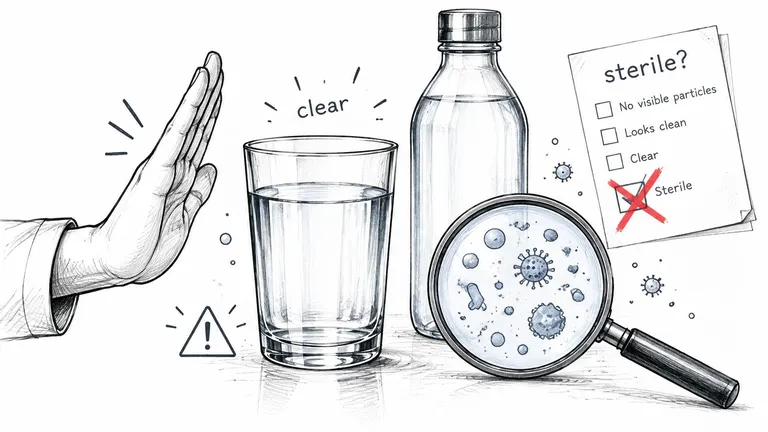
Inspecting water is useful because visible defects give you a reason to stop. It isn’t a test that allows you to approve a questionable liquid. A container with no visible particles can still have an uncertain preparation history.
Consider the difference between these decisions:
- Visible problem: You see haze, particles, or a broken seal and reject the container.
- No visible problem: You continue checking the label, packaging, expiration date, and medication instructions.
- Unknown origin: You don’t use appearance to excuse missing manufacturing or handling information.
This is why advice to boil water, let it cool, and transfer it into a clean bottle misses the central issue. It offers a procedure without establishing that the finished liquid meets injectable-product requirements.
The image illustrates the limitation of judging water by sight.
Ask a Product Question, Not a Recipe Question
The useful question is “Which labeled diluent does this medication require?” It isn’t “How can I make this water look clean enough?”
Keep the medication label and preparation instructions beside the unopened diluent. If the instructions don’t identify the diluent, or you can’t establish that your product matches them, stop before accessing either vial. Ask a pharmacist to resolve the mismatch rather than choosing whichever bottle is available.
Commercial packaging doesn’t make every water product interchangeable. You still need the right category, the right intended use, and instructions that apply to the medication you’re preparing.
How Sterile Water Differs from Everyday Water
Ask for the complete product name, not just “sterile water.” Sterile Water for Injection, bacteriostatic water, distilled water, and purified water describe different products or qualities. Don’t treat those labels as synonyms.
Pharmaceutical Sterile Water for Injection starts as Water for Injection, then undergoes sterilization and controlled packaging. The USP Sterile Water for Injection monograph specifies no antimicrobial agent or other added substance, single-dose glass or plastic containers no larger than 1 liter, a bacterial endotoxin limit below 0.25 USP Endotoxin Unit per milliliter, compliance with sterility testing, and a pH of 5.0 to 7.0 under its test conditions.
Which Water Label Matches the Job
| Label | Preservative | Typical packaging | Household substitute acceptable |
|---|---|---|---|
| Sterile Water for Injection | No antimicrobial preservative | Labeled single-dose glass or plastic container | No |
| Bacteriostatic water | Contains an antimicrobial preservative | Commercial vial, with access and discard rules on its label | No |
| Distilled water | Don’t infer preservative status from this term | Varies, the term doesn’t establish injectable packaging | No |
| Purified water | Don’t infer preservative status from this term | Varies, the term doesn’t establish injectable packaging | No |
For a focused comparison of the preserved and preservative-free products, consult this guide to bacteriostatic water versus sterile water. A preservative changes the product category; it doesn’t give you permission to substitute that product without checking the medication’s instructions.
Distilled or purified water may be chemically clean without being a finished sterile injectable diluent. Buying a sealed bottle labeled with either term doesn’t establish the manufacturing, endotoxin, or container requirements summarized above.
Sterility Is Not the Only Requirement
Endotoxins explain why killing microorganisms is not the whole job. These bacterial contaminants can trigger severe inflammatory reactions even when living bacteria are absent. The USP’s separate endotoxin and sterility requirements address different quality attributes, not redundant versions of the same test.
Formulation matters independently, too. Sterile Water for Injection is not an isotonic injectable solution and must not be administered intravascularly unless an appropriate solute makes it approximately isotonic. Its hypotonicity can otherwise cause hemolysis, or damage to red blood cells.
Don’t attempt to solve that formulation problem by adding something yourself. Use the medication’s validated preparation directions and professional guidance.
A dose calculator belongs downstream of this product decision. It can help organize a confirmed concentration and volume, but arithmetic cannot establish that a diluent is compatible, appropriately manufactured, or suitable for the intended route.
Why Home Methods Cannot Prove Sterility
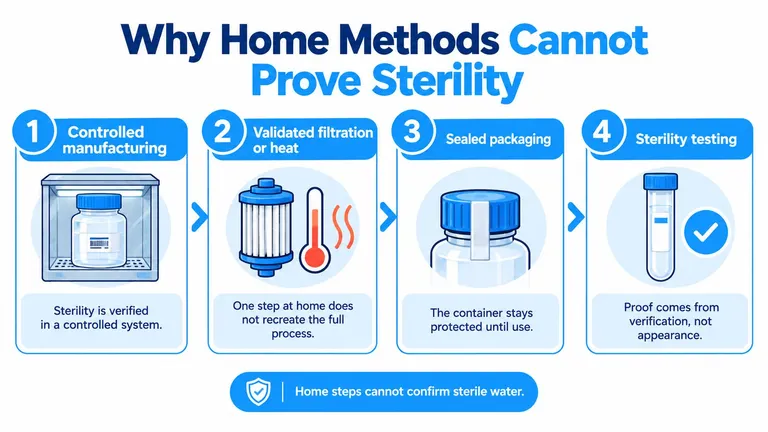
Copying a manufacturing step doesn’t reproduce a manufacturing system. Heating, filtering, and transferring water each address only part of the problem, and a household procedure doesn’t establish the quality of the final packaged liquid.
Bulk Water for Injection is not itself sterile water or a final dosage form. WHO describes a controlled pharmaceutical input whose production, storage, and distribution must prevent microbial growth and contamination. Its guidance includes continuous hot circulation above 70 °C, or suitably controlled cold systems at 4 °C or below, alongside system qualification, validation, monitoring, and maintenance. These requirements appear in WHO guidance for sterile pharmaceutical production.
A Complete System Controls More Than Heat
Manufacturers must consider feedwater, purification, storage, distribution, final sterilization, and container closure together. WHO also calls for turbulent flow to limit microbial adhesion and biofilm formation, plus integrity testing of hydrophobic bacteria-retentive vent filters before installation and after use.
Distillation is not an exemption from those controls. Neither are demonstrated equivalent purification combinations, such as reverse osmosis with additional treatment. The equipment and the complete process still need evidence that they perform as intended.
The production chain below shows why an isolated home treatment can’t stand in for a controlled system.
An Autoclave Setting Is Not an Injectable-Water Recipe
Validated steam sterilization has an important role in laboratory and equipment processing. It doesn’t mean you can heat household water and declare it pharmaceutical-grade.
For wrapped healthcare supplies, CDC identifies recognized minimum exposures of 30 minutes at 121 °C in a gravity-displacement sterilizer or 4 minutes at 132 °C in a prevacuum sterilizer. Those are load-specific equipment-processing parameters, not instructions for preparing injectable water, as described in the CDC steam-sterilization guidance.
A facility’s quality system must address:
- Load and vessel suitability: Steam needs appropriate access to the materials being processed.
- Process verification: Staff check mechanical records, chemical indicators, and biological indicators according to the quality system.
- Failure modes: Trapped air, overloaded chambers, poor steam penetration, and insufficient exposure can undermine processing.
- Protection afterward: Cooling and transfer must not recontaminate the processed material.
WHO also requires process re-verification at least annually and after significant equipment changes under the guidance cited above. That level of verification is entirely different from watching a kettle boil or an improvised pressure cooker reach pressure.
For a practical explanation of contamination prevention during handling, review what sterile technique involves. Technique protects an appropriate product; it doesn’t convert household water into one.
An improvised pressure cooker cannot establish pharmaceutical sterility or endotoxin control. For injection, buy the correctly manufactured product rather than attempting a home sterilization cycle.
Handling Commercial Sterile Water Safely
Start with the medication instructions, not the syringe. Confirm that the commercial diluent is the product those instructions require and that its intended route matches the planned use.
FDA labeling expects sterile admixtures to be prepared using strict aseptic technique, generally under a laminar-flow hood and pharmacist direction. A kitchen counter is not an equivalent preparation environment. The FDA-listed preparation and administration directions are the basis for the handling checks below.
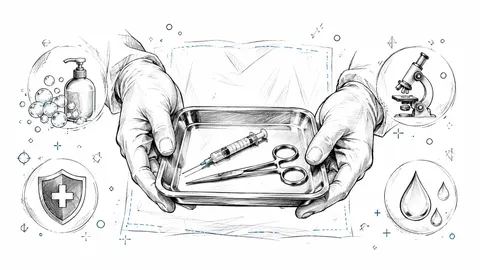
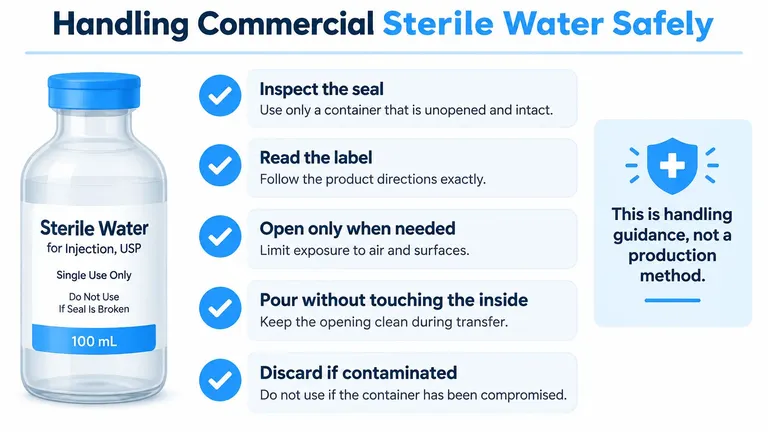
Use this visual as a general inspection reminder, not authorization to pour or transfer an injectable product outside its labeled method.
Make the Stop-or-Go Decision Before Access
Read the complete label and check the expiration date. Examine the original container for leakage, damage, and an intact seal, then inspect the solution for haze or visible particles.
Don’t continue if the label is unreadable, the route is unclear, or the medication directions conflict with what you have. Those are reasons to contact a pharmacist, not invitations to improvise.
- Proceed only with a match: The product identity, medication instructions, route, and expiration date must all support the intended use.
- Reject a defect: Don’t use a leaking, damaged, cloudy, or visibly contaminated container.
- Resolve uncertainty first: If you can’t explain what the product is and why it’s appropriate, leave it unopened.
Protect the Access Surface and Sterile Equipment
When preparation is authorized and you’ve been instructed in the appropriate technique, disinfect the vial’s access surface as directed. Use a new sterile syringe and needle, minimize open-air exposure, and avoid repeated punctures unless the labeling explicitly permits them.
Don’t substitute pouring for the specified access method. The way you enter the container is part of the preparation process, not a matter of convenience.
Practical rule: If you’re uncertain whether the product or equipment remained sterile, discard it rather than trying to rescue it.
Remember the route restriction discussed earlier. A container labeled Sterile Water for Injection does not authorize direct intravenous administration of the water itself.
This video can supplement instruction, but it doesn’t replace the product label or hands-on guidance from your pharmacist.
Your stop-or-go decision should remain simple: the correct intact product, clear instructions, and an appropriate preparation method are prerequisites. If any prerequisite is missing, pause before mixing. Replacing a questionable container is preferable to using a solution whose sterility you can no longer establish.
What Changes After You Open the Container
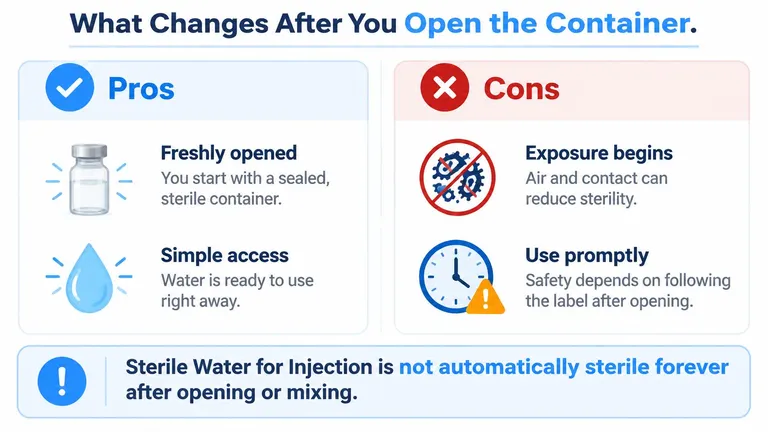
Opening or puncturing the container changes the handling question. You’re no longer deciding whether to accept a sealed manufactured product; you’re deciding what the labeling permits after access and after mixing.
There’s no universal safe duration for every reconstituted peptide or medication. The applicable beyond-use period depends on the drug, container, preservative status, preparation environment, and validated instructions. FDA labeling directs prompt use after mixing and says not to store reconstituted injectable drugs unless the drug manufacturer specifically permits it. See the FDA labeling on reconstitution, storage, and container inspection.
Don’t Turn Single-Dose Water Into a Shared Supply
Sterile Water for Injection has no antimicrobial preservative and is supplied for single-dose use. A partly full vial is not permission to save the remainder for another preparation.
Refrigeration doesn’t change that designation. Cooling may slow some microbial growth, but it does not restore sterility or make an opened single-dose container suitable for repeated use. Don’t apply another product’s storage rules just because both products look like water.
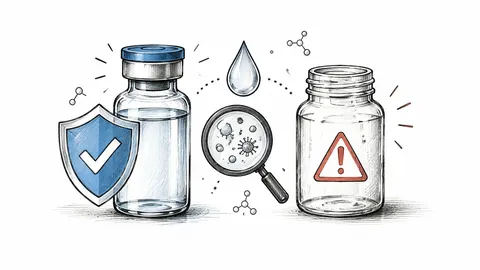
The distinction between a sealed product and an accessed container is the important point in this visual.
For the different handling questions associated with preserved products, consult this bacteriostatic-water storage guide. Don’t transfer those instructions to preservative-free water.
Do and Don’t After Mixing
| Do | Don’t |
|---|---|
| Follow the medication’s instructions for prompt use and any permitted storage. | Invent a storage window because someone uses the same peptide. |
| Record what was added and when, using the confirmed preparation instructions. | Treat a handwritten date as proof that storage is safe. |
| Discard unused single-dose contents. | Keep leftovers for repeated punctures. |
| Replace containers with leaks, particles, or uncertain sterility. | Filter, reheat, or otherwise attempt to salvage them. |
Keep the Preparation History Traceable
Follow labeled storage requirements before opening, then account for the septum’s condition, needle handling, mixing, and permitted storage afterward. Record the medication identity, confirmed concentration, preparation time, and any product-specific discard instruction so you don’t have to reconstruct them later.
Documentation supports careful handling, but it cannot validate a preparation that was already compromised. A reminder, dose log, or accurate calculation won’t make contaminated diluent safe.
If the medication manufacturer doesn’t provide the storage instruction you need, ask the pharmacist before preparing a mixture you intend to keep. Don’t choose a beyond-use period from a general article, a forum, or another vial’s label.
Plan the Dose Only After the Diluent Is Right
Dose planning should begin with confirmed medical instructions. It shouldn’t begin with choosing an available bottle of water and calculating around that choice.
For someone reconstituting a peptide, the priority is to resolve the product decision before entering a concentration into a calculator. A calculation can be internally consistent while relying on the wrong diluent, an unconfirmed mixing volume, or an unsupported storage assumption. Correct arithmetic does not validate those inputs.
Bring the Actual Labels to a Professional
Take the medication or peptide label, its preparation instructions, and the proposed diluent label to a pharmacist or qualified clinician. Ask them to confirm whether the product is appropriate for the intended use, which commercial diluent applies, and what preparation and storage instructions you should follow.
Keep the questions concrete:
- Diluent identity: What exact labeled product should be used, and is substitution permitted?
- Preparation volume: What volume do the medication instructions require?
- Administration instructions: What dose, route, and syringe measurement apply to the prescribed plan?
- Beyond-use limit: Can the mixture be stored, under what conditions, and when must it be discarded?
If the professional cannot confirm the necessary instructions for the product you have, don’t fill the gap with an online reconstitution ratio. Leave the preparation on hold.
Separate Clinical Decisions From Organization
Once those instructions are confirmed, a calculator, written worksheet, and dose log can help you follow them consistently. Record the vial amount, diluent volume, resulting concentration, prescribed dose, and corresponding injection volume without treating any entry as a recommendation generated by the tool.
Keep the units explicit. A microgram amount describes the dose, while a syringe’s unit markings represent a volume scale that must match the confirmed concentration and syringe. Ask the pharmacist to verify the measurement you’ll use rather than relying on an unlabeled number in a note.
Decision boundary: Planning tools can organize confirmed instructions. They cannot supply missing medical instructions or certify a preparation as safe.
Scheduling comes after that confirmation as well. Record the prescribed frequency, start date, pauses, and reminders only after a qualified professional has established the plan. If the medication instructions change, update the calculation and log rather than carrying forward an old concentration.
The practical order is straightforward: identify the required commercial product, refuse household substitutes, resolve inspection or handling concerns, and follow the applicable discard instructions. Then organize the dose and schedule.
Your next action should be specific: gather the labels and ask a pharmacist to confirm the diluent, mixing volume, and beyond-use limit before you prepare the vial.
After your pharmacist or clinician confirms the preparation instructions, PepFlow offers a dosage calculator, vial and concentration records, cycle scheduling, reminders, and dose logging to help reduce manual calculation errors. Visit it to organize your confirmed plan, not to choose a diluent, sterilize water, or replace professional advice.