
You set the alarm, mixed the vial, and told yourself this time would be different. For a few days, it is. Then a work call runs long, you skip a morning dose, the next reminder lands while you’re driving, and by the weekend you’re staring at a half-used vial with no clean record of what happened or when you last reconstituted it. That’s the core problem behind how to stay on track with a peptide routine. Motivation gets people started, but interruption is what decides whether they finish strong or drift.
Table of Contents
- Why Most Peptide Routines Fall Apart in Week Two
- Set a Dosing Goal You Can Actually Measure
- Build a Dosing Schedule Around Real Life, Not Ideal Life
- Use PepFlow to Turn the Schedule Into Reliable Nudges
- Run a Weekly Track Measure Adjust Review
- Recover Fast When Travel, Shifts, or Life Disrupt the Routine
- Templates Troubleshooting and Your First 30 Days
Why Most Peptide Routines Fall Apart in Week Two
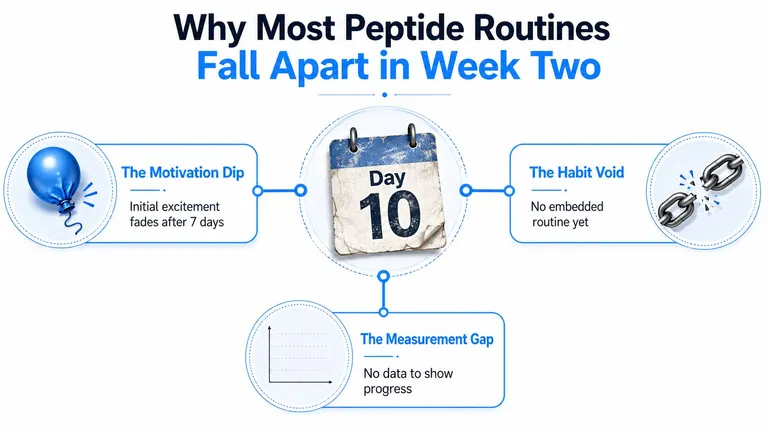
The first week usually goes fine because the routine is still new. The doses happen on time, the notes look clean, and the whole process feels lighter than it will later. By day ten, the same person is dealing with a morning alarm that got swiped away, an evening dose that now collides with dinner, and a vial that is half-used with no clear history attached to it.
The four failure points that show up early
The first failure point is vague goals. If the plan is only “get my protocol right,” there is nothing concrete to check when life gets noisy. A written goal with a schedule and regular review is consistently associated with better follow-through, and the broader goal-setting evidence points in the same direction. The Matthews benchmark often cited in this space says people with time-bound goals and weekly progress checks are more likely to succeed than people without that structure, according to Mooncamp’s goal-setting statistics. That same habit of writing the target down shows up in adjacent performance work too, including the planning style used in the Evermost LLC bodybuilding guide, where the protocol only holds up if the goal is specific enough to review.
The second failure point is a schedule that fights real life. Doses built around fantasy conditions, quiet mornings, perfect sleep, no travel, no meetings, usually lose the first time the day gets crowded. Good peptide routines need to attach to something that already happens, not to an imaginary version of the day that only exists on paper.
The third failure point is weak reminders. Alerts that can be ignored in one swipe usually are. A better reminder system makes the next action obvious, visible, and hard to miss, which is one reason practical adherence tools like the PepFlow medication adherence guide focus on cue strength rather than reminder volume.
The routine breaks at the handoff between intention and execution, not because people stop caring.
The fourth failure point is no plan for recovery. One missed dose turns into two, then the person starts avoiding the log because the log feels like evidence of failure. The healthier move is to treat the slip as a data point and decide what happens next, not to improvise a new protocol in the middle of a bad week.
Interruption is the core design problem. Travel, shift changes, long dinners, family obligations, and plain exhaustion are the moments that decide whether the routine survives past the novelty phase.
Set a Dosing Goal You Can Actually Measure
A peptide routine works better when the target is written down in plain terms. Name the compound, the dose, the cadence, the cycle length, and the one weekly metric you will review. Without that reference, every reminder and every adjustment gets argued from memory, which makes it hard to keep the routine steady for months.
Write the protocol brief in one sentence
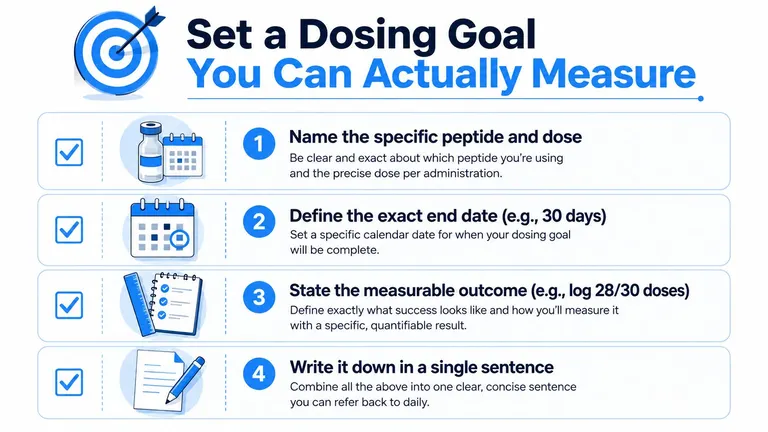
Use one sentence that includes the specific peptide, the target dose, the frequency, the cycle length, and the weekly check-in. A clean brief might read like this: “Compound X, 250 mcg daily, for five weeks, with Sunday review of on-time dose logging.”
That sentence does three jobs at once. It tells you what to do, when to do it, and how to judge whether the week went well. It also gives you a single anchor for later choices, including reminders, check-ins, and any mid-cycle correction.
Keep the check-in metric simple
Do not build a dashboard with five indicators when one will do. The most useful weekly metric is usually something concrete like on-time dose completion, because it shows whether the routine is happening. Goal-tracking systems work best when they stay narrow, and the broader evidence on external monitoring, including a meta-analysis of 138 studies summarized at Goals and Progress, points in the same direction.
A written goal plus accountability also changes the work from private intention to visible follow-through. The MSU summary at Achieving Your Goals cites a 76% achievement rate for participants who wrote down their goals, actions, and weekly progress to a friend, compared with 43% for unwritten goals, a 33 percentage-point gap.
A practical place to start is to write the protocol brief on paper, save it in your notes app, and keep it where you prepare doses. Once it exists as a reference, the rest of the routine has somewhere to point when the day gets messy.
Build a Dosing Schedule Around Real Life, Not Ideal Life
A dosing plan that only works on the version of you who wakes early, never gets interrupted, and always has supplies close by will fall apart the first time life gets loud. A workable schedule has to fit the day you live, with delays, travel, and late starts built in from the beginning.
Anchor the dose to something that already happens
Wake time, first meal, brushing teeth, and a nightly shutdown routine all give the dose a fixed place in the day. That kind of anchor holds up better than “sometime in the morning,” because it stays attached to an event you already expect. If the day is chaotic, use the most stable habit you already keep.
The same approach works for weekly review. Put the check-in on the same day and at the same time each week, so it does not depend on memory alone. A protocol that only lives in your head has to compete with email, errands, family demands, and every small interruption that steals attention.
Sanity-check the dose math before you rely on it
If your vial concentration is known, convert the microgram target into the unit measurement you will draw. The goal is not to turn this into a compounding lesson, it is to reduce avoidable mistakes when you are rushed, distracted, or trying to dose between meetings. If the math feels uncertain, check it again before the schedule becomes automatic.
Common microgram to unit conversions at typical vial concentrations
| Target dose (mcg) | 10 mg vial / 1 mL | 10 mg vial / 2 mL | 10 mg vial / 3 mL |
|---|---|---|---|
| 100 | 1 unit | 2 units | 3 units |
| 250 | 2.5 units | 5 units | 7.5 units |
| 500 | 5 units | 10 units | 15 units |
Use the table as a quick check, not as a substitute for confirming the concentration on your own vial. A schedule only helps if the numbers behind it stay consistent.
Practical rule: if the plan only works on your easiest day, it is not a plan yet.
A weekly template needs to survive ordinary friction. For many people, that means one daily anchor, one weekly review slot, and one place where the schedule is stored so it can be checked quickly. If you want a reference for how schedule-driven tools are laid out, the routine schedule app guide is a useful comparison point.
Use PepFlow to Turn the Schedule Into Reliable Nudges
A written schedule still falls apart if it never reaches you at the right moment. Execution is the layer that keeps a peptide routine usable when the day gets noisy, because reminders, countdowns, and a clear dose history turn the protocol brief into something you can follow without rebuilding it in your head.
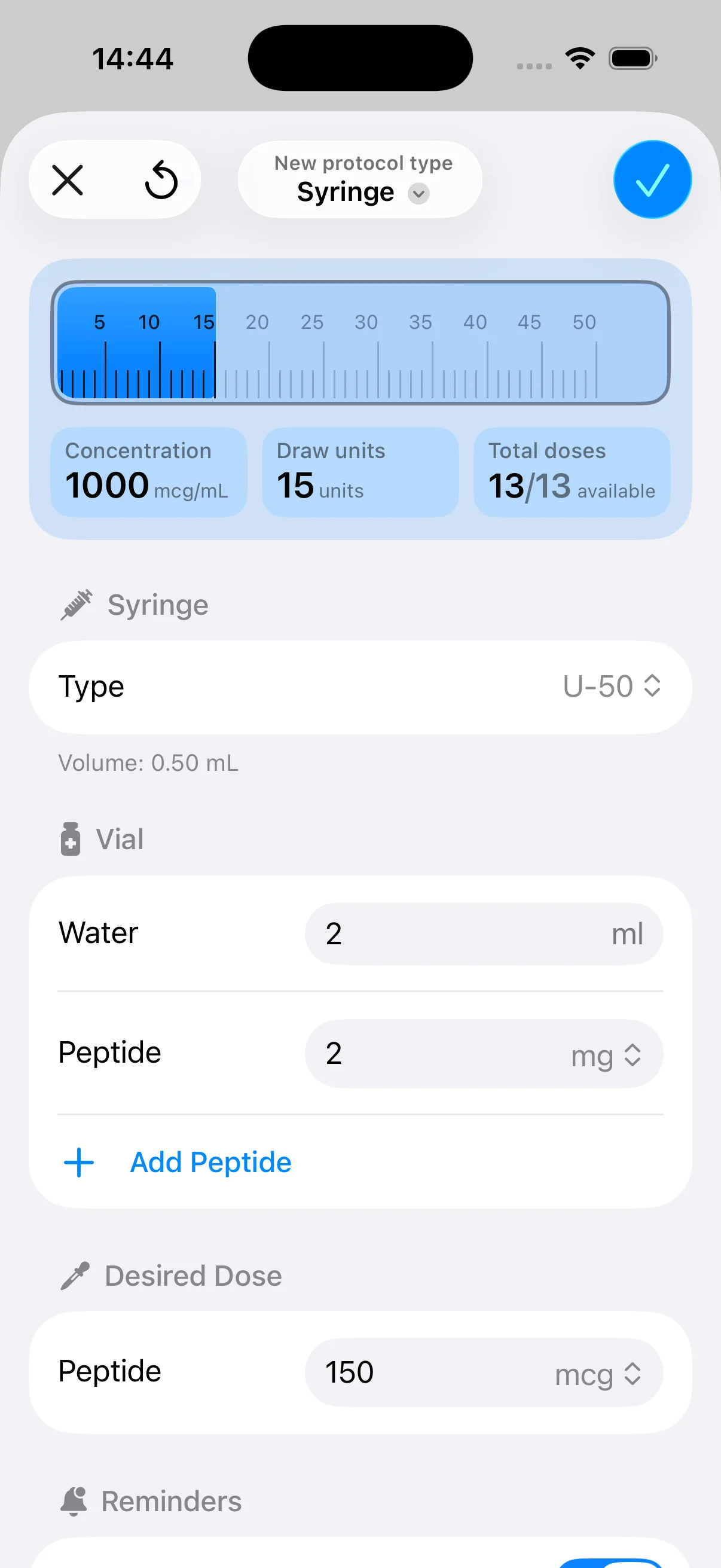
PepFlow is one option for that layer. It lets users set cycled protocols with flexible start dates, dosing frequencies, and pause periods, then keeps the plan visible through reminders, countdowns, live activities, widgets, and log-dose actions. Those features reduce friction by keeping the next action visible and the log action one tap away. A missed ping should not turn into a missed dose.
Set the cadence first, then the alerts
Enter the protocol as a cycle instead of a loose list of reminders. Once the timing is set, place alerts around the actual dosing window and keep the log action close by, not buried behind extra taps. If the dose happens while you are busy, the reminder has to survive silent mode and Do Not Disturb to matter.
The history view matters just as much as the alert. If you can see what happened yesterday without digging, the routine becomes easier to trust and easier to review later. That also makes the linked routine schedule app guide useful if you are comparing schedule-driven tools.
Use visibility tools to reduce memory load
Real-time countdowns, live activities, and widgets help because they keep the next action in view without asking you to remember it. That matters on travel days, at the gym, or during a work shift, when you are not going to open a notes app and reconstruct the plan from scratch. A good reminder system does not nag, it surfaces the next step at the exact moment you need it.
If you are comparing habit and routine tools more broadly, the best habit tracking app comparison gives a useful frame for what to look for in a tracking workflow. The key question is which app makes the right action easiest when the day is already crowded.
Run a Weekly Track Measure Adjust Review
A routine that never gets reviewed eventually starts drifting. A short weekly loop keeps the plan honest and gives you one place to correct small misses before they turn into a pattern.
Track only what you’ll actually use
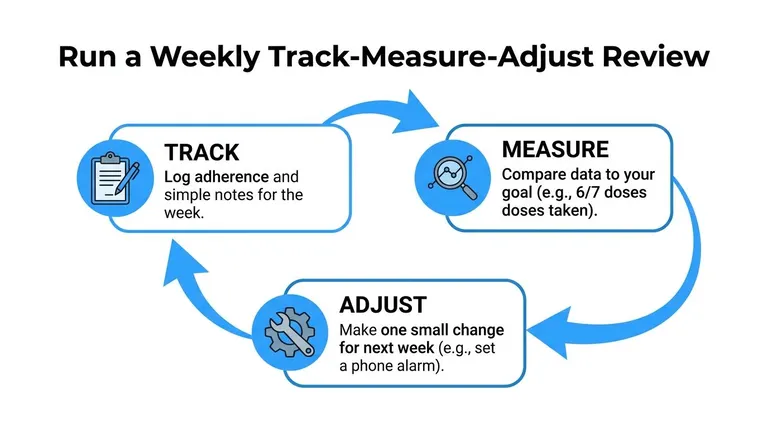
The strongest version of this loop is simple: Track, Measure, Adjust. Record daily actions, compare them to the goal, then change one thing for next week. Keep it to 1 to 3 key metrics so the review stays readable instead of becoming a second job.
That restraint matters. Too many indicators create friction, and friction is what kills consistency. External monitoring also beats self-monitoring alone, which is one reason history views and clean logs are so useful in practice.
Make the weekly review concrete
A useful review looks like this. Pull up the dose history, count the on-time doses, note the pattern of misses, and decide on one adjustment for the coming week. If the pattern is always the same, the fix should be narrow too, such as moving the reminder ten minutes earlier or changing the anchor from a vague time to a reliable habit.
Here’s a simple checklist you can reuse:
- Track the history: open the week’s log and look at what happened.
- Measure against the brief: compare the log to the written protocol, not to memory.
- Adjust one variable: change only the timing, cue, or reminder setting that caused the slip.
For people comparing tracking tools, the key issue is whether the system makes this kind of review fast. That is the test, not whether the app has colorful charts.
Give the review an accountability trigger
The review works better when it is visible to someone else or at least written somewhere that is not your head. That could be a friend, a coach, or a private journal entry. The review makes the correction obvious before the next week starts, and that clarity matters more than pressure.
A platform like PepFlow can serve as the history source for that check-in because the log is already there when you need it. The important part is the recurring habit of comparing the week to the brief and making one decision from the data. The same habit is what makes the best habit tracking app comparison useful, because the right tool is the one that turns a crowded week into a clean review.
Recover Fast When Travel, Shifts, or Life Disrupt the Routine
Travel, rotating shifts, social events, and missed alarms expose the same weak point, a schedule that only works under ideal conditions. Most adherence problems are planning failures that show up when reality changes faster than the routine does. In clinic, the people who stay consistent are usually the ones who expect interruptions and pre-write the response.
Use a low-friction recovery script
When a dose gets disrupted, log it accurately first. Do not erase the miss, and do not try to correct it by taking extra without a clear plan. The goal is to get back to the cycle cleanly and keep one missed moment from turning into a broken week.
That matters even more when travel changes time zones or work shifts move across day and night. The schedule should move with the new reality, not fight it. If the routine is off, adjust the anchor and protect the next scheduled dose rather than forcing the old timing back into place.
A recovery script should be simple enough to use while tired, distracted, or standing in an airport line. If the decision takes too much thinking, people stall, then the gap widens.
Treat the interruption as a planning input
A missed dose is information. It shows whether the reminder was easy to ignore, whether the timing was wrong, or whether the routine did not survive the setting you were in. The weekly review should capture that disruption without turning it into a judgment call.
The practical question is straightforward, what broke first, the cue, the timing, or the recovery step? Once you know that, the fix becomes smaller and easier. If travel or temperature was part of the problem, the PepFlow storage guidance helps you check whether storage conditions added another layer of risk during an already messy week.
Missed days do not ruin a protocol. Unclear recovery rules do.
Make a three-scenario fallback plan
Pick the three disruptions you run into most often and write a response for each one. If a work shift runs late, decide in advance whether the dose moves earlier, later, or to the next scheduled slot. If a social event overlaps the window, the answer should already be written down before the event starts.
If travel is part of the picture, include the handoff details too. Where the dose is stored, what the backup reminder is, and who, if anyone, gets the check-in should all be settled before departure. For storage-specific questions, keep a copy of the PepFlow storage guidance with the routine so the answer is easy to find when the week gets noisy.
The point is to remove improvisation under stress. A routine survives because the recovery path is easy to use when attention is low.
Templates Troubleshooting and Your First 30 Days
The easiest way to begin is with three reusable templates and a short rollout plan. That keeps the routine from having to be rebuilt every time the week changes, and it gives you a clear place to check when interruptions hit.
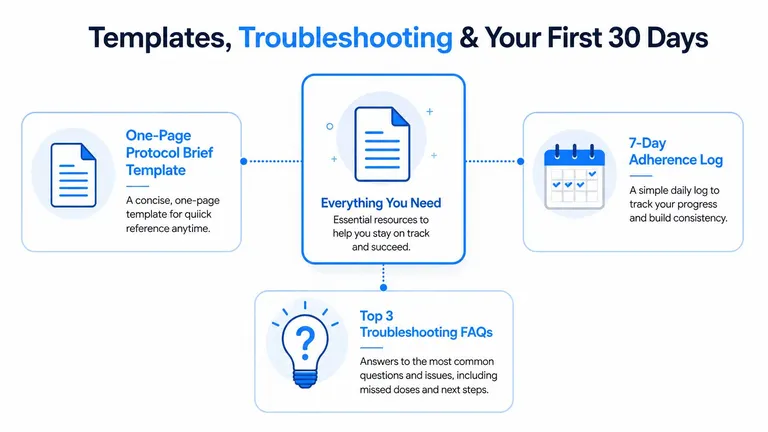
Copy these three templates
One-page protocol brief template: compound name, target dose, frequency, cycle length, and one weekly metric. Keep it short enough to scan in seconds, because a busy week is when long notes get ignored.
Seven-day dosing schedule template: day, time, anchor, dose, and log status. This is the working sheet you use when the week gets crowded, and it should show the next action without extra searching.
Weekly Track Measure Adjust checklist: history review, compare to goal, choose one adjustment. If it takes more than a few minutes to read, it is too complicated for real use.
Use the first 30 days to build the routine, not perfection
The first week is for setup. The second week is for checking whether the cue still works inside a normal schedule. The third and fourth weeks are for spotting where the plan breaks and tightening the recovery step.
That is the shape of how to stay on track. Staying on track is about building a system that can be interrupted and still restart cleanly, rather than relying on flawless motivation.
Quick troubleshooting answers
How do I restart after a missed dose without overcorrecting? Log the miss, return to the next scheduled time, and check whether the reminder or the anchor was too weak. Do not invent a new cycle in the middle of the week. Write down the reason for the miss, then change one thing before the next dose.
What if my work or travel schedule changes? Move the anchor to the new stable point in the day, such as the first meal, arrival at the hotel, or the new shift boundary. The routine should follow the life pattern you have. Update the protocol brief and the reminder timing at the same time.
When is it better to pause than push through? If the routine cannot be followed safely or the context makes timing unreliable, pausing and resetting is often cleaner than half-executing the plan. Put the pause in writing, note the reason, and set the restart date before the break begins.
Consistency gets easier when the routine does not depend on perfect conditions. Use the brief, the schedule, the weekly review, and the recovery script together, and the protocol stops living in your head. It becomes a system you can trust.
If you want a simple way to keep your dosing plan visible, logged, and easy to resume after a disruption, try PepFlow. It is built to organize cycled protocols, reminders, countdowns, and dose history so the next step stays obvious even when the week gets chaotic.