You’ve got a box of vials, a printed protocol, and a calendar that still doesn’t tell you when to start, what to do after a missed dose, or where a pause belongs. That uncertainty is common. A peptide routine can look simple on paper, yet small planning gaps quickly create skipped doses, improvised timing, inconsistent logs, and unnecessary confusion about syringe units.
The practical answer isn’t another complicated protocol. It’s a repeatable schedule built around a clear goal, a defined cycle, a manageable frequency, accurate calculations, and honest tracking. These guidelines for planning focus on the operating system around a regimen, not on prescribing what anyone should take. Peptides can carry meaningful health risks, so product selection, safety screening, and dose decisions belong with a qualified healthcare professional.
Table of Contents
- The Four Pillars of a Sound Peptide Plan
- Define Your Goal and Choose a Cycle Length
- Pick a Frequency That Matches the Goal
- Convert Micrograms Into Units on Your Syringe
- Configure Reminders, Logs, and Pause Periods
- Why Planning Does Not Stop at First Injection
- Quick Checklist and Common Questions
The Four Pillars of a Sound Peptide Plan
A busy week exposes weak planning quickly. A late shift, a trip, poor sleep, or an unexpected recovery day can turn an unclear protocol into missed doses and improvised timing. Build the routine around four decisions before the first injection:
- Clear goal: State what you want to evaluate or support, then choose a checkpoint for reviewing progress.
- Realistic schedule: Set the cycle length, dosing days, time window, and planned pauses in advance.
- Accurate dosing: Keep vial quantity, diluent volume, concentration, and syringe units in the same record.
- Tracking and safety: Use reminders and logs, monitor your response, and define what happens after a missed dose or during a pause.
The four pillars map onto how any durable routine is built: an outcome, a cadence, a measurement, and a record. The UK government’s Programme and Project Data Standard distinguishes between a baseline planned date, a current forecast date, and a completion date. Applied carefully to a personal regimen, the same separation helps you see what you intended, what you currently expect, and what you completed.
Turn the pillars into decisions
Write the goal first. Select a cycle length that creates a useful review point, then choose a frequency that fits both the goal and your normal week. Set reminders and logs around that schedule, including a clear response to disruption. A plan that works only on ideal days will not hold up across a full cycle.
Keep dose calculations separate from medical decisions. A dedicated peptide dosage guide can support arithmetic and preparation concepts alongside professional advice. It cannot determine whether a compound, dose, route, or schedule is appropriate for you.
Practical rule: If you cannot explain the schedule in one short note, it is not ready to follow.
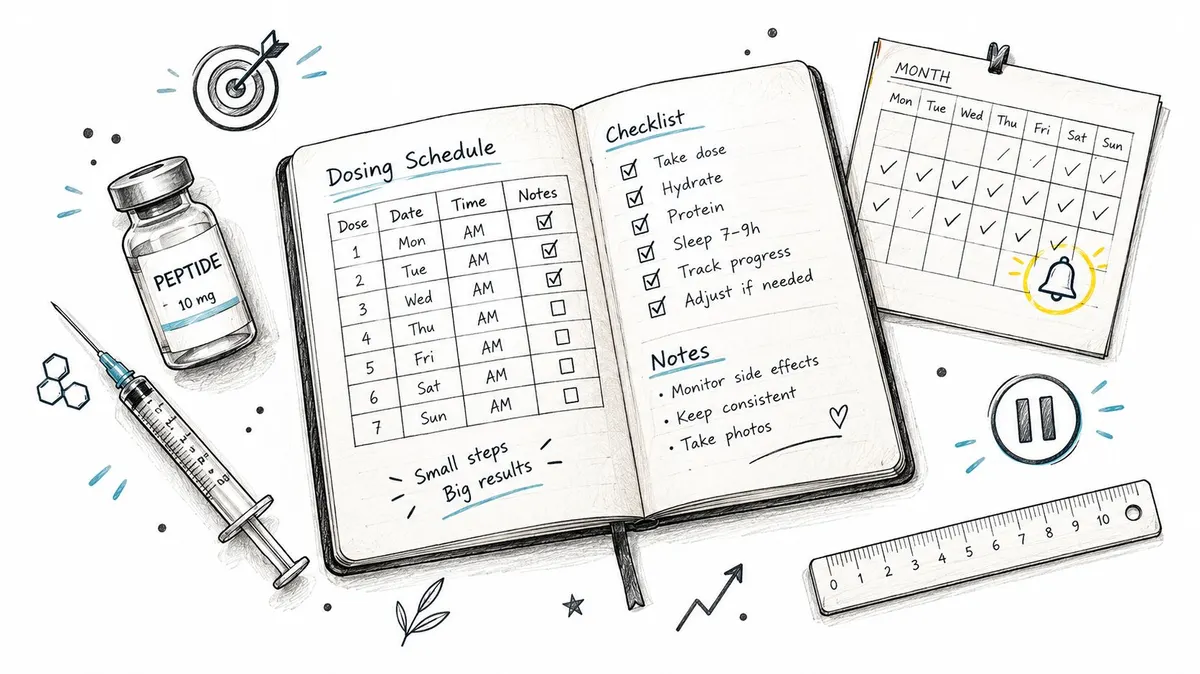
A useful note should show the intended cycle, frequency, dose record, reminder window, pause rules, and review point. That single page gives you something to check before each dose and something reliable to update when the week changes. It also makes adherence visible instead of leaving gaps to memory.

Define Your Goal and Choose a Cycle Length
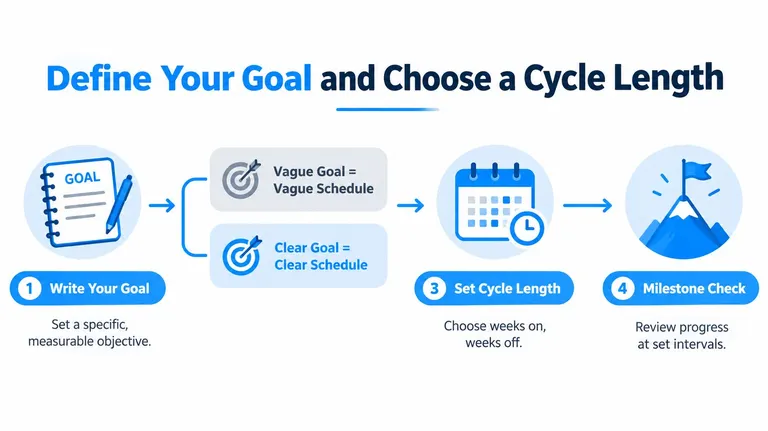
A vague goal produces a vague schedule. “Improve recovery” may be a useful theme, but it doesn’t tell you what to record, when to review it, or what would justify continuing. Put the intended outcome in writing, connect it to observable markers, and set a review date before you schedule the first dose.
A useful goal might identify a training-recovery pattern, a sleep-related observation, or another outcome your clinician has agreed is appropriate to monitor. Keep the checkpoint practical. You’re not trying to prove a result from a single day. You’re creating a consistent reference point for deciding whether the plan should continue, pause, or change under professional guidance.
Choose the cycle before the calendar fills
Cycle length should serve the goal, not convenience. A short intensive may make sense when you need early feedback and have a tightly controlled routine. Many structured protocols are planned as 8 to 12 week runs, while longer maintenance windows may suit ongoing work, provided a qualified clinician is involved.
The important habit is to write the cycle length down before logging a dose. That single decision controls the number of planned review points, the reminder window, the expected supply, and the point at which you stop treating the routine as an open-ended experiment.
Worked example with planned pauses
Suppose a clinician-approved schedule uses a 5-on-2-off pattern inside a 10-week cycle. The five active days are entered first, followed by two visible rest days. Weekends aren’t treated as emergencies or forgotten exceptions. They’re part of the design.
The same principle applies beyond peptide routines. An adaptable 90 day training guide can help illustrate how a longer plan becomes manageable when it’s divided into scheduled phases and checkpoints. The training details aren’t a substitute for medical guidance, but the planning logic is useful: define the endpoint, make the weekly rhythm visible, and review progress at predetermined moments.
Pick a Frequency That Matches the Goal
Frequency is the bridge between an intention and a repeated action. The right pattern depends on the compound, its duration of action, the clinician’s instructions, and the reason for the protocol. Don’t choose daily dosing just because it feels more disciplined, or twice-weekly dosing because it seems easier.
Use the table as a planning comparison, not as a dosing recommendation:
| Frequency | Best For | Main Trade-Off |
|---|---|---|
| Daily | Routines that benefit from a steady daily habit and a clinician-approved daily instruction | It’s easy to remember when tied to an existing habit, but a missed dose can disrupt the pattern |
| Every other day | Plans where alternating active and recovery days fits the intended approach | It needs a clear anchor day, because the schedule can drift when the week changes |
| Twice weekly | Longer-acting protocols prescribed on a less frequent basis | There are fewer injection days, but the gaps leave more room to forget or postpone |
A 10-week cycle with a recovery-oriented goal may fit an every-other-day structure if that’s what the prescribing professional directs. A short intensive may use a daily pattern for the same reason a daily training habit works: the action is attached to a predictable cue. Neither pattern is automatically superior. The plan must match the medical instruction and the person’s actual life.
Anchor the pattern before starting
Pick a stable cue, such as a consistent morning routine or a specific evening window. For every-other-day schedules, record the first active day clearly and let the calendar calculate the alternation. For twice-weekly routines, choose named weekdays rather than relying on “every few days.”
Lock the frequency into your reminder system before opening the vial. If a pattern requires frequent mental recalculation, it’s already too fragile. A good schedule tells you what happens today, what happens next, and what to do when reality interrupts.
Convert Micrograms Into Units on Your Syringe
The most error-prone part of many schedules is the conversion from a target amount in micrograms to a measurable syringe volume. The arithmetic is simple, but it depends entirely on the vial quantity and the volume used during reconstitution.
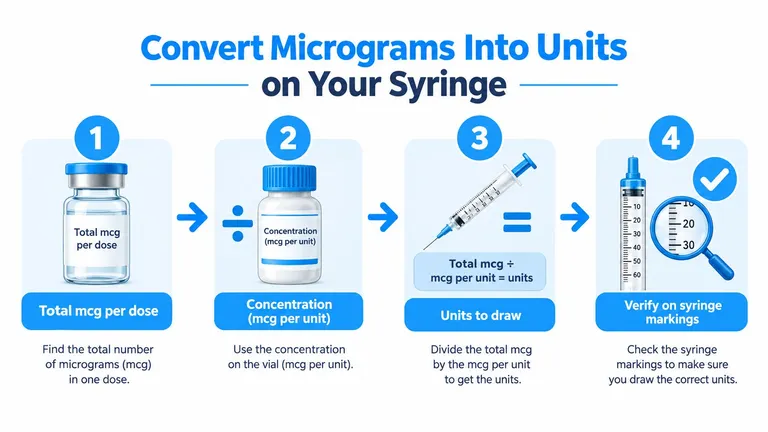
Use this sequence:
- Find concentration: Total micrograms in the vial divided by the reconstituted volume in millilitres.
- Find injection volume: Target micrograms divided by concentration in micrograms per millilitre.
- Convert to syringe units: Translate the millilitre volume to the markings on your syringe.
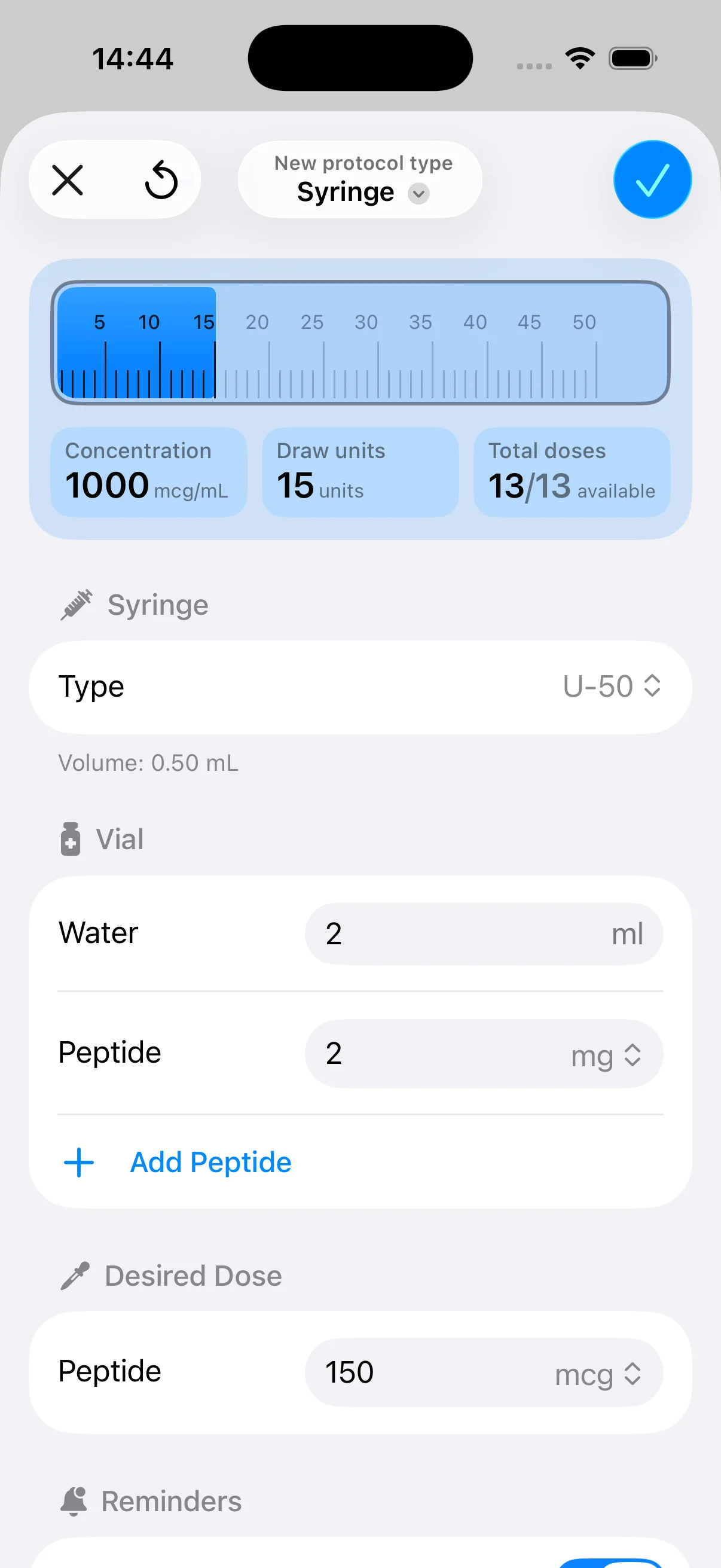
Here’s a worked example using the quantities in this planning model. A vial containing 5,000 micrograms reconstituted with 2 mL produces a concentration of 2,500 micrograms per mL. A target dose of 250 micrograms therefore equals 0.1 mL, which corresponds to 10 units on a U-100 syringe.
That example only demonstrates the calculation. It doesn’t tell you what dose to use, whether the product is suitable, or whether the reconstitution method is safe. Confirm the instructions with a qualified professional and follow the product’s validated preparation guidance.
Put the calculation into a repeatable workflow
Record the vial size and diluent volume together. If either changes, the concentration changes, even when the target microgram amount stays the same. An accurate peptide reconstitution tool can provide another way to check the concentration and resulting volume before you draw.
PepFlow can be configured with the vial quantity, diluent volume, and target amount so its calculator displays the corresponding unit count. Its guide to converting micrograms to units is useful for checking the logic before you rely on a syringe marking.
Double-check concentration before every draw when you switch vials, preparation volumes, or suppliers.
Two habits prevent most over-drawing errors. Reconstitute each vial in the same documented way, and keep the concentration written beside the target dose and syringe units. Never assume a new vial has the same concentration as the previous one.
Configure Reminders, Logs, and Pause Periods
A schedule that works only during a quiet week isn’t a sustainable schedule. Travel, illness, late nights, missed alarms, and supply gaps are normal disruptions, so the plan needs a defined response for each one.
Start with the reminder window. Tie the notification to a routine you already perform, then pair it with injection-site rotation if that’s part of your clinician-approved instructions. The log should capture the dose, units drawn, date, time, and a short note about anything relevant, such as a missed reminder or an unusual response.

Make pauses visible
For a 5-on-2-off routine, enter the off-days as deliberate rest days rather than leaving blank spaces. A pause toggle can move the cycle clock forward during travel, illness, or a supply interruption, which is different from silently deleting missed entries or restarting the whole plan.
The key distinction is between a pause and a reset. A pause preserves the cycle’s history and identifies why the routine stopped. A reset starts a new planning period and should be considered only when the clinician directs it or when the original plan no longer reflects the situation.
For more detail on keeping a routine intact when life changes, use the guidance on adherence to schedule. The principle is simple: record what happened instead of editing the history until it looks perfect.
If your healthcare professional has given you a specific missed-dose instruction, follow that first. Without individualized advice, don’t improvise by stacking doses. The commonly used 12-hour rule described in this workflow is not a universal medical rule, so confirm whether it applies to your medication and protocol before using it. Log a missed dose accurately, then ask a qualified professional whether to resume, skip, or pause.
After the written guidance, this short walkthrough shows how reminders and logs can fit into a day-to-day workflow.
Why Planning Does Not Stop at First Injection
The first injection starts a feedback loop. Your written plan rests on assumptions about your schedule, energy, travel, sleep, and expected response. Your records show which assumptions held up and which did not.
Review the pattern with your clinician after two to three weeks of consistent records. Note missed days linked to late nights, weekends, travel, or work changes. If a reminder repeatedly arrives while you are unavailable, move its time window. A workable prompt supports adherence better than self-criticism.
Treat the cycle as a testable plan
A cycle length is a working hypothesis, not a promise. If a recovery marker plateaus around week six, review the records before changing course. Check technique and adherence, then discuss whether shortening, pausing, or revising the plan fits your situation.
Keep the original schedule visible while recording expected and completed events separately. The logged record shows the difference between the plan you wrote and the week you lived. Do not rewrite the baseline to make missed doses or delays disappear. Preserving both versions makes changes easier to identify and discuss.
A later cycle should use better defaults where the record supports them. Adjust the reminder time, clarify the anchor day, make the pause rule easier to find, or simplify the logging habit. Small changes often matter more than adding complexity.
Planning continues because adherence is shaped by ordinary disruptions. A schedule that accounts for those disruptions gives you a clearer record and a more useful discussion with your clinician.
Quick Checklist and Common Questions
Before starting a new protocol, check each item:
- Goal: Write the intended outcome and the date or milestone for review.
- Cycle: Record the start date, active period, planned rest days, and end point.
- Frequency: Confirm the prescribed pattern and identify its anchor day or days.
- Concentration: Record vial quantity and reconstitution volume together.
- Units: Verify the calculation against the syringe markings before drawing.
- Reminders: Choose a realistic time window and configure notifications.
- Logs: Record every dose, missed dose, pause, and relevant note.
- Safety: Keep professional oversight in place and stop to seek advice if you experience concerning symptoms.
The recurring mistakes are predictable. People skip logs because the day felt normal, stack too many peptides into one cycle, or assume a replacement vial has the same concentration as the previous one. Each error removes information you need for a safe review.
Common questions
What should I do after a missed dose?
Follow the medication-specific instructions from your healthcare professional. Don’t double up to compensate unless you’ve been explicitly told to do so. Record the missed dose and preserve the planned cycle history.
When does a pause become a reset?
A pause keeps the existing cycle intact while the interruption is documented. A reset creates a new baseline. Discuss a reset when the interruption is substantial, the product or concentration changes, or the original goal is no longer appropriate.
How should I handle travel across time zones?
Keep the prescribed interval as the priority, then choose a local reminder window that supports it. For a short trip, write down the departure and arrival times, identify the next planned dose, and ask your clinician or pharmacist how to handle any ambiguity.
What reminder works for every-other-day dosing?
Use a repeating calendar pattern anchored to the first scheduled day, not a vague reminder such as “take it again soon.” Display active and rest days separately, and log the actual action so the next reminder remains aligned.
A sustainable routine has four visible parts: a clear goal, a realistic schedule, accurate dosing information, and honest tracking. If one is missing, fix the planning system before adding complexity.
PepFlow helps organize cycled protocols, calculate syringe units from recorded vial and concentration details, schedule reminders, log doses, and document pauses. Set up your next plan with fewer manual calculations by visiting PepFlow.