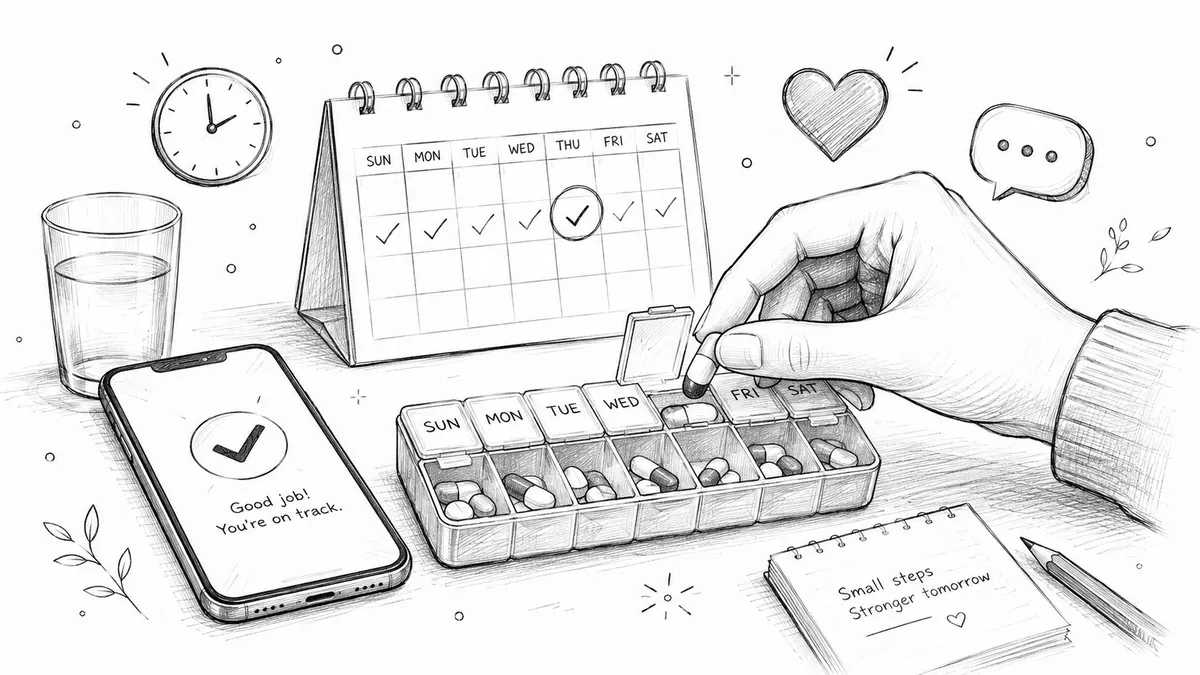
You meant to take it. You even thought about it earlier in the day. Then work ran long, dinner happened late, your phone battery died, and now you’re standing in the kitchen wondering whether you missed a dose, took it already, or should just try to do better tomorrow.
That loop is more common than often acknowledged. It doesn’t mean you’re careless. It usually means your medication system is weak.
Advice on how to improve medication adherence is often shallow: set an alarm, use a pillbox, be more disciplined. Some of that helps. But adherence is rarely a pure memory problem. Sometimes the schedule is too complicated. Sometimes the refill process is annoying enough that you drift off plan. Sometimes the instructions weren’t clear. Sometimes cost, side effects, privacy, travel, stigma, or plain friction gets in the way.
A better approach is to treat adherence like a system you design. First diagnose the underlying barrier. Then simplify the regimen if you can. Only after that do you add reminders, tracking, and support. That order matters more than is often acknowledged, especially if you’re managing long-term treatment or a precision-based protocol where timing and dose consistency matter.
Table of Contents
- Why Sticking to Your Schedule Is Harder Than It Looks
- First Find Your True Adherence Barrier
- Design a Schedule You Can Actually Follow
- Build Your Digital Reminder and Routine System
- Use Tracking and Logging to Maintain Momentum
- Troubleshoot Missed Doses and Build a Support Network
Why Sticking to Your Schedule Is Harder Than It Looks
At 7:10 a.m., the plan still seems easy. The medication is on the counter. Breakfast is half-made. Then a child needs a form signed, your phone starts buzzing, and you leave the house without taking the dose you meant to take with food. Later that night, you remember. By then, you are tired and unsure whether to take it late or wait until tomorrow.
That pattern is common, and it does not mean you are careless. It usually means the plan was too dependent on ideal conditions.
Medication adherence gets framed as a memory problem because missed doses show up at the moment you forgot. In practice, the breakdown often starts earlier. The timing may clash with work. The instructions may be too easy to misread. The dose may need food, privacy, refrigeration, or a level of predictability your day does not have.
Guilt does not solve any of that.
For long-term treatment, consistency gives the medication a fair chance to do its job. For more structured protocols, consistency also lowers the risk of doubling up, taking a dose too late, or making judgment calls when you are rushed. Less improvisation usually means fewer mistakes.
The practical lesson is not “try harder.” It is to stop treating adherence like a character test. Adherence is a system problem first. If the schedule is awkward, the instructions are fuzzy, or the routine changes every day, missed doses are a predictable result.
Stop blaming yourself for a design problem
I see the same mistake over and over. People start with reminders before they have a plan worth reminding themselves about. A phone alarm can prompt action, but it cannot fix a schedule that never fit your life in the first place.
A workable adherence setup answers basic questions clearly. What time window is realistic on weekdays and weekends? What has to happen before the dose? Where will the medication live so it is available at the right moment? If you miss a dose, do you know what to do next, or do you guess?
Those details sound small until they are not. A vague instruction like “take in the evening” means one thing to someone who eats dinner at 6 p.m. and something very different to a shift worker who gets home at midnight.
Consistency comes from reducing friction
People who stay consistent usually do not have more willpower. They have fewer points of failure.
They have a plan that fits the day they live, not the day they wish they had. They know where the medication is, what routine it attaches to, what travel changes, and what side effects or timing rules make the dose easier or harder to take. In coaching, this is the difference between a fragile routine and one that holds up under stress.
That is why improving adherence starts with design. Reminders matter, but they come later. First, make the regimen easier to execute. Then use tools to support it.
First Find Your True Adherence Barrier
The fastest way to stay stuck is to solve the wrong problem. If your real issue is cost, an alarm won’t fix it. If your schedule is chaotic, motivation won’t fix it. If you don’t fully understand the instructions, a pill organizer won’t fix it either.

Stop assuming the problem is memory
A lot of adherence advice starts from forgetfulness because it’s visible. It’s also easy to talk about. But hidden barriers often matter more.
The CDC’s Grand Rounds guidance emphasizes that reducing barriers to obtaining medication matters, along with team-based care, patient education, and health IT tools. That same guidance also points to practical supports such as pillboxes and blister packs, and broader help with access issues like cost and pharmacy logistics in the CDC discussion of improving medication adherence.
If you keep missing doses, ask yourself whether the failure happened at the moment of taking the medication, or much earlier. Maybe the refill was delayed. Maybe you spaced out because the routine has too many moving parts. Maybe you were never fully sure whether it should be taken with food, at bedtime, or away from another medication.
Use four diagnostic questions
Sit down and answer these truthfully. Don’t aim to sound responsible. Aim to identify the bottleneck.
- Is the regimen too complicated? If your medication plan has multiple dosing times, changing instructions, or special timing rules, complexity may be the main problem.
- Is access getting in the way? If refills, pharmacy trips, delivery issues, or price are causing delays, your barrier is logistical or financial.
- Do you understand the plan? If you hesitate when someone asks how and when you take each medication, the issue may be clarity, not commitment.
- Are you resisting the routine itself? Some people avoid doses because the treatment feels emotionally loaded, stigmatizing, disruptive, or tied to side effects.
Diagnostic rule: The barrier that shows up earliest is usually the real one. If the medication never gets refilled on time, the problem isn’t memory. If you refill it but keep missing the evening dose, the problem is probably routine design.
Once you know the true barrier, the next move gets obvious.
If cost or access is the issue, talk to your prescriber or pharmacist about generic options, longer supplies when appropriate, simpler refill logistics, and written instructions you can use. If understanding is weak, ask for the regimen to be written in plain language. If the schedule is the issue, fix that before buying new gadgets.
Design a Schedule You Can Actually Follow
A workable medication schedule survives bad days. It still makes sense when you wake up late, eat at odd hours, travel, or get pulled into other responsibilities. If your plan only works under ideal conditions, adherence will slide.
Reduce friction before you add alerts
Simpler regimens tend to get followed more consistently than schedules that require several dosing windows and special rules. That is why schedule design comes before reminder apps, pill alarms, or habit trackers. If the plan is awkward, technology just nags you about an awkward plan.
A useful question is: what is creating the extra decision points?
Sometimes the fix is clinical. Ask the prescriber or pharmacist whether timing can be combined, whether a longer-acting option fits the treatment goal, or whether a combination product would reduce clutter. Sometimes the fix is behavioral. A dose that technically says “twice daily” may still be easier if both doses are tied to stable anchors instead of floating across the day.
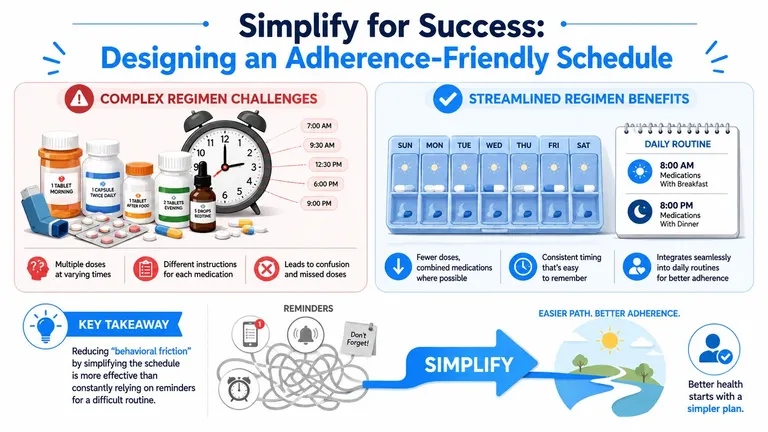
A practical medication review often comes down to four decisions:
- Can dosing times be consolidated? Fewer separate medication moments usually means fewer misses.
- Can the plan be synchronized with existing routines? One stable morning block is easier to repeat than scattered instructions across the day.
- Can special rules be reduced? Food requirements, spacing rules, and rotating instructions create friction fast.
- Can the written plan be simplified? Clear directions beat mental notes and vague portal messages.
The goal is not convenience for its own sake. The goal is to remove enough friction that the right action becomes the default.
Anchor doses to a real routine
The strongest schedule attaches each dose to something that already happens with very little variation. Breakfast works for some people. Brushing teeth works for others. Feeding the dog, making coffee, or getting into bed can also work well. “Later this morning” usually fails because it depends on memory and motivation.
Good anchors are specific and visible. Weak anchors are broad and movable.
Use these rules when you set the schedule:
- Pick one clear cue for each dosing window. If every medication gets its own separate ritual, complexity creeps back in.
- Store the medication where the routine happens, if storage instructions allow it. Near the coffee setup or toothbrush is often better than hidden in a cabinet.
- Write the plan in plain language. “Take with breakfast and water” is easier to follow than a vague label you have to interpret each day.
- Build for the household, not just the patient. If another person helps manage doses, labels, storage, and handoff rules should be obvious. This guide to organizing loved one’s medications has practical examples.
- Respect precision when the regimen requires it. Some protocols leave less room for approximation. If you are dealing with measured dosing and want to avoid calculation errors that turn into routine errors, review this peptide dosage guide.
I tell clients to test the schedule against a messy Tuesday, not a perfect Sunday. If the plan still holds when lunch is late, the school pickup changes, or work runs long, you probably have a schedule you can keep.
The best adherence plan asks the least from your memory on your busiest day.
Build Your Digital Reminder and Routine System
At 9:00 p.m., the phone buzzes. You swipe it away because you are driving home, finishing dinner, or helping a kid with homework. An hour later, the reminder is gone and the dose is no longer in front of you. That is the failure point. The problem is not awareness alone. It is a reminder system that did not survive real life.
Once the schedule is simple enough to hold on a messy day, digital reminders start doing useful work. They should reduce decisions at the exact moment a dose is due. If the prompt creates more questions, people ignore it, snooze it, or plan to deal with it later.
Choose the right level of reminder
As noted earlier, research on adherence interventions shows that reminder systems can improve follow-through. The catch is fit. A reminder only helps if it arrives in a form you can act on immediately.
A basic phone alarm works for one fixed daily dose. It is often too thin for anything more demanding. If timing changes, if the protocol cycles, or if doses differ by day, a generic alert leaves too much for memory to fill in.
Use the simplest tool that still answers the question in front of you. What do I take now, how much, and how do I confirm I took it?
People who already rely on recurring prompts for work usually adapt well to the same structure in health routines. The principle is familiar. Fewer memory-dependent tasks means fewer avoidable misses. This article on how automated reminders can boost productivity for professionals makes that point clearly in another context.
Build reminders that are hard to ignore and easy to complete
Set reminders with plain-language labels. “Metformin 500 mg with dinner” beats “Take meds.” Include the action, not just the time.
Use escalation sparingly. One alert at the right moment is better than five alerts you learn to dismiss. For clients with a history of missed evening doses, I usually set a primary reminder at the anchor time and one follow-up 20 to 30 minutes later. More than that often becomes wallpaper.
Match the tool to the regimen:
| Tool | Best For | Pros | Cons |
|---|---|---|---|
| Phone alarm | One simple daily dose | Fast to set up, built into your phone, clear basic cue | Easy to dismiss, no history, poor fit for changing schedules |
| Pill organizer | Stable weekly routine | Visible, tactile, useful for daily routines | Does not clarify missed doses, less helpful for cyclical plans |
| Calendar reminders | People who live by schedule blocks | Can include notes, fits well with time-blocked days | Can get buried under other notifications |
| Text reminders | People who respond to direct prompts | Simple, familiar, effective for straightforward routines | Limited context, weak fit for nuanced protocols |
| Dedicated dosing app | Complex, cyclical, or measured regimens | Keeps timing, dose details, and history together | Requires setup and daily discipline |
One rule matters here. The reminder should lead straight to completion, not to interpretation.
For more complex protocols, use a system that keeps dose math, scheduling, and confirmation in one place. If you are comparing options built for that workflow, this review of a peptide calculator app for tracking and dosing accuracy is a useful reference beyond basic alarms.
Use Tracking and Logging to Maintain Momentum
A reminder gets you to the moment. A log helps you stay consistent over weeks and months. That distinction matters.
Why logging changes behavior
People often think tracking is optional admin. In practice, it closes a dangerous gap: the difference between “I intended to take it” and “I know I took it.”
For complex, cyclical, or self-directed regimens, reminders alone can fail. A recent review notes that the most durable gains come from simplification, synchronization, and active follow-up or tracking, especially when precision dosing is involved and consistency depends on a reliable log in the 2024 review on adherence interventions and complex regimens.
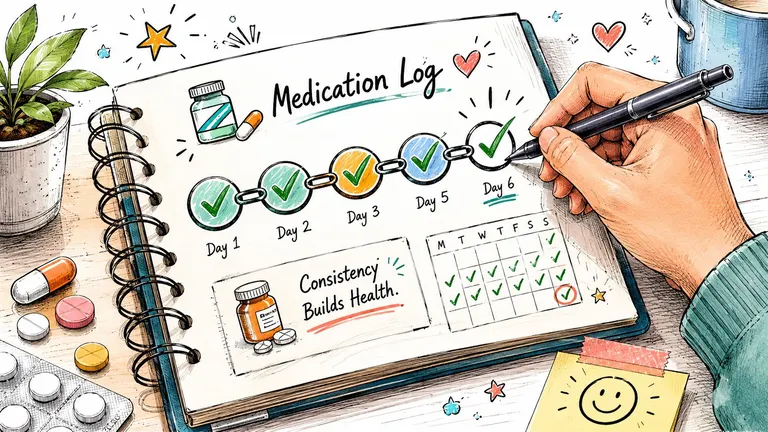
Logging creates proof. It also creates momentum. Once you’ve recorded several days in a row, you’re less likely to break the chain casually.
That doesn’t require an elaborate setup. A paper notebook works. A calendar with checkmarks works. An app with dose history works. What matters is that the log is immediate, easy, and visible enough to trust.
What a useful adherence log should capture
A good log is short enough to maintain and detailed enough to solve confusion later.
Include these fields if they matter for your regimen:
- Date and time taken
- Dose used
- Any variation from plan
- Relevant note, such as taken late, taken with food, or skipped due to refill delay
Keep the note field brief. The goal isn’t journaling. The goal is clean recall.
This short video gives a simple visual reminder that medication routines work better when they’re visible and repeatable:
For cyclical protocols, logging matters even more because the risk isn’t just forgetting. It’s losing your place. Once that happens, people often start guessing. Guessing is where precision breaks down.
Track the action, not just the intention. Memory is not a reliable medical record.
Troubleshoot Missed Doses and Build a Support Network
You miss a dose after a long travel day, then spend the next hour trying to remember whether you took it late, skipped it, or only meant to take it. That kind of mistake usually starts before the missed dose itself. The system was already too fragile.
Missed doses are feedback. Use them to find the point of failure and tighten the plan.
Treat misses as a system problem first
Start with safety. Check the instructions for that specific medication, or contact the prescribing clinician or pharmacist if the next step is unclear. Do not double the next dose unless you were told to do that for that medication.
Then diagnose the miss with some honesty. In practice, the cause is often more specific than “I forgot.”
- Timing problem: the dose was attached to a routine that changes too often
- Access problem: the refill was late, the medication was packed away, or supplies were left at home
- Instruction problem: the plan was too hard to interpret in real life
- Avoidance problem: side effects, anxiety, cost, or simple resistance made you put it off
That distinction matters. A timing problem needs a better anchor. An access problem needs a refill buffer or travel kit. An avoidance problem needs a real conversation, not another alarm.
I tell clients to repair the weak point within 24 hours. If the same miss happens twice, the regimen or the routine is still asking too much.
Build support that does one clear job
Human support works when each person has a defined role. Vague accountability usually fades fast.
Useful support can look like this:
- A partner checks whether the evening dose was taken
- A family member watches refill dates and pickup deadlines
- A pharmacist reviews whether the regimen can be simplified
- A clinician helps address side effects that are causing avoidance
- A coach or friend notices patterns you keep missing on your own
As noted earlier, direct human follow-up often works better than passive reminders once adherence starts slipping. That does not mean everyone needs intensive oversight. It means support should match the failure point. If the issue is confusion, get clarification. If the issue is friction, reduce steps. If the issue is isolation, bring in one reliable person.
Operational details matter too. If your plan includes temperature-sensitive compounds, mixed materials, or anything with a shorter usable window, uncertainty about storage can turn into skipped doses. Reviewing basics like how long peptides last after storage or reconstitution can prevent avoidable hesitations.
Protect your privacy while you do this.
Share the minimum information someone needs to help the plan work. A good support system reduces friction, catches problems early, and stays specific enough that you can keep using it for months, not just for one motivated week.
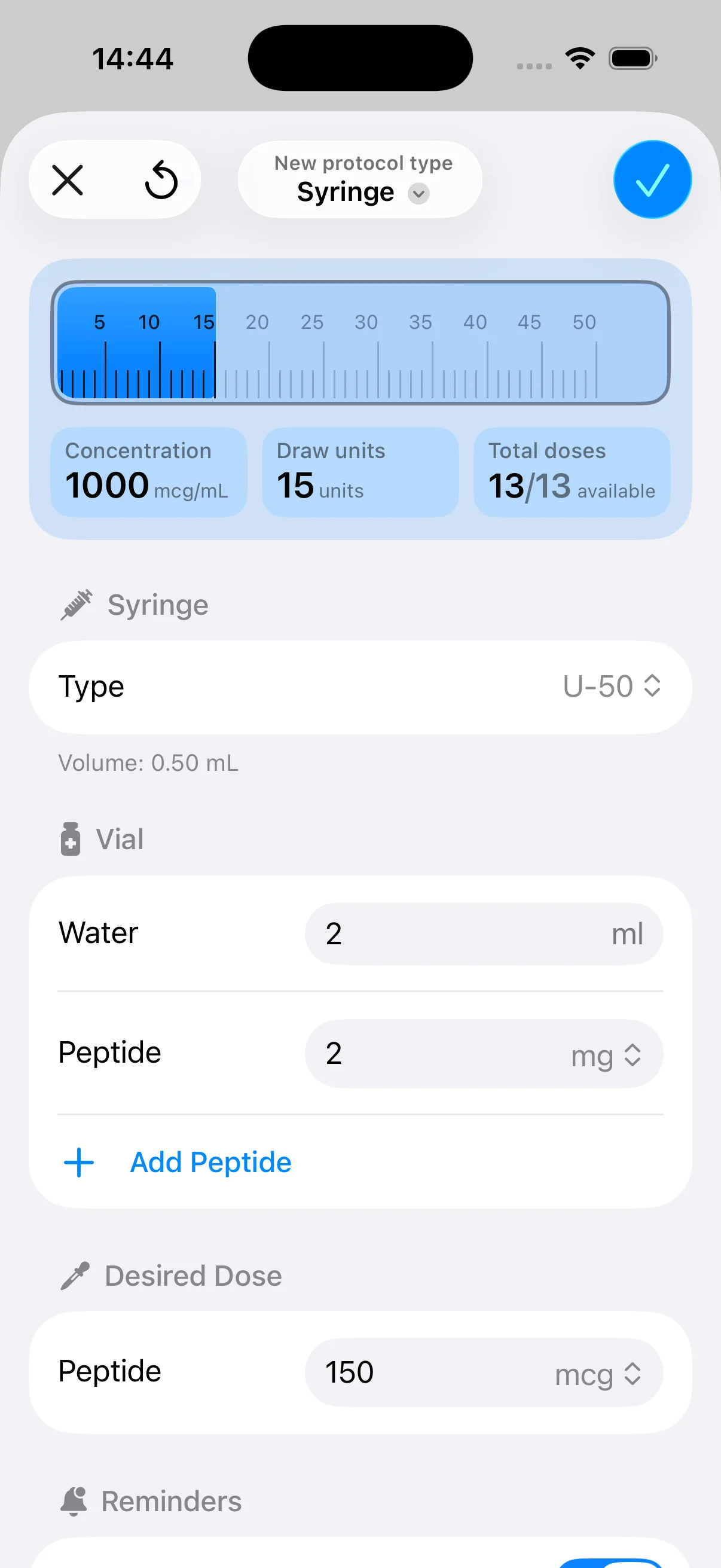
If you want a lighter way to manage peptide schedules without doing manual math or relying on scattered reminders, PepFlow is built for that exact job. It helps you calculate doses, plan cycled protocols, stay on schedule with reminders, and log what you took so your routine stays accurate and easy to follow.