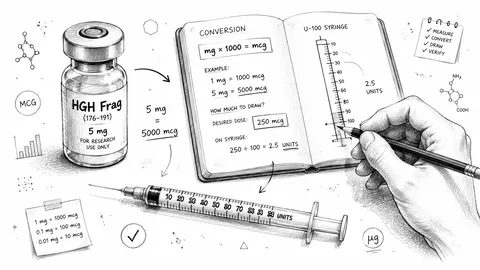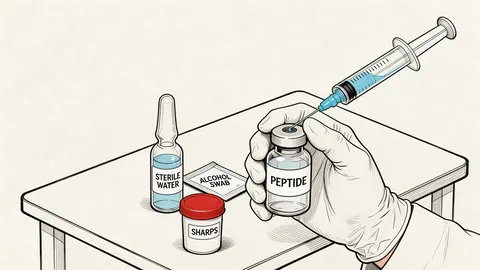
The most popular advice about HGH fragment dosage is the most misleading part of the conversation. People talk as if there’s a clean number you can copy, measure, and trust, but the human evidence doesn’t support that confidence. What exists is a mix of studied AOD-9604 trials, licensed growth-hormone prescribing context, and a lot of online protocol language that blurs compound identity, route, and bioavailability into one false shortcut.
Table of Contents
- Why There Is No Single HGH Fragment Dosage
- What Clinical Evidence Actually Shows for AOD-9604
- How to Distinguish Compound Identity and Route Before Calculating
- What Approved Somatropin Dosing Can and Cannot Teach Us
- Community Conventions Versus Evidence Thresholds
- When and Why Professional Supervision Matters
- Practical Steps for Cautious Readers
Why There Is No Single HGH Fragment Dosage
The idea that HGH Fragment 176-191 has one standard dosage sounds neat because it removes uncertainty. The problem is that the human evidence doesn’t give you that certainty, and it never has. What people often call an HGH fragment dose is usually borrowed from a different compound, a different route, and a different study design.
The core identity problem
AOD-9604 is related to the 176-191 region of human growth hormone, but it is not the same thing as an unmodified fragment. That matters because the clinical data available for AOD-9604 came from oral administration in obesity studies, not from validated injectable fragment protocols. When an article or calculator presents oral trial doses as if they were ready-made syringe units, it’s skipping the most important scientific question, which is whether the molecules and exposure patterns are comparable. See the AOD-9604 identity reference.
A responsible educational resource has to separate the concepts before it gets anywhere near a number. The guide to peptide therapy benefits from ProMD Health Ashburn Med Spa is useful in that sense, because it frames peptide use as a broader therapeutic topic instead of pretending every peptide can be handled with one universal dosing template.
Why route changes the meaning of a dose
Oral study doses and injectable microgram regimens don’t translate cleanly into each other. Bioavailability, product purity, formulation, and exposure can all differ in ways that make a mathematical conversion misleading. A table that says “X milligrams oral equals Y micrograms subcutaneous” may look precise, but precision isn’t the same as clinical validity.
Practical rule: if the product name, route, and concentration aren’t explicit, the dose number is not meaningful yet.
That’s why a calculator such as the one at PepFlow’s peptide dosage guide should be treated as a math tool, not a substitute for evidence. The math can help you avoid unit errors. It can’t turn an unstudied injectable fragment into a validated therapy.
What Clinical Evidence Actually Shows for AOD-9604
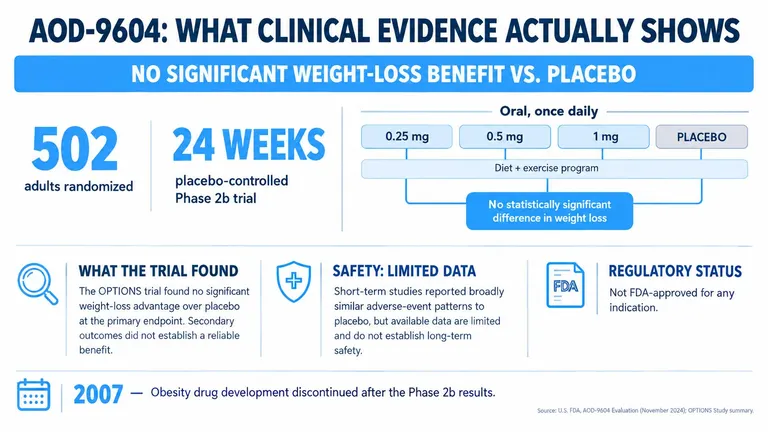
The strongest human data in this area comes from AOD-9604, not from unmodified HGH Fragment 176-191. That distinction matters because the trial record shows why a dose number alone doesn’t create confidence. More compound doesn’t automatically mean better outcomes, and one early signal does not override later controlled findings.
What the early oral trial suggested
An early 12-week trial in approximately 300 adults with obesity tested oral daily doses of 1, 5, 10, 20, and 30 mg. The 1 mg group reportedly lost about 2.6 to 2.8 kg versus roughly 0.8 kg with placebo, while the higher doses did not produce a consistent incremental response. That pattern is important because it does not behave like a simple dose-response curve where more drug reliably creates more benefit.
A later 24-week Phase 2b study enrolled 502 adults and compared 0.25, 0.5, and 1 mg/day with placebo alongside diet and exercise. Available summaries report that none of the tested doses separated from placebo on the primary weight-loss endpoint, so the trial did not demonstrate a dose-related clinical benefit for obesity treatment AOD9604 development program summary. That’s the kind of result people should pause over, because it means the most careful trial design still did not validate a practical dosing recommendation.
Why the dose-response pattern matters
The temptation is to read the early result and conclude that a specific amount “works.” That’s not a safe conclusion. Trial outcomes can reflect adherence, diet and exercise cointerventions, statistical variation, or study design, not a dependable pharmacologic gradient. If a larger dose doesn’t improve the outcome, then an internet chart that escalates the number is giving you confidence without evidence.
The peptides for body composition guide can help readers understand how peptide goals are often oversold when body-composition language gets detached from real human data. That caution applies here in a very direct way.
How to Distinguish Compound Identity and Route Before Calculating
A cautious reader should start with a simple question, what exactly is in the vial, and how was it studied? If that sounds basic, it should. Many dosing mistakes happen because people assume the label, the route, and the reference study all describe the same thing when they don’t.

A practical pre-calculation checklist
Before any unit conversion, check these points in order:
- Compound identity: confirm whether the product is marketed as AOD-9604, HGH Fragment 176-191, or something else entirely.
- Route used in evidence: ask whether the cited study used oral or injectable administration.
- Concentration on the label: verify the mass of peptide per vial and the actual diluent volume used.
- Source quality: determine whether the product comes from a regulated supply chain or an unverified internet source.
- Exposure logic: remember that bioavailability and tissue exposure are not interchangeable between oral and injectable use.
That checklist matters because a mathematically exact syringe volume can still be clinically meaningless if the underlying assumptions are wrong. A protocol can be internally consistent and still be built on an invalid comparison.
Bottom line: unit conversion is a math problem. Dose validity is a pharmacology problem.
Why calculators can mislead when the compound is unclear
A calculator is useful only after you already know what you’re calculating. If someone plugs an oral AOD-9604 study dose into a subcutaneous fragment routine, the output may look tidy while the clinical reasoning collapses. That’s why the peptide purity testing resource is relevant, because source quality and identity testing come before any serious dose discussion.
The same logic applies to community conventions that circulate as if they were settled science. A number repeated often enough can start to feel official, but repetition doesn’t establish equivalence. The route, the molecule, and the exposure context still decide whether the number means anything.
What Approved Somatropin Dosing Can and Cannot Teach Us
Approved growth-hormone therapy offers context, but it does not offer a shortcut for fragment dosing. FDA labeling for somatropin in adults with growth-hormone deficiency describes a low starting dose of no more than 0.04 mg/kg/week, with some labeling allowing titration up to 0.08 mg/kg/week through individualized adjustment at intervals of about 4 to 8 weeks. Another FDA label expresses an alternative starting approach as no more than 0.006 mg/kg/day, with a maximum of 0.0125 mg/kg/day FDA somatropin prescribing information.
Those numbers belong to licensed somatropin for diagnosed deficiency, not to HGH fragments such as 176-191. The key lesson is not the amount itself, it’s the dosing framework. Clinicians adjust based on clinical response, adverse effects, and age- and sex-adjusted IGF-1 concentrations. That is a biomarker-guided model, not a universal fixed-dose model.
This distinction matters because fragment protocols don’t inherit the same safety net. If a person borrows a somatropin number and applies it to an unapproved peptide, they’re skipping the labeling and monitoring logic that made the original dose usable in the first place. The result can be a false sense of medical legitimacy.
Clinical caution: approved GH dosing became individualized because fixed dosing was never the real answer.
That’s also why concentration calculations and route labeling deserve more attention than community shortcuts. When the product, dose, and monitoring system aren’t aligned, the number becomes decoration.
Community Conventions Versus Evidence Thresholds
Consumer content often gives a tidy range and stops there, but the harder question is whether any dose has shown durable benefit or acceptable safety. For HGH Fragment 176-191, the answer remains no. It is not approved by the FDA or comparable international regulators, and there is no established human dosing regimen.
| Protocol Type | Cited Dose Range | Evidence Status | Route |
|---|---|---|---|
| Community convention | 200 to 500 mcg daily | Not validated in human fragment trials | Usually injectable |
| AOD-9604 early trial context | 1 to 30 mg daily | Investigational, mixed results | Oral |
| AOD-9604 later Phase 2b context | 0.25 to 1 mg/day | No separation from placebo on the primary endpoint | Oral |
| Licensed somatropin therapy | Weight-based, individualized titration | Approved for diagnosed deficiency | Injectable |
The table shows why “commonly cited” and “clinically supported” are separate categories. The AOD-9604 program adds context, not confirmation. As covered above, the program ended without a validated dose, and the table above shows how that compares with community conventions. Its route also matters, because oral AOD-9604 and injected HGH Fragment 176-191 are not interchangeable compounds, even when people use similar shorthand.
The biggest risk is not only that a dose may be wrong. Product-source risk, route confusion, and unregulated distribution can matter more than fine-tuning a number that was never validated in the first place. In that setting, a precise-looking chart can create more confidence than the evidence supports, especially if the units are copied without checking whether they belong to the same compound or route.
When and Why Professional Supervision Matters

Professional supervision isn’t a luxury here, it’s the only defensible path when evidence is thin and product quality varies. Unapproved peptide fragments can come from sources that bypass regulated distribution safeguards, which means the consumer often can’t verify identity, purity, or concentration with enough confidence to make self-dosing low-risk. That problem gets worse when no established human dosing regimen exists.
What oversight actually adds
A clinician can help with the questions an internet chart can’t answer. They can evaluate whether the goal is even appropriate, whether a different therapy fits better, and whether monitoring is possible at all. They can also spot when a person is trying to make a fragile protocol look precise just because the math checks out.
The practical red flags are straightforward:
- Unclear source: the product description doesn’t name the compound cleanly.
- Route confusion: the protocol mixes oral data with injectable use.
- No monitoring plan: there’s no discussion of labs, adverse effects, or follow-up.
- Dose certainty without evidence: the advice sounds firm even though the human data are not.
- Isolation from care: the person is expected to self-manage everything alone.
Why accountability matters more than optimization
The point of supervision isn’t to chase a perfect peptide stack. It’s to reduce preventable mistakes in a space where the evidence doesn’t support false certainty. In practice, that means asking informed questions instead of arriving with a fixed protocol and hoping a clinician signs off on it.
If you’re discussing unapproved peptides with a medical professional, lead with compound identity, route, and source, not with a number you found online. That gives the conversation a chance to stay anchored in evidence rather than folklore.
Practical Steps for Cautious Readers
A careful reader usually gets this right by slowing the process down. First, they identify the compound by its exact name. Then they check whether the evidence they found was oral or injectable, and whether it involved the product in hand. Only after that do they look at concentration, source quality, and whether a clinician should review the plan.
For example, someone comparing an internet protocol with a vial label can use a simple sequence. Confirm the identity. Confirm the route. Confirm the concentration. Then, if the product still seems relevant, ask a qualified clinician whether it belongs in your plan at all. If any part of that chain is fuzzy, the safest answer is to stop and verify rather than improvise.
That’s also the point where lab-handling basics matter. A practical resource such as bac water guidance is useful for general handling concepts, but it still doesn’t solve the bigger question of whether the peptide itself is appropriate, legal, or evidence-based.
The main takeaway is simple. Accuracy and routine matter more than chasing an unvalidated dose. The number only helps when the compound, route, and source are already understood.
PepFlow helps people handle peptide math, vial planning, and protocol organization with less guesswork, which is exactly where many dosing errors start. If you want a clearer way to keep concentration calculations, scheduling, and reminders in one place, visit PepFlow and use it as a planning companion, not a substitute for professional medical advice.