You’re probably staring at three things that don’t seem to speak the same language: a vial labeled in mg, a protocol discussed in mcg, and an insulin syringe marked in units or mL. That mismatch is where most HGH Frag mistakes begin.
The good news is that HGH Frag dosage isn’t mainly a guessing problem. It’s a translation problem. Once you understand how to convert powder in a vial into a repeatable draw on a syringe, the process gets much less intimidating.
Plenty of people who use research peptides are also trying to improve body composition, recovery habits, and training quality at the same time. If that broader goal sounds familiar, this conversation on Strength training to feel better at 50+ is useful context because it frames peptide use as one small part of a bigger health strategy, not the whole strategy.
Table of Contents
- Navigating the Complex World of Peptide Dosing
- What Is HGH Fragment 176-191
- Understanding Dosage Ranges and Scientific Context
- The Core Calculation From Vial to Syringe
- Sample Dosing Schedules and Cycle Templates
- Safety Side Effects and Protocol Adjustments
- Conclusion Dosing with Confidence and Precision
Navigating the Complex World of Peptide Dosing
A beginner usually makes the same assumption: “If I know my dose, I know what to inject.” But with peptides, that’s only half true. Knowing the target dose is like knowing you need one cup of coffee beans. You still have to know whether the scoop in your hand holds a tablespoon, a quarter cup, or something else entirely.
That’s the friction point with HGH Frag. The vial contains dry peptide powder. Your protocol is usually described in micrograms. Your syringe measures liquid volume. The math lives in the middle.
The common point of confusion
A typical thought process goes like this:
- The vial says milligrams: You know the total amount of peptide in the container.
- The protocol says micrograms: You know the amount you want per injection or per day.
- The syringe says units: You need to know how much liquid corresponds to the peptide amount you want.
Miss one conversion, and the draw can be off.
Practical rule: Never draw a peptide dose until you can answer one question clearly. “How many micrograms are in each milliliter after reconstitution?”
People get into trouble when they skip that step and work backward from syringe markings alone. Syringe units don’t tell you the peptide dose by themselves. They only tell you volume.
Precision reduces stress
A careful routine helps more than confidence does. Label the vial after reconstitution. Write down the concentration. Keep the intended dose in one unit system before you inject. If you train hard and track nutrition closely, this should feel familiar. The more moving parts a protocol has, the more it benefits from routine instead of memory.
What Is HGH Fragment 176-191
HGH Fragment 176-191 is a small peptide fragment derived from human growth hormone, not full HGH itself. The name tells you what it is. It refers to the amino acid segment from positions 176 through 191 of the larger hormone chain.
The easiest way to think about it is with a key analogy. Full HGH is like a master key that interacts with multiple systems. HGH Fragment 176-191 is more like a cut-down key made from one specific section. People are interested in it because that section has been associated with fat metabolism rather than the wider set of effects people associate with full growth hormone.
Why that distinction matters
Often, beginners get mixed up. They hear “growth hormone fragment” and assume they should think about it the same way they’d think about pharmaceutical HGH. That’s a category error.
HGH Frag is discussed in body composition circles because users hope for a more targeted effect. That doesn’t mean the biology is simple, and it doesn’t mean the dosing is established like a prescription drug. It just means the goal is usually narrower.
If you’re trying to place HGH Frag in the bigger picture of body composition, recovery, and optimizing hormone balance, it helps to separate three ideas: full hormone replacement, performance-oriented peptide use, and general wellness claims. Those aren’t interchangeable.
The practical takeaway
When people talk about HGH Frag dosage, they’re usually not asking, “How do I mimic full HGH?” They’re asking a much more specific question: “How do I prepare and administer this fragment consistently for a body-fat-focused protocol?” That narrower framing makes the math cleaner and the expectations more realistic.
Understanding Dosage Ranges and Scientific Context
A beginner usually runs into the same problem here. They see a number like 250 mcg or 500 mcg in a forum, then assume the hard part is over. It is not. A reported dose is only the starting point. You still need to decide whether that number came from research, analogy, or community habit, and then translate it into a repeatable amount you can draw correctly.
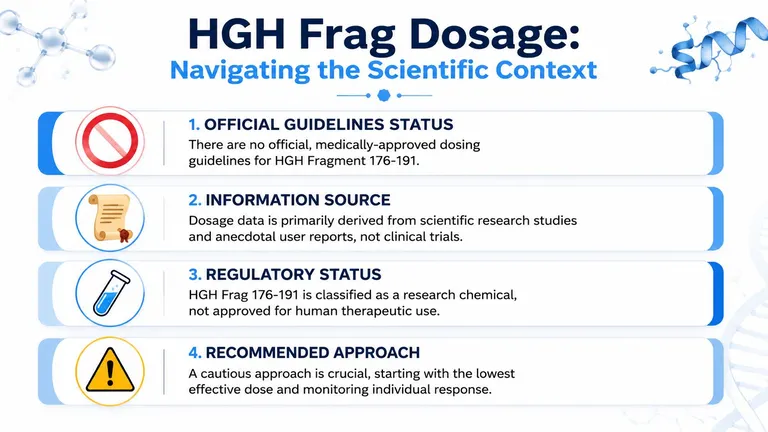
The key scientific limitation is straightforward. HGH Fragment 176-191 does not have formal human clinical trial data that establishes a validated dosing standard. That means the dose ranges repeated online should be treated as community conventions, not prescription-style guidance.
Why the common numbers need context
In practice, user discussions around unmodified HGH Fragment 176-191 often circle around a daily range of 200 to 500 mcg, sometimes split into one or two subcutaneous injections over multi-week runs. Those numbers are common because they are easy to remember and easy to plug into a reconstitution calculator.
Popularity does not make a dose precise.
A useful way to frame it is to separate three layers of certainty. First, there is direct human evidence for the exact compound. Second, there is indirect evidence from related compounds or mechanistic reasoning. Third, there is community reporting. HGH Frag dosing mostly lives in the second and third layers. That is why careful users avoid treating repeated numbers like proven targets.
This matters for safety as much as for expectations. If the source of a dose is weak, the margin for math mistakes gets smaller. A shaky starting assumption plus a bad conversion can turn a modest protocol into an accidental over- or under-dose.
What Related Human Data Tells Us
Some of the discussion around HGH Frag borrows from AOD-9604, a modified analog derived from the same 176-191 region. Human studies have been conducted on AOD-9604, including placebo-controlled work in overweight adults, but that compound is still not the same as unmodified HGH Fragment 176-191. The comparison is useful for context and safety framing, yet it does not create a validated dose for HGH Frag itself.
That distinction is easy to miss. Two compounds can share part of a sequence and still behave differently enough that dose comparisons become rough estimates rather than clean conversions. In other words, borrowing numbers across compounds works more like using a nearby city’s weather report. It may give you a general sense of conditions, but it does not tell you exactly what is happening on your street.
So what should a careful reader do with all this?
Use reported dose ranges as rough reference points, then shift your attention to process. True skill is not memorizing a popular microgram number. True skill is converting that theoretical target into a concentration, then into the exact syringe volume that matches your setup every single time. If you want a clear walkthrough of that logic, this peptide dosage guide for reconstitution and unit conversion is helpful because it focuses on the math behind preparation rather than hype.
The same evidence-first mindset applies outside peptides too. Articles on collagen for skin benefits and dosage make the same larger point. A dosage conversation only becomes useful when you separate mechanism, marketing claims, and measured outcomes.
For HGH Frag, that separation keeps you grounded. It also sets up the part that matters most in practice. Getting from vial label to correctly drawn syringe without guessing.
The Core Calculation From Vial to Syringe
This is the part that matters most in day-to-day use. You don’t inject “milligrams in a vial.” You inject a volume of liquid that contains a target amount of peptide.

Start with concentration not with syringe units
The cleanest sequence is always:
- Know the total peptide amount in the vial
- Know how much bacteriostatic water you added
- Calculate the concentration
- Convert your target mcg dose into mL
- Convert mL into syringe units if needed
Think of reconstitution like mixing drink concentrate. If you pour the same powder into more water, each milliliter becomes weaker. If you use less water, each milliliter becomes stronger. The peptide amount in the vial doesn’t change. The concentration changes.
Formula: concentration = total peptide amount ÷ total liquid volume
Before doing anything else, keep the units aligned. Most peptide vials are labeled in mg, but injection targets are often discussed in mcg. So first convert milligrams to micrograms.
Unit reminder: 1 mg = 1000 mcg
A worked example using a 5 mg vial
Use the exact scenario people struggle with most.
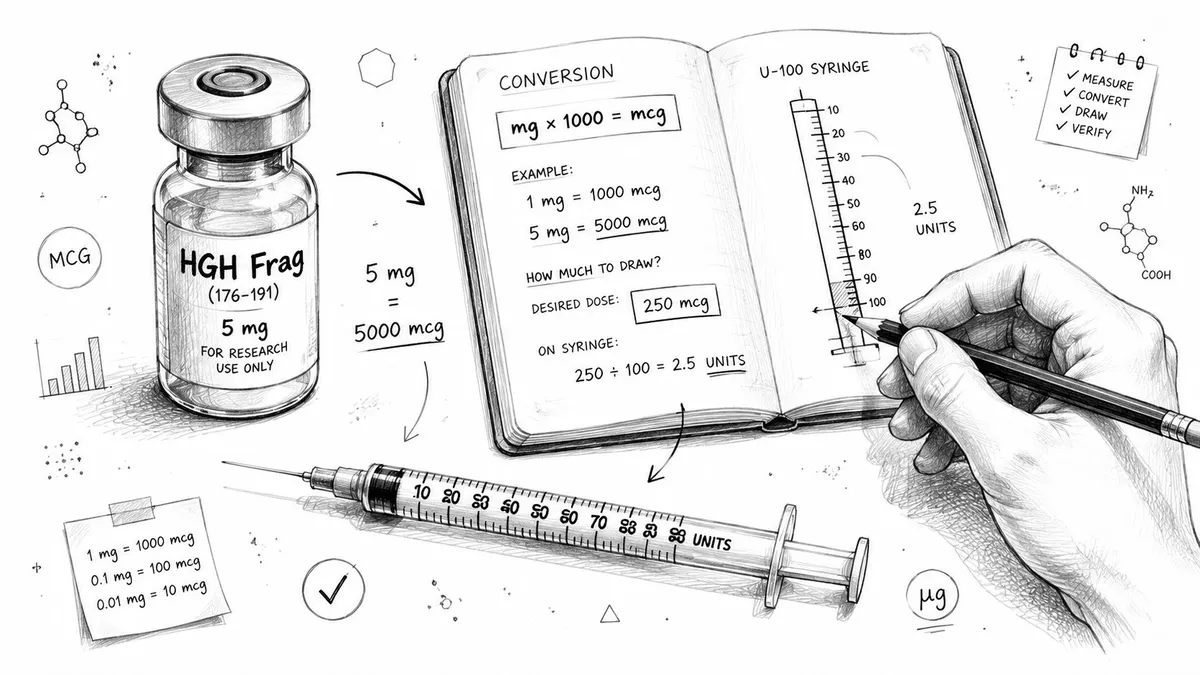
You have a 5 mg vial of HGH Frag. You reconstitute it with 2 mL of bacteriostatic water. You want a 250 mcg dose.
First convert the vial amount:
5 mg = 5000 mcg
Now calculate the concentration:
5000 mcg ÷ 2 mL = 2500 mcg per mL
That means every 1 mL of solution contains 2500 mcg of peptide.
Next solve for the volume needed for your dose:
desired volume = desired dose ÷ concentration
Plug in the numbers:
250 mcg ÷ 2500 mcg/mL = 0.1 mL
So your injection volume is 0.1 mL.
If you’re using a standard insulin syringe marked from 0 to 100 units per 1 mL, then:
0.1 mL = 10 units
That’s the full chain.
- Vial content: 5 mg
- Converted amount: 5000 mcg
- Added water: 2 mL
- Concentration: 2500 mcg/mL
- Target dose: 250 mcg
- Injection volume: 0.1 mL
- Insulin syringe reading: 10 units
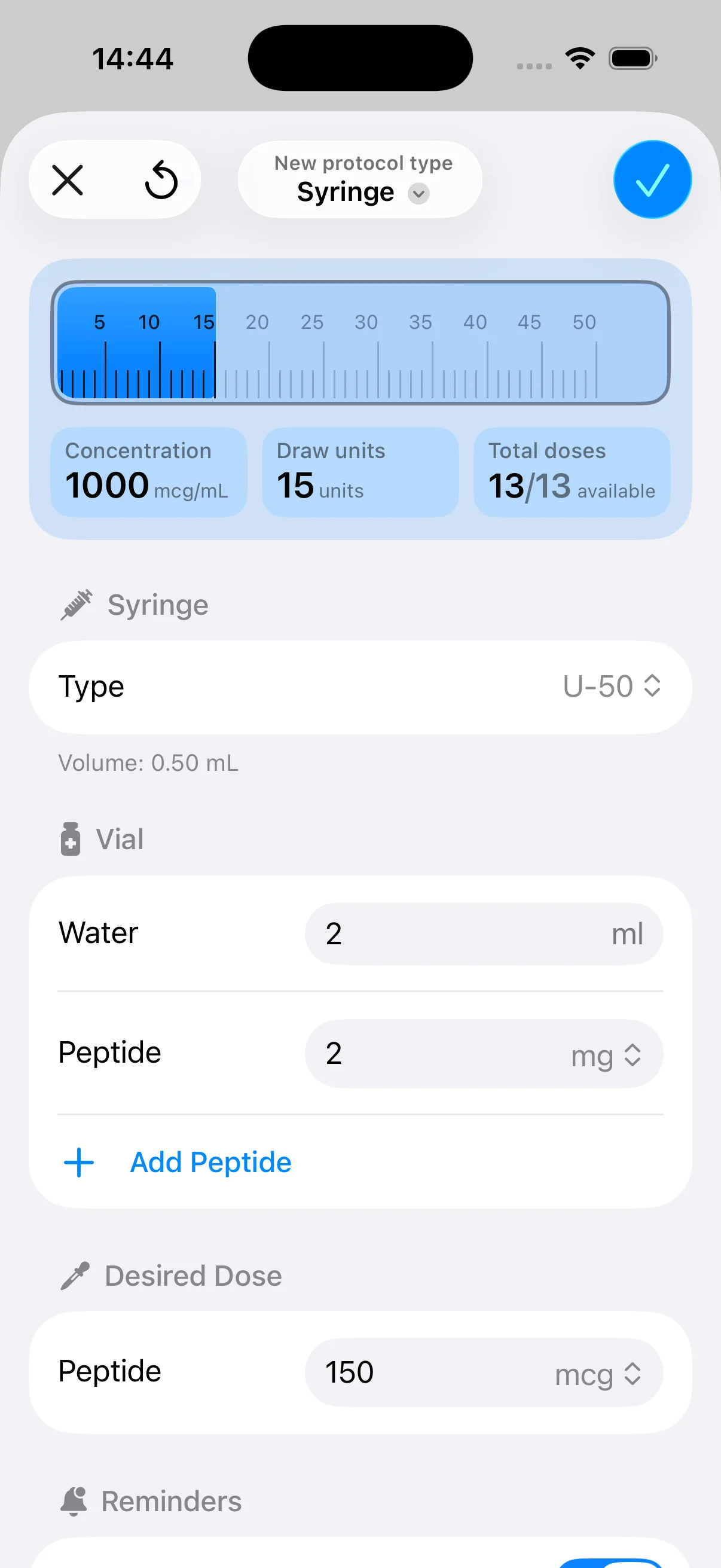
A dedicated calculator removes the risk of doing this by hand. One option is PepFlow, which lets users enter vial strength, reconstitution volume, and target dose, then returns the injection amount in practical terms. If you want the underlying logic first, this walkthrough on how to convert mcg to mL mirrors the exact math above.
Where people make avoidable mistakes
Most dosing errors come from one of four places:
- Mixing mg and mcg: Writing 5 mg in one spot and treating it like 5 mcg in another.
- Forgetting the reconstitution volume: Two people can own the same vial and need very different syringe draws if they added different amounts of water.
- Assuming units equal dose: Units only tell you liquid volume on that syringe.
- Changing syringes without checking markings: The same number of units doesn’t mean the same thing on every device unless you know the total volume scale.
Here’s a short visual explainer if you prefer seeing the process rather than reading formulas.
A good habit is to write the final answer in plain English before injecting: “My current vial concentration is X mcg per mL. My target dose is Y mcg. I will draw Z mL, which equals N units on this syringe.” That one sentence catches a surprising number of mistakes.
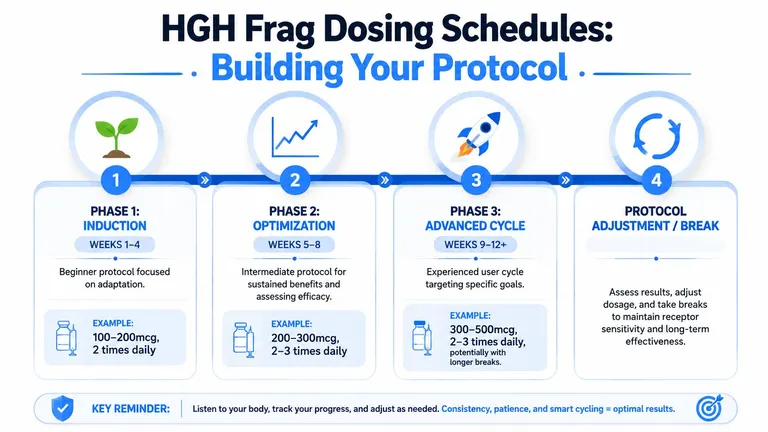
Sample Dosing Schedules and Cycle Templates
Once the single-dose math is clear, the next challenge is consistency. A protocol that looks neat on paper can become messy if the timing is unrealistic, the injection count is too high, or the daily routine changes every week.
Two simple ways to structure a protocol
The most practical starting point is to choose between a simple adherence-first schedule and a timing-focused schedule.
Starter protocol
This style favors repeatability. It’s usually built around the lower end of community-reported use and a fixed daily rhythm.
- Daily dosage: A lower-end amount within the commonly cited community range
- Frequency and timing: One daily injection, often at the same time each day
- Why people choose it: Fewer moving parts means fewer missed doses and fewer calculation mistakes
- Best fit: Beginners who want to assess tolerance and build a routine before adding complexity
This approach works well for people who know they’re more likely to stay consistent if the plan is boring. That’s not a flaw. It’s often a strength.
Timed protocol
This style adds structure around meals, fasting windows, or training sessions.
- Daily dosage: Often split across more than one injection while still staying within commonly discussed daily totals
- Frequency and timing: Commonly timed away from meals, or around training, depending on the user’s reasoning
- Why people choose it: Users often want tighter control over when exposure occurs during the day
- Best fit: People who already follow a stable eating and training schedule
Timing only helps if you can actually follow it. A perfect protocol that gets skipped is worse than a simpler one you can maintain.
Many users prefer injections on an emptier stomach because they’re trying to keep the protocol aligned with the way community members discuss fat-mobilization windows. That logic is common, but it still sits in the realm of practice convention rather than hard clinical proof for this exact peptide.
Sample cycle table
| Protocol | Daily Dosage | Frequency & Timing | Cycle Length |
|---|---|---|---|
| Starter Protocol | Lower end of the commonly cited range | Once daily at a consistent time | Short trial cycle to assess response |
| Split Daily Protocol | Mid-range community-reported total | Two injections spaced through the day | Moderate cycle with close tracking |
| Timed Protocol | Community-reported total divided by schedule | Timed around fasting or training routine | Structured cycle for experienced users |
A simple schedule often beats an intricate one because adherence is part of dosing accuracy. If a protocol calls for multiple daily injections, keep a written log of planned dose, actual draw, and actual time taken. Without that, people tend to remember the intent and forget the deviations.
Safety Side Effects and Protocol Adjustments
A protocol can look tidy on paper and still go wrong in practice. The usual failure point is not the headline dose. It is the chain of decisions around route, reconstitution, draw accuracy, timing, and what you do after the first sign that your body is not responding well.
Why route changes the safety picture
Earlier clinical discussion around Fragment 176-191 includes oral and intravenous exposure patterns that do not match the subcutaneous routines commonly copied in peptide communities, as noted in this Fragment 176-191 dosing analysis.
That difference matters because route changes exposure over time. An infusion is controlled and supervised. A subcutaneous injection creates a different absorption curve, and repeated use adds another layer because the actual question becomes, ‘Can you recreate the same draw and timing every day without drift?’
A good way to frame it is to treat route as part of the dose, not as a footnote. If someone says they used a certain number of micrograms, but leaves out whether that was oral, intravenous, or subcutaneous, you do not yet have enough information to judge risk.
What to monitor once a protocol starts
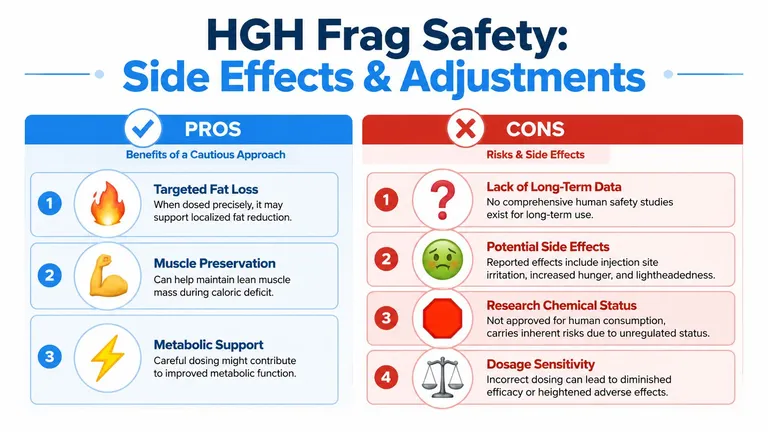
Long-term human safety data for routine HGH Frag use is still limited, so caution has to show up in the process, not just in the plan. Keep your monitoring simple enough that you will do it.
Track four things:
- Injection site response: Redness, itching, swelling, heat, or soreness that lasts longer than expected
- Whole-body response: Lightheadedness, unusual hunger, nausea, headache, or a general sense that something feels off
- Math and handling errors: Misreading syringe units, changing bacteriostatic water volume mid-cycle, or drawing inconsistent amounts from day to day
- Protocol creep: Increasing the dose, adding extra injections, or changing timing because the original plan felt too subtle
The third point gets missed often. Safety is not only about side effects after the injection. It is also about whether the amount entering the syringe matches the amount you intended to use. A small math mistake repeated daily works like a scale that is off by a little each morning. One reading may not alarm you, but the pattern can pull the whole protocol away from your original target.
How to adjust without creating more confusion
If a problem shows up, reduce variables first. Keep the schedule stable, stop changing multiple inputs at once, and verify the concentration math before assuming the peptide itself is the only issue.
In practice, that usually means checking three basics:
- Was the vial reconstituted the way you wrote it down?
- Does the syringe draw match the intended microgram target?
- Have food timing, sleep, training load, or other compounds changed at the same time?
This step-by-step review matters because symptoms and protocol mistakes can look similar. A person may think they are reacting to the peptide when the actual issue is an inconsistent draw, a concentration mix-up, or several routine changes piled on top of each other.
For a broader framework on symptom tracking and reaction patterns, this guide to peptide side effects and what to monitor is a useful companion. It works best if you treat your log like part of the protocol itself, not a note you write only after something goes wrong.
Conclusion Dosing with Confidence and Precision
A good HGH Frag protocol is not built by memorizing a popular dose. It is built by getting from idea to syringe without distortion.
That is the key skill this article has focused on. Community discussions often start with a number in micrograms, but your body never receives “200 mcg” as an abstract idea. It receives a specific liquid volume drawn from a vial with a specific concentration, using a specific syringe. If any part of that chain is off, the protocol on paper and the protocol in practice become two different things.
That gap between theory and administration is where many avoidable mistakes happen. A person may read a common dosing range, mix the vial differently than intended, then draw by habit instead of by calculation. The result can look consistent because the same syringe is used each day, but consistency only helps if the underlying math is correct.
Precision works like using the right conversion when baking. The recipe may call for a certain amount of an ingredient, but what matters is what goes into the bowl. Peptide dosing follows the same logic. The target dose is the recipe. Reconstitution sets the concentration. The syringe draw is the measured ingredient. Once those pieces line up, the process becomes repeatable instead of guesswork.
That is why confidence in dosing should come from a written process, not memory.
Keep the framework simple. Know what is in the vial. Know how much liquid was added. Calculate the concentration. Convert the intended microgram amount into the syringe units you need to draw. Then repeat that setup the same way each time. A smaller, well-calculated routine is easier to track and evaluate than a complicated plan built on rough estimates.
Grounded expectations matter too. The dose ranges discussed around HGH Fragment 176-191 are drawn largely from community use and research-oriented discussion, not formal clinical guidance for general self-administration. That does not make the math less important. It makes the math more important, because careful execution is one of the few variables you can control.
Educational content can help you understand the process, but it cannot replace individualized medical advice. If you are considering any peptide regimen, speak with a qualified healthcare professional first.
If you want a simpler way to handle peptide math and scheduling, PepFlow is built for that exact workflow. It helps convert target microgram doses into practical syringe amounts, organize cycled protocols, and keep your dosing routine documented so you’re relying less on memory and handwritten notes.