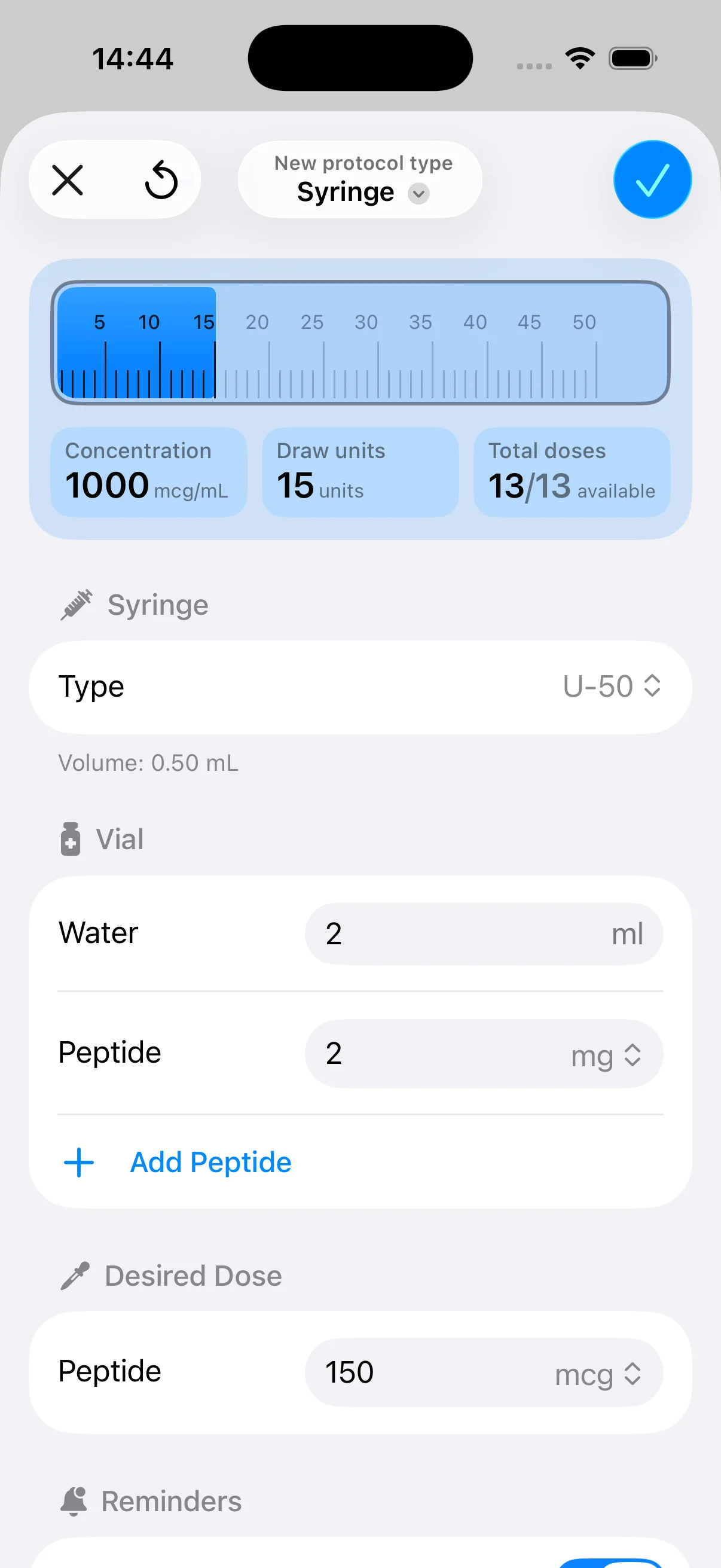
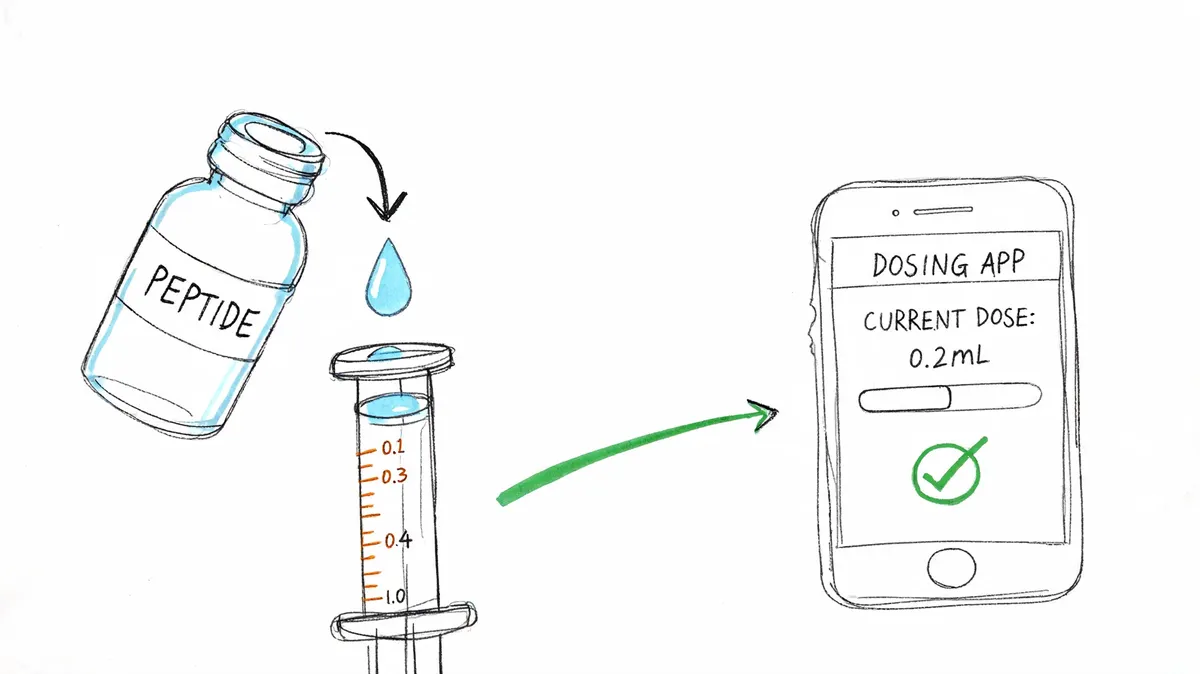
You’re probably here because you have a vial, a syringe, and a target dose written somewhere in mcg, but the syringe doesn’t show mcg. It shows units. The vial might be labeled in mg. The liquid you add is measured in mL. That mix of units is where people get stuck.
Most peptide dosage guide articles stop too early. They list “common doses” and assume the hard part is done. It isn’t. The true challenge is turning a target dose into something you can measure the same way every time, then building a schedule you can consistently follow without guessing.
Think of peptide dosing like baking from scratch. Knowing the recipe says “use flour” doesn’t help much unless you also know how much, what measuring tool to use, and when each step happens. Precision matters here even more. A small reading mistake can become a large dosing mistake.
Table of Contents
- Why Accurate Peptide Dosing Is More Than Just Numbers
- Decoding Vials Units and Concentrations
- The Core Calculation How to Convert Micrograms to Syringe Units
- Designing Your Peptide Protocol and Schedule
- Common Dosing Mistakes and Safety Practices
- Streamlining Your Workflow with PepFlow
- Conclusion Your Path to Precise Dosing
Why Accurate Peptide Dosing Is More Than Just Numbers
A peptide dosage guide should do more than throw ranges at you. Most people can find a target dose. What they struggle with is the workflow after that.
Clinic-oriented protocol guidance emphasizes documenting the peptide name, concentration, dose, route, frequency, cycle length, and start date because the practical side is where complexity shows up, not just the number on paper, as noted in this protocol documentation guide for longevity clinics. That tells you something important. Accurate dosing is a system, not a single calculation.
If you’ve ever asked questions like these, you’re dealing with a workflow problem:
- “My vial says mg, but my dose says mcg.” That’s a unit conversion problem.
- “My syringe shows units, not volume I can visualize.” That’s a measurement translation problem.
- “I know the dose, but how often do I take it?” That’s a scheduling problem.
- “I changed vial strength, and now my old syringe pull doesn’t make sense.” That’s a concentration problem.
Practical rule: A safe protocol is one you can repeat the same way tomorrow, not one you barely decoded today.
That’s why memorizing popular doses isn’t enough. Two people can aim for the same microgram target and still end up drawing different syringe amounts if their vial concentration differs. Another person may get the math right once, then lose track of frequency or cycle timing and drift into inconsistency.
A useful peptide dosage guide teaches a repeatable process:
- Read the vial correctly.
- Understand the concentration after reconstitution.
- Convert the target dose into a measurable syringe pull.
- Attach that dose to a schedule you can follow.
- Record what you did.
That process turns peptide dosing from a nervous guess into a practical skill. Once you understand the workflow, you’re not dependent on one chart or one peptide. You can handle new vial strengths, new schedules, and protocol changes with much more confidence.
Decoding Vials Units and Concentrations
The fastest way to get comfortable with peptide dosing is to learn the vocabulary. Once the labels make sense, the math stops feeling mysterious.
Why the labels feel confusing
A peptide vial usually contains lyophilized powder, which means the peptide is in a dry, stable form. You then add a reconstitution liquid, commonly bacteriostatic water, to dissolve it. After that, you no longer think only about “how much peptide is in the vial.” You think about how much peptide is in each mL of liquid.
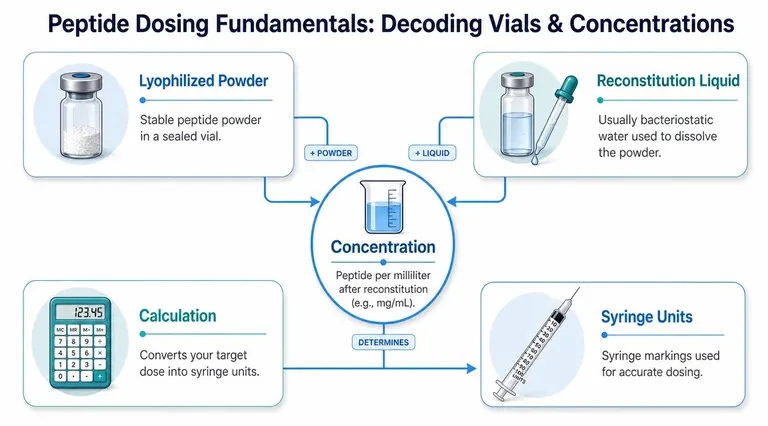
The unit confusion usually starts here:
- mg tells you the mass in the vial.
- mcg often tells you the target dose.
- mL tells you how much liquid you added.
- IU or syringe units tell you what you physically draw.
One reason this matters so much is simple. 1 mg equals 1000 mcg, and a misread can make a dose wrong by a factor of 1000. That’s not a rounding issue. That’s a completely different dose.
For a broader primer on what’s sitting in the vial before you add liquid, this guide to freeze-dried peptides helps clarify the starting point.
The recipe analogy that makes it click
Think of the vial as a jar of concentrated soup mix.
The powder is the soup base. The water you add is what dilutes it. The final concentration tells you how strong each spoonful is. If you add a little water, each spoonful is stronger. If you add more water, each spoonful is weaker.
That’s exactly how peptide concentration works.
Here’s the plain-language version:
| Term | What it means in practice |
|---|---|
| Vial amount | Total peptide in the vial before mixing |
| Diluent volume | How much liquid you add |
| Concentration | How much peptide exists per mL after mixing |
| Target dose | The amount you want to take each time |
| Syringe units | The visible measurement you draw |
Short-acting peptides can add another layer of difficulty because dosing may need to happen multiple times in a day to maintain steadier levels.
That means peptide dosing isn’t only “how much.” It’s also “in what concentration” and “on what schedule.” Once those terms are clear, the next step is just arithmetic.
The Core Calculation How to Convert Micrograms to Syringe Units
This is the skill required by the majority of individuals. Not “what’s a common dose,” but “how do I turn my chosen dose into the right syringe pull for my specific vial?”
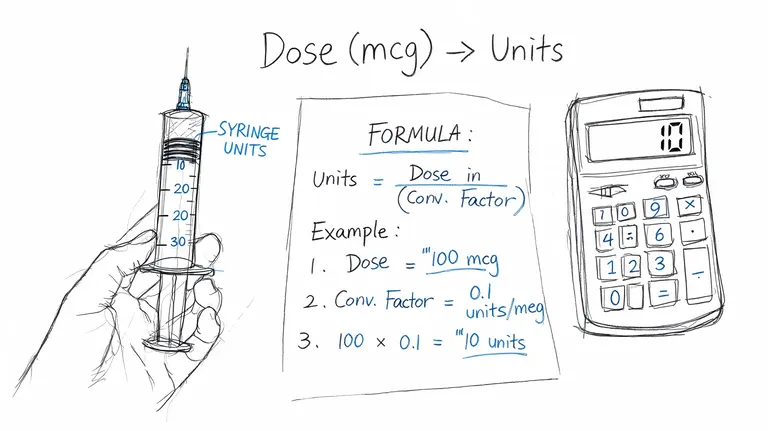
Research dosage charts vary widely. One chart lists GHRP-2/GHRP-6 at 100 to 300 µg/kg 1 to 2 times daily, ipamorelin at 100 to 200 µg/kg 1 to 2 times daily, CJC-1295 with DAC at 100 to 300 µg/kg every few days, while another chart lists BPC-157 at 250 to 500 mcg twice daily and TB-500 at 2 to 5 mg weekly in this peptides dosage chart reference. That variation is exactly why dose-to-volume calculation has to be done peptide by peptide.
The formula in plain English
You only need three pieces of information:
- How much peptide is in the vial
- How much liquid you added
- What dose you want in mcg
Then work through it in this order:
Step 1: Convert vial amount from mg to mcg if needed.
Step 2: Divide total mcg in the vial by total mL added.
Step 3: That gives you concentration in mcg per mL.
Step 4: Divide your target dose by the concentration.
Step 5: Convert that mL amount into syringe units.
If you want a separate walkthrough on the unit side alone, this quick reference on mg to mcg conversion is useful to keep handy.
Worked example with a 5 mg vial
Use a 5 mg vial and add 2 mL of bacteriostatic water.
First, convert the vial amount:
- 5 mg = 5000 mcg
Then calculate concentration:
- 5000 mcg ÷ 2 mL = 2500 mcg per mL
Now pick a target dose. Let’s use 250 mcg.
Find the volume needed:
- 250 mcg ÷ 2500 mcg per mL = 0.1 mL
If you’re using a standard insulin syringe where 1 mL = 100 units, then:
- 0.1 mL = 10 units
So in this setup, a 250 mcg dose = 10 syringe units.
That’s the whole game. The math isn’t hard once the sequence is clear.
Mental shortcut: stronger concentration means fewer syringe units for the same mcg dose. Weaker concentration means more syringe units.
Many dosing errors happen before this step, during mixing. If you want a practical reference for how to properly reconstitute peptides, that resource can help you sanity-check the setup before you calculate the pull.
How concentration changes the syringe pull
The target dose can stay the same while the syringe pull changes a lot depending on how much water you added.
| Bacteriostatic Water Added | Vial Concentration | Syringe Units (IU) for 250mcg Dose |
|---|---|---|
| 1 mL | 5000 mcg/mL | 5 IU |
| 2 mL | 2500 mcg/mL | 10 IU |
| 3 mL | about 1666.7 mcg/mL | 15 IU |
| 5 mL | 1000 mcg/mL | 25 IU |
This is why copying someone else’s “draw 10 units” instruction can be risky. Ten units only means something if the vial concentration matches yours.
A short visual walkthrough can help the arithmetic click before you do it yourself:
When you learn the calculation process instead of memorizing a single answer, you can adapt to any vial concentration with less confusion and far fewer mistakes.
Designing Your Peptide Protocol and Schedule
Getting one injection right is useful. Building a protocol you can follow for weeks is what makes dosing consistent.
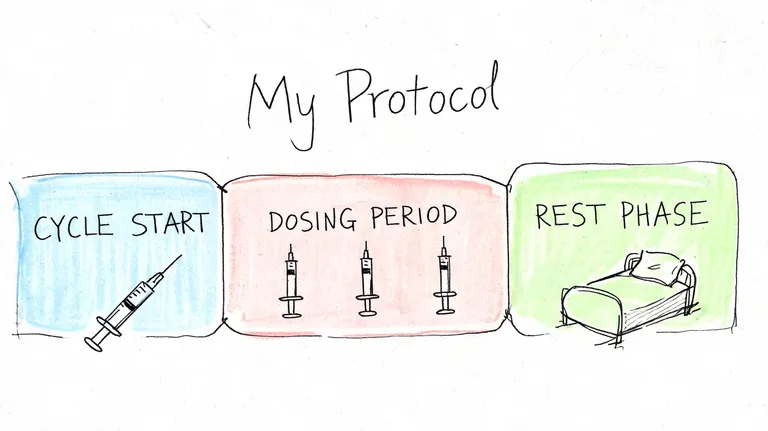
Clinical-style guidance often starts conservatively. One dosing framework notes that initial dosing is often only 25 to 33% of the anticipated therapeutic dose, with later adjustment based on factors like body weight, body composition, age, renal function, and hepatic status, as described in these peptide dosing guidelines. The same guidance also shows that frequency can range from multiple times daily to weekly depending on the compound.
Start lower than you think
A lot of people focus on the “full” dose and ignore the value of an assessment phase. That’s backward.
A conservative start gives you room to observe:
- how you tolerate the protocol
- whether your schedule is realistic
- whether your logging system is clear
- whether your vial concentration and syringe pull still make sense in daily use
That approach is less exciting than jumping straight to a headline dose, but it’s far easier to manage responsibly.
Start with a protocol you can measure, document, and repeat. Then adjust only when the record is clear.
Build a protocol like a calendar not a wish
A practical protocol has at least six parts:
-
Compound name
Don’t rely on memory if you use more than one vial or rotate compounds. -
Dose per administration
Write the target in mcg or mg, then note the matching syringe units for your concentration. -
Route
Keep the route recorded with the protocol so you don’t treat all compounds as interchangeable. -
Frequency
Some protocols call for daily use, some every other day, some multiple times a day, and others only weekly. -
Cycle length
Decide when the protocol starts and when it stops. A protocol without an end point tends to become sloppy. -
Start date and tracking log
This matters more than people think. Without dates, it becomes hard to know whether a change helped or whether you just lost consistency.
A good schedule should fit your life. If a peptide requires several touchpoints across the week, put those on a calendar immediately. If you can’t maintain the schedule, the protocol isn’t practical yet, even if the math is correct.
Common Dosing Mistakes and Safety Practices
Correct math doesn’t automatically create a safe routine. People can calculate accurately and still make poor decisions around dose escalation, evidence quality, or day-to-day handling.
That’s where a lot of peptide dosage guide content falls short. It treats dosing like a solved number instead of a behavior that has to stay precise over time.
Where people make preventable errors
One common mistake is assuming a higher dose must work better. That isn’t always supported. In ARA-290 guidance, a standard neuropathy protocol of 4 mg daily for 28 days is discussed, a 2 mg option is described as more conservative, and the 8 mg high-end protocol showed no superiority over 4 mg.
That should change how you think about dosing. More isn’t automatically smarter.
Other common errors are much more ordinary:
- Unit confusion: mixing up mg and mcg
- Concentration drift: changing the amount of diluent but forgetting that the syringe pull must also change
- Memory dosing: trying to remember yesterday’s units instead of checking the written protocol
- Schedule creep: missing doses, then improvising make-up doses without a plan
- Protocol inflation: stacking changes too quickly, so you can’t tell what caused what
Safety habits that make dosing repeatable
The safest users tend to look boring on paper. That’s a compliment. They use routines.
A solid practice checklist looks like this:
- Write everything down: peptide name, concentration, planned dose, actual syringe pull, date, and frequency.
- Double-check every conversion: especially when moving between mg, mcg, mL, and syringe units.
- Stay conservative with changes: if you adjust, change one variable at a time and document why.
- Keep administration consistent: similar timing and similar measurement habits reduce accidental variability.
- Treat uncertain evidence with respect: if support for a protocol is limited or mixed, that’s a reason for caution, not bravado.
A careful protocol protects you twice. It reduces obvious mistakes, and it also slows down the subtle drift that happens when confidence outruns documentation.
Peptide use gets riskier when people become casual. Precision is not just for the first week. It’s the habit that keeps the protocol stable.
Streamlining Your Workflow with PepFlow
Manual dosing works when you’re focused, organized, and willing to check your math every time. The problem is that real life gets noisy. A changed vial concentration, a new schedule, or a missed reminder can turn a clean setup into a messy one.
That’s why workflow tools matter. The hardest part of peptide use often isn’t understanding the concept. It’s executing the same process accurately over time.
What a dosing tool should actually solve
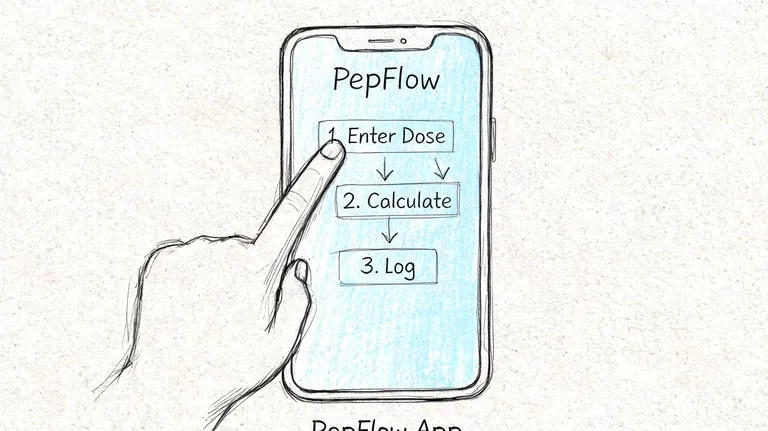
A useful tool should handle the repetitive failure points:
- converting a target mcg dose into practical syringe units
- storing vial strength and reconstitution details
- mapping doses onto a real calendar
- tracking cycle start dates and pause periods
- helping you log what you took
If you want an example of that type of workflow support, PepFlow’s peptide calculator app overview shows how a dosing tool can combine calculator logic with protocol scheduling in one place.
That matters because the workflow is interconnected. Change the vial concentration, and your syringe units change. Change the protocol frequency, and your reminders need to change too. If those details live in scattered notes, dosing gets harder to trust.
When manual math becomes the weak link
A majority of individuals do not encounter difficulties due to an inability to perform the calculations. Rather, the challenge arises from having to execute those calculations repeatedly, under varying conditions, while concurrently managing timing, cycle structure, and previous doses.
A dedicated routine helps by reducing decision fatigue. Instead of recalculating from scratch each time, you can rely on a saved setup and focus on whether the protocol still matches your plan.
That’s the real value of workflow support in a peptide dosage guide. It doesn’t replace understanding. It reinforces it. You still need to know what concentration means and why scheduling matters. But once you know the process, using a structured tool can make consistency much easier.
Conclusion Your Path to Precise Dosing
Peptide dosing becomes much less intimidating once you stop treating it like secret math. It’s a sequence.
You read the vial. You understand the concentration. You convert the target dose into a measurable syringe pull. Then you put that dose on a schedule you can follow and document. That’s what a useful peptide dosage guide should teach.
The bigger lesson is that precision lives in the routine. A dose isn’t just a number. It’s a number tied to concentration, timing, measurement, and recordkeeping. When those pieces line up, dosing becomes clear and repeatable.
You don’t need to memorize every peptide protocol to be competent. You need to understand the process well enough to handle your own setup carefully. That’s a much more durable skill.
If you want a simpler way to manage the math and schedule without relying on scattered notes, PepFlow helps convert target doses into syringe units, organize cycled protocols, and keep your dosing routine on track with reminders and logs.