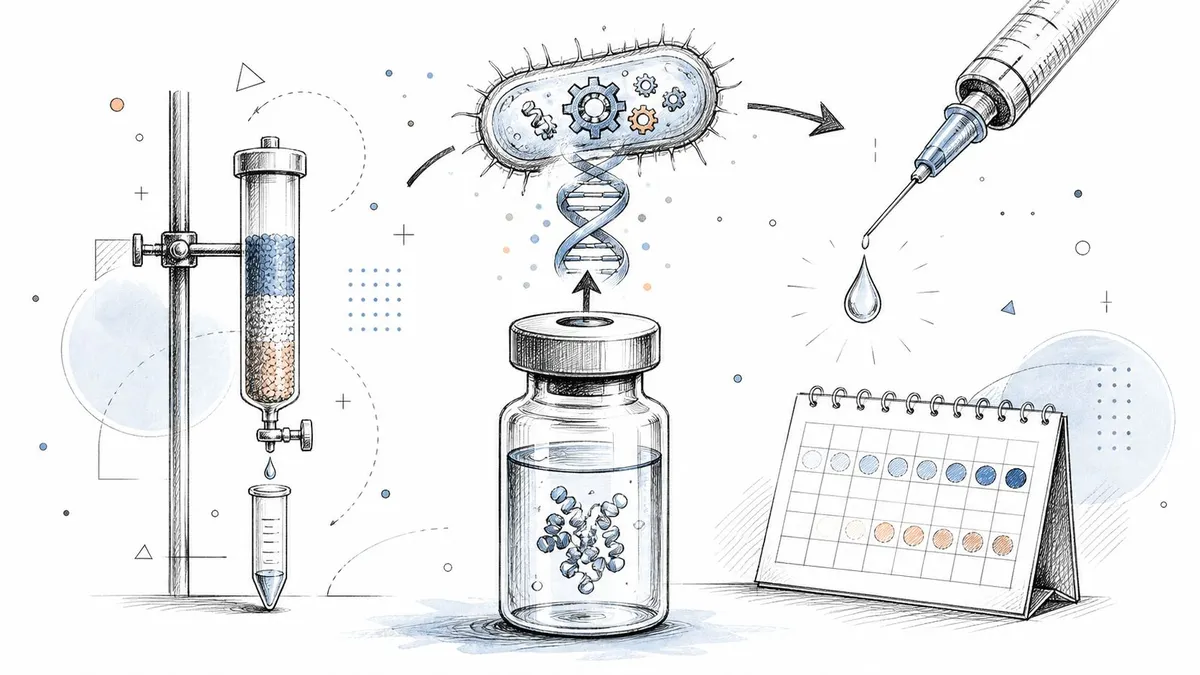
You’ve got a vial on the counter, a lab label that says somatropin, and a dozen tabs open trying to answer one simple question, what exactly is this stuff, and how is it different from the “HGH” people talk about online? The confusion is normal. Human Growth Hormone recombinant sits at the intersection of molecular biology, prescription medicine, and peptide-user planning, so the same word can mean very different things depending on who’s talking.
Table of Contents
- What Recombinant Human Growth Hormone Actually Is
- How Recombinant HGH Is Made
- Approved Uses Versus Off-Label and Wellness Contexts
- Efficacy Evidence and Where It Stops Short
- Safety Signals, Side Effects, and the Long-Term Debate
- Legal Status, Prescriptions, and Anti-Doping Rules
- Storage, Reconstitution, Detection, and Practical Dosing Workflow
- Putting It All Together and Common Questions
What Recombinant Human Growth Hormone Actually Is
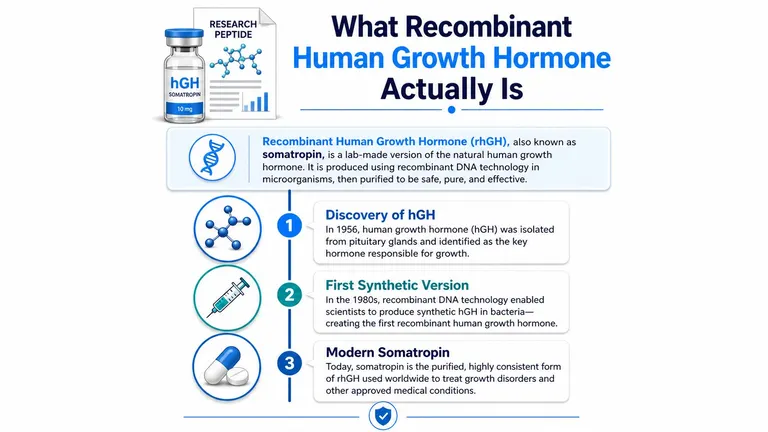
You might first meet recombinant human growth hormone, often shortened to rhGH or called somatropin, on a product label, a clinician’s prescription, or a research page that lists a 191-amino-acid sequence. The clean definition is simple. It’s a copy of human pituitary growth hormone made by inserting the human GH gene into a host cell, usually engineered E. coli, then purifying the expressed protein into a standardized medicine.
Why the word recombinant matters
“Recombinant” is not just a chemistry label. It means the protein was made through recombinant DNA technology, rather than extracted from human pituitaries. That distinction changed everything, because after pituitary-derived GH was discontinued, recombinant production made human GH available in effectively unlimited quantities and turned a scarce human-sourced biologic into a standardized medicine (historical review).
That transition became a major clinical milestone in 1985, when Genentech’s synthetic methionyl GH received rapid U.S. FDA approval for severe childhood growth hormone deficiency after pituitary-derived human GH was stopped (historical review). Before that shift, the U.S. National Pituitary Agency coordinated supply from 1963 to 1985, and about 7,700 children in the United States and 27,000 children worldwide received pituitary-extracted GH during that period (historical review).
Practical rule: if a discussion blurs “recombinant” and “synthetic,” pause and ask how the molecule was actually produced. Those words are often used loosely online, but they don’t mean the same manufacturing pathway.
If you’re coming from peptide forums, the biggest mental shift is this. rhGH is not a vague wellness compound, it’s a biologically active human protein with a defined sequence, approved indications, quality standards, and safety oversight. The rest of this guide separates the molecule from the marketing, so you can tell clinical use from wellness claims, and molecule-level facts from the way users plan around vials, reconstitution, and schedules.
What are peptides and how do they work?
How Recombinant HGH Is Made
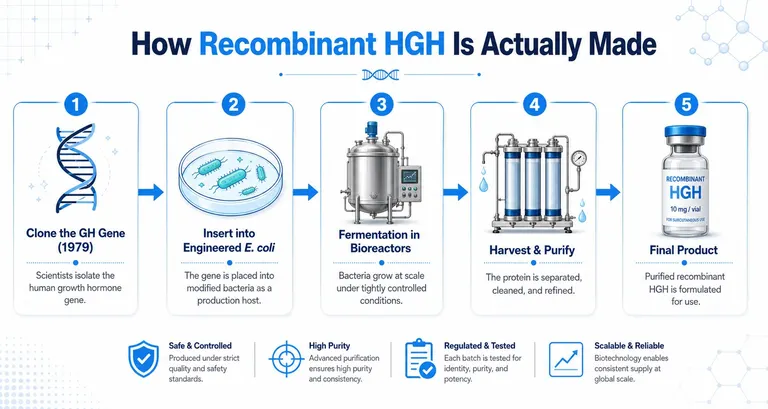
A simple production line helps make rhGH easier to understand. The gene provides the sequence, the host cell serves as the manufacturing platform, and the protein is the finished biologic. That shift from sequence to medicine moved quickly after the GH gene was cloned and expressed in 1979, recombinant hGH was reported by Genentech in 1981, and the field moved from molecular biology into clinical use soon after (recombinant GH overview).
From cloned gene to purified protein
Production begins by cloning the human GH gene into a plasmid, then putting that plasmid into an expression host such as engineered E. coli. The bacteria grow in fermentation tanks, make the protein, and the manufacturing team then harvests and purifies it. Depending on the platform, the protein can be found in inclusion bodies or in a soluble fraction, but the important steps are still folding, purification, and quality control.
That quality control matters because commercial rhGH is typically a 191-amino-acid, about 22 kDa, non-glycosylated monomer that matches pituitary GH sequence in approved labeling. Omnitrope’s FDA label states the amino acid sequence is identical to human pituitary growth hormone and that the drug is produced in an engineered E. coli strain (FDA label). The non-glycosylated structure means there is no glycan processing step, but it still requires careful folding and strict endotoxin control.
What a good lot looks like
A Certificate of Analysis for rhGH usually uses the language of identity, purity, endotoxin, and bioactivity. Those are the checks that show whether a lot is suitable for assay work or clinical manufacture.
- Purity: commercial research preparations often specify ≥95% purity, with GMP-grade material reporting similarly high purity and a 22 kDa non-glycosylated monomer profile (product specs).
- Endotoxin: some preparations list <1 EU/µg, while GMP-grade material reports <0.1 EU/µg (product specs).
- Bioactivity: potency is often reported with the rat Nb2-11 lymphoma cell proliferation assay, where some products show ED50 <0.1 ng/mL and others 0.4–2 ng/mL, reflecting different specific-activity profiles (product specs).
If the terms SDS-PAGE and HPLC sound technical, they are methods for checking whether the protein looks like one clean product rather than a mix of fragments, aggregates, or contaminants. In practice, those tests matter because rhGH is a small, well-defined protein, and small proteins can still be compromised by contamination, adsorption losses, or poor folding.
A lot of people assume “made in bacteria” means crude or low-grade. That is the wrong conclusion. The bacterial host is only the production platform, and the final medicine is defined by purification, folding, potency testing, and release specifications, not by the fact that a microbe expressed it.
The distinction matters for readers comparing medical rhGH with wellness products or with small pellet-based hormone approaches like small pellets hormone optimization. rhGH is a recombinant protein with a defined amino acid sequence, while other hormone products may use different delivery systems, different regulatory pathways, and different clinical assumptions.
Approved Uses Versus Off-Label and Wellness Contexts
A patient hears three different conversations about rhGH and assumes they refer to the same thing. They do not. One conversation is approved medicine, where children and adults with defined growth hormone problems receive somatropin under medical supervision. Another is off-label prescribing, where clinicians use judgment in edge cases. The third is wellness, recovery, anti-aging, and performance, where claims often move faster than the evidence.
The clinical lane and the broader treatment picture
The approved lane is built around diagnosis, monitoring, and documented deficiency or a related growth condition. The exact indication list varies by regulator and product, but the clinical intent stays the same, replace or support growth hormone biology where there is a legitimate medical reason.
The scale of use is not trivial. One review estimated that about 4,000–5,000 children are treated with rhGH every week worldwide (review summary). That figure does not decide who should receive it, but it shows that this is an established therapy, not a fringe experiment.
Where off-label and wellness claims start to drift
Off-label use sits in the middle. A clinician may decide a case does not fit a neat label, yet still deserves individualized treatment. Wellness use is different. There, people often talk about recovery, body composition, anti-aging, or performance without the same level of evidence used in approved pediatric growth disorders or adult replacement therapy.
A useful way to sort the categories is to ask three questions. Is there documented deficiency or an accepted medical indication? Is the use supervised by a clinician? Is the goal restoring function or enhancing normal biology? The first two belong to medicine. The third often does not.
For readers comparing hormone-related therapies more broadly, small pellets hormone optimization is a helpful example of how clinicians frame replacement versus enhancement in a general hormone context.
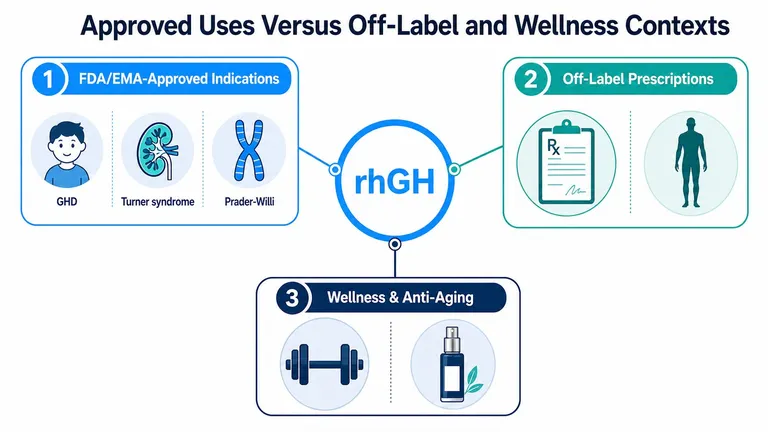
A simple map for readers
- FDA/EMA-approved indications: childhood growth hormone deficiency, and other accepted pediatric or adult endocrine uses.
- Off-label prescriptions: clinician-directed use where the diagnosis or treatment path is not a clean label match.
- Wellness and performance: recovery, physique, anti-aging, or athletic goals, where evidence and oversight are much thinner.
The confusion usually comes from treating all three as if they are one category. They are not. A prescription for a child with GHD, a specialist’s off-label decision, and a forum post about “optimization” belong in different conversations, with different standards.
Efficacy Evidence and Where It Stops Short
A dose of rhGH can look impressive on paper, but the result depends on the biological problem it is meant to solve. In childhood growth hormone deficiency, the evidence supports meaningful gains in growth because the treatment is replacing a signal the body is not producing enough of. In other pediatric conditions, the effect can still be real, yet it is usually more variable, more individualized, and tied closely to the underlying diagnosis.
Where the signal is strongest
The clearest efficacy story is the simplest one, treatment of true deficiency. In that setting, rhGH has a direct physiologic role, because the clinician is replacing a missing hormonal message instead of hoping for a broad performance boost. In adults with growth hormone deficiency, the goal is usually not dramatic height change. The aim is broader physiologic replacement, so expectations need to stay grounded.
The field is also shifting toward more individualized use. A 2025 bibliometric analysis of rhGH for idiopathic short stature found keyword bursts from 2021 to 2024 emphasizing safety, growth hormone deficiency, for gestational age, and adolescents (bibliometric analysis). That pattern suggests the discussion is moving from a simple “does it work?” question toward a more careful one, who benefits, under what conditions, and with what tradeoffs.
Where the evidence gets thinner
The farther rhGH moves from documented deficiency, the more mixed the evidence becomes. That does not mean the hormone has no effect. It means the size and meaning of the effect depend on patient selection, timing, dose strategy, and the outcome being measured. Height velocity, body composition, and subjective well-being are different endpoints, even if they are often discussed as one.
A useful parallel comes from hormone replacement education more broadly. Pause Medical’s HRT education separates symptom relief, risk, and monitoring in a way that helps readers set realistic expectations, and the same discipline matters when people evaluate rhGH claims.
Good test: if a source promises the same result for a deficient child, a healthy adult, and a physique user, the claim is too broad. Biology does not flatten that neatly.
The practical takeaway is straightforward. rhGH is powerful where deficiency exists, modest where biology is uncertain, and overhyped where deficiency does not exist. Use that lens before trusting any testimonial, clinic pitch, or protocol screenshot.
Safety Signals, Side Effects, and the Long-Term Debate
A lot of public content treats rhGH safety as if it’s settled. It isn’t. The immediate side effects are familiar and often manageable, but the long-term picture becomes more complicated when treatment lasts longer, cumulative exposure rises, or the use case drifts away from approved pediatric deficiency.
Common side effects versus higher-stakes concerns
The common issues are the ones clinicians usually watch first, edema, arthralgia, carpal tunnel–like symptoms, insulin-resistance shifts, and injection-site reactions. Those are the kinds of effects that can show up early and may be handled by dose adjustment or monitoring, depending on the patient and the indication.
The harder question is what happens over longer periods. A 2022 clinical review noted that recent studies raised concerns about childhood GH treatment and possible effects on adult morbidity and mortality, with controversy around cancer risk and cerebrovascular events (JCEM review). That same review reported that in a Swedish registry of 3,408 patients, longer duration and higher cumulative dose were associated with higher cardiovascular-event risk, with an adjusted HR of 1.69 for all CVD events and 2.27 for severe CVD events (JCEM review).
What those signals mean in practice
Those numbers do not prove every user faces the same risk. They do mean the long-term discussion can’t be reduced to “it’s just a growth aid.” The more a protocol resembles long-duration exposure or non-idealized use, the more carefully the monitoring conversation needs to happen.
Rule of thumb: the farther a use case sits from approved pediatric GHD, the thinner the safety evidence becomes, and the more important medical supervision is.
A separate anti-doping angle also matters here, because safety and legitimacy often overlap with testing risk. The IOC banned growth hormone in 1989, and the first Olympic test for GH abuse came at the 2004 Athens Games, where several hundred analyses found no positives (sports and anti-doping overview). That history shows detection exists, but it’s not the same thing as easy screening or casual use.
The honest position is not fear, and it’s not reassurance. It’s informed consent, supervised decision-making, and a clear understanding that long-term data get less certain as you move away from the approved clinical lane.
Legal Status, Prescriptions, and Anti-Doping Rules
The legal and regulatory picture is easier to understand if you split products by intended use. Prescription somatropin products in the U.S. and EU are tightly controlled medicines. Research-grade material sold outside that system may contain the same protein sequence, but it doesn’t come with the same oversight, intended-use framework, or clinical safeguards.
Prescription products versus research material
Brand examples you’ll see in the market include Omnitrope, Norditropin, Genotropin, Humatrope, and Saizen. These are prescription contexts, with product labeling, storage requirements, and clinician oversight. Research-grade material is different, even if the label looks familiar, because the purpose is laboratory use rather than routine human treatment.
A practical way to check legitimacy is to compare the product’s documentation with the setting it’s sold for. If the material is being presented as human-use medicine, but the oversight and labeling look like a lab reagent, that mismatch deserves caution.
| Product example | General profile | Typical use context |
|---|---|---|
| Omnitrope | Recombinant somatropin produced in engineered E. coli | Prescription growth hormone therapy |
| Norditropin | Commercial somatropin brand | Prescription endocrine use |
| Genotropin | Commercial somatropin brand | Prescription endocrine use |
| Humatrope | Commercial somatropin brand | Prescription endocrine use |
| Saizen | Commercial somatropin brand | Prescription endocrine use |
For readers who want a broader map of prescription peptide medicines, PepFlow’s FDA-approved peptide drugs list is a useful reference point for understanding how regulated peptide-like therapies are categorized.
Anti-doping still shapes the legal risk
Athletes need a separate lens. The IOC banned growth hormone in 1989, and the first Olympic test arrived in 2004 at the Athens Games, where several hundred analyses found no positives (sports and anti-doping overview). That matters because a compound can be medically legitimate and still create eligibility problems in tested sport.
The cleanest approach is to read somatropin as a regulated medicine, not a casual supplement. If it’s being sold or used outside a prescription framework, the burden shifts heavily onto the user to understand what they’re handling.
Storage, Reconstitution, Detection, and Practical Dosing Workflow
A vial in hand raises practical questions fast. Where should it be kept, what does reconstitution change, how can potency be protected, and how do people plan a schedule without introducing avoidable mistakes? Those are workflow questions as much as medical ones.
Cold chain and reconstitution basics
Lyophilized rhGH is commonly kept cold before reconstitution, and after mixing it may be stored frozen at -20°C to -80°C for longer-term stability, with attention to light and moisture. The aim is straightforward, preserve conformational integrity and reduce degradation risk.
Reconstitution is the step where confusion often starts. Bacteriostatic water and sterile water are not interchangeable in every context, so the choice should follow product instructions and clinician guidance. Gentle swirling is the rule, not shaking, because agitation can stress the protein and increase foam or adsorption loss. For readers who want a practical walk-through, a guide to reconstituting peptides can help connect the general handling steps to the dosing workflow.
Practical rule: if the vial is very low concentration, adsorption to the container can matter more than beginners expect. That is why some preparations use a carrier environment and why careful handling is part of dose accuracy, not just cautious technique.
Detection and planning without medical overreach
Anti-doping detection uses GH isoform ratio and biomarker-based methods, while routine clinical labs like IGF-1 and IGFBP-3 only provide indirect signals. That distinction matters because a normal indirect marker does not prove there has been no exposure, and an abnormal one does not tell the whole story.
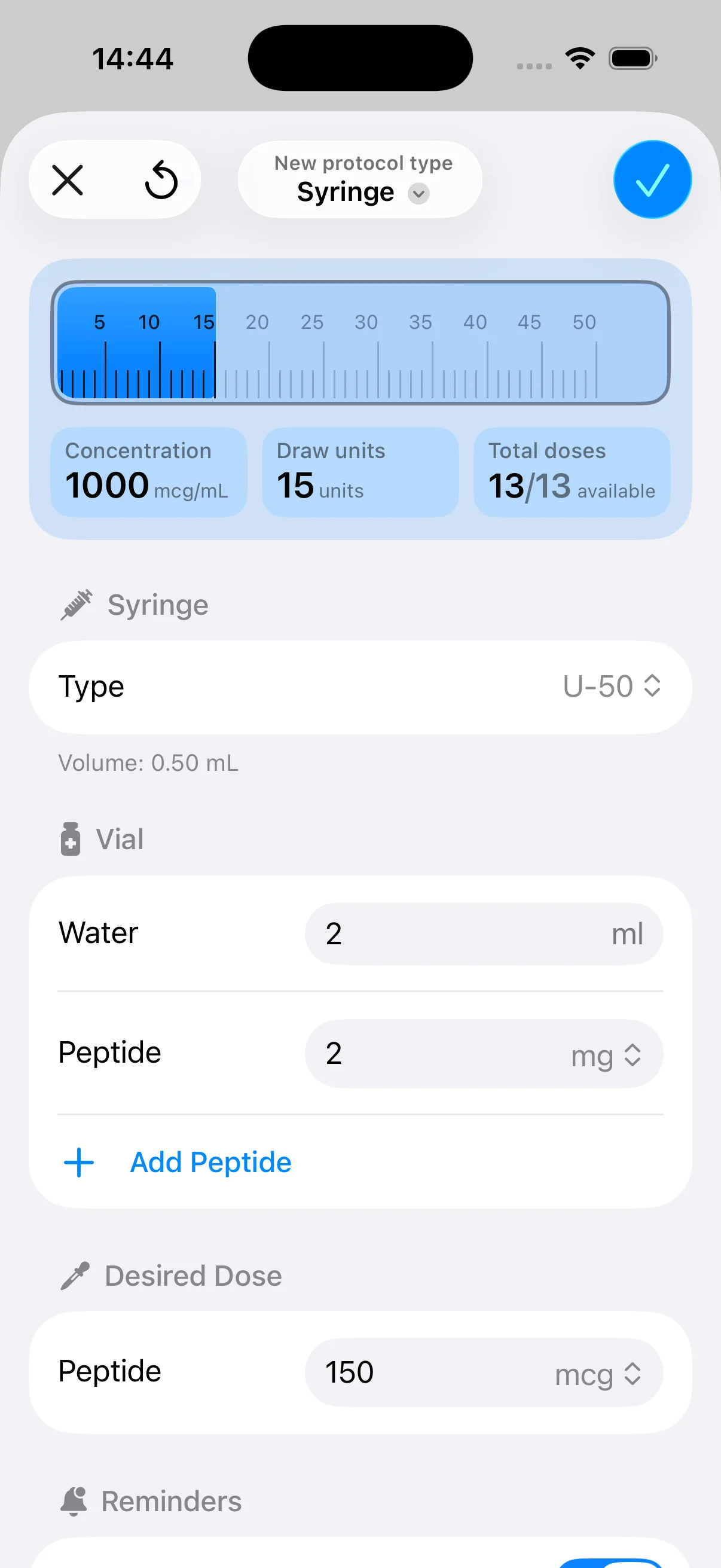
For people organizing structured peptide routines, the planning step usually centers on vial configuration, concentration, unit conversions, cycle length, and pause periods. A scheduling tool can help reduce arithmetic errors at that stage. PepFlow is one option for that workflow, because it converts desired microgram amounts into unit measurements, helps plan start dates and pause periods, and keeps reminders and logs organized, while still not replacing medical advice.
Putting It All Together and Common Questions
The simplest way to remember rhGH is to hold four lenses at once: what the molecule is, what the evidence supports, what the safety signals mean, and how the workflow works. If one of those pieces is missing, the whole picture gets distorted. The biggest mistake people make is treating wellness use like approved endocrine care, or treating a regulated medicine like a casual supplement.
A few quick questions usually come up here. How is rhGH different from secretagogues? Secretagogues try to stimulate the body’s own release pathway, while rhGH replaces the hormone itself. Will long-acting preparations change scheduling? Likely yes, because the field is moving toward less frequent dosing and adherence-focused regimens, including products that are already marketed in some regions and others that have been nearing regulatory review (long-acting review). What should a dosing-planning tool do? It should handle math, reminders, cycle logs, and schedule clarity, not make medical decisions for you.
This isn’t personal medical advice, and it shouldn’t be treated like a green light for self-treatment. If you’re considering rhGH for a clinical reason, work with an endocrinologist or prescribing clinician. If you’re evaluating it for wellness or performance, recognize that the evidence base is thinner, the safety discussion is less settled, and the regulatory risk is very real.
If you want a practical way to organize peptide schedules without the manual math, visit PepFlow and see how it handles dose conversion, cycle planning, reminders, and logging in one place. It’s built for accuracy and routine, which matters when you’re dealing with compounds as technical as recombinant growth hormone.