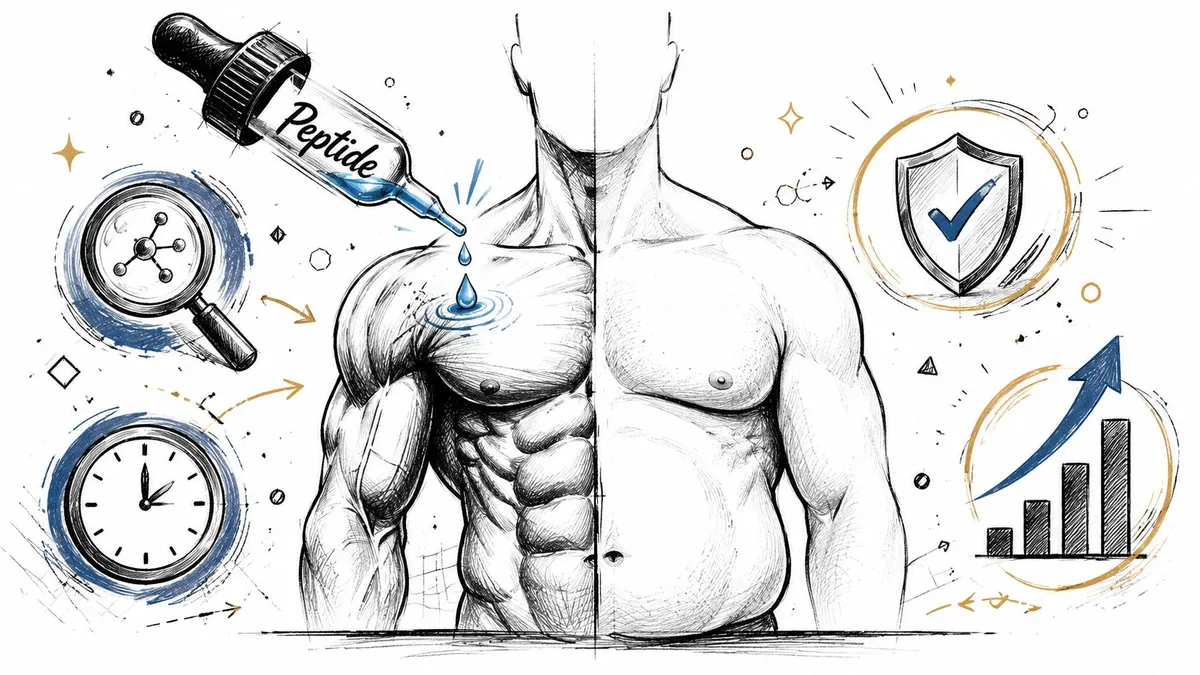
Most advice about peptides for body composition gets the headline wrong. The market keeps pushing “muscle-building peptides” as if they reliably add new muscle in healthy adults. That claim doesn’t hold up well once you separate mechanism from outcome.
The key distinction is simple. Some peptides have strong human data for fat loss. Others are discussed as if they drive muscle gain, but the practical evidence is far thinner. That gap matters because people often choose compounds based on gym talk, social clips, or protocol screenshots rather than on what has been shown in humans.
For healthy adults, that mistake usually shows up in one of two ways. First, someone expects a recovery peptide or growth hormone secretagogue to act like an anabolic drug. Second, someone assumes any peptide that changes appetite, growth hormone, or inflammation must automatically improve body composition. It doesn’t work that way. As NewYork-Presbyterian notes in its overview of peptides, expert consensus is that no “recovery” or “GH-secretagogue” peptide such as BPC-157 or CJC-1295 has proven anabolic effects in humans without concurrent growth hormone deficiency. Their main role is recovery support, not direct tissue hypertrophy.
That single point clears up a lot of confusion. Body composition means more than losing scale weight. It means changing the ratio of fat mass to lean mass, while protecting performance, health markers, and sustainability. If the goal is evidence-based planning instead of anecdotal guesswork, you need to know which peptide classes are proven for which outcomes, where the gray areas start, and how to build a protocol around what’s known.
Table of Contents
- Introduction Beyond the Hype
- Understanding Peptide Classes and Mechanisms
- Peptides for Fat Loss The Evidence-Backed Path
- Peptides for Muscle Gain The Speculative Frontier
- Designing Your Peptide Protocol
- Monitoring Progress and Mitigating Risks
- Frequently Asked Questions About Peptides
Introduction Beyond the Hype
The biggest myth in this space is that peptide use for physique goals is mostly about finding the right “muscle-building stack.” In practice, that’s backwards. The strongest evidence in peptides for body composition sits on the fat-loss side, not the hypertrophy side.
That matters because many people don’t buy peptides for the effect they’re likely to get. They buy them for the effect they were promised. A person who wants visible recomposition may start a GH-secretagogue protocol expecting fuller muscles, faster growth, and easier leaning out, only to find the response is subtle, inconsistent, or mostly limited to recovery and routine adherence.
Peptides as a body composition tool
Peptides aren’t one thing. They’re a broad category of signaling compounds. Some are studied in regulated medical settings. Others circulate in gray-market channels with weak standardization, variable purity, and a lot of borrowed confidence from animal work, forum threads, and before-and-after claims.
Reality check: If a peptide is sold primarily on mechanism talk but not on strong human outcomes, caution is warranted.
For body composition, the practical question isn’t “Does this peptide do something in the body?” Almost all of them do. The useful question is “What outcome has been demonstrated in humans like the person using it?”
That standard changes how protocols should be built. It pushes fat-loss planning toward clinically validated GLP-1 drugs. It also forces a more honest view of growth hormone secretagogues, recovery peptides, and other compounds often marketed as anabolic shortcuts.
What a smarter standard looks like
A practitioner’s job is to reduce avoidable mistakes. With peptides, that means three rules:
- Match the class to the goal: Use compounds with evidence for the specific outcome you want.
- Separate support from primary effect: Recovery support isn’t the same as muscle growth.
- Treat protocol design as risk management: Compound choice, dosing logic, timing, and sourcing all matter.
If you keep those rules in place, the conversation becomes much clearer. GLP-1s belong in the “proven fat-loss” category. GHS compounds belong in the “possible support, limited anabolic proof” category. Collagen peptides belong in a different lane again, where oral supplementation plus resistance training has more credible human support than many injectable compounds promoted online.
Understanding Peptide Classes and Mechanisms
Peptide discussions go off track fast when every compound gets treated like it belongs in the same category. That is how weak evidence gets dressed up as a smart protocol.
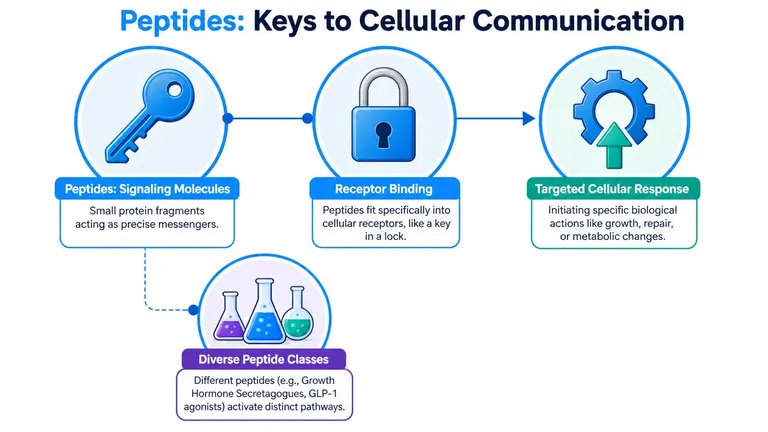
Peptides are signaling molecules. They bind to receptors and nudge a system in a specific direction. What matters for body composition is not whether a signal exists. It is whether that signal leads to a useful human outcome, at a tolerable risk, for the goal in front of you.
Peptides as signals, not shortcuts
A mechanistic effect can be real and still fail to change the mirror, the scale, or training performance in a meaningful way. That gap is where many users waste time.
Satiety signals, gastric emptying, growth hormone pulses, tissue repair signaling, and inflammatory pathways all sound impressive on paper. The body still filters those effects through calorie intake, protein intake, sleep, training quality, insulin sensitivity, stress, and product quality. A peptide does not erase those variables. It works inside them.
That is why I separate mechanism from outcome every time I review a protocol. If a compound has a clear pathway but weak human results for the specific goal, it belongs in the “interesting but limited” bucket, not the “build a plan around this” bucket.
Two classes dominate body composition talk
For body composition, the practical split is simple.
GLP-1 receptor agonists are primarily appetite and metabolic regulation tools. Their mechanism lines up closely with the outcome people usually want from a cutting phase, which is lower food intake and better adherence to an energy deficit. If you want a clearer overview of that category, this guide to peptides used for fat loss is the relevant lane.
Growth hormone secretagogues, or GHS, are discussed very differently online than they perform in real planning. Compounds such as ipamorelin and CJC-1295 are used to stimulate growth hormone release, which leads many users to assume direct muscle-building or fat-loss effects. That assumption gets ahead of the evidence. The mechanism is plausible. The physique payoff in humans is much less settled, and side effects such as appetite changes, water retention, and blood sugar issues can complicate the picture.
A third category deserves a separate lane. Collagen peptides are nutritional support, not a shortcut to an anabolic state. Their relevance is usually connective tissue support and recovery capacity, especially when resistance training is already in place. That makes them useful in some body composition plans, but for a different reason than injectable peptides marketed for fat loss or muscle gain.
The practical mistake is grouping all three classes together and expecting them to do the same job. They do not. GLP-1s have the clearest case for fat loss. GHS compounds remain a speculative option for muscle and recovery goals. Collagen peptides support training, not large-scale physique change on their own.
Peptides for Fat Loss The Evidence-Backed Path
If the goal is fat loss, one peptide class has clearly separated itself from the rest. GLP-1 receptor agonists have the strongest human evidence and the clearest practical role.
Why GLP-1s set the standard
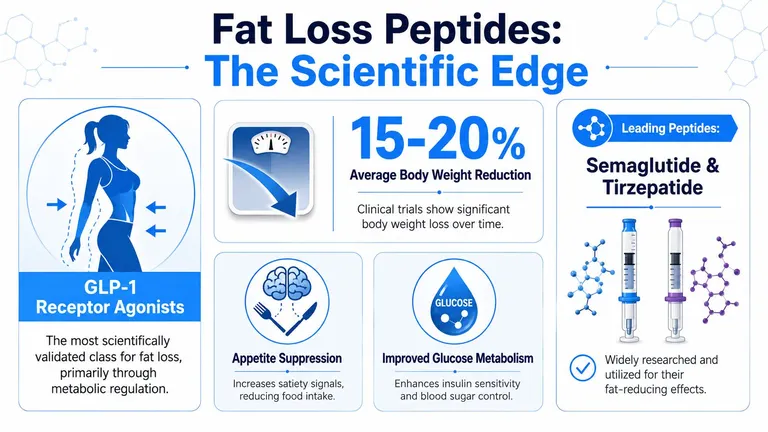
The reason GLP-1s matter isn’t hype. It’s clinical evidence. In trials, participants using semaglutide achieved average body weight loss of around 15% over 68 weeks, while those using tirzepatide saw losses of up to 22%, which is why this class is widely viewed as the strongest option for peptide-driven fat reduction in humans, as summarized in this review of peptides for weight loss.
That level of evidence changes the coaching conversation. With GLP-1s, you’re not leaning on theory alone. You’re working from a class with strong human outcome data, extensive regulatory oversight for approved uses, and a mechanism that lines up closely with the observed result.
The practical effect is less appetite pressure, better satiety, and a more manageable calorie deficit for many users. That doesn’t make GLP-1s magic. It makes them effective tools when the person also protects lean mass through training, protein intake, and sensible pacing.
For a broader look at compounds commonly discussed in this category, PepFlow has a useful overview of peptides for fat loss.
What this means in practice
The main lesson isn’t just that GLP-1s work for fat loss. It’s that they establish the benchmark for what “proven” should mean in this space.
A practical framework looks like this:
- Primary use case: A person whose biggest obstacle is appetite, adherence, or sustained fat loss.
- Expected role: Reduce fat mass through appetite and metabolic effects, not through an anabolic pathway.
- Main coaching concern: Preserve muscle while body weight drops.
Practical rule: The faster fat loss works, the more deliberately you need to protect lean mass.
That’s where many people mishandle these drugs. They celebrate scale loss but ignore resistance training, protein intake, recovery, and body composition tracking. Then they blame the peptide for muscle loss when the underlying issue was an underbuilt support plan.
GLP-1s also help expose a common misunderstanding in the peptide world. A peptide can be extremely effective for one body composition goal and almost irrelevant for another. These compounds are a strong example. They can reshape fat-loss planning. They do not provide anabolic support for building muscle.
Peptides for Muscle Gain The Speculative Frontier
Muscle-focused peptide marketing often gets the story backward. The compounds with the strongest human outcome data in body composition are used for fat loss, while the peptides pushed for muscle gain usually sit on thinner evidence.
The main examples are growth hormone secretagogues, especially ipamorelin and CJC-1295. On paper, the appeal is obvious. Increase growth hormone signaling, support recovery, improve body composition, and train harder often enough to grow. In practice, that chain of assumptions breaks in several places.

Why GHS peptides attract lifters
Lifters usually reach for GHS peptides because they want something between standard training support and overt anabolic drugs. They are not chasing appetite control or medical obesity treatment. They want better recovery, better sleep, and a hormonal nudge that might translate into more lean mass over time.
That is a reasonable question to ask. It is not the same as having a reliable muscle-building tool.
In coaching practice, the first effects people describe are usually softer variables. They may sleep better. They may feel more recovered between sessions. They may find it easier to maintain training volume. Those changes can matter, but they are still indirect. Indirect support is not the same thing as a proven anabolic effect in healthy adults.
Where the expectation usually goes wrong
The common mistake is treating a plausible mechanism as if it were a finished result. Growth hormone pulses, improved recovery, and better training readiness can all sound muscle-building. Yet the human evidence for clear hypertrophy from these protocols in otherwise healthy, resistance-trained adults remains limited.
That changes how I frame these compounds. They belong in the category of speculative support tools, not primary drivers of muscle gain.
A more realistic view includes trade-offs like these:
- Possible upside: Better subjective recovery, better sleep, or improved training tolerance for some users.
- Weak point: Visible muscle gain may be modest, inconsistent, or hard to separate from improvements in training, food intake, and recovery habits.
- Protocol burden: Shorter-acting compounds can create frequent dosing schedules, more decision fatigue, and more opportunities for sloppy use.
- Side effects: Fluid retention, appetite changes, and impaired glucose control can work against a lean-gain phase just as easily as they can support it.
That last point gets ignored too often. A peptide that increases hunger or worsens blood sugar control can make body composition less predictable, especially for people already prone to overeating during mass phases.
The practical question is not whether a GHS can do something. It is whether it does enough, reliably enough, to justify the cost, complexity, and risk. For many healthy lifters, the answer is unclear.
That is why fundamentals still beat speculative injectables in most muscle-gain plans. Progressive training, calorie control, total protein intake, meal structure, and sleep quality do more of the primary work. Protein supplements can be convenient when meals fall short of a daily target, but no single supplement replaces the broader plan.
For people researching this category further, PepFlow has a useful overview of peptides commonly discussed for muscle growth. Use the same evidence standard you would use for any body composition tool. “Discussed for muscle growth” and “proven to add muscle” are different claims.
Designing Your Peptide Protocol
A good peptide protocol starts by ruling things out.

For body composition, the first decision is not dose. It is evidence standard. If the primary goal is fat loss, build around peptide classes with human outcome data. If the goal is muscle gain, treat peptide use as speculative support at best, not as the engine of the plan.
That distinction prevents a common mistake. People often design an aggressive protocol around a weak premise, then keep adding compounds, timing rules, and injection frequency to compensate for poor evidence. More moving parts usually create more confusion, not better results.
Start with the outcome and the evidence level
Set the goal in plain language. Fat loss. Lean-mass retention during a calorie deficit. Recovery support. Experimental recomp. Each goal changes what a reasonable protocol looks like.
For fat loss, the practical question is whether appetite regulation, energy intake, and adherence improve enough to justify the intervention. That is where GLP-1 based approaches have a real evidence advantage. For muscle gain, the standard should be stricter than online anecdotes. If a compound is mainly discussed for growth hormone signaling but has limited physique data in healthy adults, plan around uncertainty from day one.
A useful sequence looks like this:
- Name the primary outcome: Fat loss, muscle retention, recovery support, or recomp.
- Match the peptide class to the evidence: Proven fat-loss class first. Speculative class only if expectations stay conservative.
- Define the operating limits: Budget, dosing frequency, meal timing, training schedule, and how much complexity you can repeat consistently.
- Choose the success markers: Body weight trend, waist measurement, appetite control, training quality, and side effect tolerance.
The simpler protocol usually wins because it is easier to execute, easier to monitor, and easier to stop if the trade-offs are poor.
Peptide Class Protocol Comparison
| Characteristic | GHS Class (e.g., CJC-1295/Ipamorelin) | GLP-1 Agonist Class (e.g., Semaglutide) |
|---|---|---|
| Primary body composition role | Recovery support and possible permissive fat-loss effects | Direct fat-loss support through appetite and metabolic regulation |
| Evidence quality for physique goals | Limited and inconclusive in healthy adults | Strong human evidence for fat reduction |
| Typical planning challenge | Timing, frequency, and inflated muscle-gain expectations | Lean-mass protection during weight loss |
| Common protocol risk | Overcomplication and poor adherence | Under-eating protein, undertraining, unmanaged GI effects |
| Best user mindset | Experimental and conservative | Outcome-driven and tightly monitored |
The table matters because protocol design should reflect what the compound can reasonably do. GLP-1 planning is usually about preserving training performance, protein intake, and lean mass while body fat comes down. GHS planning is different. The main job there is limiting downside, because the upside is less predictable.
Build the protocol around adherence and source quality
The best schedule on paper fails if it is too annoying to follow. Daily life matters. Meal timing matters. Travel matters. So does your willingness to log symptoms and keep the plan boring for long enough to judge it fairly.
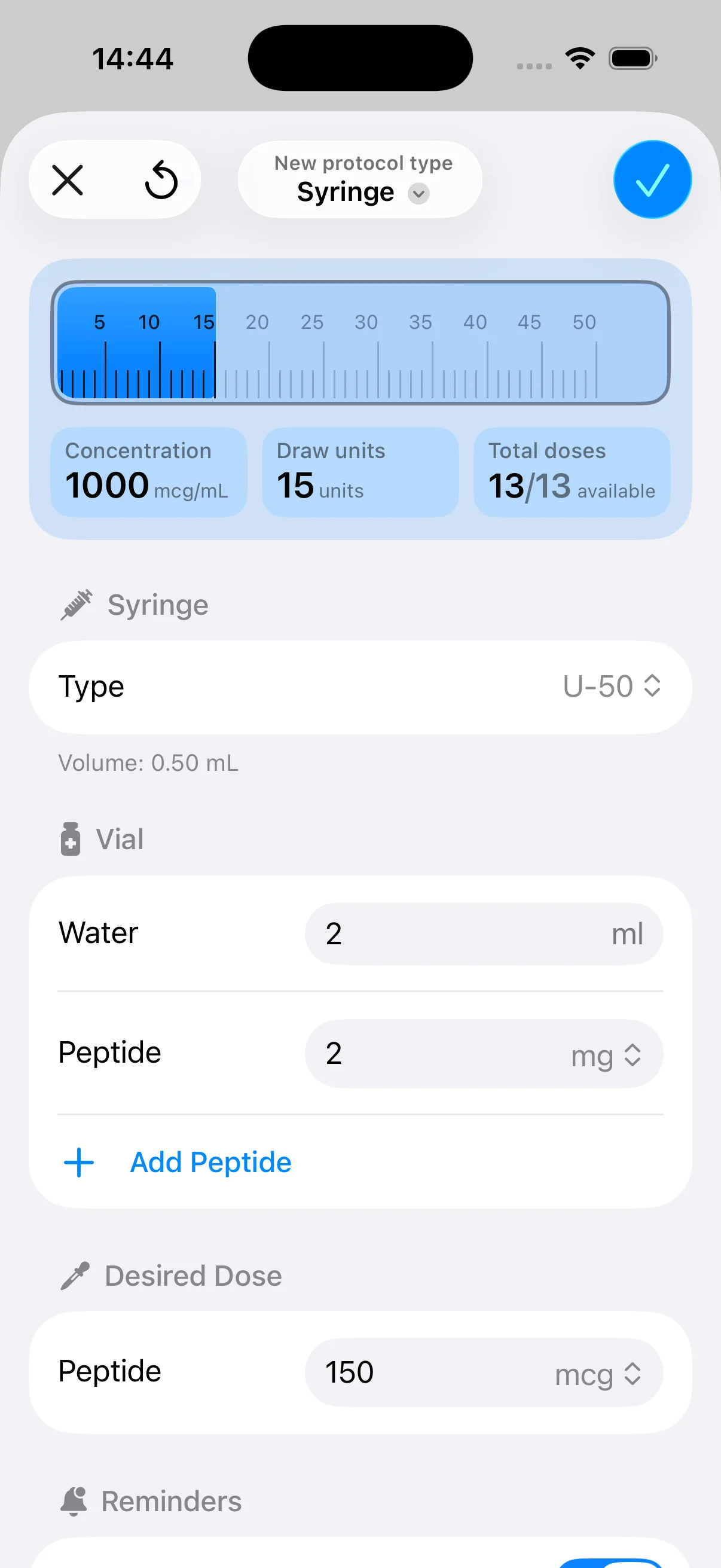
Use one system to track dose math, timing, and response. Some people use a spreadsheet. Some use a clinician-run plan. PepFlow is one option for organizing reconstitution math, dose schedules, and adherence logs in one place. The point is not convenience for its own sake. The point is fewer arithmetic errors and fewer memory-based decisions.
Source quality belongs in protocol design, not as an afterthought. A dosing plan is only as good as the material behind it, which is why peptide purity testing and verification practices should be part of the planning process before anyone starts calculating units.
Another useful reference point is seeing how protocol planning gets explained visually.
A practical protocol usually includes these decisions:
- Timing: Keep it realistic enough to survive work, meals, training, and sleep.
- Frequency: More injections and tighter windows raise the chance of missed doses and sloppy execution.
- Titration: Start low enough to interpret side effects before changing multiple variables at once.
- Nutrition guardrails: Fat-loss protocols need a plan for protein, hydration, and training output. Muscle-focused experiments need calorie control so extra hunger does not blur the result.
- Exit criteria: Set the review point in advance. If the expected benefit is not showing up, stop adjusting endlessly and reassess.
If you want better feedback than scale weight alone, choose a repeatable body composition method and review it on a schedule. Use the same method under similar conditions at each protocol check-in so the comparison stays meaningful.
Good protocol design is less glamorous than peptide marketing. That is a strength. It forces clear goals, realistic expectations, and cleaner decision-making.
Monitoring Progress and Mitigating Risks
If someone uses peptides for body composition without monitoring, they’re not running a protocol. They’re running an experiment on themselves with poor controls.
What to monitor regularly
The basics should be objective and repeatable. Start with body weight, training performance, appetite patterns, digestion, sleep quality, and subjective recovery. Then add a consistent body composition measure when possible, choosing a method that gives more useful feedback than scale weight alone.
Lab work also matters. In practice, people commonly track markers such as IGF-1, fasting glucose, and lipid panels with medical oversight, especially when using compounds that may affect metabolic or hormonal signaling. The exact panel depends on the person, the peptide class, and the clinician involved.
A protocol should become more data-driven over time, not less.
Risk control is part of the protocol
The risk picture changes by class. GHS users often watch for fluid retention, appetite changes, and blood sugar issues. GLP-1 users often need to manage early gastrointestinal discomfort and make sure reduced appetite doesn’t develop into poor nutrition.
Source quality is another major issue. Many mistakes blamed on “the peptide” are really sourcing, concentration, or handling problems. Anyone using research compounds should understand why contamination and mislabeling matter, and PepFlow’s article on peptide purity testing is a useful read on that point.
The safest mindset is simple. If you can’t measure the effect, track the response, and verify the source, you shouldn’t pretend the protocol is under control.
Frequently Asked Questions About Peptides
Are most body composition peptides actually approved for this use
No. Some compounds are approved for specific medical uses, while many others are sold as research chemicals or discussed off-label. That difference matters because approved use, gray-market use, and social-media use are not the same thing.
Can you stack peptides
People do, but stacking increases complexity fast. It becomes harder to know which compound is causing a benefit, side effect, or adherence problem. If stacking is considered at all, each compound should have a distinct purpose. “More pathways” isn’t a strategy by itself.
How are peptides different from SARMs or steroids
They’re not interchangeable. Peptides are signaling molecules with different targets and different effect profiles. SARMs and anabolic steroids are usually pursued for more direct anabolic effects, which is exactly why it’s misleading to talk about all peptide protocols as if they belong in the same muscle-gain conversation.
How long until results show up
That depends entirely on the class and the outcome being measured. Appetite changes may show up sooner than visible body composition changes. Recovery perceptions may show up sooner than actual hypertrophy. The useful rule is to judge outcomes by tracked trends, not by day-to-day impressions.
Are collagen peptides part of this conversation
Yes, but in a different lane. Human evidence supports specific collagen peptides when combined with resistance training, particularly for fat-free mass support in certain populations. In elderly sarcopenic men, supplementation combined with resistance training produced a statistically significant gain in fat-free mass of 3.42 ± 2.54 kg versus 1.83 ± 2.09 kg with placebo, and dose analysis found that 15 g/day produced 19% more fat-free mass gain than 10 g/day, while 20 g/day added only 2.6% more than 15 g/day, supporting 15 g post-exercise as the practical benchmark in those studied settings, according to this PMC paper on specific collagen peptides and resistance training.
If you’re trying to make peptide use more organized and less guesswork-driven, PepFlow helps with the practical side: dose calculations, schedule planning, reminders, and logging. It won’t replace clinical judgment, but it can make a structured protocol easier to execute consistently.