No, you can’t reliably make bacteriostatic water at home that matches a regulated product’s sterility, accurate 0.9% w/v benzyl alcohol concentration, and endotoxin control. Injecting a non-authorized homemade mixture carries serious risk, even if the liquid looks clear and your recipe seems simple.
That answer surprises many people because the ingredient list reads like a short shopping list. Water plus a preservative sounds like something a careful person could assemble on a kitchen counter. The hidden problem is that safety for injection isn’t defined by what you can see, taste, or measure with home tools. It’s defined by invisible controls, including microbial limits, pyrogens, particles, pH, container integrity, and whether the final product stays sterile after sealing.
Table of Contents
- A Direct Answer to the Question
- What Bacteriostatic Water Actually Is
- How Bacteriostatic Water Differs from Sterile Water
- Why a Homemade Version Cannot Match the Standard
- Multidose Vials, Preservatives, and Real-World Safety
- Safer Best Practices for Peptide Preparation Workflows
- Common Questions About Storage, Reuse, and Shelf Life
A Direct Answer to the Question
If you’re asking, can you make bacteriostatic water at home for injection, the safe answer is no, not reliably and not safely. You might be able to mix water with benzyl alcohol, but mixing isn’t the same as manufacturing a sterile, nonpyrogenic parenteral preparation. A regulated product is defined by its entire production and testing system, not just its recipe.
Baking resembles making medicine. If a cake is slightly underbaked, you notice and adjust next time. If an injectable liquid contains bacteria, endotoxin, or the wrong preservative concentration, you usually can’t detect that problem by looking at the vial.
A clear liquid isn’t proof of sterility. Sterility is proven through controlled manufacturing and testing, not appearance.
What This Guide Covers and What It Doesn’t
You’ll learn what bacteriostatic water for injection is, how it differs from sterile water, and where a homemade attempt breaks down. You’ll also learn why a preservative doesn’t make repeated vial entry risk-free, and how peptide users should separate dose accuracy from infection prevention.
This guide won’t give you a homemade formula or a workaround for sourcing injectable supplies. It also won’t replace the official instructions for a specific medication or advice from a qualified clinician. If a drug label specifies a particular diluent, that instruction controls the decision, even if another liquid seems similar.
Why the Question Deserves More Than a Yes or No
People usually ask this question for understandable reasons, including cost, shortages, convenience, or curiosity about how peptides are reconstituted. A blunt refusal without explanation doesn’t help you judge other claims you’ll see online. The reasoning matters because many unsafe suggestions contain one true fragment, such as the preservative concentration, while omitting every control that makes that concentration meaningful.
By the end, you should be able to spot that omission yourself. You’ll know why matching an ingredient percentage is only one small requirement, why boiling or filtering at home doesn’t solve the core problems, and what safer sourcing and handling look like in practice.
What Bacteriostatic Water Actually Is
A useful analogy is a sealed, treated workspace. The workspace isn’t valuable just because it has four walls. It matters because someone controls who enters, cleans the surfaces, checks the air, seals the doors, and verifies that nothing harmful is left behind. Bacteriostatic water works on the same principle, except the workspace is a sealed vial of injectable diluent.
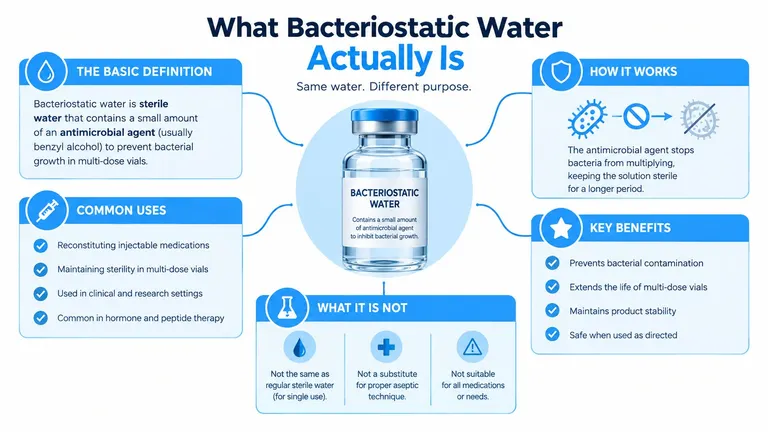
Formally, U.S. labeling defines the product as Water for Injection containing benzyl alcohol as a bacteriostatic preservative, most commonly at 0.9% w/v, equivalent to 9 mg/mL, as shown in FDA labeling records for bacteriostatic water. Some labeled products use 1.1% benzyl alcohol, or 11 mg/mL, according to that same source. That variation matters because concentration is a defined pharmaceutical specification, not an estimate you round to the nearest kitchen measurement.
What Bacteriostatic Actually Means
Bacteriostatic means the preservative suppresses bacterial growth. It doesn’t mean the liquid sterilizes itself, destroys every organism introduced into it, or repairs unsafe handling. Benzyl alcohol slows or inhibits growth so a properly manufactured multidose vial can be entered more than once under strict technique.
That distinction is where readers often get confused. A preservative is a backup control inside an already sterile system. It isn’t a cleaning agent for contaminated water, dirty containers, or reused needles.
What the Product Is For
The formulation is intended primarily as a diluent or solvent for compatible injectable medicines. It isn’t a general-purpose injectable fluid and it isn’t a replacement for body fluids. Compatibility also matters, because a medicine’s official instructions may require a specific diluent or prohibit benzyl alcohol for a particular use or patient group.
Labeling also warns that intravenous administration of the water without an appropriate solute can cause hemolysis, meaning damage to red blood cells. That warning alone shows why this product shouldn’t be treated like ordinary water that happens to be clean.
The Controls That Define the Product
- Validated water quality: The starting water must meet pharmaceutical standards before preservative is added.
- Accurate preservative concentration: Too little may fail to inhibit growth, while too much creates a different formulation than the label specifies.
- Sterility assurance: Manufacturing must produce and maintain a sterile product through sealing.
- Endotoxin control: The product must control pyrogens, which can remain harmful even when bacteria are no longer alive.
- Suitable container integrity: The vial and closure must protect the contents and avoid introducing contaminants or leachables.
- Quality testing: Finished product checks confirm specifications you can’t verify by sight.
Practical rule: Judge an injectable diluent by its validated controls and labeling, not by whether its ingredient list looks short.
How Bacteriostatic Water Differs from Sterile Water
Sterile water and bacteriostatic water start from a related idea, but they behave differently after opening. Sterile water for injection contains no preservative, so once you open or enter it, there’s no antimicrobial backup for later use. Bacteriostatic water contains benzyl alcohol, so it’s designed for multidose use only when handling rules are followed and the medication is compatible.
Water for Injection is the underlying pharmaceutical water ingredient. The finished product you use depends on whether it’s supplied as a sterile single-use product, a preserved multidose diluent, or another labeled preparation. You can explore the practical contrast further in this comparison of bacteriostatic water and sterile water.
Bacteriostatic Water vs Sterile Water for Injection
| Attribute | Bacteriostatic Water for Injection | Sterile Water for Injection |
|---|---|---|
| Preservative | Contains benzyl alcohol as a bacteriostatic preservative | Contains no preservative |
| Intended container use | Multidose-capable under labeling and strict technique | Single-use orientation after opening or entry |
| Main role | Diluent or solvent for compatible injectable medicines | Diluent, solvent, or other labeled sterile use |
| Protection after entry | Preservative lowers microbial growth risk, without eliminating it | No antimicrobial protection after entry |
| Key limitation | Not suitable for every drug or patient situation | Leftover liquid isn’t protected for later entries |
Why the Choice Isn’t Interchangeable
The right choice depends on the drug, how many doses you’ll draw, and the time window in the official instructions. If a medicine must be used immediately after reconstitution, a preservative may offer no workflow advantage. If a compatible medicine is drawn from a multidose vial over time, the preserved diluent may be the labeled option.
Don’t choose based on which bottle you already own. Benzyl alcohol can be inappropriate for certain medicines or patient groups, and sterile water can be inappropriate when you plan repeated entries. The medication label and clinician direction should make that decision, not habit.
Why Water Alone Can Damage Blood Cells
Labeling warns that intravenous administration without an appropriate solute can cause hemolysis. In plain language, water by itself doesn’t match the balance of fluids in blood. When red blood cells encounter that mismatch in the wrong setting, they can be damaged.
That warning also explains why terms like sterile, distilled, purified, and bacteriostatic aren’t interchangeable. Each describes a different property, intended use, or manufacturing standard. A product can be clear and purified without being sterile, nonpyrogenic, preserved, or suitable for injection.
The preservative changes how a sealed sterile vial tolerates repeated entry. It doesn’t make the water intrinsically stronger, cleaner, or universally safer.
Why a Homemade Version Cannot Match the Standard
Consider a plausible home attempt. You start with distilled water, buy benzyl alcohol online, measure with a kitchen scale, mix in a clean-looking jar, boil the liquid, and transfer it into a vial. Every step sounds careful, yet every step leaves a control unverified.
Where Each Home Assumption Fails
- Distilled isn’t the same as Water for Injection: Distillation addresses certain impurities, but it doesn’t prove the water, container, and transfer process meet injectable standards.
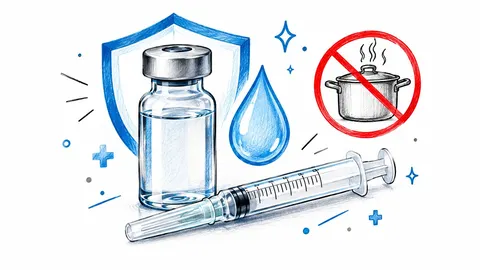
- Boiling doesn’t remove endotoxin: Heat may kill many living bacteria, but bacterial endotoxin can remain after the organisms die. That’s why nonpyrogenic control is separate from heating a liquid.
- A kitchen scale can’t validate concentration: Milligram-level accuracy depends on calibrated equipment, suitable technique, and confirmed ingredient purity. A display reading doesn’t prove the final concentration matches the intended pharmaceutical specification.
- A clean kitchen isn’t a sterile environment: Air, skin, utensils, jar rims, funnels, and vial closures can introduce microorganisms during mixing and transfer. Wiping a surface reduces visible dirt, but it doesn’t create sterility assurance.
- The container becomes part of the product: Unvalidated glass, plastic, caps, and stoppers can contribute particles or leachables, or fail to maintain a reliable seal. You also have no container integrity testing to show the closure protects the contents.
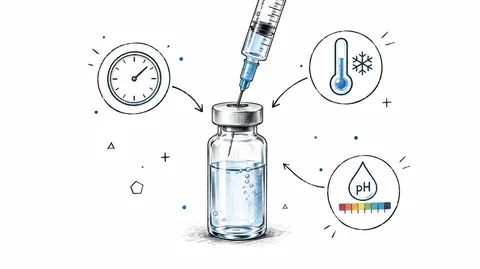
- pH and compatibility remain unknown: You can’t assume the final liquid has suitable pH or is compatible with a particular drug just because the preservative percentage was your target.
Why Matching the Number Isn’t Enough
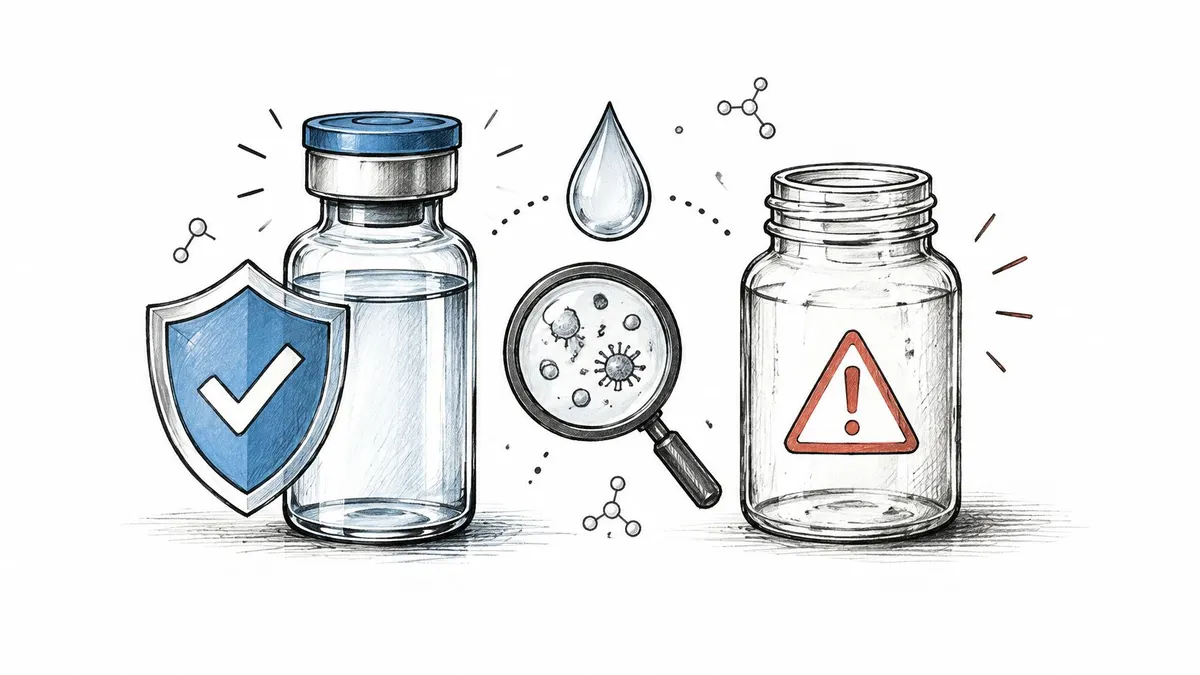
The nominal benzyl alcohol percentage says nothing by itself about sterility, pyrogens, particulates, correct pH, container integrity, or drug compatibility. That’s the central flaw in most homemade claims. They treat the easiest number to copy as if it were the whole product definition.
Each pharmaceutical control exists because a specific failure mode can cause harm. Remove validated water and you reintroduce starting-material risk. Remove endotoxin testing and you can’t detect pyrogen contamination. Remove sterility assurance and you can’t know whether organisms entered during filling or sealing.
You also can’t test your way out of the problem with home observation. Cloudiness may signal trouble, but a contaminated liquid can look perfectly clear. Smell, taste, and a basic pH strip can’t confirm that an injectable product is sterile and nonpyrogenic.
The core test: If you can’t verify sterility, endotoxin control, concentration, pH, particles, and closure integrity, you haven’t reproduced the regulated product. You’ve reproduced only its appearance.
For that reason, any product intended for injection should come from a properly authorized pharmaceutical or compounding source. It should then be used only according to the medication’s official instructions and a qualified clinician’s advice.
Multidose Vials, Preservatives, and Real-World Safety
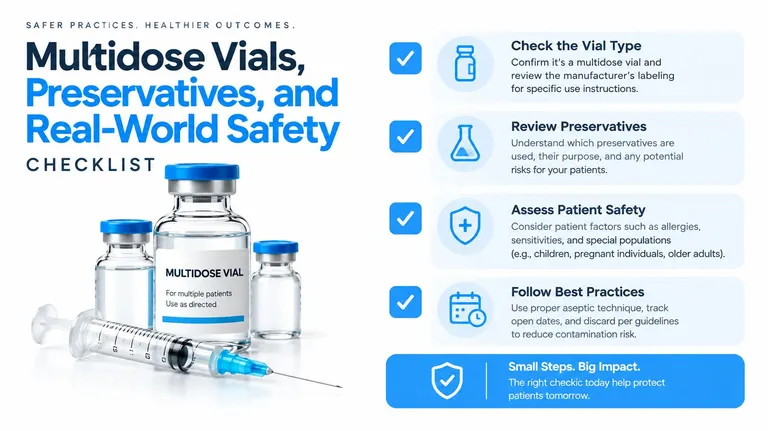
Even with a regulated product, bacteriostatic doesn’t mean repeated entry is automatically safe. The preservative lowers microbial growth risk inside a sterile vial, but it doesn’t eliminate contamination introduced through poor technique. Your hands, the preparation surface, the vial septum, and every needle entry still matter.
The CDC recommends single-dose vials whenever possible and states that each multidose vial access requires a sterile needle and syringe, with disposal if sterility is compromised or questionable, as detailed in CDC clinical guidance on injection safety. The same guidance emphasizes that preservatives don’t protect against contamination caused by unsafe handling. That’s an important correction to the idea that benzyl alcohol acts like an internal disinfectant.
What Safe Multidose Handling Requires
- Prepare in a clean, dedicated area: Keep medication preparation away from sinks, waste, used supplies, and the immediate injection area where contamination is more likely.
- Wash your hands before handling supplies: Clean technique starts before you touch a vial, cap, needle, or syringe.
- Disinfect the septum and let it dry: The rubber top isn’t sterile after the protective cap is removed, and wet disinfectant hasn’t finished its job if you puncture immediately.
- Use a new sterile needle and syringe for every entry: Reusing equipment can carry contaminants back into the vial, even if the same person will use the next dose.
- Date the vial when opened: Dating supports the manufacturer’s storage and discard instructions and prevents guesswork later.
- Discard when sterility is questionable: Don’t try to rescue a vial after a dropped uncapped needle, a touched septum, a damaged closure, or uncertainty about what happened during preparation.
Why There’s No Universal Internet Discard Rule
Online answers often give one fixed beyond-use period for every opened vial. That shortcut ignores the product label, storage conditions, number and quality of entries, contamination events, and local pharmacy or health-regulator rules. Manufacturer labeling and applicable local rules control the decision.
A vial kept properly and entered with strict technique presents a different risk from a vial left in a warm gym bag, shared between people, or accessed with reused supplies. The calendar alone can’t capture those differences. If an event makes sterility questionable, the safe decision is disposal, not waiting for a date to arrive.
Preservative is a backup inside a sterile system. It isn’t permission to reuse supplies, skip septum disinfection, or keep a vial after a questionable entry.
For peptide workflows, this is often the overlooked half of safety. A person may measure volume carefully while preparing doses on a bathroom counter, forgetting hand hygiene, or using the same syringe repeatedly. Precise math doesn’t compensate for contaminated technique.
Safer Best Practices for Peptide Preparation Workflows
A safer peptide routine uses two separate controls that shouldn’t be confused. Dose accuracy asks whether the amount, concentration, volume, and schedule are calculated correctly. Infection prevention asks whether the diluent, vial, supplies, hands, and preparation area were handled in a way that protects sterility.
A Concrete Preparation Routine
- Source from an authorized supplier: Obtain bacteriostatic water from a licensed pharmacy or properly authorized pharmaceutical or compounding source, and check the label, seal, lot information, and expiration dating before use.
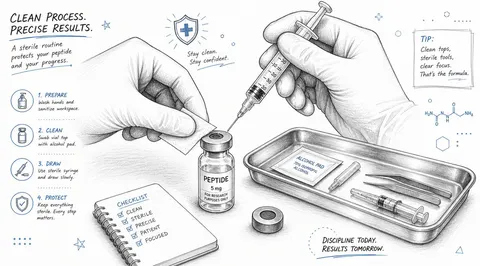
- Set up before you open anything: Clean the work surface, wash your hands, and lay out only the supplies you need so you aren’t searching through drawers mid-preparation.
- Disinfect every vial septum: Wipe the septum with alcohol and allow it to dry before entry. For a fuller explanation of the underlying habits, review this guide to sterile technique basics.
- Use single-use sterile equipment: Use a new sterile syringe and needle for every vial entry, and don’t set an uncapped needle down on the counter.
- Label and store deliberately: Write the opening date on the vial and follow the manufacturer’s storage instructions rather than relying on memory.
- Stop if something goes wrong: If you touch a critical surface, drop equipment, or lose track of an entry, replace the supply or discard the vial as appropriate.
Where Planning Tools Fit
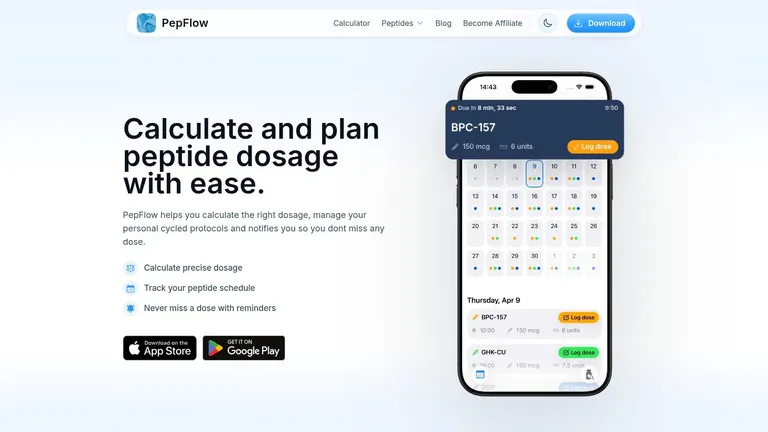
A calculator can convert a desired microgram amount into practical units and help you configure vial concentration and injection volume. A scheduling tool can manage start dates, dosing frequency, pauses, and reminders. PepFlow is one example of an app that supports those calculation and scheduling tasks for structured peptide routines.
Those functions are useful, but they operate at the planning layer. They can’t inspect a vial, verify a seal, confirm endotoxin control, or tell you whether a septum was disinfected properly. Treat the calculator as your arithmetic check and sterile technique as your contamination check, because passing one check says nothing about the other.
Workflow principle: Calculate carefully, prepare cleanly, and never let confidence in the numbers substitute for disciplined handling.
Common Questions About Storage, Reuse, and Shelf Life
How Long Can You Use an Opened Vial
Follow the manufacturer’s labeling and any instructions from your pharmacy or clinician. A fixed number shared online isn’t a substitute for product-specific dating, storage conditions, and what happened during each entry. For product-dating context, see this explanation of bacteriostatic water shelf life.
When Should You Discard It
Discard a vial if you see cloudiness, particles, visible contamination, a compromised seal, or damage to the closure. Also discard it if dating has been exceeded, storage instructions weren’t followed, or you can’t be confident sterility was maintained. If a vial was left at the wrong temperature, don’t guess from appearance. Ask the dispensing pharmacy or follow the label’s excursion guidance.
Are There People Who Need Extra Caution
Benzyl alcohol exposure requires special caution in neonatal care, so products containing it shouldn’t be assumed suitable for newborns. Always check the specific medication and diluent labeling and ask a qualified clinician when the patient is an infant, pregnant, medically complex, or receiving a drug with compatibility restrictions. If you want a clinical example of how injection instructions are organized for patients, this semaglutide injection step-by-step resource from ProMD Health Columbia shows the value of following procedure-specific guidance rather than improvising.
Any product intended for injection should come from a properly authorized source and be used only according to the medication’s official instructions and a qualified clinician’s advice.
Keep your focus on the two controls you can manage well, accurate dosing and disciplined sterile technique, while sourcing bacteriostatic water only from an authorized supplier. PepFlow can support the calculation and scheduling side with microgram to unit conversions, cycled protocols, reminders, and dose history, so your routine stays organized without manual math errors. Visit PepFlow to set up your next vial calculation and schedule with a cleaner, more deliberate workflow.