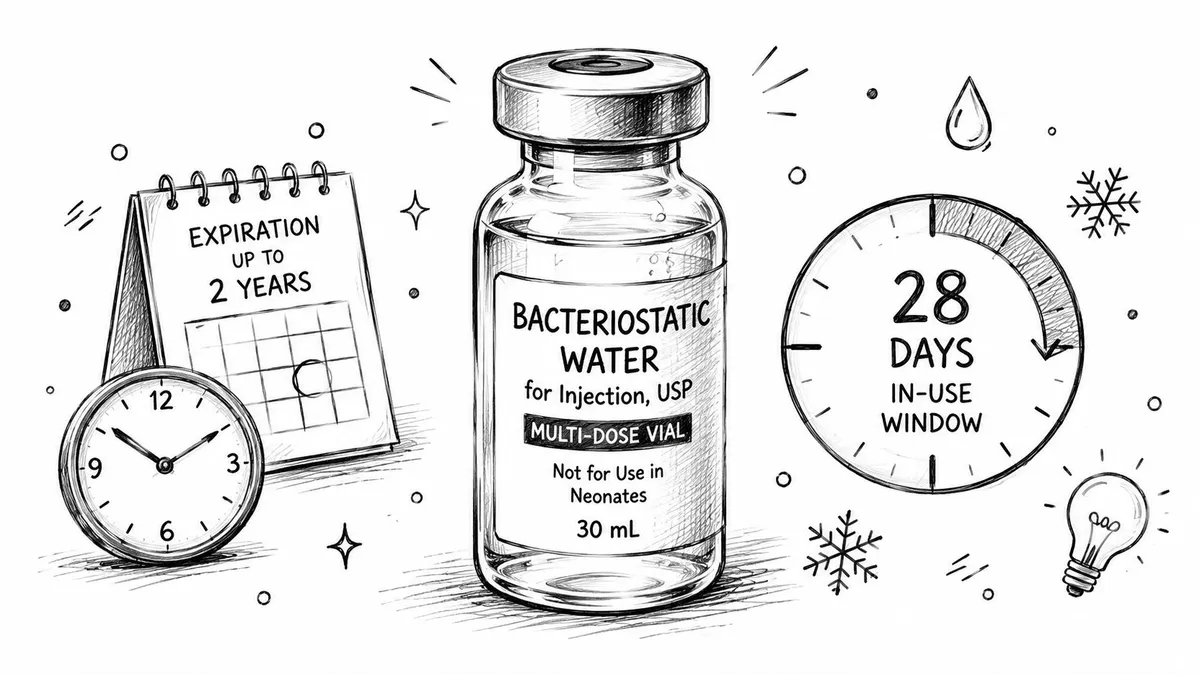
An unopened vial follows the manufacturer’s expiration date, often 2 to 3 years from manufacture, while a punctured vial must be discarded 28 days after first use, regardless of how much remains. The printed date and the in-use window are separate clocks, and the earlier deadline always controls.
That distinction challenges the most popular advice about bacteriostatic water shelf life. “It lasts 28 days” is useful, but incomplete. The 28-day rule applies after the stopper is first breached, not automatically from the day you buy the vial. Before that moment, the sealed container follows its manufacturer’s labeled expiration date.
The confusion matters because a vial can look perfectly clear and still be outside its permitted in-use period. It can also be well within the printed expiration date yet become unsuitable after the opened-vial window ends. The safest approach is to track both dates, record the first puncture, follow the product label, and discard the vial when either deadline arrives.
Table of Contents
- Why Bacteriostatic Water Has Two Different Clocks
- What Bacteriostatic Water Actually Is
- How Long an Unopened Vial Lasts
- The 28 Day Rule After First Puncture
- Storage Conditions That Change the Risk
- Handling Myths and Real World Tradeoffs
- Warning Signs a Vial Has Gone Bad
- A Simple Routine for Every Vial You Own
Why Bacteriostatic Water Has Two Different Clocks
The question “When does bacteriostatic water expire?” has two answers because the vial exists in two different conditions. While sealed, it remains protected by its original container and closure system. After a needle enters the stopper, it becomes a multi-dose vial that has been accessed repeatedly, so a separate in-use limit applies.
The sealed-vial clock
The manufacturer expiration date governs an unopened vial stored according to its label. That date relates to the product’s expected stability in intact packaging, including the water, preservative, container, and closure. Independent guidance describes unopened bacteriostatic water as commonly carrying a shelf life of about 2 to 3 years from manufacture when stored correctly (PS Peptides explains the sealed and opened shelf-life model).
The printed date isn’t a countdown that starts when the vial reaches your cabinet. It’s the manufacturer’s labeled endpoint for the sealed product. If the vial remains unopened, the date on the vial or carton is the one to use.
The punctured-vial clock
The second clock starts at the exact moment a needle first pierces the rubber stopper. FDA-approved labeling for bacteriostatic water gives a clear 28-day multi-dose limit. Any remaining solution must be discarded after that period, even when the original printed expiration date is later (FDA-labeling-based guidance describes the first-puncture rule).
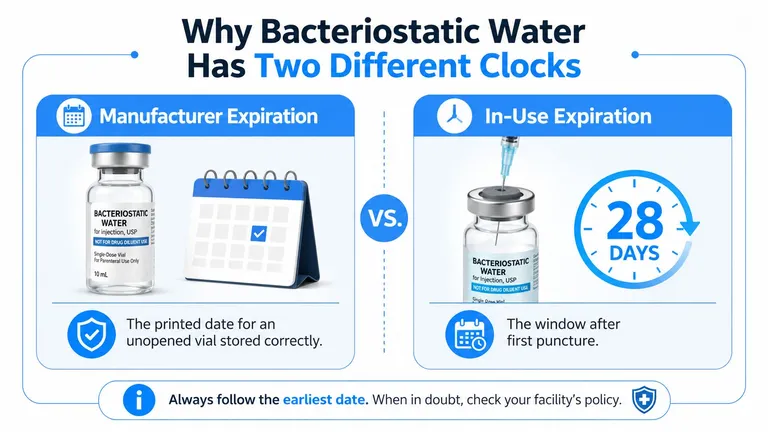
Think of the printed expiration date as the deadline for a sealed package. The first puncture opens a second deadline, and that deadline can arrive sooner. Refrigeration, a mostly full vial, or clear-looking liquid doesn’t erase the in-use clock.
Practical rule: Write down both dates. If you can’t verify when the vial was first punctured, treat the opening date as unknown rather than guessing.
What Bacteriostatic Water Actually Is
Bacteriostatic water is sterile water prepared with 0.9% benzyl alcohol, a preservative that helps suppress bacterial growth after a multi-dose vial is entered. The preservative is what makes repeated withdrawals possible in the labeled container format. It doesn’t turn the vial into an endlessly protected reservoir, and it doesn’t make poor handling harmless.
A useful analogy is a preserved food product. The preservative can slow microbial growth, but it can’t rescue food that has been contaminated or left under unsuitable conditions. Benzyl alcohol serves a comparable risk-control role here. It buys limited time for repeated access, while sterile technique, inspection, storage, and discard dates still matter (this guide to what bacteriostatic water is used for provides additional background).
Preserved versus preservative-free water
Bacteriostatic water shouldn’t be confused with sterile water for injection. Sterile water in a one-time sterile format doesn’t contain the preservative needed for a repeated-entry design. The container type and label instructions therefore matter as much as the word “sterile.”
The difference is practical:
- Bacteriostatic water: Contains benzyl alcohol and is designed for limited repeated entry when handled according to its labeling.
- Preservative-free sterile water: Doesn’t contain a bacteriostat and follows single-entry handling instructions where specified by the product label.
Multi-dose packaging only makes sense when the product is formulated and labeled for that purpose. A person shouldn’t assume that any sterile water vial can be used repeatedly because it looks similar to bacteriostatic water.
The preservative also doesn’t guarantee that the solution will remain acceptable if it becomes cloudy, develops particles, or has a compromised seal. Those conditions override a calendar calculation. Date control and physical inspection work together.
How Long an Unopened Vial Lasts
An unopened vial follows one clock: the manufacturer’s printed expiration date. It remains within the labeled shelf life only when the seal and packaging are intact and storage has followed the product directions. General guidance describes sealed bacteriostatic water as lasting about 2 to 3 years from manufacture, but that estimate never replaces the date printed on your vial. The manufacturer’s label controls.
Where to find the date
Check the vial label first. If the print is hard to read, inspect the carton, peel-off sticker, or secondary label. Record the expiration date before storing the vial, particularly when several vials have different lot or expiry information.
The expiration date is the manufacturer’s endpoint for the sealed product meeting its specifications. It is not a promise that the solution changes condition at one exact moment. It is the date to use for routine decisions about whether an unopened vial belongs in active inventory.
After that date, do not treat a clear appearance or a full container as permission to continue using it. Clarity can support a visual check, but it cannot replace the manufacturer’s stability assessment.
Benzyl alcohol is part of that assessment. The labeled shelf life covers the solution, preservative, vial, stopper, and sealed container system together. A vial does not have a separate, longer expiration period just because the water still looks normal.
Reading the printed format
| Label Format | Example | How to use it |
|---|---|---|
| Month and year | 08/28 | Follow the manufacturer’s stated convention. If the label gives no day, check the package insert or supplier labeling to confirm how the date is defined. |
| Day, month, and year | 08/08/28 | Confirm whether the label uses day/month/year or month/day/year before recording the date. |
| Carton or secondary sticker | Printed lot and expiry details | Match the carton information to the vial so a date from another product is not recorded by mistake. |
A receiving check prevents a common mix-up: the purchase date is not a new expiration date. Arrival at your home or facility does not restart the manufacturer’s shelf-life clock.
Keep unopened vials separate from vials that have been accessed. Once the stopper has been punctured, the unopened-vial rule no longer applies. The first puncture starts the 28-day in-use window, even if the printed expiration date remains in the future.
The 28 Day Rule After First Puncture
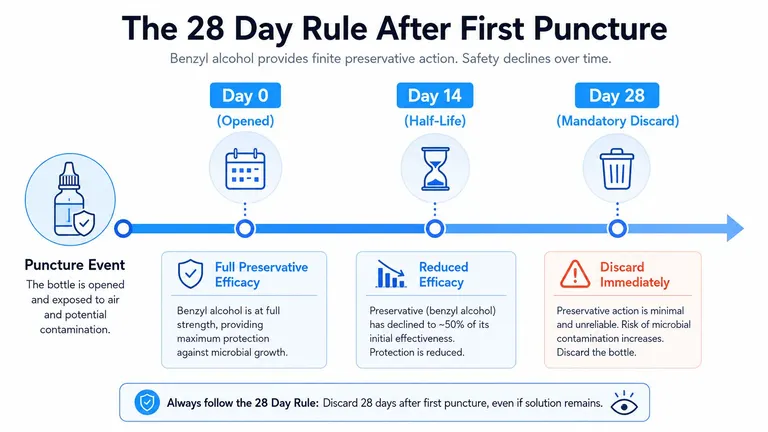
The printed expiration date and the 28-day in-use window govern different stages. The expiration date applies while the vial remains sealed. The in-use window begins with the first needle entry into the stopper, even if the vial still looks clear and the printed date is months away. Product labeling requires the remaining solution to be discarded after that period.
Benzyl alcohol lowers the risk from limited repeated entry, but it does not make contamination impossible. Microorganisms can enter through a puncture, cling to a needle, or reach the stopper during handling. A vial that is nearly full therefore does not receive extra time. Each access creates another opportunity for contamination.
A simple dating workflow
- Identify day zero. Treat the first puncture as the opening event, whether you withdrew a small amount or used the vial during a larger preparation.
- Mark the vial immediately. Write the opening date on the label with a permanent marker, or place the vial in a clearly dated holder.
- Calculate the discard date. Count 28 calendar days from first use. Do not start over when you prepare a later mixture.
- Use the earlier deadline. If the manufacturer’s expiration arrives first, follow that printed expiration.
- Discard on schedule. Refrigeration, remaining volume, and clear appearance do not extend the in-use period.
The same habit applies to other stored materials, although their rules differ. For comparison, this resource on extend dried mushroom shelf life discusses preservation principles for dried goods, not sterile liquids.
What does not change the deadline
A multi-dose vial does not gain time because it has been entered only a few times. Refrigeration may reduce risk between uses, but it does not reset or extend the labeled in-use period. Reconstituted medications or peptides have separate, product-specific stability instructions. A bacteriostatic water reconstitution guide can clarify the preparation steps, but it cannot replace the medication label or professional instructions.
Single-dose products belong to a different category. A sterile liquid in a single-dose container should not be managed like bacteriostatic water in a multi-dose vial.
Storage Conditions That Change the Risk
The calendar rule gives you a discard date, but handling conditions influence what happens before that date. Guidance commonly frames opened bacteriostatic water as a refrigerated product at 2 to 8°C, while unopened storage follows the product’s own label. Refrigeration slows microbial proliferation, but it doesn’t stop it or create permission to reuse a vial indefinitely (Peptide Mind outlines refrigeration and handling priorities).
Four variables matter together
Temperature affects the pace at which contaminants can multiply. A vial that repeatedly sits out of its recommended storage environment faces a different risk profile from one returned promptly to consistent refrigeration.
Light exposure is another reason to use the original carton, a cabinet, or a dark storage area. Protecting the vial from unnecessary light helps preserve the product environment, but light protection still doesn’t override the 28-day discard rule.
Puncture hygiene matters because every entry interacts with the stopper and the contents. A clean-looking stopper isn’t proof that every withdrawal was aseptic.
Ambient cleanliness matters around the vial, needle, and preparation surface. Home environments don’t provide the controlled conditions of a professional sterile workspace, so reducing clutter and unnecessary handling is sensible risk reduction.
| Variable | Lower Risk | Higher Risk |
|---|---|---|
| Temperature | Consistent storage within the product’s stated range | Repeated or prolonged excursions outside the stated range |
| Light | Original packaging, drawer, or cabinet | Direct sunlight or unnecessary prolonged exposure |
| Punctures | Fewer entries with a new sterile needle each time | Frequent entries or contact with nonsterile surfaces |
| Surroundings | Clean, organized preparation area | Clutter, dust, moisture, or avoidable handling |
Temperature logging can be useful where storage conditions are difficult to verify. An MSP Packaging temp monitoring guide explains the role of data loggers in monitoring temperature-sensitive storage environments.
The risk variables aren’t independent switches. A refrigerated vial with minimal handling sits in a more controlled position than a vial that is repeatedly punctured, exposed to light, and left out. Neither scenario changes the labeled discard date, but the second deserves less confidence and may justify earlier disposal if storage conditions were compromised.
For related peptide-storage considerations, see how to store reconstituted peptides. The prepared medication may have constraints that don’t match the water alone.
Handling Myths and Real World Tradeoffs
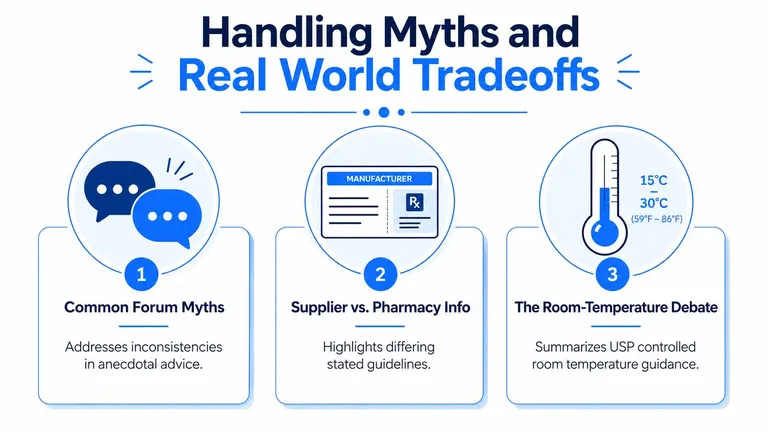
Readers often encounter conflicting advice about room temperature, refrigeration, and the number of times a vial may be entered. Some pages treat refrigeration as mandatory, while others describe room-temperature storage as acceptable under particular labeling or handling conditions. That conflict exists because product instructions and general vial-handling practices aren’t always presented in the same way.
The conservative decision is to follow the actual product label first. Where the label doesn’t resolve the question, refrigeration between uses is a reasonable risk-reduction choice, but it doesn’t lengthen the opened-vial window.
The room-temperature debate
The key distinction is between storage condition and in-use duration. A product may have a labeled storage range for an unopened vial, while stricter operational guidance recommends refrigeration after puncture. Those instructions shouldn’t be blended into a single universal rule.
If a punctured vial has been left out, don’t try to convert time at room temperature into extra days in the refrigerator. Return it to the appropriate storage condition if the label permits continued use, document what happened, and seek pharmacist or manufacturer guidance when the excursion was substantial or uncertain.
Puncture count isn’t a safe extension formula
Some online discussions claim that a lightly used vial can last longer, while other guidance repeats a flat 28-day limit regardless of remaining volume or entry count. There isn’t enough practical contamination data in the supplied guidance to turn puncture count into a reliable extension formula. The defensible rule is to minimize entries, not to use a low count as permission to exceed the discard date.
Before each entry:
- Prepare cleanly: Use a clean work area and avoid placing sterile components on questionable surfaces.
- Use a new needle: Never reuse a needle or allow it to contact another surface before entry.
- Disinfect the stopper: Swab it with 70% isopropyl alcohol and allow it to dry before the needle touches it.
- Avoid back-contamination: Don’t let the needle contact skin, clothing, countertops, or another container.
- Return the vial promptly: Put it back in its designated storage location after the withdrawal.
These steps lower risk, but they don’t eliminate it. A vial without a reliable first-puncture date, or one that has crossed the 28-day boundary, should be replaced rather than rationalized.
Warning Signs a Vial Has Gone Bad
The printed expiration date and the opened-vial window are limits, not guarantees of acceptable condition. A vial can become questionable earlier if the stopper, seal, glass, or solution is compromised. Visual clarity is helpful, but it isn’t a laboratory test for sterility.
Inspect the solution
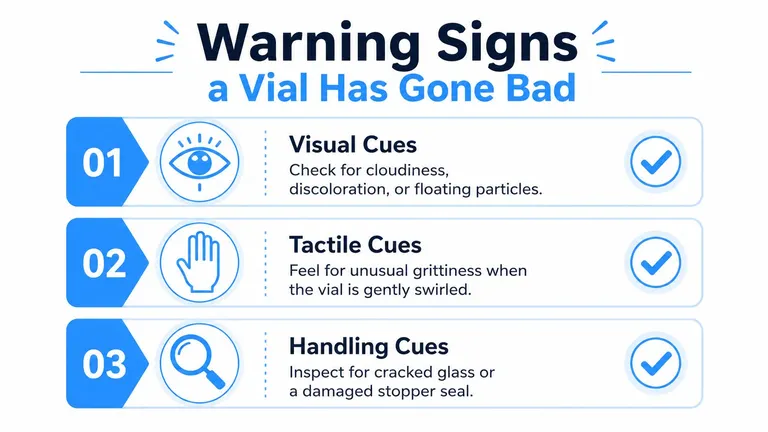
The expected appearance is clear and free of visible foreign material. Stop using the vial if you see:
- Cloudiness or haze: A clear liquid that becomes cloudy or turbid has changed.
- Floating particles: Fibers, fragments, or suspended material make the vial unsuitable.
- Unusual swirls or sediment: Movement that reveals material in the solution isn’t normal.
- Discoloration: A change from clear to yellow-tinted or another unexpected color is a discard signal.
- Visible growth: Any mold-like fragment or film means the vial should be retired immediately.
Don’t try to filter, shake, or “clear” a questionable vial. Appearance can’t tell you whether contamination is harmless.
Check the container and handling history
The vial itself also provides warning signs. Look for cracks, a loose crimp, a damaged flip-off cap, or a stopper that feels tacky or has unusual residue. If the container’s sterile barrier looks compromised, the contents shouldn’t be used.
Handling cues deserve equal attention. Resistance during withdrawal, an unusual odor, or evidence that the vial experienced damaging storage conditions should prompt disposal. The supplied guidance doesn’t establish a universal visual test that can prove safety, so uncertainty is itself a reason to stop.
When one red flag appears, don’t negotiate with it. Set the vial aside, follow your local disposal procedure, and replace it with a properly dated container.
Don’t open a vial to smell it, and don’t deliberately manipulate the stopper to test its condition. Inspection should happen before use, with minimal handling.
A Simple Routine for Every Vial You Own
A reliable vial routine needs two dates and one override. Keep the manufacturer’s expiration date for the sealed vial, then record the first puncture date when active use begins. The earlier deadline always wins. Any visible problem takes priority over both dates.
Build the record before use
When a vial arrives, check its label, carton, seal, and solution. Record the printed expiration date in an inventory list or tracking note. If you store several vials, arrange them so the one expiring soonest is easy to identify.
| Record | What to write |
|---|---|
| Product identity | Product name and lot details shown on the label |
| Manufacturer expiration | The printed expiration date |
| First puncture | The date the stopper was first entered |
| Discard-by date | The date calculated from the first puncture |
| Condition check | Clear solution, intact container, no visible warning signs |
The vial becomes opened when a needle first breaches the stopper, not when you remove the outer packaging. That small distinction keeps a sealed vial from being discarded too early and prevents a punctured vial from being kept beyond its use window.
Use the routine every time
- Before the first draw, confirm the printed expiration date and the product’s storage instructions.
- At first puncture, write the opening date immediately. This starts the separate in-use clock.
- During storage, keep the punctured vial in one consistent location, protected from light and stored as directed. A conservative opened-vial workflow uses refrigeration between 2 and 8°C, as described by Bac Water Catalog.
- Before every later draw, inspect the solution and container, confirm the discard date, and use clean handling.
- At the deadline, discard the remaining solution, even if considerable liquid remains.
The routine should still work when you are tired or distracted. Missing the opening date, uncertainty about storage, or any warning sign means the vial should not be stretched past its known limits.
Personal rule: When in doubt, throw it out. Replacing a vial costs less than dealing with a compromised preparation.
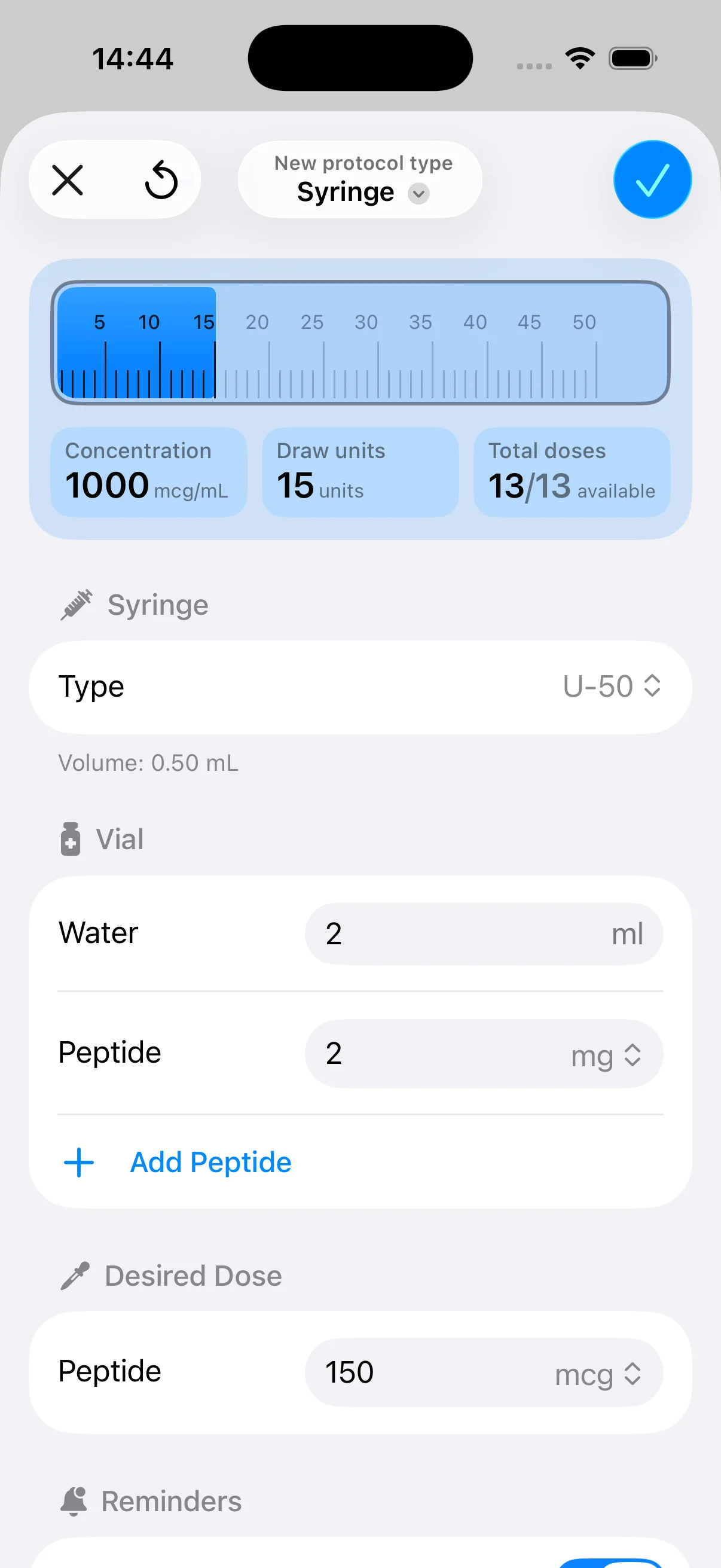
PepFlow helps organize peptide schedules, dose calculations, reminders, and preparation-related records. Its tools can keep vial dates alongside an established routine. Visit PepFlow to see how its calculator and tracking features may support consistent day-to-day planning.