You’ve entered a target amount into a BPC 157 dosage calculator, selected a syringe, and received a number of units to draw. The result looks precise, but one question remains: does that number represent a medically established dose, or only accurate syringe math?
That distinction matters. A calculator can convert a selected amount of peptide into milliliters and U-100 syringe units, but it can’t establish whether the selected amount is appropriate, safe, or supported by adequate human research. The most reliable workflow separates those two questions from the start: first verify the evidence and medical context, then perform the arithmetic carefully.
Table of Contents
- What a BPC 157 Dosage Calculator Actually Does and Does Not Do
- Understanding Core Units and Conversions for BPC 157
- Preparing Your Vial Concentration Without Math Errors
- Worked Examples for Common BPC 157 Dosing Scenarios
- Automating Calculations and Protocols With PepFlow
- Troubleshooting Mistakes and Staying Within Safe Boundaries
What a BPC 157 Dosage Calculator Actually Does and Does Not Do
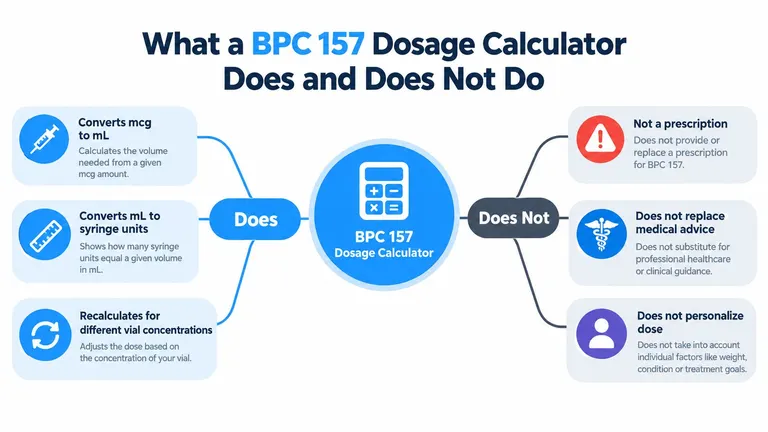
A BPC 157 dosage calculator is a conversion tool, not a prescription generator. It takes inputs such as the peptide amount in a vial, the final liquid volume, and a chosen target amount, then calculates concentration and injection volume. If you’re using a U-100 syringe, it can also translate that volume into syringe units.
It doesn’t decide whether BPC-157 should be used, which administration route is appropriate, or whether a particular target amount has been established for humans. Those decisions require clinical judgment, product verification, and an understanding of the unusually limited evidence base.
Arithmetic accuracy is not evidence quality
An independent 2025 review identified only three pilot human studies, involving intra-articular knee pain, interstitial cystitis, and intravenous safety or pharmacokinetics, and concluded that BPC-157 shouldn’t be recommended for musculoskeletal clinical use until better trials are published. The review also stated that the compound hasn’t reached the evidence threshold normally expected for routine clinical adoption. Read the review of the human evidence base.
That leaves online dosage discussions resting largely on small pilot studies, preclinical research, and secondary protocol language rather than a large body of human pharmacology data. As a result, there is no universally accepted therapeutic dose, no FDA-approved indication, and no late-stage human development program providing an authoritative dosing standard.
A calculator can still prevent a mathematical mistake. It can’t turn an uncertain research target into a validated treatment dose.
Regulatory status changes how you interpret every result
The FDA’s information on BPC-157 as a bulk drug substance says the agency has limited or no safety-related information for proposed routes of administration and lacks enough information to know whether the substance could cause harm in humans. The same regulatory history includes a clinical trial registration under the name Bepecin in 2015, but that registration didn’t create an approved use.
Athletes face an additional issue. The World Anti-Doping Agency’s prohibited-substance framework places BPC-157 in S0 Non-Approved Substances, meaning it is prohibited at all times under WADA rules.
For a plain-language explanation of peptide conversion workflows, the Peptoro dosage calculator guide can help with the arithmetic side. Readers interested in the compound’s proposed research context should keep that separate from the calculator output, such as when reviewing discussion of BPC-157 for wound healing.
Practical rule: Treat the calculator’s answer as “this is the volume that matches the inputs,” not “this is the dose I should take.”
Understanding Core Units and Conversions for BPC 157
Most errors begin before a syringe is filled. Users confuse mass, which describes how much peptide is present, with volume, which describes how much liquid is drawn. The syringe marks show volume, not the amount of BPC-157 itself.
Keep mass and volume separate
Use these terms consistently:
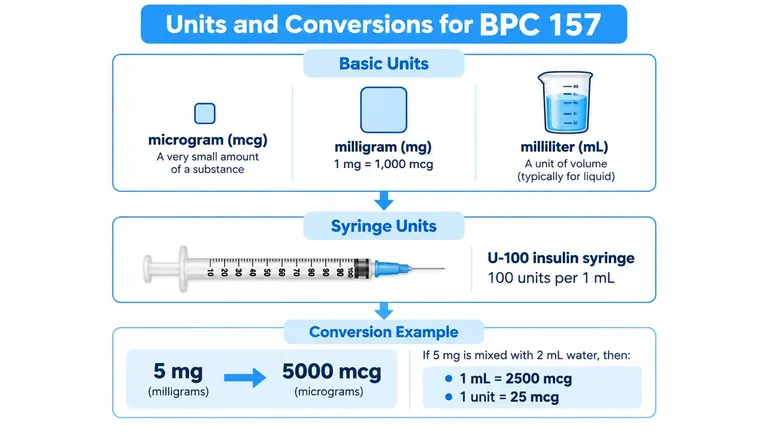
- Microgram, or mcg: A small unit of peptide mass.
- Milligram, or mg: A larger unit of mass. 1 mg equals 1,000 mcg.
- Milliliter, or mL: A unit of liquid volume.
- U-100 syringe unit: A volume marking on an insulin syringe. A U-100 syringe contains 100 units per 1 mL, so one unit represents a volume fraction, not a fixed BPC-157 mass.
That last point causes many avoidable mistakes. A syringe unit doesn’t always equal the same number of micrograms. The microgram amount per unit changes whenever the concentration changes.
The two formulas that control the calculation
First calculate concentration:
Concentration, mcg/mL = total peptide, mcg ÷ final liquid volume, mL
Then calculate the volume needed for a selected target:
Injection volume, mL = desired amount, mcg ÷ concentration, mcg/mL
For a U-100 syringe, convert the result into units:
Syringe units = injection volume, mL × 100
A research-oriented dosing guide describes a commonly used concentration of 500 mcg/mL. At that concentration, a 250 mcg target corresponds to 0.5 mL, which equals 50 U-100 units. That example demonstrates the arithmetic only. It isn’t a recommendation for a human dose. Review the concentration and conversion workflow.
The same target could require a very different syringe draw if the vial were diluted differently. That’s why entering only a target amount into a calculator isn’t enough. You also need the actual vial quantity and final concentration.
For another explanation of the relationship between mass and liquid volume, see this guide to converting mcg to mL.
A syringe unit is not a dose. It’s a volume marker whose peptide content depends on concentration.
Preparing Your Vial Concentration Without Math Errors
The calculator can only be as accurate as the concentration you enter. If the vial contains a different amount than expected, or if the final liquid volume is misread, every later unit conversion will be wrong even if the formula is flawless.
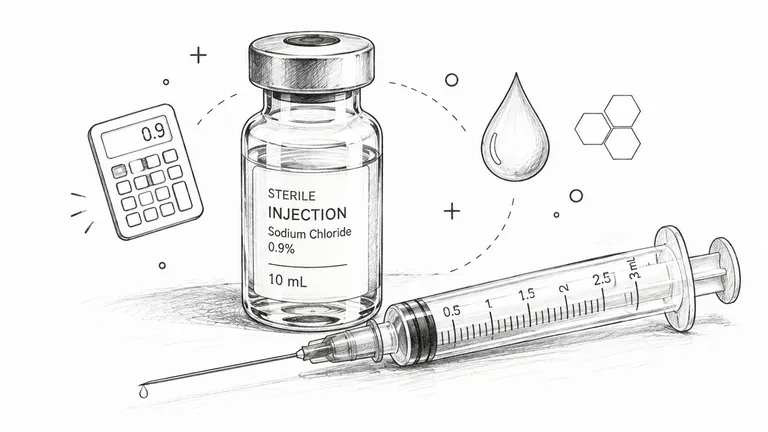
Reconstitution also involves sterile technique and product-specific handling. Follow instructions from a qualified clinician or legitimate dispensing source for the correct diluent, storage conditions, handling time, and administration method. Don’t treat a generic internet workflow as a substitute for those instructions.
Establish the concentration before selecting a target
Start with the amount printed on the vial. Convert milligrams to micrograms before doing any division. For example, 5 mg equals 5,000 mcg.
Next, decide the final liquid volume only within the limits of the product instructions and professional guidance. The concentration formula is straightforward:
5,000 mcg ÷ final volume in mL = concentration in mcg/mL
If the final volume is 2 mL, the concentration is 2,500 mcg/mL. If the final volume is 4 mL, the concentration is 1,250 mcg/mL. A smaller dilution produces a more concentrated solution, while a larger dilution produces a weaker solution.
A research guide describes 500 mcg/mL as a practical concentration used in some research workflows because it makes the arithmetic easy to check. At that concentration, a 250 mcg target would be 0.5 mL. Again, this is a concentration example, not an instruction to use that target or route.
Understand how dilution affects measurement
The same target amount can become easier or harder to measure depending on the chosen concentration. A very concentrated solution may require a small draw that is difficult to read accurately on a syringe. A more dilute solution may create a larger draw, but it also changes how much liquid is introduced.
Neutral calculator guidance highlights the effect of mixing a vial with 1 mL, 2 mL, or 4 mL of bacteriostatic water. The target mass stays the same, but the U-100 draw changes because the concentration changes. See the dilution and syringe-precision discussion.
Before using the vial, write down:
- The labeled peptide amount in mg and its equivalent in mcg.
- The final liquid volume.
- The resulting concentration in mcg/mL.
- The date and any handling instructions supplied by the dispensing source.
- The intended syringe type, if a specific device has been recommended.
Before you calculate a draw, calculate and record the concentration.
Preclinical work also shows why the vehicle and final delivered concentration matter. In one administration workflow, researchers diluted a concentrated stock in 0.9% sodium chloride before dosing. That preparation detail doesn’t establish a home-use method, but it illustrates why the nominal amount alone never tells the whole story.
Worked Examples for Common BPC 157 Dosing Scenarios
The following examples show how to reproduce the arithmetic. They don’t endorse a target amount, injection route, frequency, or treatment plan. The selected target is used only to demonstrate how a single mass translates into different volumes.
Example one with a 500 mcg per mL concentration
Assume a vial has been prepared to a final concentration of 500 mcg/mL, and the selected research target for the calculation is 250 mcg.
First determine the liquid volume:
250 mcg ÷ 500 mcg/mL = 0.5 mL
Then convert the liquid volume to U-100 syringe units:
0.5 mL × 100 = 50 units
The answer is therefore 0.5 mL, or 50 U-100 units, based on those inputs. It doesn’t mean that 250 mcg is an established human dose. It means that the chosen target amount is present in that calculated liquid volume.
Example two with a more concentrated preparation
Now use a concentration of 2,500 mcg/mL, such as the concentration produced when 5 mg is combined to a final volume of 2 mL.
For the same 250 mcg target:
250 mcg ÷ 2,500 mcg/mL = 0.1 mL
On a U-100 syringe:
0.1 mL × 100 = 10 units
The target mass hasn’t changed. The draw has changed from 50 units to 10 units because the solution is more concentrated. That difference is the central reason users should never copy syringe units from another person’s vial setup.
| Reconstitution Volume | Concentration mcg per mL | Volume for 250 mcg | U-100 Units |
|---|---|---|---|
| 1 mL | Depends on vial amount | 250 ÷ concentration | Volume × 100 |
| 2 mL | Depends on vial amount | 250 ÷ concentration | Volume × 100 |
| 4 mL | Depends on vial amount | 250 ÷ concentration | Volume × 100 |
The table intentionally leaves concentration dependent on the vial amount. Reconstitution volume alone isn’t enough to calculate a draw. A 1 mL dilution of one vial size won’t match a 1 mL dilution of another.
A quick verification routine
Do the calculation in both directions. If your result says 0.1 mL, multiply the concentration by 0.1 mL and confirm that the result returns 250 mcg. Then multiply 0.1 mL by 100 to verify the syringe units.
Don’t round a result merely to make it look convenient. If the calculated draw is too small for the syringe’s markings to measure reliably, pause and ask a qualified professional whether the concentration or equipment is appropriate. Changing the concentration changes the measurement, but it doesn’t resolve the underlying question of whether the target itself is justified.
Automating Calculations and Protocols With PepFlow
Manual math is useful because it lets you audit an answer. Automation becomes useful after the inputs have been verified, especially when a protocol involves changing dates, recurring reminders, or multiple concentration setups.
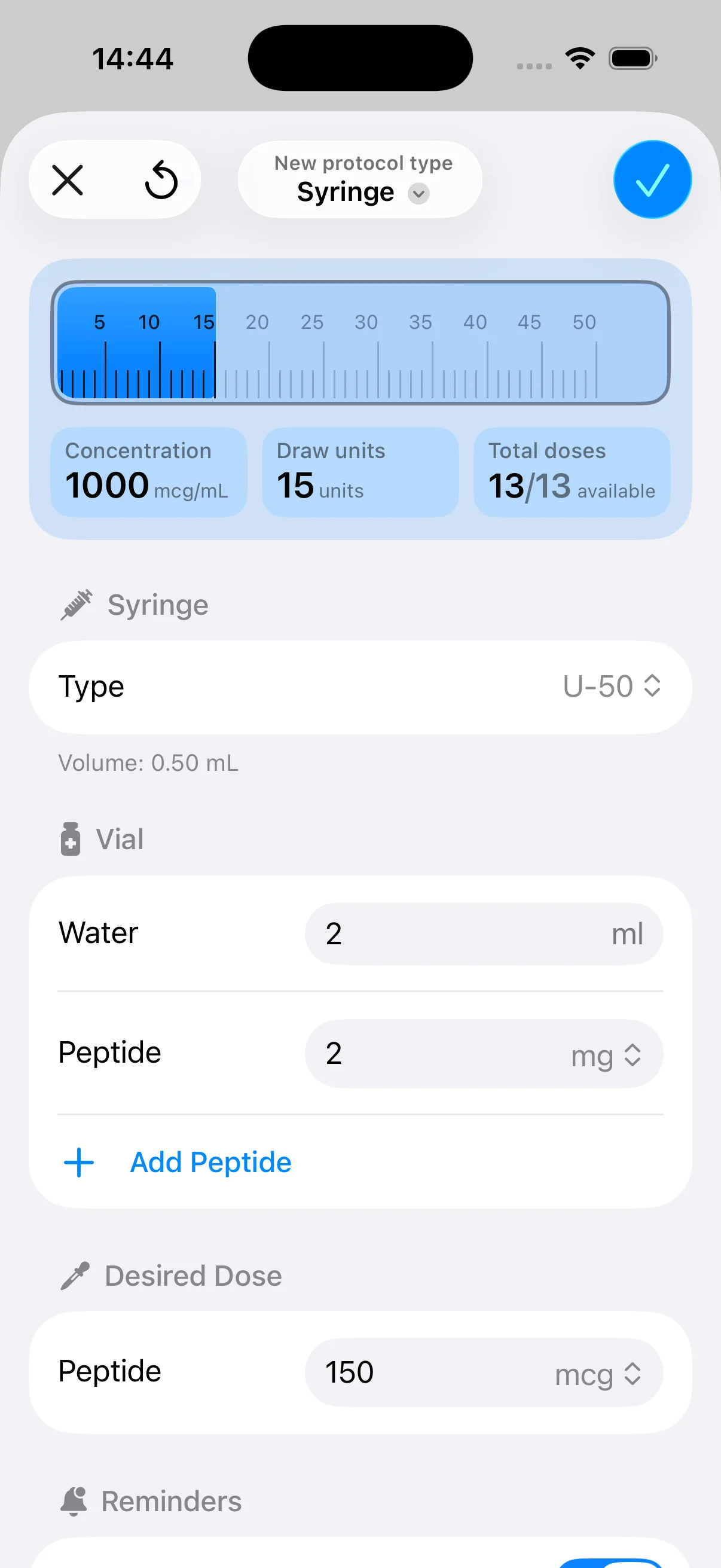
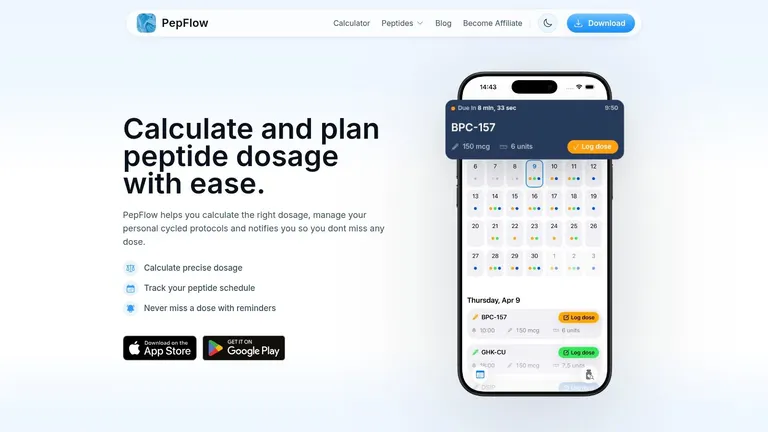
PepFlow is an iOS planning app that supports a peptide dosage calculator workflow. Users can select a syringe type, enter the vial amount, specify the target amount, and review the resulting concentration and syringe pull. That makes it possible to compare a manually checked calculation with the app’s output rather than treating the app as an authority on medical dosing.
Use automation after checking the inputs
A reliable entry sequence is:
- Vial amount: Enter the labeled peptide quantity, then confirm the mg-to-mcg conversion.
- Final volume: Enter the actual final liquid volume, not the amount you intended to add if the final volume differs.
- Target amount: Enter only a target selected through appropriate professional or research guidance.
- Syringe type: Confirm that the selected syringe scale matches the device you’ll use.
- Result review: Compare the displayed volume and units with a hand calculation.
The app can reduce transcription work, but incorrect inputs still produce incorrect outputs. A calculator shouldn’t conceal uncertainty. It should make assumptions visible, including concentration, target mass, and syringe scale.
For users who need more than one conversion, a dedicated peptide calculator app workflow can place the calculation beside scheduling and dose logging.
Move from arithmetic to routine management
PepFlow also supports cycled protocols with start dates, dosing frequencies, pause periods, reminders, countdowns, widgets, live activities, and dose logs. Those functions address a different problem from concentration math: maintaining a consistent record of what was planned and what was logged.
That separation is valuable. The calculator handles conversion, while the protocol tools handle organization and adherence. Neither feature determines whether BPC-157 is appropriate for an individual, verifies product sterility, or supplies medical advice.
Double-check the first result manually. Once the vial amount, concentration, and syringe type are confirmed, automation can help prevent repeated re-entry errors.
Troubleshooting Mistakes and Staying Within Safe Boundaries
The most common failure isn’t difficult arithmetic. It’s using correct arithmetic with incorrect inputs. A user may remember a syringe draw from another vial, enter milligrams where micrograms are expected, or read a U-100 mark as though it were a fixed peptide amount.
Start by checking the label and concentration record. Then check the calculator’s units. If the vial amount is in mg but the target is in mcg, convert the vial amount before calculating. Finally, confirm that the result is expressed in the same syringe scale as the device in hand.
Diagnose the calculation before changing it
Use this short audit:
- Wrong vial concentration: Recalculate total mcg divided by final mL.
- mg and mcg confusion: Remember that 1 mg equals 1,000 mcg.
- Incorrect syringe scale: Confirm whether the device is U-100 before converting mL into units.
- Unexpectedly tiny draw: Ask whether the solution is too concentrated for the available markings.
- Copied animal regimen: Stop. Animal findings can’t be transferred directly to humans.
Preclinical evidence is broad but inconsistent in a way that prevents a universal human rule. One summary describes a commonly reported systemic rodent regimen of about 10 mcg/kg/day, while other animal studies used 10 ng/kg or lower amounts. The same source describes route-specific testing in rats and dogs at 20 mcg/kg IV, 20, 100, and 500 mcg/kg IM, and repeated daily IM dosing. These figures demonstrate variation across species, routes, and models, not a human dosing chart. Review the preclinical dose range and route context.
A recent dog safety evaluation found repeated dosing was well tolerated in that model, with no abnormal group differences versus solvent control except a creatinine decrease at 2 mg/kg. That result still doesn’t establish human safety or a therapeutic dose.
Know when the calculator should stop
The FDA has stated that BPC-157 has limited or no safety-related information for proposed routes and insufficient information to determine whether it could harm humans. BPC-157 also appears in WADA’s S0 Non-Approved Substances category, so competitive athletes subject to WADA rules must treat it as prohibited.
Stop and seek qualified medical guidance if you’re unsure about the product identity, sterility, route, concentration, syringe markings, or whether symptoms could reflect an adverse reaction. A calculator is suitable for research planning and educational arithmetic only. It doesn’t approve the substance, personalize treatment, or replace a clinician’s assessment.
PepFlow gives you a place to check vial concentration, convert a selected microgram amount into syringe volume, and organize reminders and dose logs without repeating the same manual steps. Visit PepFlow to explore its calculation and scheduling tools, then verify every target and handling decision with a qualified healthcare professional.