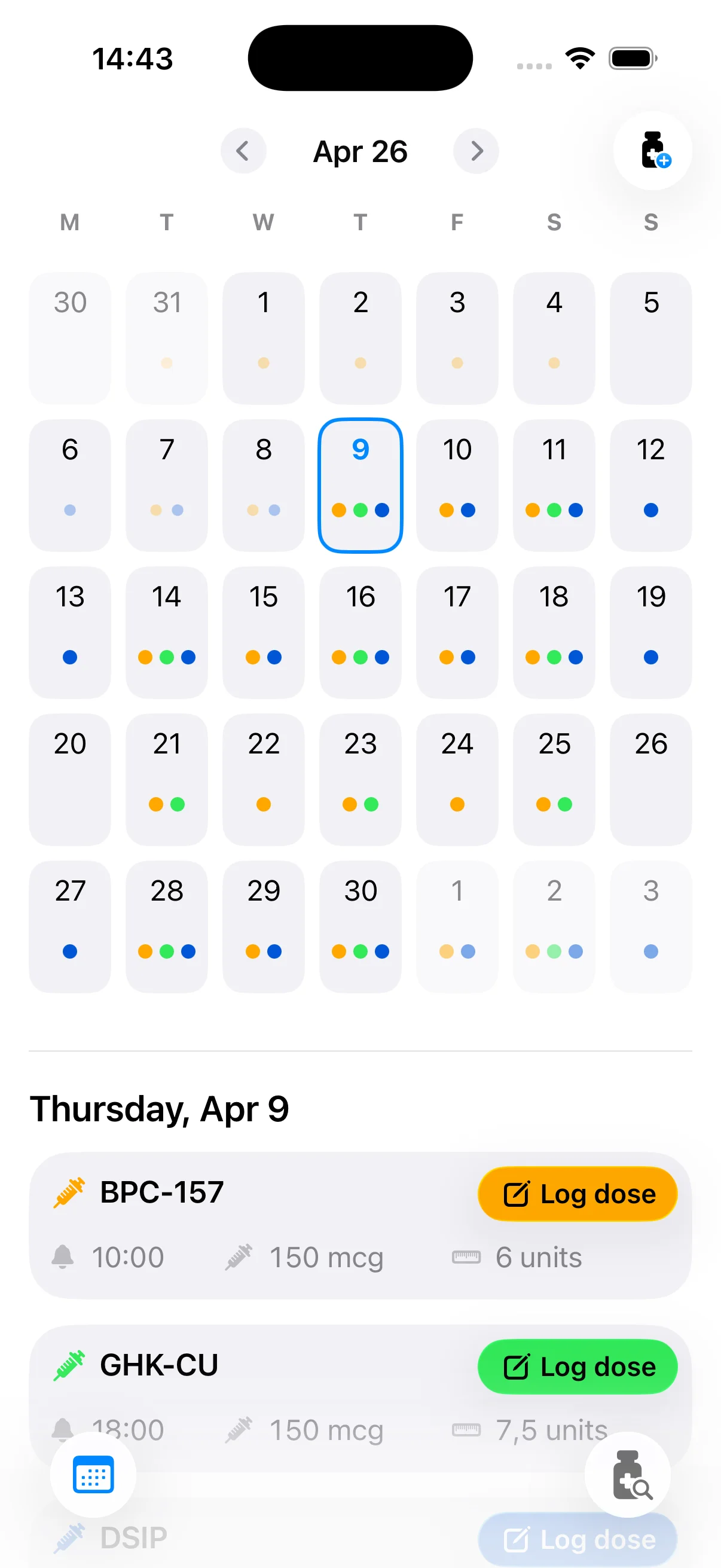
BPC-157 dosage chart
This summary table compares BPC-157 amounts per administration, frequency, and duration by route. The injectable range describes common practice; the oral row describes a specific tablet formulation, and the topical row describes an experimental mouse cream. Read the route sections for schedule details and daily totals.
| Route | Dose | Frequency & duration |
|---|---|---|
| Injectable | 250–500 mcg | 1–2x daily · 4–8 wk |
| Oral | 3 mg | 3 times daily · 14 days |
| Topical | 1 mcg/g cream (mouse experiment) | Once daily · Observations through 21 days |
BPC-157 dosage by administration route
BPC-157 injection dosage
Commonly reported injection protocols use 250–500 mcg per dose, 1–2x daily, for 4–8 wk. Once-daily schedules use one administration; twice-daily schedules separate morning and evening administrations. An alternative reported subcutaneous schedule uses 200 mcg daily in weeks 1–2, 400 mcg daily in weeks 3–4, and 600 mcg daily from week 5. An alternative schedule uses an 8–16-week course; this is separate from the fixed-dose pattern above.
Subcutaneous BPC-157 is given beneath the skin. BPC-157 may support tendon, muscle and ligament repair. [4][13][5][6][11]
Oral BPC-157 dosage
For the oral tablet formulation, the documented schedule is 3 mg every eight hours (3 times daily) for 14 days, totaling 9 mg per day.
Oral BPC-157 may support protection and repair of the stomach and intestinal lining. [1][7]
Topical BPC-157 dosage
The experimental burn-wound cream contains 1 mcg of BPC-157 per gram and is applied once daily, with observations through 21 days. This mouse preparation specifies a concentration, not a quantified amount of cream per application or a human topical regimen.
Topical BPC-157 may support local skin and wound repair. [8][9]
Frequency and timing
Once-daily schedules use a morning or evening administration; twice-daily schedules separate morning and evening administrations. The oral tablet schedule uses an eight-hour interval.
| Amount per administration | Administrations per day | Daily total |
|---|---|---|
| 250 mcg | Once daily | 250 mcg |
| 250 mcg | Twice daily | 500 mcg |
BPC-157 dosage calculator
Convert a chosen BPC-157 amount in mcg or mg into mL and U-100 syringe units. Enter the peptide vial amount, final solution volume, and desired dose; add the daily frequency to calculate daily totals and vial supply.
For preparation terminology and concentration basics, see the reconstitution guidelines. Follow the arithmetic in the BPC-157 calculation walkthrough.
BPC-157 safety and side effects
Approval and product quality
BPC-157 is not FDA-approved. Compounded BPC-157 products may pose risks from immune reactions, peptide impurities and uncertain ingredient quality. [12][10]
Side effects and long-term safety
Human healing benefits remain unproven. Side-effect frequency and long-term safety are unknown, including with repeated cycles. [3][10][5][6][7][8]
Route-specific dosing limits
The oral schedule is formulation-specific. A human topical dose or treatment duration has not been established. [1][8][9]
Discuss treatment decisions with a qualified healthcare professional.
Stacks that include BPC-157
These library references describe the components and evidence behind each named stack. A stack name does not specify a vial formula or a dose.
GLOW is a three-component recovery and skin-matrix stack built around BPC-157, TB-500, and GHK-Cu. It is used to frame soft-tissue repair, cell migration, collagen and extracellular-matrix remodeling, and post-procedure skin-support discussions.
KLOW is a four-component recovery, skin, and inflammation-support stack built around BPC-157, TB-500, GHK-Cu, and KPV. It is used to frame tissue repair, cell migration, skin-matrix remodeling, gut or barrier inflammation, and post-procedure support in one plan.
The Wolverine Stack is a two-component repair and mobility stack built around BPC-157 and TB-500. BPC-157 supplies the localized repair and cytoprotection rationale, while TB-500 supplies the thymosin beta-4-derived cell-migration and wound-healing rationale. The exact combination lacks controlled human outcome trials.
For a blend calculation, each component's amount and the final volume must be known. A total blend weight alone cannot tell you the dose of each component.
Common BPC-157 dosage questions
Should BPC-157 be taken once or twice daily?
How long is a BPC-157 cycle, and how long should a break be?
Should BPC-157 dosage be calculated by body weight?
The reviewed evidence does not establish a weight-based human dosing rule for the routes covered here. A body-weight table cannot supply a validated personal dose, and animal mg/kg amounts cannot be directly converted into a human protocol. [12]
What is the maximum safe BPC-157 dose?
A maximum safe human dose has not been established. The upper end of a commonly reported range is not a proven safety ceiling. Higher amounts have not been established as more effective, and small, short studies cannot establish long-term safety. [12]
How many syringe units equal 250 mcg?
With 5 mg in 2 mL, 250 mcg equals 0.1 mL, or 10 units on a U-100 syringe. Changing the concentration changes the marking; use the calculator above for different inputs.
Sources
Show citationsHide citations
For the wider research bibliography, mechanisms, and route-specific regulatory notes, read the BPC-157 library entry.