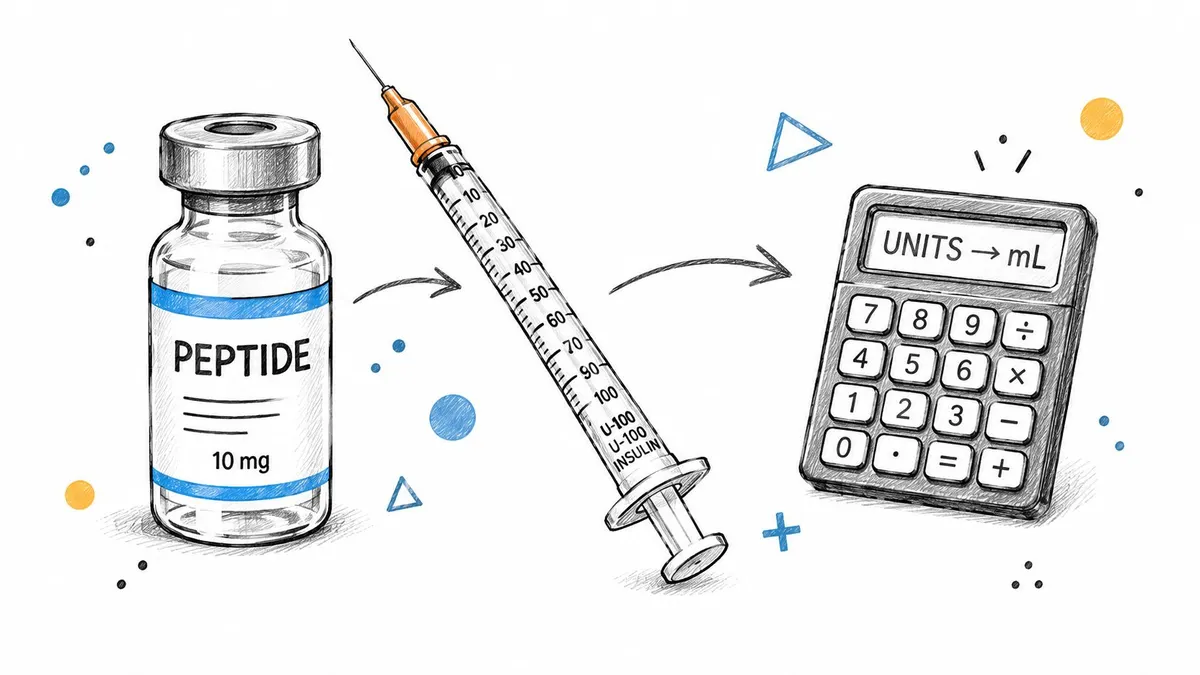
You’re standing at a clean counter with a 5 mg peptide vial in one hand and a U-100 insulin syringe in the other. The label gives you a dose in micrograms, the syringe gives you “units,” and the liquid itself needs to be measured in milliliters. The arithmetic looks easy until the numbers on the barrel and the numbers on the vial start speaking different languages.
That’s the moment when a simple units to mL conversion can go wrong. The safest approach is context first, math second. Identify the syringe, confirm what “unit” means, check the vial concentration, and only then calculate the volume.
Table of Contents
- Why Units to mL Conversion Trips People Up
- What a Unit Actually Means in This Context
- The Core Formula and Two Worked Examples
- Matching the Formula to Your Syringe Type
- Automating the Math with PepFlow
- Common Pitfalls and Quick Fixes
- Building a Consistent Dosing Routine
Why Units to mL Conversion Trips People Up
The word unit does double duty in medication preparation. On one syringe, it may refer to volume markings. On a vial or medication label, it may describe biological potency or the labeled amount of a drug. Those meanings aren’t interchangeable, even when the same word appears in both places.
A U-100 syringe is the familiar example. Its scale is based on 100 units per 1 mL, so 1 unit equals 0.01 mL. That relationship is useful, but it belongs to that syringe scale. It isn’t a universal definition of a unit.
The danger becomes obvious when someone treats a U-500 setup like a U-100 setup. FDA labeling warns users not to perform U-100-style dose conversions with U-500 insulin because the markings represent U-500 insulin units. Using the wrong syringe can create a fivefold dosing difference. That error can happen in the few seconds it takes to glance at a barrel, assume the scale, and draw.

Practical rule: Never ask “How many mL is this many units?” until you know what type of units you’re looking at.
Start by checking three items:
- The syringe barrel: Look for U-40, U-100, U-500, or a plain mL scale.
- The medication label: Confirm whether the dose is expressed in mg, mcg, IU, or another labeled unit.
- The vial concentration: Know how much active substance is present in each mL after preparation.
A useful primer on what unit conversion means in practice can help clarify the distinction before you begin. For broader medication and pharmacy context, find pharmacy facts for US shoppers is also a useful resource.
What a Unit Actually Means in This Context
Before you touch a calculator, name the kind of unit you’re converting. In peptide dosing, the term usually falls into one of three categories.
Syringe volume units are the tick marks printed on an insulin syringe barrel. Hold the syringe up and inspect the scale. If it says U-100, the markings express a volume relationship based on 100 units per mL. These units tell you where to position the plunger, not how much peptide is present in the liquid.
Insulin biological units describe potency. The U-40, U-100, and U-500 designations identify different concentration systems. They are not three visual styles for the same measurement. The same number printed on different syringe systems can represent different physical volumes and different medication amounts.
Labeled dose units come from the medication itself. A vial may state a dose in milligrams, micrograms, or another unit used by the product label. A milligram measures mass, while a milliliter measures liquid volume. You need the vial concentration to connect the two.
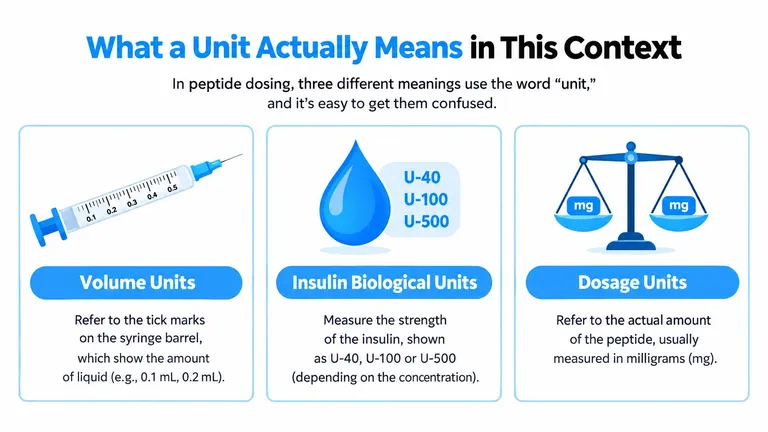
A physical check helps. The syringe shows where to draw. The vial tells you what is in the liquid. Your dosing plan tells you how much active substance you intend to use. Those are three separate pieces of information.
For readers learning to work with very small quantities, these microdosing measurement basics provide useful background on mass units. The one-sentence rule is simple: before applying any formula, state which unit you’re converting from and what it represents.
The Core Formula and Two Worked Examples
For a U-100 insulin syringe, the basic volume relationship is:
mL = syringe units ÷ 100
So, on this specific syringe scale, 10 units corresponds to 0.10 mL, and 20 units corresponds to 0.20 mL. The formula only converts the syringe marking to liquid volume. It doesn’t calculate the peptide dose by itself.
The full chain is:
- Convert the vial amount into micrograms.
- Divide by the added liquid volume to find micrograms per mL.
- Divide the target microgram dose by the concentration.
- Convert the resulting mL into U-100 syringe units.
- Confirm that the calculated fill line is practical for the syringe.
Example one
Take a 5 mg vial prepared with 2 mL of diluent.
- Convert the vial amount: 5 mg equals 5,000 mcg.
- Find concentration: 5,000 mcg ÷ 2 mL = 2,500 mcg/mL.
- Set the target: 250 mcg.
- Find volume: 250 mcg ÷ 2,500 mcg/mL = 0.10 mL.
- Convert for U-100: 0.10 mL × 100 = 10 units.
The final reading is 10 units, or 0.10 mL, on a U-100 syringe.
Example two
Now use a 10 mg vial prepared with 3 mL of diluent.
- Convert the vial amount: 10 mg equals 10,000 mcg.
- Find concentration: 10,000 mcg ÷ 3 mL = approximately 3,333 mcg/mL.
- Set the target: 500 mcg.
- Find volume: 500 mcg ÷ approximately 3,333 mcg/mL = approximately 0.15 mL.
- Convert for U-100: 0.15 mL × 100 = 15 units.
That gives approximately 15 units, or 0.15 mL, on a U-100 barrel. Because the concentration is rounded, the result is also rounded. Keep the original vial math available rather than relying on a copied number.
| Vial Size | Diluent Volume | Concentration (mcg/mL) | Target Dose (mcg) | Insulin Units | Volume (mL) |
|---|---|---|---|---|---|
| 5 mg | 2 mL | 2,500 | 250 | 10 | 0.10 |
| 10 mg | 3 mL | Approximately 3,333 | 500 | Approximately 15 | Approximately 0.15 |
The mcg to mL conversion guide is useful when you want to audit each step rather than jump straight to a syringe number. The important distinction is that mcg determines the amount of peptide, while mL and syringe units describe the liquid volume needed to deliver it.
Matching the Formula to Your Syringe Type
The divisor comes from the syringe, not from the peptide. A U-100 formula becomes unsafe when it gets applied to a U-40 or U-500 scale.
Read the barrel before drawing. Look for the concentration marking, identify whether the scale is in syringe units or direct milliliters, and check whether the device is a pen system with dose-step clicks. Tuberculin syringes generally show mL directly, so their calculation doesn’t use insulin-unit markings.
| Syringe Type | Units per mL | mL per 1 Unit | Best For |
|---|---|---|---|
| U-40 insulin syringe | 40 | 0.025 mL | Medication specifically paired with a U-40 system |
| U-100 insulin syringe | 100 | 0.01 mL | Medication instructions that specify a U-100 scale |
| U-500 insulin syringe | 500 | 0.002 mL | Medication specifically paired with a U-500 system |
| Tuberculin syringe | Direct mL scale | Read the barrel | Volume measurement without insulin-unit markings |
| Pen device | Dose steps or clicks | Device-specific | Medication supplied for that pen system |
For a U-40 syringe, the conversion is mL = units ÷ 40. For U-100, it’s mL = units ÷ 100. For U-500, it’s mL = units ÷ 500, but only when the medication and device are intentionally matched to that system.
The same 20-unit marking therefore represents different volumes. On U-40, it is 0.5 mL. On U-100, it is 0.2 mL. On U-500, it is 0.04 mL. Those are not interchangeable readings.
Before drawing: identify first, divide second, inject only after the result matches the label and device.
A practical visual guide to reading insulin syringes correctly can help you distinguish the barrel scale, tick spacing, and printed concentration. If the syringe doesn’t clearly match the medication instructions, stop and ask a pharmacist or qualified clinician rather than reverse-engineering the device.
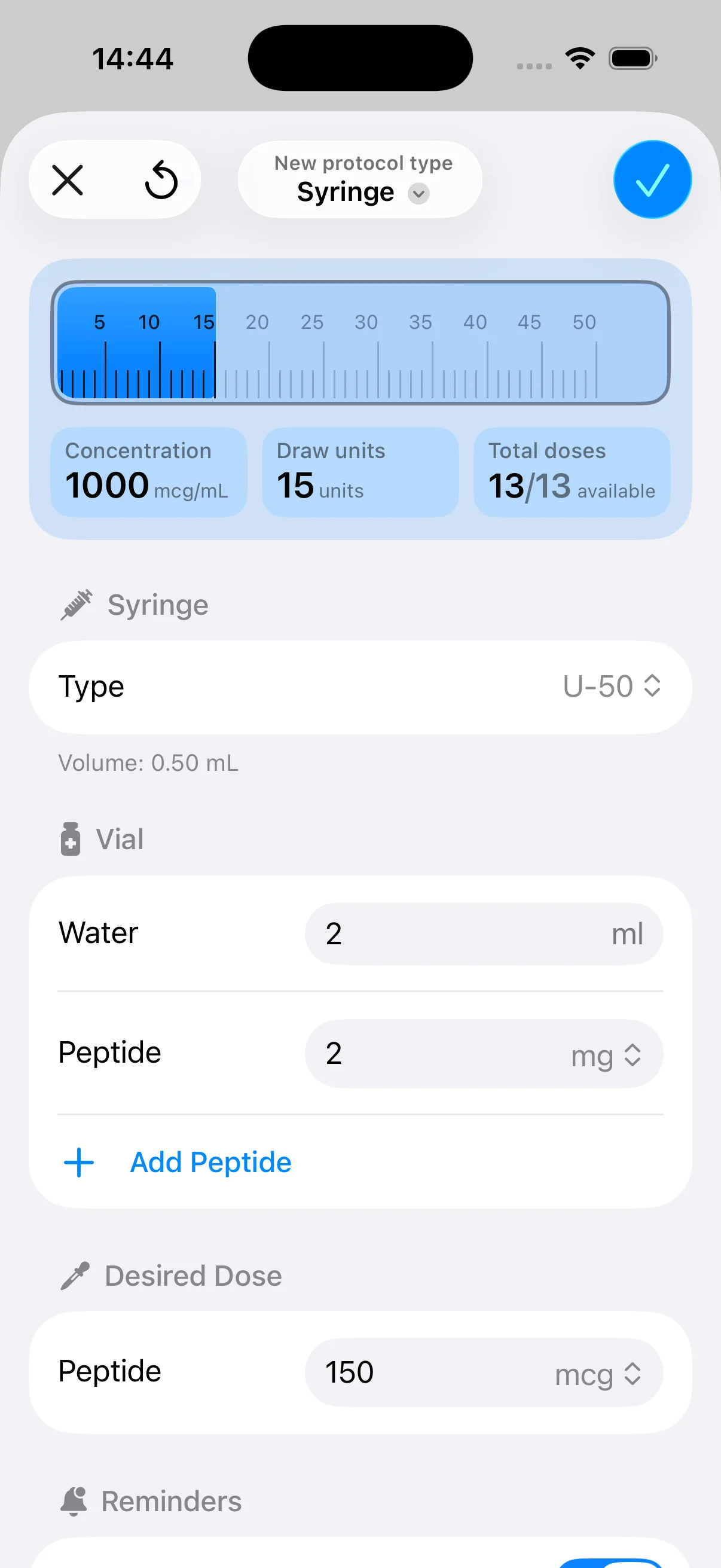
Automating the Math with PepFlow
Manual calculation creates several opportunities for slips. You can transpose the vial amount, forget to convert milligrams into micrograms, use the wrong syringe divisor, or copy a previous concentration after changing the diluent volume.
PepFlow’s calculator is designed around the inputs that determine the result:
- Enter the vial size in milligrams.
- Enter the diluent volume in milliliters.
- Enter the target dose in micrograms.
- Select the relevant syringe scale.
- Review the calculated concentration, syringe units, and fill volume.
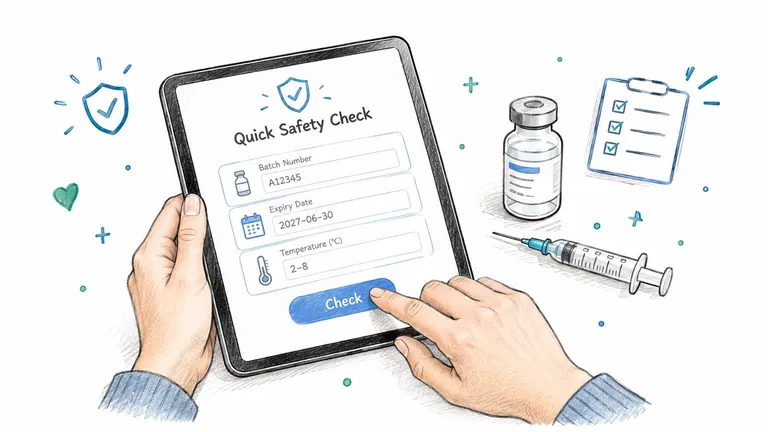
Use the same example from the calculation above: a 5 mg vial with 2 mL of diluent produces 2,500 mcg/mL. A 250 mcg target requires 0.10 mL, which reads as 10 units on a U-100 syringe.
The advantage of automation isn’t that it replaces verification. It removes repeated arithmetic between the vial label and the plunger, while leaving you responsible for confirming the syringe type, medication instructions, preparation method, and final result.
Don’t let a calculator hide a mismatch. If you enter U-100 settings while holding a U-500 syringe, the output may be mathematically consistent and practically wrong. The device in your hand still has the final say.
Common Pitfalls and Quick Fixes
Most errors don’t come from advanced chemistry. They come from treating a familiar-looking syringe as if every barrel uses the same scale.
The five mistakes to catch
-
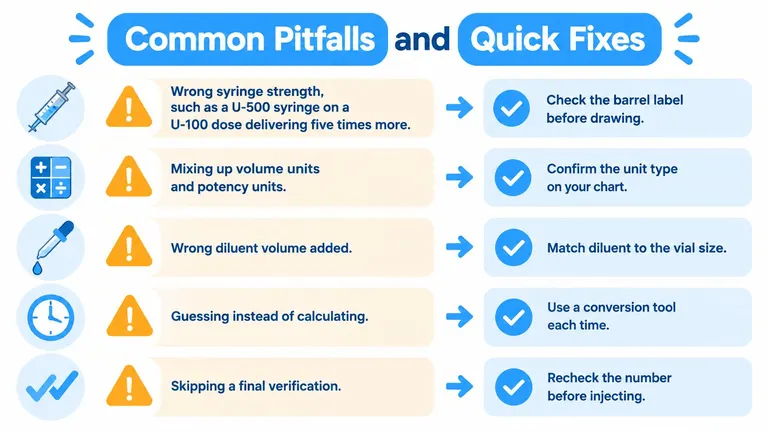
Wrong syringe strength: Using a U-500 syringe for a U-100 dose can create a fivefold difference in the delivered amount. Fix: Read the barrel label before drawing, every time. FDA guidance specifically warns against applying U-100-style conversions to U-500 insulin systems. Read the FDA safety alert on compounded medication dosing errors before relying on a conversion chart.
-
Wrong diluent volume: Adding a different liquid volume changes the concentration inside the vial, even if the vial’s labeled peptide amount stays the same. Fix: Write the intended diluent volume on the preparation record and verify it before mixing.
-
Milligrams and micrograms get mixed: A 5 mg vial equals 5,000 mcg, not 5 mcg. Fix: Convert the vial amount once, write the converted amount beside the original, and use one unit system through the calculation.
-
Air bubbles displace liquid: A visible bubble means part of the syringe space contains air rather than the intended liquid volume. Fix: Tap the barrel gently, move the bubble upward, and expel air according to the syringe and medication instructions before reading the fill line.
-
Guessing at a tiny fill line: Very small volumes can be difficult to measure reliably by eye, especially when tick marks are coarse or the liquid is hard to see. Fix: Use a suitable device and ask a pharmacist or clinician whether the volume is practical to measure manually.
One more habit matters: don’t reuse disposable syringes. Repeated use can dull the needle, compromise cleanliness, and leave residue that makes the next measurement less predictable. Use a new sterile syringe for each draw and follow the product instructions for storage and handling.
Final check: Read the vial, read the syringe, read the calculated dose. If those three statements don’t agree, don’t inject.
Building a Consistent Dosing Routine
Accuracy improves when the same checks happen in the same order. A rushed calculation invites memory-based shortcuts, while a short routine makes the syringe, vial, concentration, and intended dose visible before the plunger moves.
Use this sequence at each preparation:
- Match the syringe: Confirm the barrel scale matches the medication instructions.
- Confirm the vial: Check the labeled amount, preparation status, and concentration record.
- Review the target: State the intended dose in one unit, preferably before converting it into volume.
- Draw slowly: Remove air, align the plunger with the correct mark, and inspect the liquid at eye level.
- Record the action: Log the dose and time immediately after administration.
Keep the preparation method consistent. If you change the diluent volume, syringe type, or target dose, recalculate instead of adapting an old fill line. Label the prepared vial with the relevant date and concentration information, and follow the storage instructions supplied by the pharmacy or clinician.
A notebook can work, but a dosing app can make repeated schedules easier to track. Record enough detail to spot drift, including the vial strength, diluent volume, syringe scale, target dose, and actual draw. Reminders are useful for timing, but they don’t replace the arithmetic or the final verification.
Tape this five-point checklist inside the medicine cabinet:
- Syringe scale confirmed.
- Vial and concentration confirmed.
- Target dose converted correctly.
- Air and fill line checked.
- Dose and time recorded.
Make the routine boring. Boring is what keeps a familiar syringe from turning a three-second assumption into a fivefold dosing error.
PepFlow provides a peptide dosing calculator for vial size, diluent volume, target micrograms, concentration, and syringe pull units, along with scheduling and dose logging features for structured routines. Visit PepFlow to put the units to mL calculation and your ongoing dosing reminders in one workflow, while continuing to follow professional medical guidance.