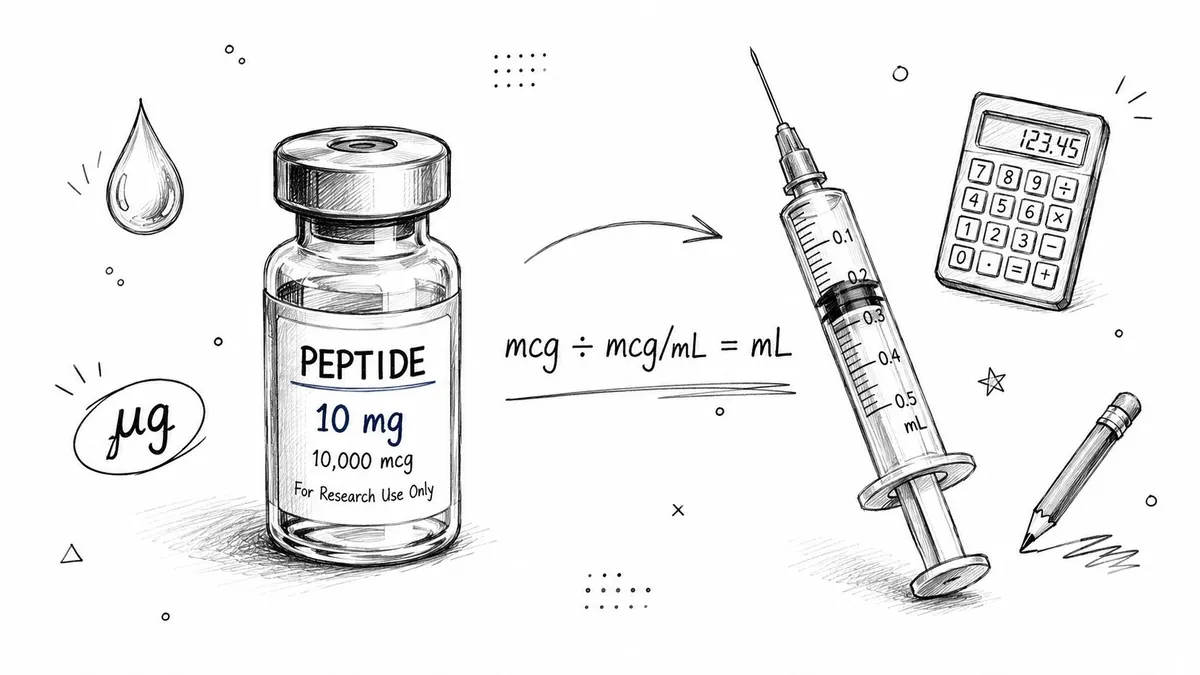
You’re probably staring at a vial label with a peptide amount in mcg or mg, a syringe marked in mL or units, and a simple question that suddenly doesn’t feel simple at all: how much liquid do you draw?
That confusion is normal. The math itself isn’t hard. The risky part is usually reading the label correctly. Many people try to treat mcg to mL like a direct unit swap, but it isn’t. The safe way is to standardize the concentration first, then calculate the volume. If you skip that step, especially with labels written as mg/mL, mcg/10 mL, or a vial that needs reconstitution, you can end up solving the wrong problem.
Table of Contents
- Why You Cannot Directly Convert mcg to mL
- The Fundamental Formula for Accurate Conversion
- Worked Examples for Common Peptide Vials
- Achieving Dosing Precision and Safety
- How to Troubleshoot Common Calculation Mistakes
- Automate Dosing Calculations with PepFlow
Why You Cannot Directly Convert mcg to mL
A microgram is a mass measurement. A milliliter is a volume measurement. Those are different kinds of quantities, like asking how many spoonfuls equal a gram of sugar without knowing how tightly the spoon is packed.
That’s why there isn’t a universal answer to “how to convert mcg to ml.” You need one missing bridge piece: concentration. In plain language, concentration tells you how much substance is dissolved in each milliliter of liquid.
If you have a vial and a syringe, the vial might tell you the amount of peptide present, while the syringe tells you how much liquid you can draw. The concentration connects those two. Without it, the question is incomplete.
Why label reading matters more than the formula
Many guides jump straight to an equation. The bigger real-world problem is that labels aren’t always written in the same format. Some show strength as mg/mL. Some show a total amount per vial. Some use a format like mcg per a stated volume. Some products are compounded and need a little interpretation before you can do any arithmetic.
Practical rule: Never calculate from a label you haven’t translated into one clear concentration.
That means you want the strength expressed in a single format before you touch the syringe. For most peptide users, the easiest target format is mcg/mL.
If you’re still shaky on metric dose units, PepFlow’s mg to mcg conversion guide helps clear up the most common unit mix-ups before you work out liquid volume.
The question to ask first
Before asking “how many mL is this dose,” ask:
- What is the desired dose in mcg?
- What is the concentration of the final liquid?
- Is the label showing total vial content or concentration?
- Was the vial reconstituted, and if so, with how much liquid?
That short checklist prevents most errors. Good dosing starts with identifying what the label says, not what you assume it means.
The Fundamental Formula for Accurate Conversion
Once the concentration is clear, the calculation is straightforward:
Volume (mL) = Desired Dose (mcg) / Concentration (mcg/mL)
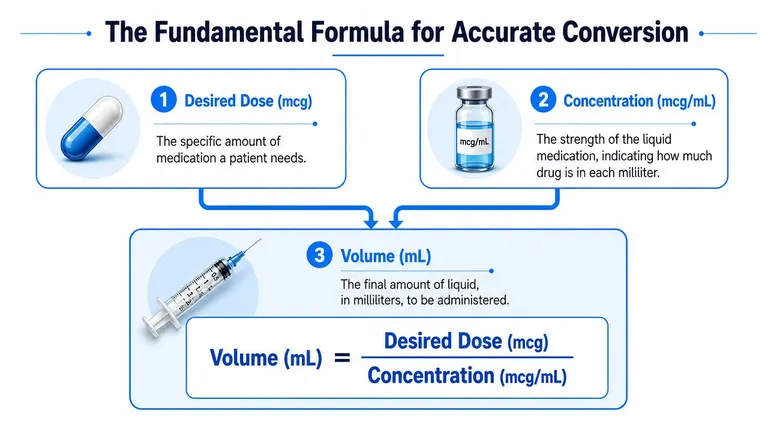
The key point is not the formula itself. The key point is that the conversion from mcg to mL is impossible without the product’s actual concentration, because mcg is mass and mL is volume. The same guidance also warns that a major source of error is failing to normalize non-standard labels such as mg/mL or mcg/10 mL into a standard mcg/mL format before calculating, as explained by Omni Calculator’s discussion of mcg to mL conversion.
What each part means
Think of concentration like coffee strength.
If one cup contains a lot of coffee concentrate, you need only a small amount to get the flavor you want. If it’s weak coffee, you need more liquid. Peptides work the same way. The desired dose is the amount of active material you want. The concentration tells you how much of that active material sits in each mL. The volume is what you draw.
Here’s the formula broken down:
- Desired dose (mcg) means the amount you intend to administer.
- Concentration (mcg/mL) means how many micrograms are present in each milliliter.
- Volume (mL) is the amount of liquid you pull into the syringe.
How to standardize the label first
This is the step many people skip.
If your vial label already says mcg/mL, you’re ready. If it doesn’t, convert it first.
Common situations:
-
The label shows mg/mL
Convert the mass unit to mcg, then keep the mL the same. -
The label shows total mass in the vial
Divide that total amount by the amount of liquid used after reconstitution. -
The label shows mcg over a different liquid amount, such as mcg per a stated volume
Rewrite it into mcg per 1 mL before you calculate a dose.
When the label format changes, the formula doesn’t. Only the concentration setup changes.
A careful process looks like this:
- Read the full label: Identify whether it gives total content, concentration, or both.
- Convert to one basis: Rewrite the strength as mcg/mL.
- Check your denominator: Make sure the liquid amount matches the final reconstituted volume.
- Then divide: Desired dose ÷ concentration.
That order matters. If you calculate before standardizing the label, you can get a tidy-looking answer that’s still wrong.
Worked Examples for Common Peptide Vials
The pattern of the process is always the same: determine the final concentration, then divide the desired dose by that concentration.
Example one with a smaller reconstitution volume
Suppose you have a vial containing 5 mg total peptide, and you reconstitute it with 1 mL of bacteriostatic water.
First, convert the vial content to micrograms.
- 5 mg = 5000 mcg
Then find the concentration.
- 5000 mcg ÷ 1 mL = 5000 mcg/mL
Now say your desired dose is 250 mcg.
- 250 mcg ÷ 5000 mcg/mL = 0.05 mL
That means you would draw 0.05 mL.
Example two with a more dilute mix
Now take the same 5 mg vial, but reconstitute it with 2 mL instead.
Convert the vial content first.
- 5 mg = 5000 mcg
Find the concentration.
- 5000 mcg ÷ 2 mL = 2500 mcg/mL
If the desired dose is 500 mcg:
- 500 mcg ÷ 2500 mcg/mL = 0.2 mL
This mix is less concentrated than the first example, so the volume you draw is larger.
Same vial mass, different reconstitution volume, different draw amount. That’s why copying someone else’s syringe marking without matching their exact mixture is unsafe.
If you’re comparing protocols across compounds, XO’s guide to weight loss peptides is useful for understanding how people often discuss peptide use cases, but the actual draw volume still depends on the concentration in your own vial.
Example three with a larger vial
Suppose the vial contains 10 mg total peptide and you add 2 mL of liquid.
Convert first:
- 10 mg = 10000 mcg
Now concentration:
- 10000 mcg ÷ 2 mL = 5000 mcg/mL
If your desired dose is 500 mcg:
- 500 mcg ÷ 5000 mcg/mL = 0.1 mL
That gives you a small draw volume because the final liquid is fairly concentrated.
For anyone working with cosmetic peptides and trying to map a calculated dose to an actual protocol, this GHK-Cu dosage calculator guide shows the same logic in a peptide-specific context.
Sample mcg to mL Peptide Dose Calculations
| Vial Total Mass | Reconstitution Volume | Final Concentration | Desired Dose | Required Volume (mL) | Required Volume (Units) |
|---|---|---|---|---|---|
| 5 mg | 1 mL | 5000 mcg/mL | 250 mcg | 0.05 mL | 5 units |
| 5 mg | 2 mL | 2500 mcg/mL | 500 mcg | 0.2 mL | 20 units |
| 10 mg | 2 mL | 5000 mcg/mL | 500 mcg | 0.1 mL | 10 units |
A useful habit is to write this out on paper the first few times:
- Convert total vial mass to mcg
- Divide by final liquid volume to get mcg/mL
- Divide desired dose by concentration to get mL
- If needed, translate mL to syringe units
That handwritten check catches mistakes your brain tends to skip when you’re in a hurry.
Achieving Dosing Precision and Safety
The calculation can be correct and the dose can still be wrong if you read the syringe poorly or round carelessly.
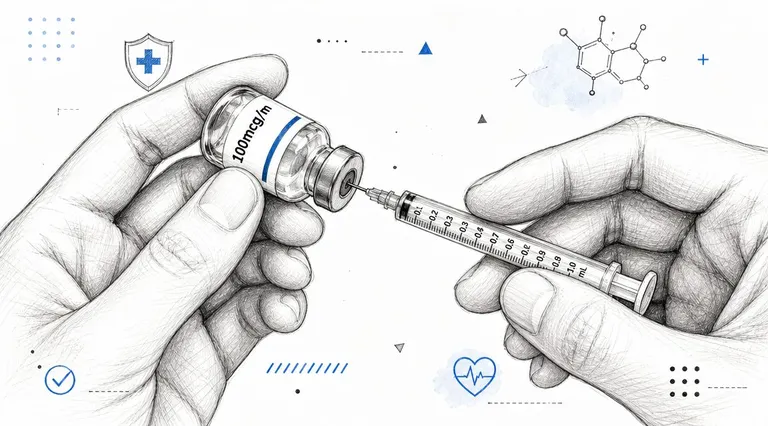
A syringe is a measuring tool, not a rough guide. Treat it like lab glassware. If the math says a small volume, you need to line that volume up with the syringe markings accurately, not “close enough.”
Reading syringe markings without guessing
A frequent sticking point is the word units on insulin syringes. People often talk in units when they really mean a fraction of a milliliter. That shorthand can be handy, but only if you know what your syringe markings represent.
On a standard U-100 insulin syringe, 100 units = 1 mL. So:
- 10 units = 0.1 mL
- 20 units = 0.2 mL
- 5 units = 0.05 mL
That’s why the examples above can be shown in both mL and units. But don’t assume every syringe type should be interpreted the same way without checking its labeling.
For readers who’ve seen how confusing unit systems can get in aesthetics, this guide to Dysport vs Botox units is a useful reminder that “units” are only meaningful within the correct measurement context.
How to handle awkward decimals
Not every result lands on a tidy syringe line. You may end up with a volume that falls between markings.
In that situation:
- Pause and reassess: See whether the concentration can be adjusted at the reconstitution stage, if your instructions allow that.
- Avoid casual rounding: Small-volume injections make rounding errors more significant.
- Use repeatable measurements: If you must round, do it consistently and document what you drew.
A clean protocol is one you can repeat the same way every time.
A second check helps too. Re-read the vial. Re-read the reconstitution amount. Re-run the math. Then compare the final draw volume to what feels physically plausible in the syringe. If a very small dose somehow gives a large draw volume, or a large dose gives a tiny one, stop and inspect your setup again.
Here’s a practical refresher on careful draw technique:
Accuracy isn’t just about getting through the math. It’s about being able to reproduce the same dose tomorrow.
How to Troubleshoot Common Calculation Mistakes
Most dosing errors come from a small handful of habits. The good news is that they’re predictable.
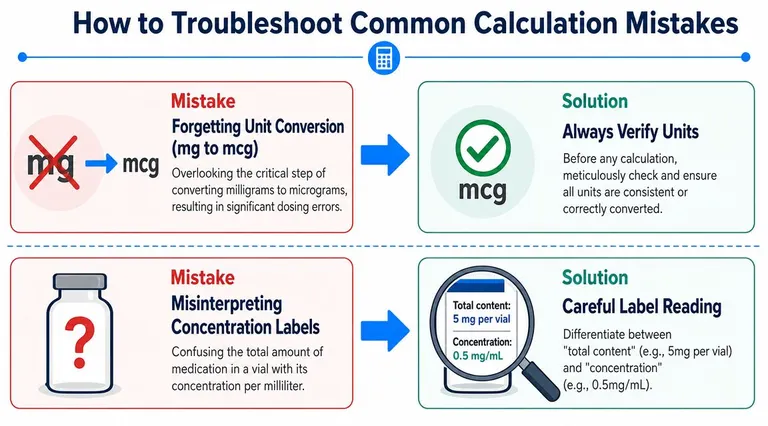
Problem and solution checks
Problem: You used the vial amount in mg but the dose in mcg.
Solution: Put both on the same mass scale before dividing. If the dose is written in mcg, convert the vial strength to mcg too.
Problem: You divided the formula backward.
Solution: The dose goes on top. The concentration goes underneath. If the answer gets larger when the concentration gets stronger, something is off.
Problem: You treated total vial content as if it were already a per-mL concentration.
Solution: Stop and calculate the final concentration from the full vial amount and the final liquid volume.
Problem: You relied on a copied syringe number from someone else.
Solution: Rebuild the math from your own vial, your own reconstitution volume, and your own target dose.
When you are solving the wrong type of calculation
This is the more subtle mistake.
Some people search for mcg-to-mL help when what they really need is a dose-rate calculation. A single injected dose asks one question: how many micrograms are in each milliliter, and how much liquid contains my target amount? A rate-based problem asks additional questions involving time, and sometimes body weight too.
The distinction matters. Guidance on medication calculations notes frequent confusion between a simple mass-to-volume conversion and dose-rate conversions such as mcg/min to mL/hr, which require extra time-based steps. It also points out that the primary issue is often identifying what other variable, such as time or body weight, must be included before the calculation is valid, as explained in Manuel’s Web discussion of mcg, kg, min, and infusion logic.
If the order includes a time element, you are no longer doing a simple mcg-to-mL calculation.
That’s a useful checkpoint. Before calculating anything, ask whether you’re solving for a one-time volume or an ongoing rate. Using the wrong setup can produce a mathematically correct answer to the wrong question.
Automate Dosing Calculations with PepFlow
Manual math teaches the logic, but repeated manual math also creates room for slips. People transpose numbers, forget a conversion, or misread the vial after a long day.
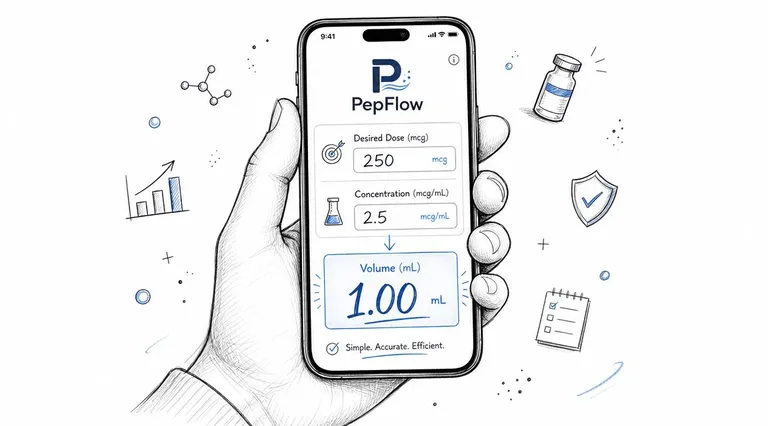
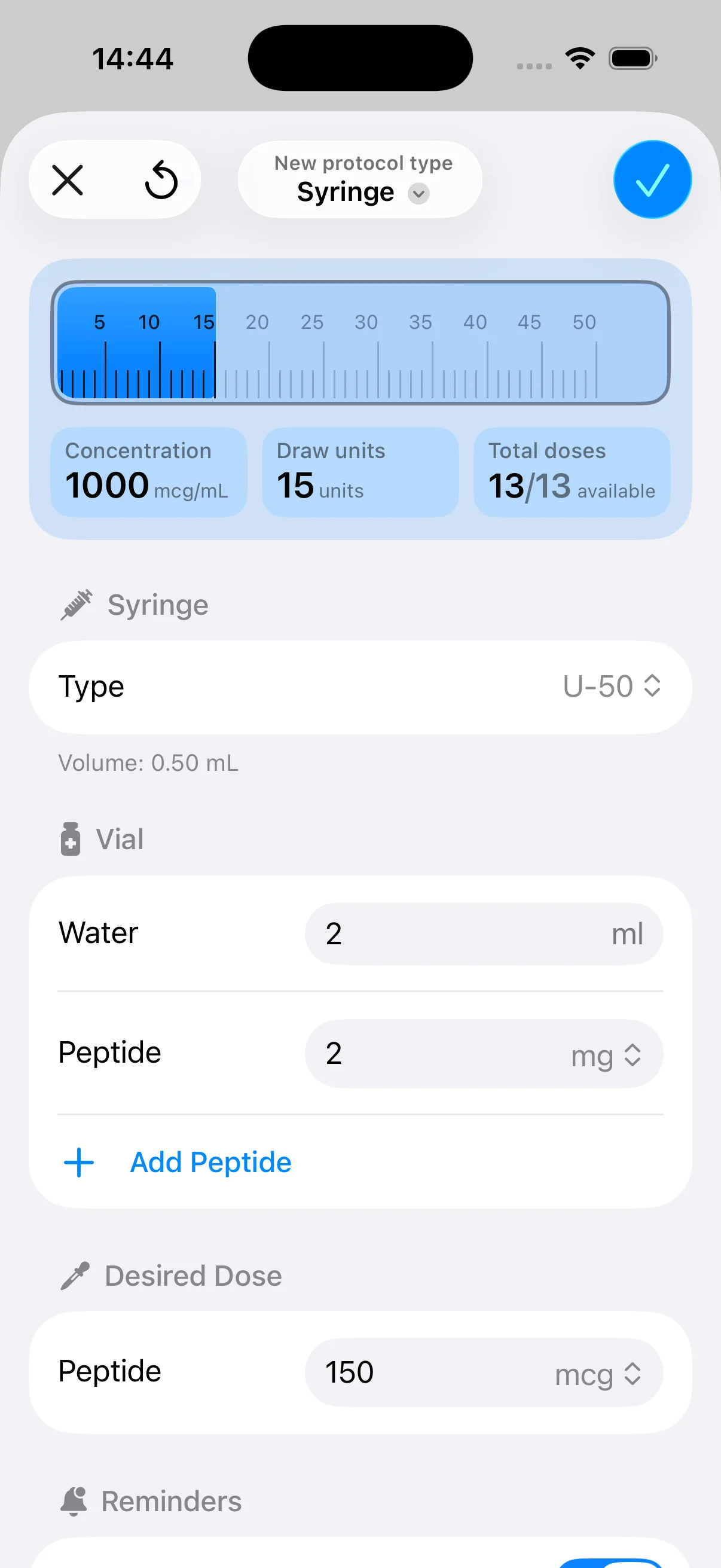
That’s where a purpose-built calculator becomes practical. PepFlow’s peptide calculator lets users enter the vial amount, reconstitution volume, and desired dose, then outputs the corresponding draw amount in usable measurement terms. For someone who already understands the concentration logic, that kind of tool reduces repetitive arithmetic and helps keep calculations consistent.
Its true value isn’t magic. It’s standardization. You still need the right vial details and the right target dose. But once those inputs are correct, using one repeatable system lowers the chance of making a simple hand-calculation mistake.
It also helps with the part many people underestimate: routine. A reliable protocol isn’t just one correct dose. It’s the same correct setup, calculated the same way, every time.
If you want a simpler way to turn vial strength and target dose into a practical draw amount, PepFlow can help you calculate mL and syringe units from your inputs while keeping your dosing routine organized.