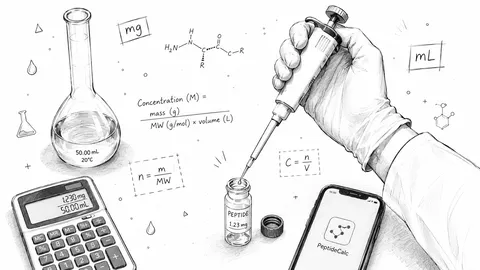
Concentration is the amount of solute in a defined amount of solution, and the unit on the label changes what that amount means. You can have the same total mass in a vial and still draw a very different dose, because what is concentration depends on the denominator, not just on how much substance is present.
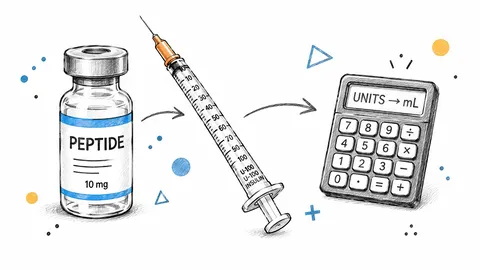
You’re likely holding a small vial, a syringe marked in units, and a target written in micrograms, and those three numbers don’t line up at first glance. That’s normal. The vial tells you mass, the syringe tells you volume, and concentration is the bridge you have to build between them before any drawing up makes sense. See the peptide calculator.
Table of Contents
- A Practical Definition of Concentration
- Common Chemistry Units and What Their Denominators Really Mean
- Why Syringe Units Are a Volume Scale, Not a Dose
- A Worked Reconstitution Example You Can Reuse
- Temperature, Density, and the Hidden Assumptions on Every Label
- Bringing the Chemistry into a Real Peptide Routine
- Common Questions About Concentration in Peptide Work
A Practical Definition of Concentration
You have a vial of lyophilized peptide powder, a separate vial of diluent, and a protocol that calls for a specific microgram amount. The question you’re really asking isn’t what’s in the vial in total. It’s how much active substance is in the liquid you’re about to draw.
Concentration is a ratio. You take an amount of solute, the substance being dissolved, and you divide it by a defined amount of solution or solvent. Change either side of that ratio and the concentration changes, even if nothing else about the vial changes.
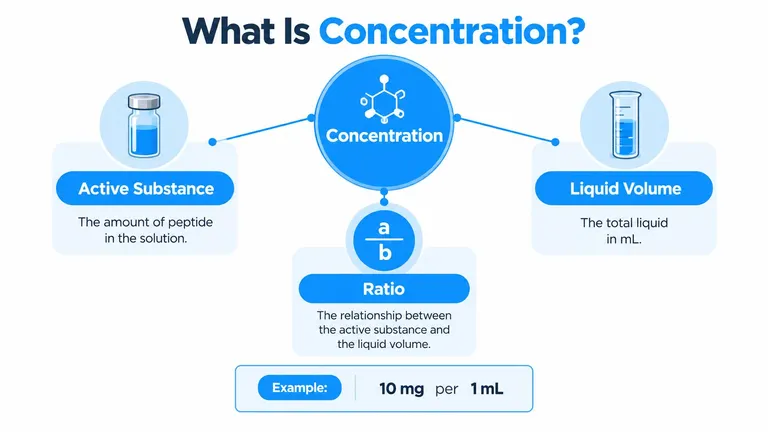
Total Mass Is Not Concentration
Two vials can both contain the same total mass of peptide and still behave differently in your syringe. If you dissolve that mass into a small final volume, each milliliter carries more substance. If you dissolve it into a larger final volume, each milliliter carries less.
That’s why the label number isn’t your dose. It’s one variable in a calculation. Treat it as the dose and you’ve skipped the step that determines what you draw.
Practical rule: Name the numerator and the denominator out loud before you calculate. If you can’t say what’s on the bottom of the ratio, you don’t know what the number means yet.
This framing also helps avoid a wider confusion. People use the word concentration for mental focus too, where it’s better understood as sustained, goal-directed attention rather than one fixed capacity, which shows how easily one word hides different problems in different fields, as described in this overview of focus and concentration in cognitive science. In chemistry, you don’t have that ambiguity if you insist on units. A ratio without units is just a guess.
Hold onto that working definition. Every formula that follows is the same idea with a different denominator.
Common Chemistry Units and What Their Denominators Really Mean
Labels look chaotic because chemistry has several legitimate ways to express the same ratio. They’re not interchangeable. Each one divides by something different, and that denominator decides how you can use the number.
Molarity is moles of solute per liter of solution. Molality is moles of solute per kilogram of solvent. Those sound similar until you notice one denominator is the finished liquid and the other is only the solvent you started with.
Concentration Units at a Glance
| Unit | Formula | Denominator | Typical use |
|---|---|---|---|
| Molarity (M) | moles / L | Liters of solution | Lab reactions, volumetric work |
| Molality (m) | moles / kg | Kilograms of solvent | Temperature sensitive studies |
| Mass concentration | mass / volume, such as mg/mL | Volume of solution | Peptide vials, dosing liquids |
| % w/v | grams solute per 100 mL solution | Volume of solution | Pharmacy and supplement labels |
| % w/w | grams solute per 100 g mixture | Mass of mixture | Creams, solids, dense liquids |
| % v/v | mL solute per 100 mL solution | Volume of solution | Liquid in liquid mixtures |
| Parts per million | mass or volume per million parts | Total mixture | Trace contaminants, water testing |
A percent sign by itself tells you almost nothing. A percentage must specify whether it’s mass/mass, mass/volume, or volume/volume, because 10% in one convention isn’t 10% in another. Educational material on concentration units and their measurement conditions stresses that same point for molarity, molality, mass concentration, volume percentage, and parts per million.
Why mg/mL Dominates Peptide Work
Peptide labels most often use mg/mL, a direct mass concentration. It answers the practical question, how many milligrams are in each milliliter I’ll draw? You don’t need moles or molecular weight for routine drawing calculations, which is why molarity rarely appears on a peptide vial.
- Read the denominator first: Liters of solution, kilograms of solvent, and milliliters of solution lead to different math.
- Don’t convert by name alone: Molarity and molality aren’t synonyms, and swapping them introduces error.
- Question bare percentages: If a label doesn’t say w/v, w/w, or v/v, you don’t have a usable concentration yet.
If the step of moving between these forms still feels shaky, work through the basics of unit conversion and dimensional consistency before you trust a calculation. Matching the printed number to its denominator is the skill. Everything after that is arithmetic.
Why Syringe Units Are a Volume Scale, Not a Dose
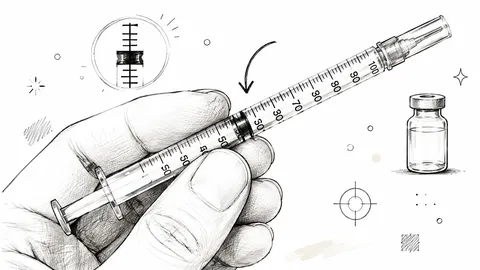
Look at the markings on an insulin syringe before you look at the vial. Those unit lines measure how much liquid you’re moving. They don’t measure how much active ingredient is in that liquid.
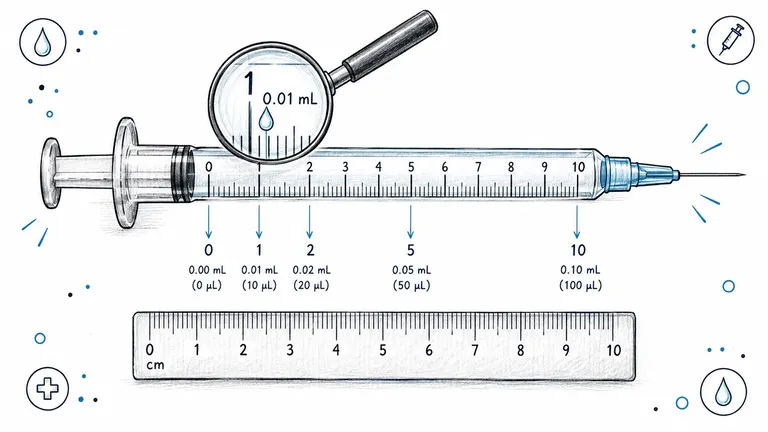
On a standard 1 mL insulin syringe, 1 unit corresponds to 0.01 mL, so 10 units drawn from a 5 mg/mL vial delivers roughly 50 micrograms, while the same 10 units from a 10 mg/mL vial delivers roughly 100 micrograms. The syringe didn’t change. The concentration did, and that doubled the mass in an identical looking draw.
The Mental Model to Keep
Keep three separate ideas in three separate places. Units live on the barrel and describe volume. Milligrams live on the vial and describe mass. Concentration connects them, and without it you can’t translate one into the other.
Prefilled devices hide some of this work, which is why instructions for setting up a device matter. The Pfizer HGH pen startup guide from Dream Body Clinic shows how a pen handles preparation steps that a plain syringe leaves entirely to you. With a syringe, you’re the conversion step.
The short clip below walks through reading those barrel markings slowly, which is worth doing before you rely on them under time pressure.
If the markings themselves are still confusing, review how to read insulin syringe markings step by step and check your syringe size first. A different barrel size can change what each line represents, and assuming every syringe reads the same way is a quiet source of error.
A syringe never tells you a dose. It tells you a volume, and you supply the concentration that turns that volume into a dose.
A Worked Reconstitution Example You Can Reuse
Follow one example from powder to final draw, then you can substitute your own vial size, diluent volume, and target. The structure stays the same. Only your numbers change.
Start with a hypothetical 10 mg vial of lyophilized peptide. You add 2 mL of bacteriostatic water and let the powder dissolve gently. Your final volume is 2 mL, so your concentration is 10 mg divided by 2 mL, which gives 5 mg/mL.
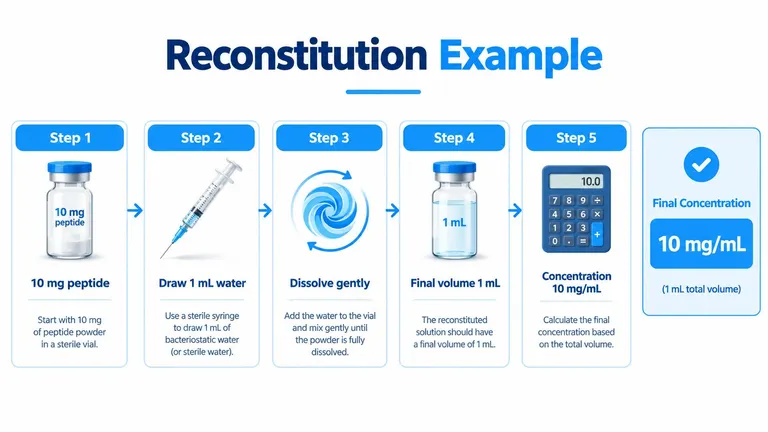
From Target Dose to Syringe Units
- State your concentration: 5 mg/mL means 5,000 micrograms in each milliliter, or 50 micrograms in each 0.01 mL unit.
- State your target: Suppose your target is 250 micrograms for this worked example only.
- Divide target by amount per unit: 250 divided by 50 gives 5 units on a standard 1 mL syringe.
- Check backward: 5 units is 0.05 mL, and 0.05 mL at 5 mg/mL gives 0.25 mg, which is 250 micrograms. The math closes.
Compare that with dissolving the same 10 mg into only 1 mL. You’d get 10 mg/mL, each unit would carry twice as much, and the same target would need half the units. Identical mass, different final volume, different draw. That’s the central lesson in one calculation.
Where Small Slips Compound
- Wrong final volume: You planned for 2 mL but added a different amount, so every later draw inherits that error.
- Milligrams and micrograms swapped: A factor of a thousand hides in that one prefix.
- Syringe size assumed: You calculated for one barrel and picked up another.
- Label read as dose: You drew the number on the vial instead of converting your target.
Write the calculation down instead of doing it in your head. A calculator that stores your vial concentration and converts a target into units externalizes the arithmetic, so one tired moment doesn’t rewrite your dose. It still can’t check whether your inputs were right, and real injectable preparations require validated instructions and professional oversight.
Temperature, Density, and the Hidden Assumptions on Every Label
A formula looks exact on paper. The liquid in front of you makes assumptions the formula doesn’t mention, and those assumptions are where careful people slow down.
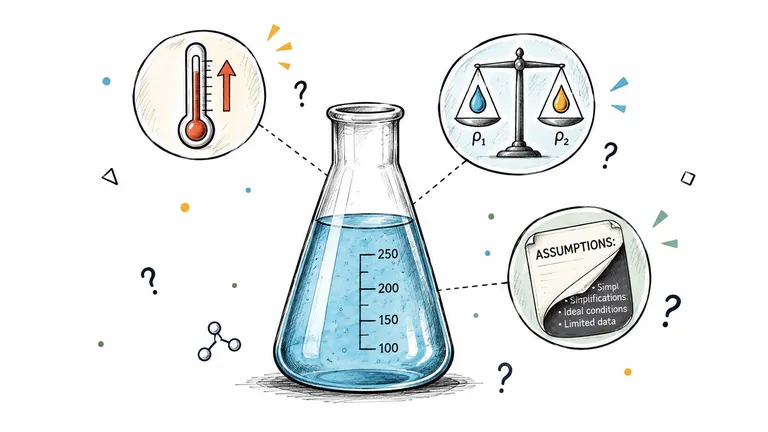
Molarity can vary with temperature because solution volume expands or contracts as temperature changes. Molality is temperature independent because it’s based on kilograms of solvent, and mass doesn’t expand. For most peptide work you’re using mg/mL at room conditions, but storage and handling still matter, which is why peptide storage temperature guidance belongs in the same routine as your calculations.
Solvent Volume Is Not Final Solution Volume
When you dissolve a powder, the liquid level can rise. The volume of diluent you added isn’t automatically the final volume of solution, yet many quick calculations treat them as identical. In reconstitution, that shortcut is common, but you should know you’re making it.
Density creates a similar trap with percentages. A liquid that’s denser than water weighs more per milliliter, so a mass based percentage and a volume based percentage drift apart. The same printed percent can describe different amounts depending on which pair of quantities it compares.
Dimensional Analysis as a Safety Check
Track units the way you track numbers. Write mg/mL, multiply by mL, and watch the milliliters cancel so you’re left with milligrams. If your units don’t cancel to the thing you want, your setup is wrong, no matter how clean the arithmetic looks.
Check before you draw: If the units don’t cancel cleanly, stop. Don’t fix the number. Fix the setup, or verify it with a qualified source.
- Temperature assumption: Volume based units shift as liquids warm or cool.
- Density assumption: Mass and volume percentages only match when density cooperates.
- Volume assumption: Added solvent and final solution aren’t always the same volume.
None of this means home calculations are impossible. It means the label is the start of verification, not the end of it.
Bringing the Chemistry into a Real Peptide Routine
A routine turns one correct calculation into a repeatable process. You set up a vial once, record its concentration, define your target amount, and then every administration becomes a lookup instead of a fresh calculation under pressure.
That’s where structure helps most. PepFlow lets you configure a vial and its concentration, convert a desired microgram amount into practical syringe units, schedule cycled protocols with reminders, and log each administration. Used that way, it owns the arithmetic, the timing, and the record keeping, which are the steps where memory and mental math most often fail.
Know where that help stops. A calculator can’t validate a supplier label, interpret a clinician’s instruction, or decide whether a protocol is appropriate for you. If you’re considering therapy in a clinical setting, the ProMD Health Tysons Corner peptide guide gives useful background on how practitioners frame peptide therapy, and that kind of professional context sits outside any app.
Routines also support focus in a practical sense. When timing and calculations are externalized into reminders and logs, you carry less decision load each day. That supports consistent execution, but it doesn’t diagnose or treat attention problems, and persistent or severe concentration difficulties in the mental sense warrant professional advice.
Your job stays the same throughout. Confirm the vial, confirm the concentration, confirm the syringe, then let the system handle repetition.
Common Questions About Concentration in Peptide Work
Is mg/mL the Same as a Percent Label
No. Mg/mL states mass per volume directly, while a percent needs a qualifier such as w/v before you know what’s being compared. Convert carefully, and don’t assume they match. If you’re exploring clinical uses, you can browse peptide therapy for skin rejuvenation to see how providers present treatment contexts.
Why Can Two Vials With the Same Mass Differ
Because concentration depends on final volume after reconstitution. Dissolve the same mass into different volumes and each milliliter carries a different amount, so the same syringe draw delivers different doses.
Do Molarity and Molality Matter for Peptides
Rarely in day to day drawing, since peptide work uses mass concentration. They matter conceptually because their denominators differ, and that difference explains why units can’t be swapped casually.
When Should a Calculation Prompt a Conversation Instead
Whenever a label is ambiguous, a result looks surprising, or instructions conflict. Treat an unexpected number as a reason to verify with a qualified professional, not as permission to proceed confidently.
Enter your vial strength and reconstitution volume once, set your target amount, and let PepFlow convert it into exact syringe units, remind you on schedule, and log every dose for you. You’ll spend less effort redoing concentration math and more effort checking the inputs that keep your routine accurate.