If you’re reading about BPC 157 for wound healing, you’re probably in one of two places. You have an injury or surgical wound that feels slow to settle, or you’re trying to separate serious biology from internet folklore before you spend time on an experimental protocol. That tension matters, because BPC 157 sits in an unusual category: the preclinical signal is strong enough to attract attention, but the human evidence is still too thin to support confident medical conclusions.
That gap is where most discussions go wrong. They either treat BPC 157 like a breakthrough already proven in people, or they dismiss it without engaging with the animal literature at all. Neither approach is useful. A more grounded view starts with the everyday reality of healing itself. Skin closure, collagen remodeling, revascularization, and tissue strength don’t move at the same pace. Anyone comparing their recovery to a standard post-op roadmap, such as this guide to blepharoplasty recovery, already knows that “healed” can mean very different things depending on whether you’re talking about surface appearance, tensile strength, or functional recovery.
BPC 157 is interesting because the animal data doesn’t point to just one narrow effect. It points to a coordinated repair response across vascular, connective tissue, and wound-bed processes. What it doesn’t yet provide is proof that the same pattern holds in humans, at known doses, with known risks, under controlled conditions.
Table of Contents
- The Search for Faster Healing
- How BPC 157 Biologically Promotes Healing
- Evaluating the Evidence Animal vs Human Data
- Common Administration Routes and Research Dosing
- Safety Profile and Regulatory Status
- Managing Protocols Accurately with PepFlow
- Conclusion Weighing Potential Against Unknowns
The Search for Faster Healing
Slow healing changes how people think. A small incision that stays irritated, a skin wound that lingers longer than expected, or a soft tissue injury that keeps reopening the same concern can push otherwise cautious people toward experimental compounds very quickly. That doesn’t mean the interest is irrational. It means the usual timeline of repair often feels longer and more uncertain than people expect.
BPC 157 keeps surfacing in those moments because the preclinical literature describes a compound that may influence several parts of tissue repair at once. That’s more compelling than a single-mechanism intervention. It suggests a broader regenerative pattern, at least in animal models, rather than a simple anti-inflammatory effect or isolated boost to one cell type.
The key question isn’t whether BPC 157 is biologically active. The key question is whether promising biological activity in animals translates into meaningful, reproducible human wound outcomes.
That distinction matters for anyone researching BPC 157 for wound healing. The internet discussion often collapses three different issues into one. First, whether the compound affects healing biology in controlled models. Second, whether it works in humans. Third, whether its use is medically and legally straightforward. Those are separate questions, and they don’t currently have equally strong answers.
A sober reading of the evidence leads to a more useful conclusion than hype does. BPC 157 deserves attention because the preclinical pattern is unusually consistent across tissue types. But it also requires restraint, because the leap from rodent wound models to real-world human wound care is still largely untested.
- What makes it compelling: animal studies repeatedly suggest accelerated repair across skin and connective tissue models.
- What keeps it experimental: human randomized wound-healing trials haven’t been completed.
- What a serious reader should do: treat it as a research topic first, not as an established therapy.
How BPC 157 Biologically Promotes Healing
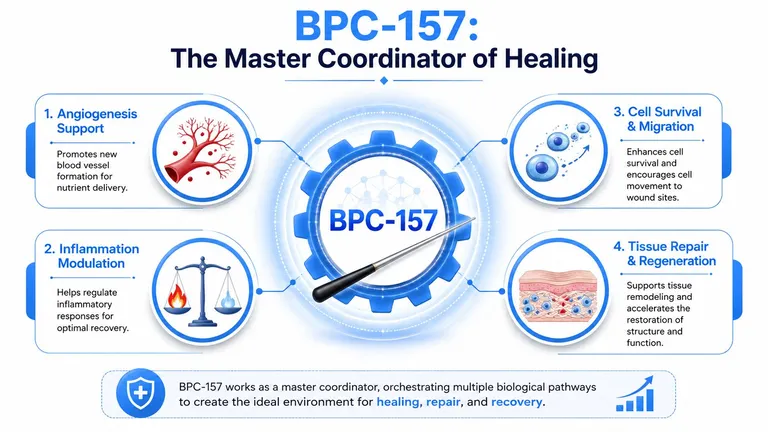
BPC 157 makes more sense when you stop thinking of it as a “healing booster” and start thinking of it as a repair coordinator. Wounds don’t heal because one switch flips. They heal because blood flow, clot resolution, cell migration, matrix deposition, and tissue remodeling line up in the right order. The interesting part of BPC 157 biology is that it appears to touch several of those steps at once.
A simple way to frame it is as a foreman at a construction site. The foreman doesn’t lay every brick personally. The foreman gets the crews to the right place, keeps materials moving, and prevents the site from stalling between phases.
To visualize that coordination, this concept map helps:
Why blood supply matters early
One of the clearest mechanistic findings is that BPC 157 upregulates vascular endothelial growth factor, or VEGF, a signal closely tied to angiogenesis. In the cited work, that VEGF effect activates ERK1/2 phosphorylation in human umbilical vein endothelial cells, which supports proliferation, migration, and tube formation needed for re-vascularizing injured tissue, as described in this wound-healing mechanism paper on PMC.
That matters because wounds don’t just need closure. They need supply lines. Oxygen delivery, nutrient transport, immune traffic, and fibroblast support all depend on circulation returning in an organized way. When a peptide appears to improve the vascular side of healing, it’s affecting more than appearance. It’s potentially affecting the infrastructure beneath the wound bed.
For readers who want a broader refresher on the normal repair sequence before layering BPC 157 on top of it, the EkagraHealth AI wound healing guide is a useful background resource.
How the repair site shifts phases
BPC 157 also appears to help the injury site move from the early clotting and inflammatory state into the proliferative phase more efficiently. The reported mechanism includes resolution of vessel constriction, support for formation of the primary platelet plug, and stabilization through a fibrin mesh, followed by clot resolution that helps restore tissue perfusion and opens the way for repair.
That sequence is easy to underestimate. A wound can fail to progress not because the body can’t heal, but because it remains trapped in an earlier stage longer than it should. BPC 157 is biologically interesting because it may reduce that bottleneck.
Later in the process, preclinical work also points toward effects on granulation tissue formation, reepithelialization, dermal remodeling, and collagen deposition. Those are the parts of healing people often notice only after the fact, when a wound starts looking flatter, stronger, or less deformed than expected.
Researchers exploring related recovery mechanisms often compare these pathways with other regenerative compounds in the broader peptides for tissue repair overview.
A short visual walkthrough can help tie those mechanisms together:
Practical rule: A plausible mechanism is not the same as proven clinical benefit. But when a compound influences blood vessel formation, endothelial behavior, and wound-phase transition together, it’s reasonable to treat it as more than a fad molecule.
Evaluating the Evidence Animal vs Human Data
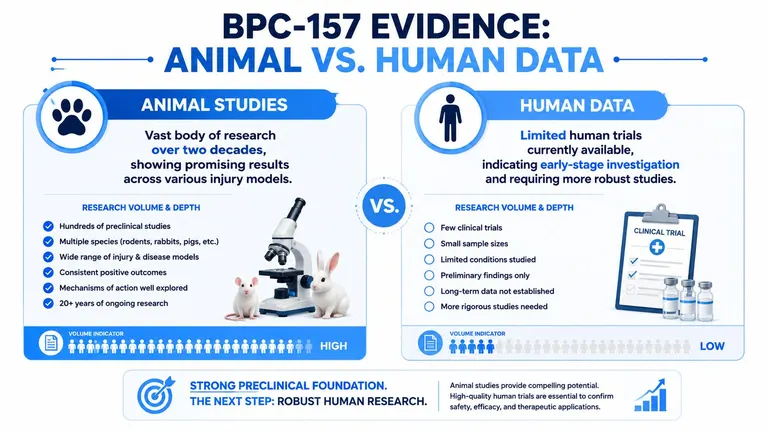
The evidence for BPC 157 for wound healing is strongest when you stay within the limits of preclinical research. Once you move into human claims, the certainty drops sharply. That contrast is the central fact any serious reader needs to hold onto.
The split is easier to see visually:
What the animal literature supports
The most concrete wound-healing signal in the provided evidence is this: in preclinical rodent studies, full-thickness skin wounds treated with BPC 157 closed 30% to 40% faster than saline controls, and that finding was replicated across multiple labs, according to the evidence summary on HealthRX. Across those studies, researchers used different administration methods, including intragastric and local topical application, and still saw a consistent directional effect.
That kind of replication matters more than people think. A single dramatic result can be noise. A similar result across independent laboratories, tissue models, and delivery methods suggests the compound is doing something biologically real in those systems.
The preclinical signal also extends beyond skin closure. In tendon healing models, BPC 157 increased the migratory potential of cultured tendon fibroblasts, accelerated ex vivo tendon explant outgrowth through the FAK-paxillin signaling pathway, and increased growth hormone receptor expression in tendon fibroblasts, based on the Journal of Applied Physiology study. The broader pattern described there includes more organized collagen architecture, greater tensile strength development, and less scar deformity in treated animal models.
Taken together, that gives BPC 157 a stronger preclinical profile than many compounds that circulate in recovery forums. The reason isn’t just that it “helps healing.” It’s that the findings point toward improved coordination of vascular repair and connective tissue organization at the same time.
Why the human gap changes the interpretation
The human side is much thinner. The entire human evidence base described in the verified material consists of three small, uncontrolled studies involving a total of sixteen patients at a single private clinic in Florida, with no control groups, no randomization, and no standardized diagnosis, as summarized in this clinical evidence review from The Arm Doc. The same source states there are no completed human randomized controlled trials for wound healing, and rates the evidence level for that application as GRADE: Very Low.
That changes how every animal result should be interpreted. Strong preclinical consistency can justify scientific interest. It can’t establish clinical efficacy. Human wound healing introduces variability that rodent models don’t capture well, including age, metabolic health, vascular disease, medication use, infection risk, and differences in wound care itself.
Animal data can tell you a compound is worth studying. It can’t tell you that a person with a real wound should expect the same outcome.
Many readers overcorrect in one direction or the other. They either say the rodent data means nothing, which isn’t true, or they treat it as enough to support a practical treatment protocol, which also isn’t true. The more accurate conclusion sits in between. BPC 157 has earned scientific attention. It hasn’t earned clinical confidence.
Common Administration Routes and Research Dosing
Most conversations about BPC 157 dosing jump straight to numbers. That’s usually the wrong starting point. The more important issue is route selection, because route changes the research logic behind a protocol.
The verified literature gives a useful but incomplete picture. Animal work has used intragastric, local topical, and injection-based approaches, and the peptide has shown activity through multiple routes in preclinical settings. At the same time, there is no published human data quantifying the bioavailability or comparative healing rates of topical application versus injection for surface skin wounds, as discussed in the PMC review on BPC 157 research gaps. For people focused on superficial skin repair, that’s a major unresolved issue.
How routes differ in research logic
Researchers usually think about routes in terms of what they are trying to test.
- Subcutaneous injection: often chosen when the goal is systemic exposure or more controlled delivery.
- Topical application: attractive for localized skin wounds, but harder to interpret because skin permeability and actual delivered dose remain uncertain in humans.
- Oral or intragastric administration: relevant because BPC 157 has shown activity in animal models through gastric delivery, which is unusual for a peptide and part of why it gets so much attention.
The practical problem is that route comparisons for cutaneous healing in humans haven’t been mapped. That means anyone trying to compare a cream, a local injection, or a systemic approach is operating with incomplete evidence. The uncertainty isn’t just about effectiveness. It’s about what dose reaches the tissue.
Research caution: The question “which route works best for skin wounds?” doesn’t have a published human answer yet.
Example research parameters
Because the verified data doesn’t provide dose ranges, the only responsible way to present protocol planning is qualitatively. A structured tracker can still help researchers organize assumptions and avoid mixing up route, target tissue, and schedule. If you’re building that framework, a general peptide dosage guide can help with the mechanics of dose calculation without turning research parameters into treatment advice.
| Example BPC-157 Research Protocol Parameters (Not Medical Advice) | ||
|---|---|---|
| Administration Route | Typical Research Dose Range (per kg) | Common Use Case in Research |
| Subcutaneous injection | Not established in the verified data | Systemic or localized research protocols |
| Topical application | Not established in the verified data | Surface wound-focused exploratory use |
| Oral or intragastric | Not established in the verified data | Gastrointestinal and systemic animal research |
A table like this may look sparse, but that sparseness is the honest state of the evidence. Filling in unsupported numbers would create false precision. In this area, uncertainty isn’t a flaw in the article. It’s part of the finding.
Safety Profile and Regulatory Status
People usually ask two practical questions after reading the mechanism and animal data. Is it safe, and is it legal to use? Those questions sound simple, but they have to be answered in layers.

What safety means in animals versus people
The animal safety profile described in the verified material is favorable. Across preclinical work, authors report no harmful effects, no identified toxic or lethal thresholds, and no observed teratogenic or genotoxic effects even at high doses, according to the earlier clinical evidence summary already cited in this article. That’s encouraging, especially because many experimental compounds show their limitations first in toxicity studies.
But that doesn’t answer the human safety question. The same verified source states there is no clinical safety data for humans. That creates a familiar but important research problem. A compound can look reassuring in animals and still carry risks in people that only become visible with structured pharmacology, standardized adverse event reporting, and controlled follow-up.
A second issue is that wound-healing compounds don’t just affect “healing” in the abstract. They may influence blood vessels, proliferation, connective tissue remodeling, and signaling pathways that matter outside the wound bed. Without formal human data, uncertainty remains uncertainty.
Why regulatory status matters
BPC 157 also sits outside approved medical practice. The verified data states that it has no approved indication by any drug regulatory agency, including the FDA, and that no completed human randomized controlled trials support wound healing use. That means it should be understood as an experimental compound, not an established therapy.
For athletes, there’s another layer. BPC 157 has been on the World Anti-Doping Agency Prohibited List since January 2022, according to the same The Arm Doc review. That status isn’t a side note. It changes the decision calculus for anyone who competes under anti-doping rules.
- Medical status: no approved indication from agencies such as the FDA.
- Clinical evidence status: no completed human RCTs for wound healing.
- Sport status: prohibited by WADA since January 2022.
The combination creates a clear picture. BPC 157 is not medically mainstream, not clinically proven for wound healing in humans, and not permissible in tested competitive sport. Anyone researching it needs to treat those constraints as central facts, not fine print.
Managing Protocols Accurately with PepFlow
Once someone moves from reading papers to planning personal research, the biggest mistakes usually aren’t philosophical. They’re operational. The wrong vial concentration gets entered. A microgram target gets mistranslated into syringe units. A schedule drifts after a missed dose, and the log becomes too messy to interpret later.
That matters more with compounds like BPC 157 because the evidence is already thin in humans. If the protocol itself is inconsistent, the observations become even harder to trust.
Where protocol errors usually happen
Most self-directed peptide research breaks down in a few predictable places:
- Dose conversion mistakes: mcg targets, reconstitution assumptions, and syringe markings don’t always line up intuitively.
- Scheduling drift: even motivated users forget whether a protocol is daily, alternating, paused, or cycled.
- Poor record keeping: after a week or two, many people can no longer reconstruct exactly what they took and when.
Those aren’t minor clerical issues. They change the internal validity of personal research. If someone feels better or worse during a protocol, they need a clean record before they can even begin asking whether the result means anything.
How PepFlow supports consistency
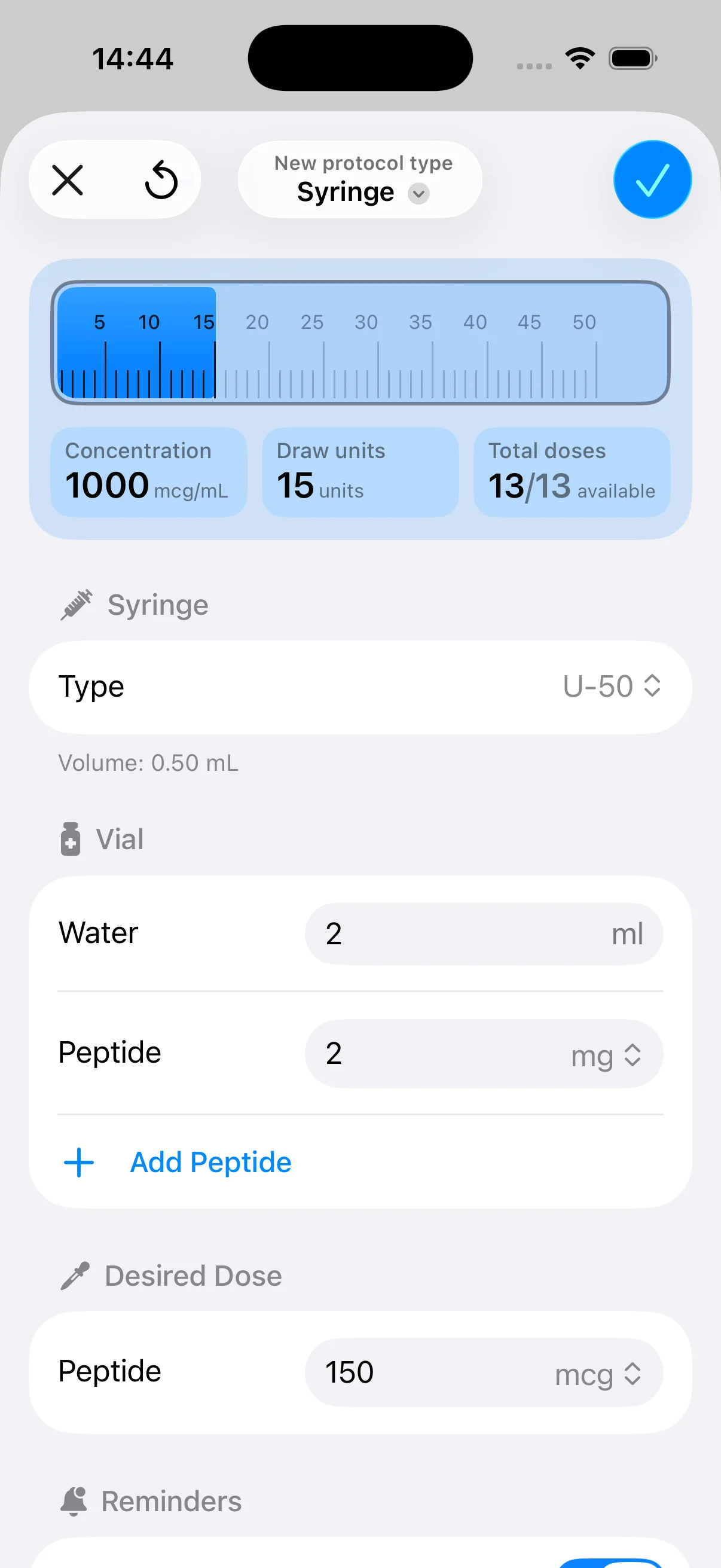
That is the problem PepFlow is built to solve. The app focuses on planning and organization rather than medical claims. It converts desired microgram amounts into practical unit measurements, helps users configure vial and concentration inputs, and reduces the mental math that often causes avoidable dosing errors.
A visual of that workflow makes the use case concrete:
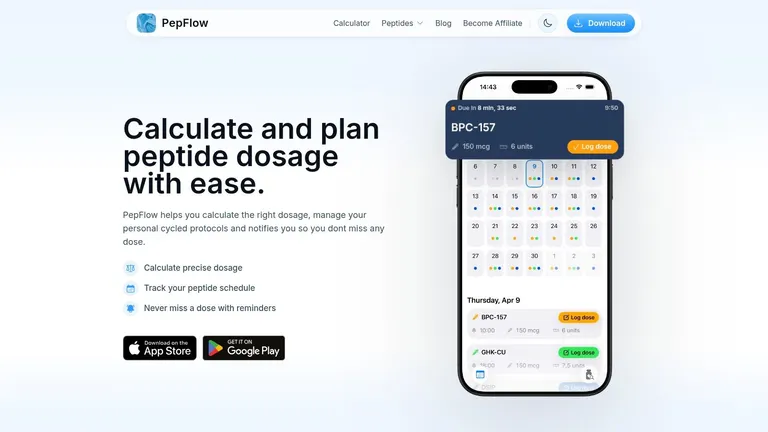
PepFlow also handles the other weak point in self-run protocols: adherence. Flexible scheduling, reminders, live activities, widgets, countdowns, and quick dose logging make it easier to keep a protocol consistent across days and weeks. That kind of consistency doesn’t make an unproven compound proven. What it does is prevent sloppy execution from adding another layer of uncertainty.
Better tracking doesn’t validate BPC 157. It validates whether your own protocol was followed as intended.
For anyone conducting structured personal research, that’s a meaningful distinction. Precision can’t fix the evidence gap, but it can stop user error from making the gap even wider.
Conclusion Weighing Potential Against Unknowns
The most honest conclusion about BPC 157 for wound healing is also the least flashy. The compound has a compelling preclinical profile. Animal studies point toward faster skin wound closure, stronger connective tissue repair signals, better collagen organization, and mechanisms that make biological sense. That combination is enough to justify serious scientific interest.
It isn’t enough to treat BPC 157 as a clinically established wound-healing therapy for people.
The human evidence remains sparse, uncontrolled, and inadequate for strong conclusions. Formal safety data in humans is missing. Regulatory approval is absent. Competitive athletes also have to account for its prohibited status under WADA. Those facts don’t erase the promise. They define the limits of what can be responsibly claimed today.
A careful reader should come away with two ideas at once. First, BPC 157 may turn out to matter in regenerative medicine if stronger human trials eventually support the animal findings. Second, anyone exploring it now is working inside a research gap, not on settled ground.
That makes rigor more important, not less important. The more uncertain the evidence, the more valuable careful protocol design, accurate dose handling, and consistent record keeping become.
If you’re organizing a peptide research protocol and want fewer math errors, cleaner scheduling, and a better dose log, PepFlow is a practical tool for keeping the process precise and consistent.