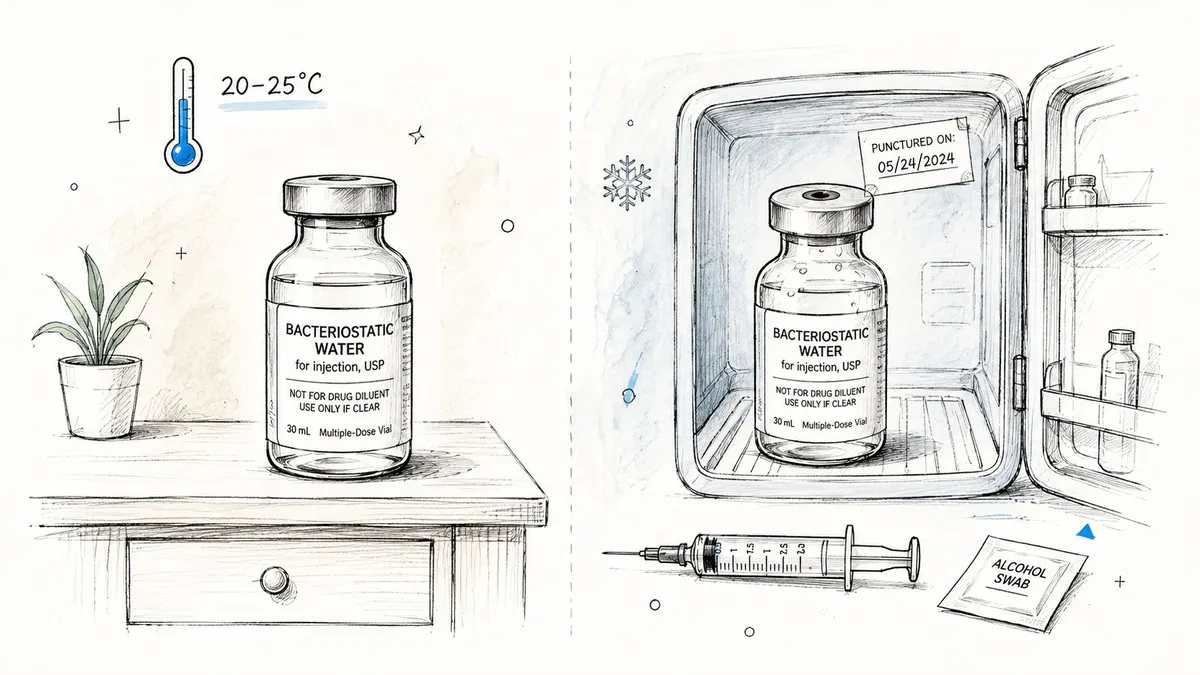
You pull a fresh vial out of the pharmacy bag, set it on the counter, and half an hour later you’re staring at a second vial in the fridge door, wondering why the rules feel inconsistent. They aren’t inconsistent. Bacteriostatic water storage has two separate phases, and the moment a needle touches the stopper, the storage logic changes.
That split matters because sealed bacteriostatic water follows the label, while an opened vial follows an in-use countdown. If you treat those as one continuous rule, you either over-handle a vial that’s still sealed or under-protect one that’s already been punctured. The right workflow is simple once you separate the phases in your head.
Table of Contents
- Why Bacteriostatic Water Storage Has Two Distinct Phases
- Unopened Vials and the 20 to 25°C Standard
- What Changes Once the Stopper Is Punctured
- Contamination Prevention Habits That Actually Matter
- Labeling and Tracking Your 28-Day Window
- Quick Storage Reference Checklist
Why Bacteriostatic Water Storage Has Two Distinct Phases
A sealed vial on your shelf and a half-used vial in the refrigerator look similar, but they’re not operating under the same storage logic. The unopened vial is protected by its original seal and labeled for controlled room temperature, while the opened vial has already entered a preservation window that depends on aseptic handling and time discipline.
The preservative in bacteriostatic water is benzyl alcohol, and its job is to inhibit microbial growth after the vial is accessed. That protection helps, but it doesn’t turn an opened vial into something you can ignore. Once the stopper is breached, the vial becomes a working container with a countdown attached to it.

Two phases, two different habits
The sealed phase is about preserving the manufacturer’s packaging and temperature band. The in-use phase is about protecting access points from contamination and respecting a discard date that isn’t negotiable just because the liquid still looks clean.
That’s the mental shift most home users need. A vial that hasn’t been punctured belongs with the rest of your supplies. A vial that has been punctured belongs in a routine, with dates, refrigeration, and careful access every time.
Practical rule: If the seal is intact, follow the label. If the stopper has been punctured, follow the in-use clock.
For a broader handling routine, the peptide storage guide at PepFlow’s peptide storage overview fits neatly into the same two-phase mindset. The point isn’t to complicate the workflow, it’s to keep a clear line between sealed product and opened product.
Unopened Vials and the 20 to 25°C Standard
The sealed-vial rule is more specific than a casual “room temperature” assumption. FDA-approved labeling for bacteriostatic water places unopened product in controlled room temperature, 20 to 25°C, or 68 to 77°F, and DailyMed records show that this standard appears across multiple labeled products and dates spanning at least 2014 through 2026. That matters because the label is tying stability expectations to a narrow band, not to a vague household environment. FDA-approved labeling on DailyMed
A closed cabinet, drawer, or shelf works well if it stays away from direct sunlight, radiators, and humid bathroom air. Refrigerating an unopened vial is unnecessary under that labeling framework, and it can be counterproductive when a cold vial is later warmed in open air, because condensation can form on the glass and around the cap. That’s not the same as saying a sealed vial is fragile, it’s just a reason not to create avoidable moisture on the outside of the container.
What the label is really asking you to protect
The sealed vial’s sterility depends on the intact closure. Until the stopper is compromised, the benzyl alcohol inside hasn’t been put to work in the way opened-vial handling requires, because the primary protection is still the untouched packaging system.
If you want a useful comparison point, insights from VirusFAQ.com are worth reading alongside the label mindset here. The value isn’t in copying vaccine storage into peptide prep, it’s in seeing how seriously regulated products are treated when packaging integrity matters.
| Parameter | Specification | Rationale |
|---|---|---|
| Storage state | Unopened, sealed vial | The seal is still intact, so the product remains in its labeled storage phase. |
| Temperature band | 20 to 25°C | This is the controlled room temperature range named on FDA-approved labeling. |
| Light exposure | Limit direct light | Packaging and placement should reduce unnecessary exposure. |
| Location | Cabinet, drawer, or shelf | Stable, dry storage is easier to maintain than a high-traffic area. |
| Refrigeration | Not needed for the sealed vial | The label does not require the cold chain before first puncture. |
The mistake is overcorrecting. Sealed bacteriostatic water doesn’t need to live in the fridge, and it doesn’t benefit from being treated like an opened multi-dose vial before it’s ever been used.
What Changes Once the Stopper Is Punctured
The moment a needle breaks the stopper, the vial stops being a sealed product and starts being an in-use container. From that point on, the practical rule changes in three ways at once, refrigerate at 2 to 8°C, track a 28-day discard window, and treat every access as a fresh aseptic event. The 28-day post-puncture rule is the standard multi-dose-vial framework commonly used for sterile containers once opened or needle-punctured, unless the manufacturer says otherwise. Neutral summary of the 28-day handling rule
That transition is where a lot of home setups go sideways. People keep the same vial on the counter for convenience, then justify it because the liquid still looks clear. Clarity is not a sterility test, and it never has been.
Each access needs the same discipline
Before every withdrawal, disinfect the stopper with 70% isopropyl alcohol and let it dry. Use a fresh sterile needle and syringe every time, because reusing either one defeats the point of a preserved multi-dose vial.
After the draw, return the vial to refrigeration if that’s the storage practice your label or institutional policy follows. The reason is practical, not ceremonial. Refrigeration slows avoidable stress on the in-use container, and it reduces the chance that warm-room handling becomes a habit.
The vial doesn’t become unusable on day 29 by magic. The 28-day window is a conservative safety boundary, and the safest move is to respect it even when the contents still look normal.
The temptation to leave a punctured vial at room temperature for convenience is understandable, but it works against the preservative’s limited role. The benzyl alcohol slows growth, it doesn’t erase contamination introduced by poor access habits.
Contamination Prevention Habits That Actually Matter
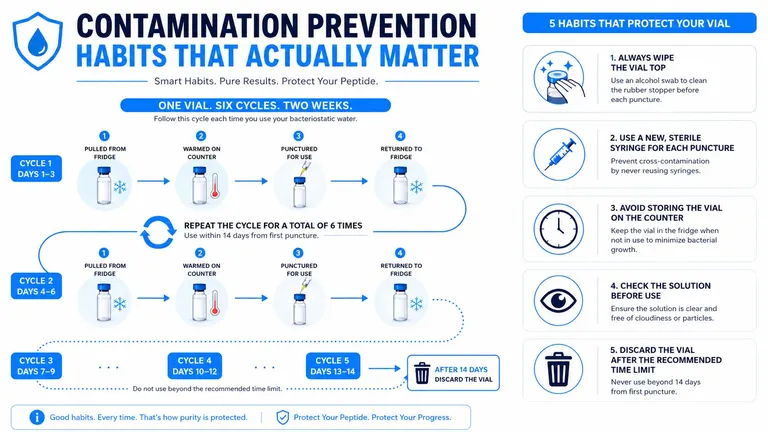
A vial can look perfect and still be a poor candidate for use. I’ve seen home prep routines where the same bottle gets pulled from the fridge, warmed on the counter, punctured, and returned again and again over two weeks. Nothing about the liquid’s appearance proves it stayed clean, and that’s the trap people fall into.
The habits that prevent avoidable mistakes
Start with the stopper. A quick wipe with a fresh alcohol pad, followed by a real drying pause, is more useful than a rushed swipe and immediate puncture. The goal is to remove surface contamination before you create a path into the vial.
Then control the hardware. A new sterile syringe and needle each time is the standard that keeps the workflow honest. Never recap a used needle and re-enter the vial, and never pool leftovers from one container into another.
Avoid unnecessary temperature cycling too. Repeated warm-to-cold swings create condensation risks and add handling steps that don’t improve safety. If the vial has been compromised, looks cloudy, shows particles, or has a damaged stopper, don’t try to nurse it along.
For a practical contamination checklist, PepFlow’s contamination prevention guide fits well with the same home setup mindset. The useful habits are boring on purpose, because boring habits are what keep the vial usable through the window it was designed for.
The safest home workflow is the one that doesn’t rely on visual reassurance. Clear liquid is nice, but sterile technique is what counts.
Bottom line: If you can’t prove the vial stayed aseptic, you should assume it didn’t.
A physical accessory like a portable germicidal disinfecting uv lamp may help in a broader clean-storage routine, but it doesn’t replace stopper disinfection, fresh needles, or the 28-day rule. Those are the controls that matter for the vial itself.
Labeling and Tracking Your 28-Day Window
The easiest way to respect the 28-day in-use limit is to make it visible before memory has a chance to fail. The moment the stopper is punctured, write the date on the label with a fine-tip permanent marker, then write the discard date right beside it. If the vial is part of a multi-vial rotation, add the peptide name or batch name too, because mixed labels are how good routines get messy.
A small printed sticker works better than a loose sticky note that gets buried behind other supplies. I prefer a label that forces me to see the deadline every time I open the fridge, because sight beats recollection when you’re moving fast.
Some people also keep a short log in a notes app or a paper book. That isn’t overkill, it’s just another way to make the discard date unavoidable.
| Field | Purpose |
|---|---|
| First puncture date | Starts the 28-day countdown |
| Discard date | Creates a clear end point |
| Product or batch name | Reduces mix-ups when several vials are in rotation |
| Storage location | Helps confirm the vial is where it should be |
| Lot number | Adds traceability if you need to review the vial later |
The point of tracking is not to prove the vial still looks fine. It’s to stop you from talking yourself into extending a vial because it seems pristine. For a structured reminder workflow, PepFlow’s expiration date tracking guide is a useful companion, since calendar discipline is half the battle with any punctured vial.
A label that shows the first puncture date and the discard date turns the storage rule into a decision you don’t have to remake every day.
Quick Storage Reference Checklist
Pin this next to the kit and the decision gets a lot easier. The sealed vial and the opened vial are handled differently, and the quickest way to stay safe is to stop blending those rules together.
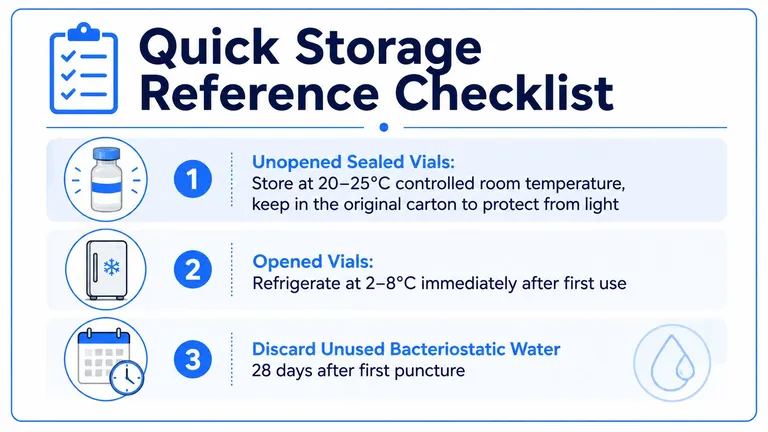
Unopened sealed vials go in controlled room temperature storage, not the fridge, unless the manufacturer label says otherwise. Keep them in the original carton when possible, away from direct light and heat, and check the printed expiration date before the vial ever enters use. The label matters more than habit.
Opened vials move into a refrigerator workflow. After first puncture, store the vial at 2 to 8°C, wipe the stopper before every access, and use a fresh sterile needle and syringe each time.
Discard timing is mandatory. Once punctured, the vial is on a 28-day countdown, and the deadline wins even if there’s visible liquid left.
The home setup rule that keeps people out of trouble
Don’t keep re-deciding what the vial needs each time you open the fridge. Sealed vials follow one rule set, opened vials follow another, and most storage mistakes happen when those two get blurred together.
If you’re building a peptide workflow, PepFlow helps with the planning side of that routine, especially when dosing math and dose timing need to stay organized. Keep the storage rules tight, then use PepFlow to stay consistent with the rest of your preparation and scheduling workflow.