You’re holding a vial of powdered medication, a vial of bacteriostatic water, and an insulin syringe, trying to decide whether the markings on the barrel match the volume you need. The arithmetic may look simple, but small errors become harder to see when the draw is only a few units. Sterility creates a second risk: a vial that appears usable can still be unsuitable after careless handling or excessive storage time.
Safe use of bacteriostatic water and insulin syringes depends on two separate disciplines. You need the correct diluent for the medication protocol, and you need a syringe size that makes the intended volume readable. You also need a clear plan for opening, storing, and discarding multi-dose vials.
Table of Contents
- What Bacteriostatic Water Is and Why It Matters
- Choosing the Right Diluent for Insulin Syringes
- Understanding Insulin Syringe Units and Dosing Accuracy
- How to Draw and Inject With Bacteriostatic Water and Insulin Syringes
- Reuse Storage and Sterility Tips You Should Follow
- Staying Accurate and Consistent Over Time
What Bacteriostatic Water Is and Why It Matters
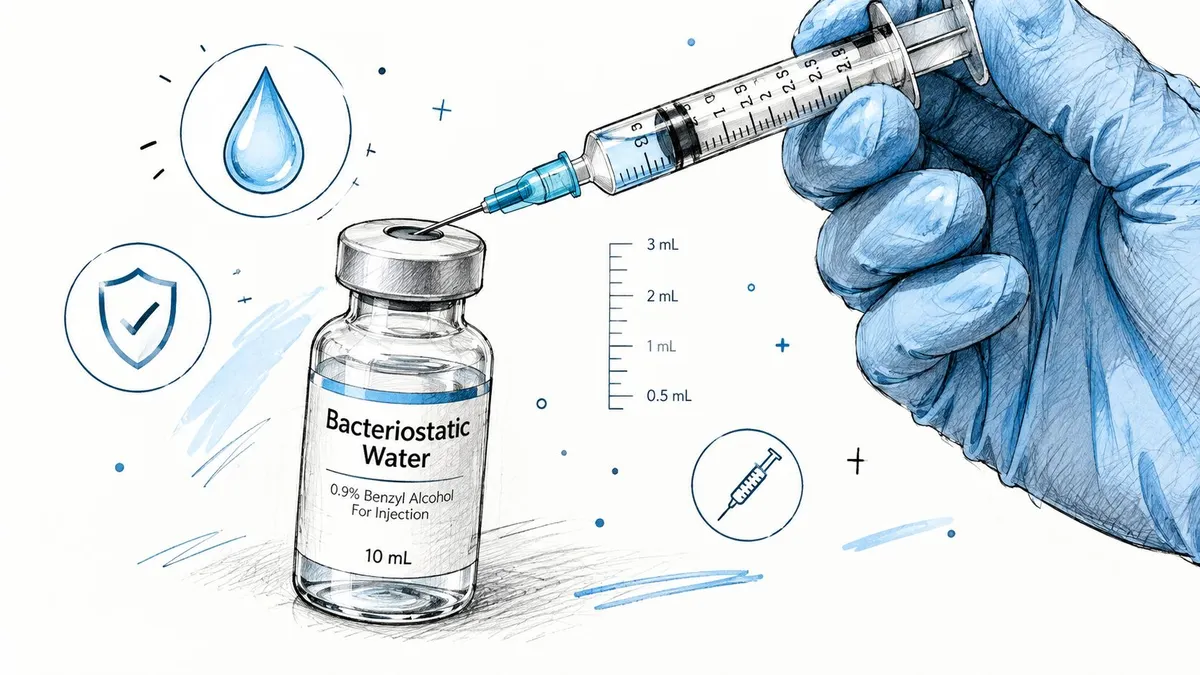
Bacteriostatic Water for Injection is a sterile, nonpyrogenic water-for-injection preparation containing benzyl alcohol as a bacteriostatic preservative. The most commonly identified formulation contains 0.9% benzyl alcohol, equal to 9 mg per mL, while some current product presentations list 1.1%, or 11 mg per mL. These details belong on the product label, so check the vial rather than relying on a generic online description. The official DailyMed labeling for bacteriostatic water identifies the composition, sterile preparation, and multi-dose presentation.
The preservative is the important distinction. Plain sterile water is sterile when supplied, but it doesn’t contain the same preservative protection between withdrawals. Bacteriostatic water is designed to inhibit bacterial growth between repeated entries when the medication protocol allows a multi-dose diluent. That doesn’t make careless technique safe, and it doesn’t make every medication compatible with it.

What multi-dose means in practice
A multi-dose vial is intended to support repeated withdrawals under controlled handling. It isn’t an invitation to keep using a vial indefinitely. Every entry can introduce contamination, especially if the stopper isn’t disinfected, a needle touches a nonsterile surface, or equipment is reused.
Benzyl alcohol also matters for patient suitability. Product labeling warns of neonatal toxicity associated with benzyl alcohol, which is why preservative-free sterile water is preferred for neonates. A clinician or pharmacist must decide which diluent is appropriate for the medication, route, and patient.
Key takeaway: Bacteriostatic water is sterile water with a defined preservative, not a universal replacement for sterile water, saline, or a pharmacy-specified diluent.
The same distinction appears in other controlled laboratory settings, where water quality depends on the system, intended use, validation, and maintenance. If you’re comparing infrastructure rather than injectable products, this overview of lab water system cost and maintenance provides useful context, but laboratory purification systems aren’t substitutes for labeled injectable water.
For a plain-language overview of applications and limitations, see what bacteriostatic water is used for. Always follow the medication label and the written direction from your prescriber or compounding pharmacist.
Choosing the Right Diluent for Insulin Syringes
The insulin syringe doesn’t determine which diluent you should use. It only measures the volume you’ve been instructed to draw. The medication label, prescriber, or pharmacist determines whether bacteriostatic water, preservative-free sterile water, saline, or another injection-grade diluent is compatible.
| Diluent | Preservative | Multi-Dose Suitability | Best Use Case |
|---|---|---|---|
| Bacteriostatic Water for Injection | Usually benzyl alcohol, with the concentration stated on the label | May support repeated withdrawals when the protocol allows it | A labeled multi-dose workflow requiring bacteriostatic water |
| Preservative-free Sterile Water for Injection | None | Generally suited to single-use handling, according to the product instructions | Situations where preservative-free water is specifically required, including neonatal use |
| Sterile saline | Product-specific, often without benzyl alcohol | Depends on the exact product and protocol | Medication-specific dilution when sodium chloride injection is prescribed or supplied |
| Tap or boiled water | Not an approved injectable diluent | Not suitable | Never use for injection or reconstitution |
Bacteriostatic water and saline aren’t interchangeable. Their ingredients, osmolarity, compatibility, and labeling differ, so substituting one for another can change the preparation in ways you can’t assess from syringe markings alone. The same caution applies to sterile water. A vial being labeled “sterile” doesn’t mean it’s appropriate for repeated withdrawal or compatible with your medication.
The comparison of bacteriostatic water and saline can help clarify the practical distinction, but it shouldn’t override the instructions attached to your specific product.
Make the decision before measuring
Check four things before you pick up the syringe:
- Medication compatibility: Confirm the diluent named in the prescription, pharmacy label, or manufacturer instructions.
- Preservative requirement: Determine whether the protocol permits benzyl alcohol.
- Withdrawal pattern: Identify whether the preparation is intended for single use or repeated access.
- Patient factors: Pay particular attention to neonatal warnings and any patient-specific contraindication.
Don’t choose bacteriostatic water just because it’s widely discussed online. Don’t choose saline because it happens to be available. The correct diluent is the one specified for that medication and handling plan.
Understanding Insulin Syringe Units and Dosing Accuracy
A U-100 insulin syringe uses a volume scale, not a universal medication-dose scale. Under the U-100 standard, 100 units equals 1 mL, so 1 unit equals 0.01 mL. That relationship applies to the syringe’s volume markings. It doesn’t tell you how many milligrams or micrograms of medication are present in those units.
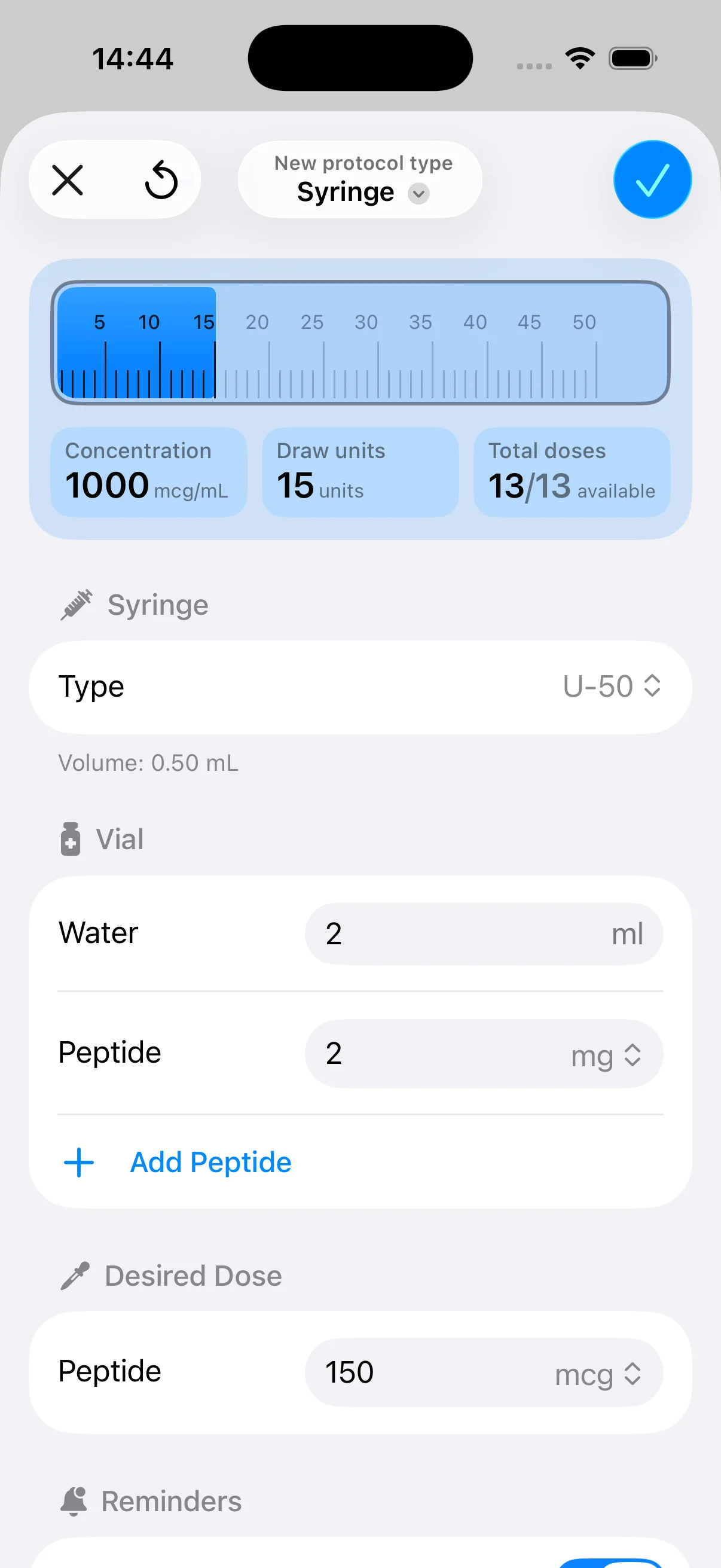
For a concentration-based calculation, first establish the medication concentration from the label or pharmacist. Then calculate the required liquid volume, and only after that convert the volume to syringe units. If the required volume is 0.10 mL, the U-100 conversion produces 10 units. If the required volume is 0.05 mL, it produces 5 units. These are volume conversions, not dosing recommendations.
Barrel size changes readability
The 0.3 mL, 30-unit syringe is generally easiest to read for low-volume draws up to about 30 units because the barrel is smaller and the markings occupy a more useful visual range. A 0.5 mL, 50-unit syringe provides more capacity, while a 1 mL, 100-unit syringe is useful when the required volume is larger but can make a tiny draw harder to judge.
The issue isn’t just convenience. Peer-reviewed measurement work reported approximately 32% error at 0.05 mL and 17% error at 0.1 mL in a 1 mL syringe, with accuracy improving as fill volume increases. Those figures are reported in the insulin syringe sizing and measurement guide. They show why a large barrel can be a poor choice for a very small draw, even when the unit conversion is correct.
Practical rule: If the intended volume is below 0.10 mL, treat syringe readability as a safety issue, not a minor preference.
When unit markings become too coarse
A U-100 scale always maps one unit to 0.01 mL, but the physical line spacing and plunger position determine how confidently you can align the dose. At very small volumes, a slight movement of the plunger can represent a meaningful fraction of the intended draw. Air bubbles, dead space, and parallax can add further uncertainty.
Choose the smallest barrel that can hold the required volume without forcing the plunger beyond its readable range. A 0.3 mL syringe usually offers the clearest view for low-unit measurements, while 0.5 mL or 1 mL syringes become more practical as the volume increases. Before drawing, have someone qualified verify both the concentration calculation and the syringe scale.
For a visual explanation of barrel markings and unit reading, use this guide on how to read insulin syringes. Never convert a microgram dose into units without confirming the final concentration.
How to Draw and Inject With Bacteriostatic Water and Insulin Syringes
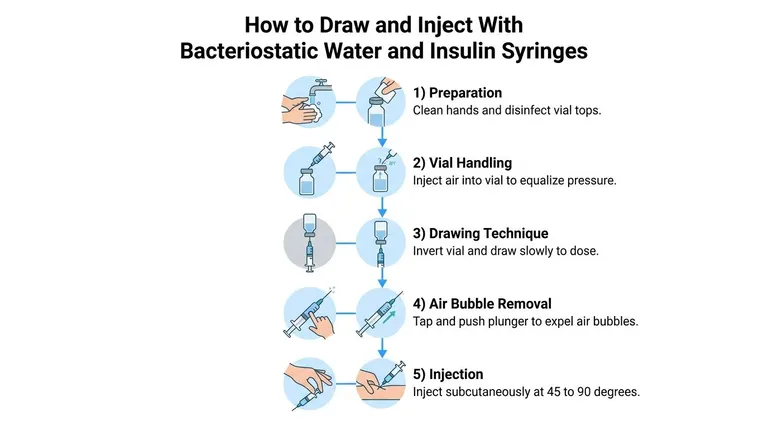
A clean workflow begins before the syringe touches either vial. Put the medication, specified diluent, new sterile syringe, alcohol swabs, and sharps container on a clean surface. Wash your hands, inspect both vial labels, and confirm that the diluent and medication match the written instructions.
Prepare the vials and syringe
Disinfect each rubber stopper with a fresh alcohol swab and let it dry completely. Don’t blow on it or wipe it dry, because that can recontaminate the surface or leave alcohol where the needle will enter. Use separate sterile equipment for reconstitution and injection whenever the instructions require it.
Draw air into the syringe if the vial instructions call for pressure equalization. Insert the needle through the diluent stopper, inject the air, invert the vial, and draw the specified volume slowly. Keep the needle tip below the liquid surface while drawing so you don’t pull air instead of diluent.
Add liquid without damaging the preparation
Insert the needle through the medication vial stopper and, if the product instructions direct you to do so, angle it toward the inside glass wall. Press the plunger slowly so the liquid runs down the side rather than striking the powder directly. Some products have specific mixing requirements, so follow the pharmacy or manufacturer instructions instead of adopting a generic technique.
Don’t shake a reconstituted vial unless the product instructions specifically permit it. Gentle swirling may be appropriate for some preparations, but the expected appearance is product-specific. If the solution becomes unexpectedly cloudy, changes color, or contains visible particles, stop and ask the pharmacist before using it.
Draw the measured dose
After the medication is prepared, swab the stopper again and let it dry. Use a new sterile insulin syringe if the medication is intended for subcutaneous administration and that device has been specified. Draw slowly to the calculated unit mark, keeping your eye level with the scale.
Small draws deserve extra attention. A bubble that looks insignificant in a larger volume can occupy a meaningful part of a very small draw, so tap the barrel gently and push the air back into the vial when appropriate. Recheck the plunger edge against the correct marking rather than estimating from the top of the liquid.
The embedded demonstration below can reinforce the visual sequence, but it doesn’t replace medication-specific instructions or hands-on training.
Inject and dispose safely
For a prescribed subcutaneous injection, clean the skin as directed, use the site and angle specified for the medication, and inject steadily. Never reuse the syringe or needle, even if the vial is being used again. Place the used sharp directly into an approved sharps container, and don’t recap unless a qualified professional has specifically taught you a safe method.
If you’re unsure whether the dose, route, needle, or prepared solution is correct, pause before injecting. A pharmacist or prescriber can resolve uncertainty before it becomes a medication error.
Reuse Storage and Sterility Tips You Should Follow
The most overlooked part of bacteriostatic water handling is what happens after the first puncture. The preservative can inhibit bacterial growth, but it doesn’t eliminate contamination risk and doesn’t create an unlimited in-use period. Neutral handling guidance identifies 28 days after opening as the discard point for opened bacteriostatic water vials, unless the product or qualified professional gives a different instruction. See the guidance on bacteriostatic water storage and discard timing alongside the label for your specific product.
Write the opening date directly on the vial or on an associated record. Don’t rely on memory, especially when several vials look alike. Store the vial exactly as its label directs, keep it protected from contamination, and avoid placing it where the stopper can be touched or exposed to spills.
A simple post-opening checklist
- Track the first puncture: Record the date as soon as the vial is opened.
- Swab before every entry: Use a fresh alcohol swab and allow the stopper to dry.
- Use sterile equipment: Never reuse a syringe or needle, and never return unused liquid to the vial.
- Inspect before drawing: Look for cloudiness, particles, discoloration, damaged packaging, or an abnormal appearance.
- Discard on time: Follow the labeled in-use period, with 28 days as the neutral guidance for opened bacteriostatic water when no different instruction applies.
Bacteriostatic water isn’t interchangeable with saline, sterile water, tap water, or boiled water. Tap and boiled water aren’t injectable diluents, and sterile water without preservative doesn’t provide the same multi-dose handling characteristics. The syringe and bacteriostatic water handling guide also emphasizes checking the U-100 scale and matching barrel capacity to the intended volume.
Storage rule: If you can’t verify when the vial was opened, how it was handled, or whether its appearance is normal, don’t try to rescue it. Discard it and obtain a properly labeled replacement through the appropriate clinical or pharmacy channel.
FDA recall language has described severe outcomes, including invasive bacterial infection, meningitis, and septicemia, when sterilization isn’t confirmed. That warning explains why a multi-dose label must never be treated as permission to relax aseptic technique.
Staying Accurate and Consistent Over Time
Accuracy is a repeatable process, not a single careful draw. Match the syringe barrel to the volume, confirm the U-100 conversion, record the concentration, and check the vial’s opening date before every use. When the draw is below 0.10 mL, choose readability over convenience and have the calculation independently checked.
A calculator can reduce manual arithmetic, but it can’t decide whether a medication is compatible with bacteriostatic water or whether a vial remains sterile. PepFlow provides a dosage calculator that converts a specified concentration and volume into U-100 syringe units, and it also supports protocol scheduling and reminders. Use tools like this to check written instructions, not to replace a prescriber or pharmacist.
Your next practical action is to label the vial with its opening date, verify the diluent against the medication instructions, and select the smallest suitable syringe before preparing anything. If you want a single place to organize concentration calculations and scheduled reminders, visit PepFlow and use it alongside professional guidance to keep your routine documented and consistent.