You’re at the bench with a lyophilized peptide vial in one hand and two diluents beside it. The protocol calls for repeated subcutaneous injections, but the labels leave you asking the practical question: bacteriostatic water or saline?
The answer depends less on which liquid looks more appropriate on paper and more on what happens after reconstitution. Will you puncture the vial once, or repeatedly? Will the preparation sit in your refrigerator across several days? Does the peptide tolerate benzyl alcohol? Do you need an isotonic vehicle, or do you need a preserved diluent designed for repeated withdrawal?
For peptide workflows, the wrong choice usually shows up downstream. You may see unnecessary injection discomfort, a preparation that doesn’t behave as expected, or a vial that has to be discarded before the protocol is complete. The most useful way to compare bacteriostatic water vs saline is to judge each option by the life of the reconstituted vial.
Table of Contents
- Staring at Two Vials on Your Bench
- What Each Diluent Actually Is
- Side-by-Side Properties That Matter
- Reconstituting Peptides With Each Option
- Multi-Dose Handling and the 28-Day Rule
- Matching the Diluent to Your Protocol
- Choosing the Right Vial for Your Situation
Staring at Two Vials on Your Bench
A common recon moment starts with a dry peptide cake, a sterile syringe, and two candidate diluents lined up on the work surface. The peptide may be labeled 10 mg, and the schedule may call for small injections over several days or weeks. At that point, the diluent isn’t a minor accessory. It determines how you prepare the concentration, how often you can access the vial, and whether the remaining solution can stay in the workflow.
Start with the protocol, not the vial.
- Count the planned withdrawals. One injection from a vial creates a very different handling problem from repeated daily access.
- Check the product instructions. The peptide manufacturer, pharmacist, or prescribing clinician may specify a particular diluent or warn against preservatives.
- Decide whether isotonicity matters. Normal saline provides an isotonic sodium chloride vehicle. Bacteriostatic water provides water for injection with benzyl alcohol, not an isotonic saline solution.
- Map the storage period. A preparation used immediately has no need for a multi-dose preservative window. A vial opened repeatedly across a longer protocol does.
Practical rule: Choose the diluent for the vial’s entire lifespan, not just for the moment the powder first dissolves.
The most frequent mistake is treating the two options as interchangeable because both can dissolve or dilute injectable preparations. They aren’t interchangeable in handling. Bacteriostatic water is designed around preserved, repeated access, while saline is preservative-free and generally treated as single-dose once opened.
That distinction affects more than contamination control. It can influence the volume you choose, the concentration you calculate, the feel of the injection, and how much material may be discarded. If the vial will be punctured repeatedly, the multi-dose design deserves priority. If you’ll use the full preparation in one sitting and need a preservative-free isotonic vehicle, saline is the cleaner fit.
What Each Diluent Actually Is
Bacteriostatic water for injection, often abbreviated BWFI, is sterile, nonpyrogenic water for injection containing 0.9% benzyl alcohol, or 9 mg/mL, as a preservative. U.S. product labeling identifies that preservative as the feature supporting multi-dose use. Bacteriostatic water is commonly supplied in 30 mL multi-dose vials, reflecting its intended repeated-withdrawal role. These label facts are documented in the DailyMed bacteriostatic water for injection labeling.
Normal saline, formally 0.9% sodium chloride injection, is sodium chloride dissolved in water for injection. Its label describes it as containing no bacteriostat, antimicrobial agent, or added buffer. It’s intended as a single-dose injection, so the absence of preservative is not an omission. It’s part of the product’s design.
| Property | Bacteriostatic Water | Normal Saline (0.9% NaCl) |
|---|---|---|
| Base | Sterile water for injection | Water for injection with sodium chloride |
| Preservative | 0.9% benzyl alcohol, 9 mg/mL | No bacteriostat or antimicrobial preservative |
| Container posture | Commonly a 30 mL multi-dose vial | Commonly supplied as a single-dose injectable |
| Main practical role | Repeated withdrawal from a preserved diluent vial | Preservative-free, isotonic dilution or injection vehicle |
| Tonicity | Not an isotonic saline solution | Isotonic 0.9% sodium chloride solution |
| Repeated access | Supported by the preservative, subject to labeling and handling rules | Not intended for routine repeated access after opening |
The composition matters because it creates two different preparation philosophies. Bacteriostatic water trades the absence of additives for a preservative that helps inhibit bacterial growth during repeated withdrawals. Saline preserves a no-antimicrobial-agent formulation and supplies sodium chloride when an isotonic vehicle is required.
Plain water is hypotonic, while normal saline is approximately isotonic at about 308 mOsm/L, a property that can affect injection tolerance and compatibility. The product label, peptide-specific instructions, and clinical guidance still control the final decision. For readers evaluating peptide use in a broader wellness context, this overview of peptide therapy for anti-aging can provide useful background, but it doesn’t replace the instructions for a particular preparation.
Historical context helps explain why saline is so familiar. Reviews trace saline use to the cholera pandemic of 1831 in Europe, and the phrase “normal saline” was first recorded in the Lancet on 29 September 1888. A UK review also reports that nearly 10 million litres of 0.9% saline are infused intravenously each year, illustrating its established clinical role. Those figures and historical details come from the review indexed by PubMed on the history and use of normal saline.
Side-by-Side Properties That Matter
At the bench, the relevant difference isn’t just water versus saltwater. It’s the way each property changes your preparation and injection routine.
| Property | Bacteriostatic Water | Normal Saline |
|---|---|---|
| Tonicity | Hypotonic water-based vehicle | Isotonic 0.9% sodium chloride vehicle |
| Preservative | Contains 0.9% benzyl alcohol | Contains no antimicrobial preservative |
| Multi-dose practicality | Suited to repeated withdrawals under labeled handling limits | Suited to single-use preparation |
| Injection feel | May produce a sting for some users because of the preservative and formulation | Often preferred when a preservative-free isotonic vehicle is needed |
| Peptide behavior | Often selected when a water-based diluent is compatible | Selected when isotonic saline or a preservative-free vehicle is specified |
| Storage posture | Requires careful refrigerated handling after reconstitution | Requires immediate-use, single-dose handling after opening |
| Cost per mL | Can be practical for a longer multi-dose workflow | May create more waste when the full vial can’t be used promptly |
The tonicity difference is the first physical property many users notice. Saline’s sodium chloride content makes it isotonic, which can make it more comfortable for some injection routes and tissues. Bacteriostatic water isn’t isotonic saline, and the benzyl alcohol may contribute to a sting. Comfort still depends on the peptide, concentration, injection volume, needle, technique, and individual sensitivity.
The preservative is the decisive operational property. Benzyl alcohol helps bacteriostatic water support repeated withdrawal, but it also means the diluent isn’t appropriate for every subject. The FDA safety communication on bacteriostatic water containing benzyl alcohol reinforces the need to respect product warnings and population-specific restrictions. Newborns must not receive benzyl alcohol-containing preparations, and clinicians may avoid benzyl alcohol for subjects with relevant sensitivity.
Peptide solubility is more compound-specific than online protocols often admit. Some preparations dissolve smoothly in water-based diluent, while others are formulated or labeled for saline. Aggregation and stability can vary with the peptide, concentration, pH, temperature, container, and storage duration. Don’t treat a general preference as a compatibility guarantee.
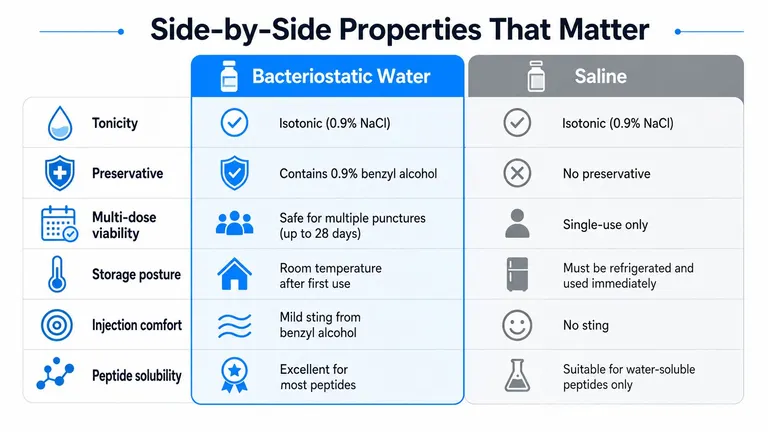
No single row wins outright. Saline wins for preservative-free isotonic use. Bacteriostatic water wins when repeated access and reduced waste matter more than avoiding benzyl alcohol.
Reconstituting Peptides With Each Option
Use the 10 mg vial as a calculation example, not as a universal protocol. The final volume must follow the peptide’s instructions and the guidance of a qualified professional.
With bacteriostatic water, the arithmetic is straightforward:
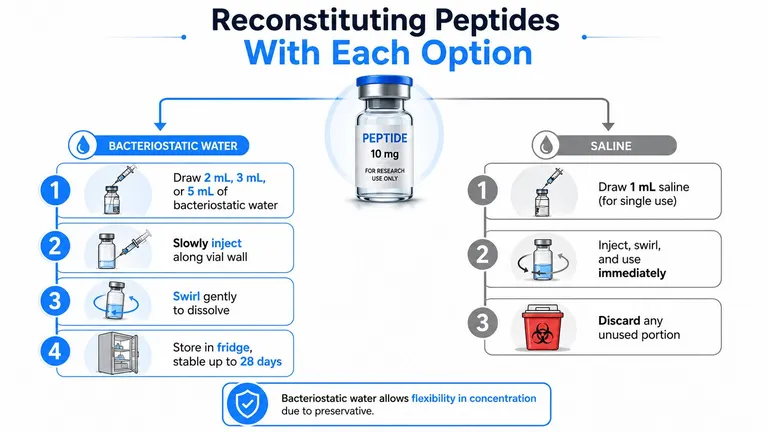
- 2 mL added to 10 mg produces a nominal concentration of 5 mg/mL.
- 5 mL added to 10 mg produces a nominal concentration of 2 mg/mL.
- 3 mL added to 10 mg produces a concentration between those examples, with the exact amount calculated from the total peptide mass divided by the final volume.
Those example concentrations are mathematical relationships, not dosing recommendations. A smaller total volume creates a more concentrated preparation, so each draw can be physically smaller. A larger volume creates a less concentrated preparation, which may be easier to measure for some protocols but requires more liquid per dose.
A careful preparation sequence
- Inspect the vial and diluent. Confirm the identity, labeling, seal, clarity, and expiration information. Don’t use a container with visible particles, cloudiness, damaged closure, or questionable storage history.
- Use sterile technique. Wash your hands, use a fresh sterile syringe and needle, and disinfect the vial stopper with an alcohol swab. Let the stopper dry.
- Control the needle angle. Insert the needle through the stopper without scraping aggressively against the rubber. Keep the process slow and deliberate.
- Add diluent against the glass wall. Direct the stream down the inside of the vial rather than blasting the dry cake. This reduces foaming and mechanical stress.
- Swirl gently. Roll or swirl the vial until the material dissolves. Don’t shake it vigorously. Agitation can create foam and may stress sensitive peptide structures.
- Inspect again. The finished solution should match the product’s expected appearance. Stop if you see unexpected particles, cloudiness, or precipitation.
Saline can use the same volume math, but the handling decision changes. If a 10 mg vial is prepared with saline for immediate use, the entire usable preparation should be handled as a single-use resource. If the planned work requires repeated access across days, saline may lead to discarded remainder unless the protocol uses separate single-use containers or directs another validated approach.
The volume calculation tells you concentration. It doesn’t tell you whether the vial is safe to keep accessing.
Some peptides or injectable compounds require a preservative-free diluent because benzyl alcohol is incompatible with the formulation or subject. In those cases, don’t substitute bacteriostatic water because the vial will be used repeatedly. Use the specified diluent and restructure the workflow around single-use handling, such as preparing only what can be used within the permitted window.
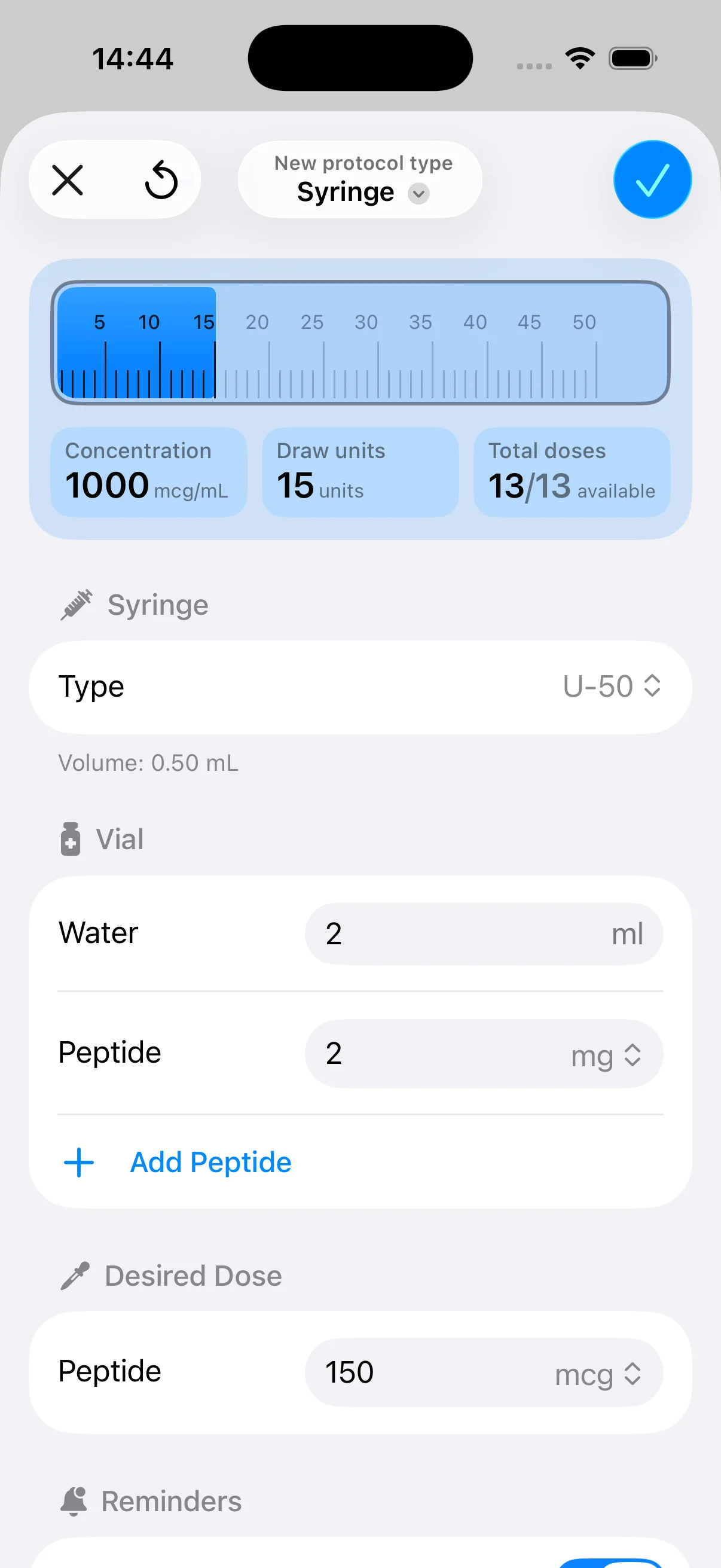
For people who need help organizing concentration and injection-volume calculations, PepFlow’s peptide reconstitution guide offers a workflow-specific reference. You can also browse peptide treatment options to understand how different clinical programs may specify different preparation requirements.
The core technique is the same with either diluent: slow addition, minimal agitation, accurate measurement, and no improvisation when the product instructions say otherwise.
Multi-Dose Handling and the 28-Day Rule
The practical advantage of bacteriostatic water appears after the first puncture. Its 0.9% benzyl alcohol preservative inhibits bacterial growth, allowing the diluent to support repeated withdrawals when the product labeling and sterile handling requirements are followed.
Common multi-dose practice constrains repeated puncture use to about 28 days after opening, and the vial should be discarded at that point even if liquid remains. That isn’t permission to ignore the package insert or product-specific instructions. It’s a handling limit used for preserved aqueous multi-dose preparations, not a promise that every reconstituted peptide remains chemically stable for the same period.
| Rule | Bacteriostatic Water | Saline |
|---|---|---|
| First-puncture posture | Multi-dose design because preservative inhibits bacterial growth | Single-dose design because no antimicrobial preservative is present |
| Access | Fresh sterile syringe and needle for every withdrawal | Use once after opening, then discard remaining solution |
| Stopper | Disinfect before each entry and allow it to dry | Disinfect before the single preparation |
| Storage | Follow the product label and keep refrigerated when directed | Use immediately after opening according to single-dose handling |
| Discard point | About 28 days after opening in common practice, or sooner if the label says so | After the single-use preparation |
| Visual inspection | Check for particles, cloudiness, discoloration, or precipitation before every draw | Check before use and discard if appearance is abnormal |
For refrigerated storage, follow the labeled range. In common handling, that means keeping the preparation in the refrigerator at 2–8°C, avoiding freezing, and protecting it from unnecessary temperature changes. The refrigerator doesn’t repair poor aseptic technique, and a preservative doesn’t make a contaminated vial safe.
A disciplined daily routine is simple:
- Fresh syringe every time: Never reuse a syringe or needle.
- Clean stopper every time: Swab the rubber closure before each puncture.
- Cold storage between uses: Return the vial to the refrigerator promptly when the label directs refrigerated storage.
- Visual check before drawing: Stop if the solution looks different from its expected appearance.
- Written discard date: Mark the opening date so the 28-day limit isn’t left to memory.
Saline follows a different rule. Once opened, it becomes a same-day, single-use resource. If you need repeated withdrawals, don’t make saline behave like bacteriostatic water by stretching it across the week. Reviewing bacteriostatic water shelf life can help organize dates, but the package insert and professional instructions remain authoritative.
Newborns and subjects with benzyl alcohol sensitivity are a hard stop for bacteriostatic water. In those situations, use a prescribed preservative-free option and redesign the preparation schedule rather than overriding the contraindication.
Matching the Diluent to Your Protocol
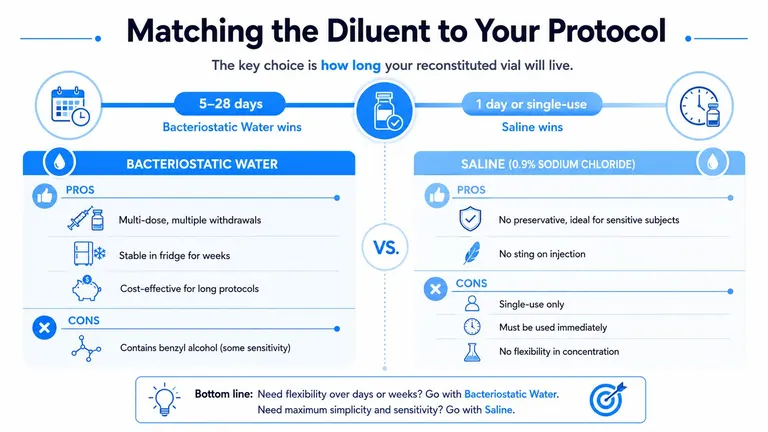
The cleanest decision rule is time. Ask how long the reconstituted vial will live and how many times someone will enter it.
Bacteriostatic water is the practical choice for a multi-day protocol. Daily peptide schedules, repeated research draws, and preparations that remain in service across several weeks all benefit from a preserved diluent, provided the peptide is compatible with benzyl alcohol and the subject can receive it. The main advantage is operational. You can plan one vial around repeated withdrawals instead of discarding usable liquid after the first access.
Saline earns the edge when the protocol is short and single-use. It makes sense for a preparation mixed in the morning and used during one session, a lab workflow that draws the full contents at once, or a compound that specifically calls for an isotonic, preservative-free vehicle. It’s also the appropriate direction when benzyl alcohol exposure is contraindicated.
The third option when BAC isn’t acceptable
Sometimes the peptide needs to cover several days, but bacteriostatic water isn’t appropriate. In that case, the solution isn’t to reuse an opened saline vial indefinitely. A clinician or laboratory may instead divide the work into separately prepared single-use containers, if the formulation and validated procedure permit it.
That approach can increase handling and material use, but it respects the preservative restriction. Purity and compatibility take priority over convenience.
The trade-off is clear:
- Choose bacteriostatic water when the vial will be accessed repeatedly, the peptide permits benzyl alcohol, and minimizing waste matters.
- Choose saline when the preparation is single-use, isotonicity is important, or preservative exposure must be avoided.
- Don’t substitute casually when the product documentation specifies one diluent.
For a protocol that needs concentration calculations, reconstitution planning, and date-based scheduling in one place, PepFlow’s peptide reconstitution solution guide is a useful planning reference. The tool you use for organization doesn’t replace clinical direction, but it can reduce avoidable math and scheduling mistakes.
Choosing the Right Vial for Your Situation
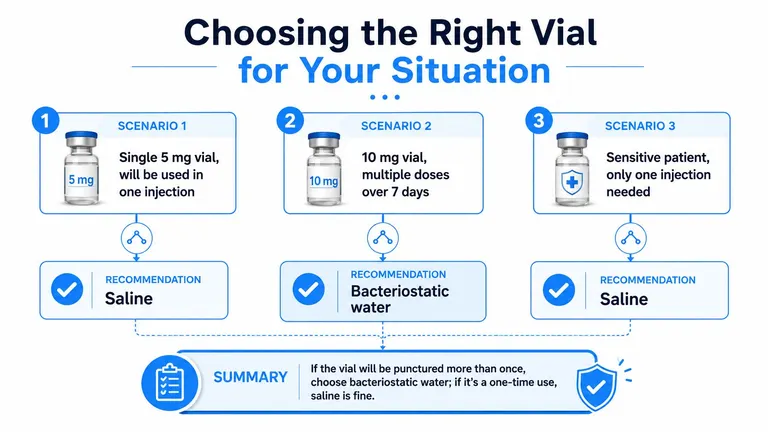
Consider three common scenarios.
A short five-day research cycle
You have a single 5 mg peptide vial and expect to consume it within five days for a short research cycle. If the preparation is intended for one immediate session, plain sterile saline is the sensible direction, assuming the peptide’s instructions permit saline. If the plan requires repeated access across those days, the single-use handling issue changes the recommendation. In that case, use a validated multi-dose approach or separate single-use preparations rather than treating an opened saline vial as reusable.
A 10 mg vial used over several weeks
A 10 mg vial divided into twice-daily doses over three to four weeks is the classic bacteriostatic-water scenario. Repeated withdrawals make the preservative relevant, and the common multi-dose practice window of about 28 days aligns with the intended duration, subject to the product label and peptide stability data. Bacteriostatic water reduces waste and makes the schedule easier to manage, provided benzyl alcohol is compatible.
A single high-dose session
A high-dose vial mixed once and discarded the same day works with either diluent if the formulation allows both. The preservative window has no practical value when there’s no second withdrawal. Choose saline when you want the preservative-free isotonic option, or use bacteriostatic water only when it’s specifically indicated and tolerated.
Use this four-question checklist before preparing the next vial:
- How long will the vial remain in use? Same session or one day points toward saline. Several days or weeks points toward bacteriostatic water if compatible.
- How many times will you puncture it? One entry supports single-use saline. Repeated entries favor bacteriostatic water.
- How does the peptide behave in the available vehicle? Follow the product’s instructions for solubility, compatibility, concentration, and storage. Don’t assume all peptides behave alike.
- Is benzyl alcohol acceptable? If the subject is a newborn, has a relevant sensitivity, or the product warns against benzyl alcohol, choose a preservative-free option and use a single-use workflow.
The decision rule is simple: repeated access over days or weeks favors bacteriostatic water; one-time use favors saline. That rule still bends to the peptide’s documentation and the subject’s safety requirements. The best diluent isn’t the one with the most appealing label. It’s the one that fits the actual life of the vial without creating an avoidable contamination, compatibility, or dosing problem.
PepFlow helps you configure vial concentration, convert a target amount into practical injection units, and schedule recurring peptide protocols with reminders and dose history. Visit PepFlow to organize the math and timing around your reconstitution workflow, while following your clinician’s instructions for product selection and safe handling.