There is no FDA-approved retatrutide dosage for routine use; studied once-weekly amounts ranged from 1 mg to 12 mg, with later targets often 4 mg, 9 mg, or 12 mg reached through escalation rather than given as the first injection. The popular advice to pick a weekly number from a chart leaves out the most important distinction: a research maintenance target isn’t a personal starting dose. See the retatrutide dosage reference.
A useful dosage explanation has to preserve the route researchers took to that target, including starting amounts, intervals, and tolerability decisions. It also has to separate a controlled trial from clinician direction and from calculations involving unregulated products. Those aren’t interchangeable ways of establishing a treatment plan. See the retatrutide evidence reference.
Table of Contents
- Weekly Doses Trials Actually Tested
- Why the Weekly Target Is Not Dose One
- How Trial Escalation Climbed to the Target
- Weight-Loss Results by Studied Dose
- When Tolerability Changes the Next Increase
- What Online Dose Math Cannot Decide
- Confirm the Plan Before You Log It
Weekly Doses Trials Actually Tested
A trial target is the amount researchers assigned for a study regimen, not necessarily the amount given at the first injection. The chart separates those targets from reported starting approaches and follow-up periods.
Studied weekly retatrutide targets
| Program | Weekly target | Typical start | Follow-up cited |
|---|---|---|---|
| Phase 2 obesity, 2023 | 1 mg research target | Low-dose arm, not a high-dose lead-in | 48 weeks |
| Phase 2 obesity, 2023 | 4 mg research target | 2 mg lead-in or direct start at 4 mg | 48 weeks |
| Phase 2 obesity, 2023 | 8 mg research target | 2 mg lead-in or direct start at 4 mg | 48 weeks |
| Phase 2 obesity, 2023 | 12 mg research target | A 2 mg lead-in before the target | 48 weeks |
| Phase 3 TRIUMPH programs | 4 mg research target | Escalation beginning at 2 mg | Outcomes to 68 weeks in a 2025 global trial |
| Phase 3 TRIUMPH programs | 9 mg research target | 2 mg, then stepwise increases | Outcomes to 68 weeks in a 2025 global trial |
| Phase 3 TRIUMPH programs | 12 mg research target | 2 mg, then stepwise increases | Outcomes to 68 weeks in a 2025 global trial |
The 2023 Phase 2 obesity trial evaluated assigned maintenance regimens and different starting strategies over 48 weeks. A later global registration trial announcement reported 9 mg and 12 mg once weekly, with outcomes measured at 68 weeks. These are study protocols, not instructions for an individual.
Read the program name before the milligrams
Different trials ask different questions. A dose-ranging study compares amounts to examine response and tolerability; a later registration program evaluates selected regimens in a defined population. A target used in one program does not provide a conversion rule for another.
Follow-up is the period researchers used to measure outcomes. It does not specify how long an individual should use an investigational product or when to stop.
For context on investigational treatments versus prescribed weight loss medicines, keep the status of each distinct. An investigational compound and an approved prescribed medicine do not become equivalent because both appear on weight-loss websites.
Chart-reading rule: Match each amount to its named trial and protocol before interpreting it.
When comparing a personal record with a published chart, check whether the amount represents a starting dose, an intermediate step, or an assigned maintenance target. The largest number in a table is not a personal dosing recommendation.
Why the Weekly Target Is Not Dose One
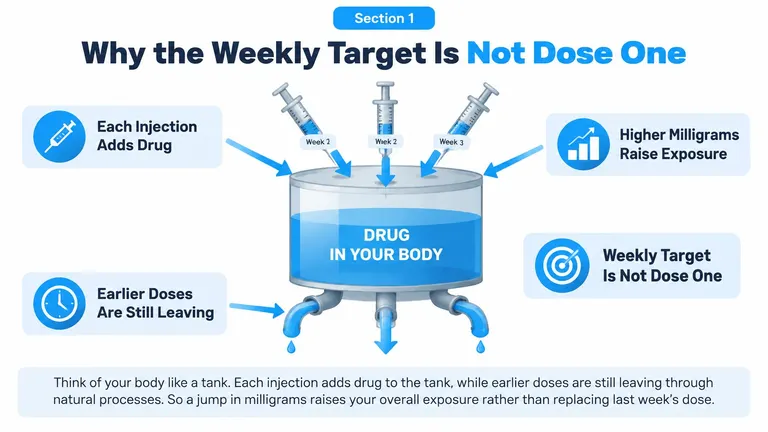
Think of a partly full tank with an inlet and a drain. An injection adds drug through the inlet while the body continues removing drug through the drain. The next injection doesn’t empty the tank and replace its contents.
That analogy explains why the sequence matters. Increasing the amount adds to exposure while some earlier drug is still leaving the body, rather than creating an isolated event with no connection to the previous injection.
The diagram illustrates that relationship between incoming medication and ongoing elimination.
What the half-life helps explain
Retatrutide’s development work described approximately dose-proportional pharmacokinetics and an elimination half-life of about 6 days, supporting the investigational once-weekly subcutaneous approach described in Lilly’s Phase 2 results announcement. That announcement also reported the largest mean weight reduction with the 12 mg regimen, up to 24.2% at 48 weeks.
A half-life describes elimination over time. It isn’t a countdown to the drug being completely absent, and it doesn’t establish a missed-dose rule. The tank analogy is conceptual, not a way to calculate someone’s remaining drug level at home.
Say a participant is assigned a higher maintenance target but is still receiving a lower introductory amount. Their current injection belongs to the introductory phase, even though the study paperwork also lists the eventual target. Entering only the target into a dose history would misrepresent what they received.
Record exposure as a sequence
A useful log preserves distinct fields rather than one ambiguous dose box:
- Current weekly amount: What the trial team or clinician has instructed for the present stage.
- Escalation date: When a change is planned, subject to the applicable instructions.
- Maintenance target: The eventual assigned amount, kept separate from today’s entry.
- Directed hold: Any pause and the instructions attached to it.
The important biological distinction is between reaching an exposure gradually and beginning with the amount intended for a later stage. A long half-life makes skipping the ladder a different exposure pattern, not a shortcut to the same plan.
How Trial Escalation Climbed to the Target
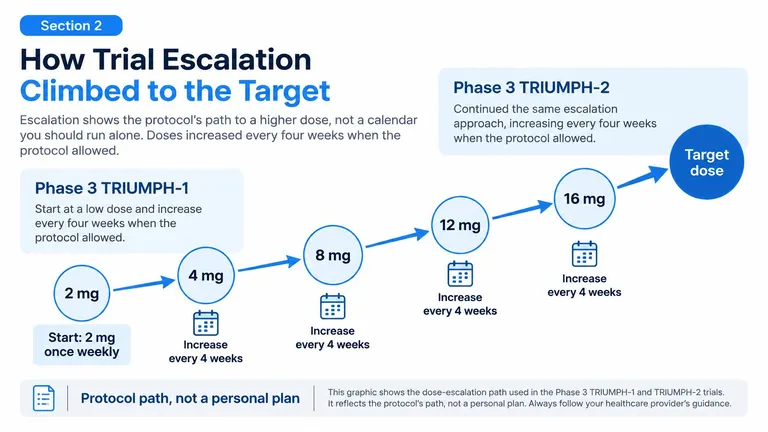
Escalation is the protocol’s path through successive dose levels. It’s not a calendar a reader should run independently.
In TRIUMPH-1 and TRIUMPH-2, participants began at 2 mg once weekly, with increases every four weeks; the higher-target sequences and their on-schedule timing are described in Lilly’s Phase 3 program reporting. The timeline below should therefore be read as a research pathway, not a personal treatment order.
Escalation paths to higher retatrutide targets
| Target | Reported sequence | Increases | Time if on schedule |
|---|---|---|---|
| 9 mg in Phase 3 | 2 mg, then 4 mg, then 6 mg, then 9 mg | 3 | About 12 weeks |
| 12 mg in Phase 3 | 2 mg, then 4 mg, then 6 mg, then 9 mg, then 12 mg | 4 | About 16 weeks |
| 4, 8, or 12 mg in Phase 2 with a lead-in | Selected arms began at 2 mg before advancing toward the assigned target | Set by the assigned arm | Followed the arm-specific protocol |
| 4 or 8 mg arms that opened higher | Direct start at 4 mg in selected arms | Fewer early steps than lower-start arms | Different early exposure than a 2 mg start |
| Type 2 diabetes Phase 2 range | Regimens from 0.5 mg to 12 mg weekly | Selected higher arms began at 2 mg | Protocol-specific |
For the diabetes comparison, the Phase 2 type 2 diabetes trial in The Lancet01053-X/abstract) evaluated weekly regimens from 0.5 mg to 12 mg, including selected higher-dose arms starting at 2 mg and selected 4 mg and 8 mg arms starting directly at 4 mg. Those different openings were part of the experiment, not interchangeable shortcuts.
Why the opening steps matter
Two participants can share a maintenance target without sharing the same early treatment exposure. If their starting regimens differ, researchers need those differences preserved when interpreting symptoms and continuation.
A log that stores only the final target erases that distinction. It may make an introductory injection look like a maintenance injection, or make a delayed increase appear to have happened on schedule.
For the terminology behind these changes, the explanation of what titration means helps distinguish a starting amount, an intermediate step, and a maintenance target. These terms describe different parts of a regimen.
The accompanying video provides another format for understanding the topic.
Keep the planned path separate from the actual path
A planned increase and a completed increase shouldn’t share the same status in a record. If the trial team delays an increase, retain both the original plan and the instruction that changed it.
Record the amount, administration date, intended interval, and any directed pause. Include who supplied the revised instruction so there’s no ambiguity when the record is reviewed.
A scheduled escalation date is an opportunity for protocol-directed review, not permission to increase without it.
An on-time research sequence assumes that each step proceeds according to the protocol. It doesn’t prove that every person should advance because the calendar has reached the next date.
Weight-Loss Results by Studied Dose
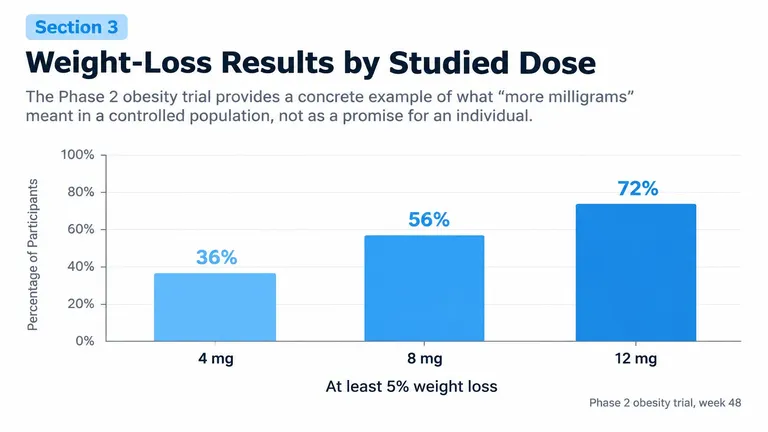
At week 48, the Phase 2 trial reported different weight-loss outcomes across the assigned retatrutide groups. The numbers describe results under studied regimens, not what an individual should expect from a particular injection.
| Weight loss by week 48 | 4 mg | 8 mg | 12 mg | Placebo |
|---|---|---|---|---|
| At least 5 percent | 92 percent | 100 percent | 100 percent | 27 percent |
| At least 10 percent | 75 percent | 91 percent | 93 percent | |
| At least 15 percent | 60 percent | 75 percent | 83 percent | |
| Largest mean reduction reported | Not the largest | Not the largest | Up to 24.2 percent |
The responder percentages come from the 2023 Phase 2 obesity trial, which randomized 338 adults and followed assigned regimens for 48 weeks. The final row reports a mean reduction, a different measure from the threshold rows: it describes an average change, not the share of participants who crossed a cutoff.
A responder rate isn’t an average
A threshold row answers one specific question: what share of a group lost at least the stated proportion of their starting weight? It does not show each participant’s result or how quickly weight changed. An average, in turn, does not predict what any one person will experience.
Keep the measures distinct:
- Assigned group: The regimen researchers allocated, rather than a dose selected by each participant.
- Response threshold: A cutoff for counting outcomes, not a personal treatment goal.
- Follow-up endpoint: The measurement window, not a promise about when an individual will reach a result.
The higher assigned maintenance groups generally had more participants cross the higher weight-loss thresholds. Those outcomes reflect the whole studied regimen, including its escalation strategy. They do not show what would happen after an immediate high-dose injection.
Benefit doesn’t settle tolerability
The trial identified gastrointestinal events as the most common adverse events and found that they were dose-related. A group’s weight-loss results alone therefore cannot establish that its regimen is appropriate for every person.
Discussions of peptides studied for fat loss should keep controlled trial outcomes separate from product claims and personal dosing advice. Results associated with a study regimen do not validate a product sold under the same compound name.
These percentages describe group outcomes. They cannot choose an individual’s retatrutide dosage or replace a protocol’s eligibility, monitoring, and safety requirements.
When Tolerability Changes the Next Increase
Beginning at 2 mg rather than 4 mg partially reduced gastrointestinal effects in the Phase 2 obesity trial report. Nausea, vomiting, and diarrhea were generally mild to moderate, but higher amounts and faster titration were associated with more gastrointestinal difficulty.
That finding challenges the assumption that reaching the target sooner means following the regimen better. Tolerability was part of what investigators were evaluating, not an inconvenience participants were expected to disregard.
Symptoms need a record, not a dose hack
A population schedule can’t determine whether a particular person’s next increase should proceed. The relevant record includes what happened after the current amount and what the responsible clinician or trial team instructed.
Useful entries distinguish:
- Planned versus actual amount: Preserve what was scheduled and what was administered.
- Delayed or omitted increase: Record the change rather than moving the calendar.
- Symptom onset: Note when symptoms began relative to administration and whether they persisted.
- Hydration concerns: Document difficulty keeping fluids down or concerns raised during clinical review.
- Pause instructions: Keep the direction, its source, and the conditions for further review together.
Say a participant reports vomiting before a scheduled increase. Marking the higher amount as due doesn’t answer whether it should be administered. The useful next step is clinical assessment and a documented instruction, not an automated advance.
Expected doesn’t mean harmless
A symptom can be anticipated in a trial and still require attention in an individual. Describing gastrointestinal events as generally mild to moderate doesn’t mean severe symptoms should be treated as routine.
Severe or persistent vomiting, signs of dehydration, or severe abdominal pain warrant urgent medical assessment. Don’t use a tracker, online discussion, or published escalation chart to decide that these symptoms are an acceptable price of continuing.
Safety boundary: Recording symptoms supports a clinical conversation. It doesn’t authorize changing the next amount.
Avoid improvised strategies such as splitting injections, compensating after a pause, or accelerating because weight loss seems slow. Those changes create a different regimen and can’t be justified by the existence of a trial target.
The person responsible for the clinical plan needs an accurate account of what was taken and what happened afterward. Only the applicable trial protocol or a qualified clinician should determine the next dose decision.
What Online Dose Math Cannot Decide
A neat weekly schedule on a webpage isn’t an approved retatrutide dosage. The Drugs.com explanation of retatrutide’s approval and dosing status distinguishes investigational regimens from prescribing instructions and cautions against self-administering research-peptide products.
A target borrowed from semaglutide or tirzepatide isn’t a validated conversion, either. Familiarity with another medicine doesn’t establish an equivalent amount of an investigational compound.
Separate the quantities before trusting the result
Online discussions often collapse different variables into one number. They answer different questions.
| Variable | What it describes | What it cannot establish |
|---|---|---|
| Milligrams of active drug | The amount of the compound | Whether that amount is clinically appropriate |
| Injection volume | The amount of liquid | The active-drug amount without a reliable concentration |
| Labeled concentration | The stated amount per volume | Whether the product actually matches its label |
| Product purity | A quality characteristic of the material | Approval, sterility, or suitability for human use |
Correct arithmetic can’t compensate for unreliable inputs. A calculation may be internally consistent while the product identity, labeled strength, or preparation remains unsuitable.
Research-peptide products are not intended for human use and shouldn’t be self-administered. A purity claim doesn’t turn a research product into an approved medicine. For terminology around regulatory status, the guide to FDA-approved peptide drugs helps distinguish approval from the broader peptide category.
Calculation is not clinical authorization
Our website calculator doesn’t choose a target dose or recommend a preparation. On Android, calculation results depend on the supplied inputs and don’t establish that a dose or preparation is medically appropriate. On iPhone and iPad, our tracking experience uses the dose details and schedules the user enters manually.
Those boundaries matter because software can display a precise result without answering the prior medical question: should this person receive this exposure at all? Precision in the output isn’t proof of validity in the inputs or appropriateness in the plan.
Keep the conclusions narrow:
- A trial milligram isn’t a starting instruction.
- A maintenance target isn’t suitable for every person.
- A calculated volume isn’t approval of a preparation.
- A product label isn’t authorization for self-treatment.
The defensible role of a record is to preserve an established instruction, its timing, and relevant product details. It shouldn’t imply that entering a regimen has medically validated it.
Confirm the Plan Before You Log It
Before treating any retatrutide amount as a personal instruction, confirm it with the responsible trial team or qualified clinician. A chart, calculator, and reminder each serve different purposes, but none can supply the missing clinical authorization.
Ask for answers that can be recorded without interpretation. If an instruction is unclear, resolve it before making a change rather than filling the gap with a schedule found online.
Questions worth taking to the appointment
- What is the current weekly amount? Ask whether it represents an introductory stage, an intermediate step, or the assigned maintenance stage.
- Is another increase planned? Confirm the earliest permitted date and what review or conditions must come first.
- What should happen after a missed administration? Obtain the applicable instructions rather than borrowing rules from another medicine.
- Which symptoms require contact? Clarify which should delay escalation and which warrant urgent assessment.
- Who should receive updates? Establish where to report symptoms, errors, pauses, or uncertainty.
Write the answers down as given. Keep a dated copy of revised instructions so an older plan doesn’t remain active by mistake.
Make the record reflect the real week
A useful dose history distinguishes planned, taken, delayed, and paused entries. If a reminder fires but administration doesn’t occur, don’t mark the amount as taken just to clear the notification.
Keep the actual administration date separate from the original scheduled date. Attach the clinician’s instruction to any change, and preserve the symptom history that prompted review. That creates a record someone can understand without reconstructing events from memory.
Don’t make the log look tidier than the clinical situation. An accurately documented pause is more useful than an uninterrupted schedule that implies treatment continued.
The final decision comes before the entry: confirm the instruction with the responsible professional before changing the amount. Once the plan is clear, record it faithfully rather than asking the record to determine it.
PepFlow helps organize an established routine with dose records, flexible schedules, pause periods, reminders, and a clear dose history. Visit PepFlow to keep clinician- or trial-directed instructions and actual administrations organized, without treating a tracker or calculator as medical approval.