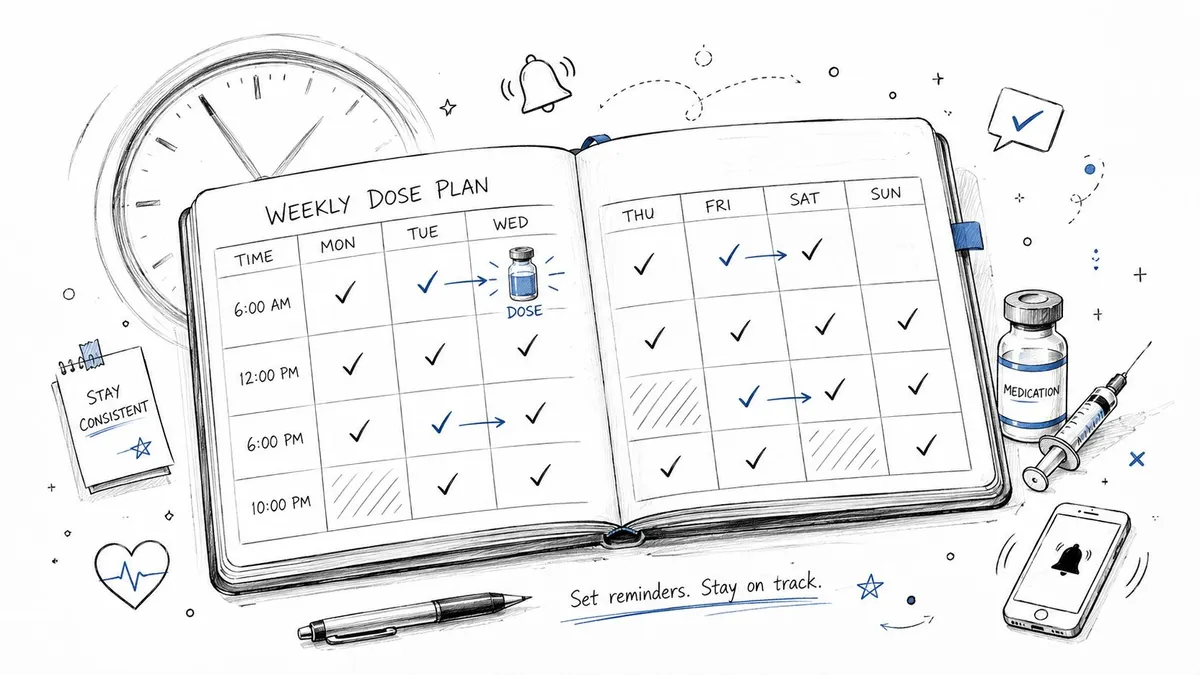
You can start a peptide protocol with a vial in the fridge, a dose on paper, and the sincere belief that you’ll “just remember.” Then day ten arrives, work runs late, you miss the window, and the whole routine starts to feel less like a plan and more like improvisation. That’s usually the moment people realize the core issue isn’t the compound, it’s the dosing schedule.
Table of Contents
- Why Your Peptide Protocol Starts with a Dosing Schedule
- What a Dosing Schedule Actually Is
- Principles for Building a Dosing Schedule That Holds Up
- Common Peptide Dosing Schedule Examples
- Mapping a Dosing Schedule into PepFlow
- Adherence, Missed Doses, and What to Do Next
- Safety Guidance and Getting Started with Confidence
Why Your Peptide Protocol Starts with a Dosing Schedule
A lot of people begin with the exciting part, the peptide itself. They pick the target, decide the amount, and assume the rest will sort itself out. It rarely does. What separates a protocol that survives from one that fades out is the structure underneath it, the part that tells you when, how often, and under what rules the dose happens.

I’ve seen this most clearly when someone starts strong, logs the first few injections carefully, then loses the thread once life gets busy. The missing piece is almost never motivation. It’s the absence of a schedule that survives ordinary friction, like travel, late nights, a changed workout time, or a weekend that doesn’t look like the rest of the week.
A protocol without a schedule is just intent.
The schedule is the connective tissue between a peptide and a real routine. It determines whether the plan is stable enough to support consistent exposure, or whether each dose becomes a fresh decision point that can be missed, delayed, or mis-timed. That matters even more when timing is tight, the half-life is short, or the protocol depends on repeated action instead of a one-time start.
If you’re mapping a regimen into a system, it helps to think in terms of protocol management, not just individual injections. A useful starting point is this guide to protocol management, because the same discipline that keeps a plan organized also keeps the schedule usable.
The practical takeaway is simple. Before you worry about vial math, reminder settings, or cycle length, decide what the schedule is. Once that’s clear, every other choice gets easier.
What a Dosing Schedule Actually Is
A dosing schedule is a time-based map. It says when each dose happens, how much is taken, and how those doses fit the body’s clearance pattern. If the schedule is vague, the protocol becomes guesswork. If it’s precise, the routine has a chance to hold together in real life.
Timing is governed by the body, not the calendar
The main mistake is treating dose timing like a calendar reminder instead of a pharmacokinetic decision. A dose schedule has to match the drug’s elimination window, not just a convenient clock slot. For most drugs with plasma half-lives of 12 hours or less, measured blood concentrations mainly reflect dosing from the prior 2 to 4 half-lives, so missed earlier doses can be masked by later catch-up dosing, while the underlying concentration pattern stays unstable, as noted in an expert review on timing and half-life (Oxford Academic review).
That matters because a one-time check can look reassuring when the routine underneath it is messy. Someone can take a delayed dose, catch up later, and still see a snapshot that seems close enough. The schedule, however, may already be drifting out of sync with the compound’s timing needs.
Practical rule: if the compound clears quickly, timing errors matter more than people expect, because the schedule is shaping exposure continuously, not just at the moment of injection.
A good dosing schedule therefore does more than assign days. It protects the interval that keeps exposure steady enough to be meaningful. That’s why short half-life agents and protocols with narrow timing tolerance punish casual scheduling so hard.
The schedule has three moving parts
A workable schedule usually answers three questions at once.
- When it happens: the clock time or interval that defines the dose window.
- How much goes in: the amount tied to each administration.
- What pattern it follows: the cycle, pause, restart, or taper logic around the active phase.
Those pieces sound obvious until they’re not written down. Then people remember the amount but forget the pause. Or they know the cycle length but not the exact injection timing after a travel day.
The point isn’t to make the plan more complicated. It’s to make it explicit enough that the same decision doesn’t have to be re-made every day.
Principles for Building a Dosing Schedule That Holds Up
A schedule that looks good on paper can still fail on a Tuesday night when the gym ran long and dinner was late. The schedules that hold up are built around a few hard rules, not around wishful thinking. The first rule is pharmacokinetic fit, the second is frequency discipline, and the third is explicit cycle logic.
Align the interval with the compound
The interval has to match how the compound clears. That’s the difference between a routine that supports steady exposure and one that accidentally creates peaks, gaps, and catch-up behavior. If the timing window is short, the schedule needs to be precise enough that one late dose doesn’t unravel the pattern.
Fewer decision points usually means fewer failures
Each additional dosing event creates another chance to miss, delay, or mis-time the dose. That’s not a moral failure, it’s a workflow problem. The more handoffs a schedule requires, the more brittle it gets.
Once-daily dosing consistently outperforms more frequent schedules on adherence metrics. A meta-regression found that compared with once-daily regimens, 2-times-daily regimens had lower adherence by 6.7% for taking adherence, 13.1% for regimen adherence, and 26.7% for timing adherence. The penalties were even larger for 3-times-daily and 4-times-daily schedules, reaching 13.5% to 19.2% lower taking adherence and 39.0% to 54.2% lower timing adherence (PubMed).
| Frequency | Taking Adherence Loss | Regimen Adherence Loss | Timing Adherence Loss |
|---|---|---|---|
| 2 times daily | 6.7% | 13.1% | 26.7% |
| 3 to 4 times daily | 13.5% to 19.2% | not specified in the verified data | 39.0% to 54.2% |
That table doesn’t mean every protocol should be forced into once-daily dosing. It means schedule simplicity is a high-impact intervention when the pharmacology allows it. If the compound demands more frequent administration, the schedule has to earn that complexity with a real reason, not habit.
Build the cycle rules before the first dose
A lot of peptide protocols aren’t just “take this on repeat.” They have active phases, pause periods, and restart rules. Those transitions matter because they’re the points where people get confused, especially if they’ve been following a routine for weeks and then stop and restart without a written rule.
A reliable schedule should answer:
- When the active phase starts
- When the pause begins
- What triggers the restart
- Whether timing changes after a gap
If those rules are vague, the protocol becomes a memory test.
Match the schedule to the person, not the idealized version
The best schedule is the one that fits the actual day, not the fantasy version of it. Sleep, training, travel, and work rhythm all matter. A morning person who leaves at 6 a.m. and a night-shift worker do not need the same time anchor, even if the compound is identical.
The best protocol is usually the one that survives weekends, travel, and imperfect mornings.
The key decision isn’t “simple or optimal.” It’s “accurate enough pharmacologically, and realistic enough to follow.” That balance is what makes the schedule stick.
Common Peptide Dosing Schedule Examples
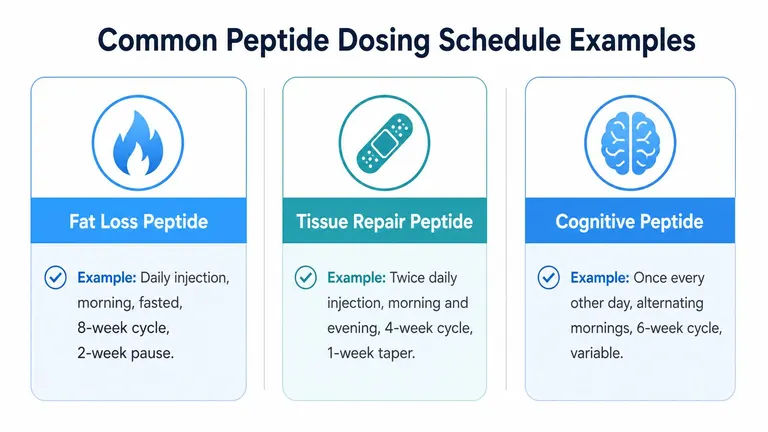
Concrete examples help because theory breaks down fast when you’re staring at a vial and trying to decide whether the plan fits your week. The three patterns below cover the kinds of schedules people run into most often, from low-friction daily routines to structured cycles with rest periods.
Evening once-daily routine
A once-daily evening schedule is the simplest to live with when the compound and the protocol allow it. It keeps the routine anchored to a predictable part of the day, which helps reduce misses caused by shifting work hours or training sessions. In peptide practice, this kind of anchor is often easier to sustain than a schedule that bounces around depending on what else is happening.
The trade-off is that simplicity only works if the timing window is wide enough for the compound. If the half-life is short or the protocol depends on exact spacing, a loose evening routine can turn into sloppy spacing. The schedule is easy to remember, but it still has to make pharmacologic sense.
Split dosing around training
Some protocols use a twice-daily pattern because the timing has to bracket activity. That can make sense when the plan is built around performance, recovery, or another event-driven goal. The downside is obvious once you’ve done it in real life, because a training split adds another appointment to an already crowded day.
Many dosing schedules start to leak. The morning dose gets done, the evening dose gets delayed, and the gap no longer matches the intended rhythm. If you’re using a split schedule, the dose times need to be anchored to events you can predict reliably, not just hope for.
Cycled protocol with pause and restart
The most operationally demanding pattern is the cycle with an on-phase, a pause, and a restart rule. That’s common in longevity or recovery stacks, where the schedule matters as much as the compound choice. The cycle is only as good as its transition logic.
A useful resource for comparing this kind of planning with broader hormone-style rhythm management is PepFlow’s HGH dosing schedule guide, because the same problems show up there too, especially around consistency, spacing, and restart behavior.
The broader comparison is straightforward:
- Once-daily routines are easier to sustain.
- Split routines give more timing control but add friction.
- Cycled protocols need the clearest rules, because the pause and restart are where people lose track.
For a general consumer-resource comparison, even a simple product page such as find the 5 Day Forecast shows how quickly a schedule becomes part of the product experience. The important point isn’t the product itself, it’s that the schedule is never just background detail.
Mapping a Dosing Schedule into PepFlow
A written plan is useful. An executable plan is better. The gap between the two is where most routine failures happen, because people still end up doing manual math, re-reading notes, and trying to remember whether the current week is an on-week or a pause week.
Start with the vial, not the guess
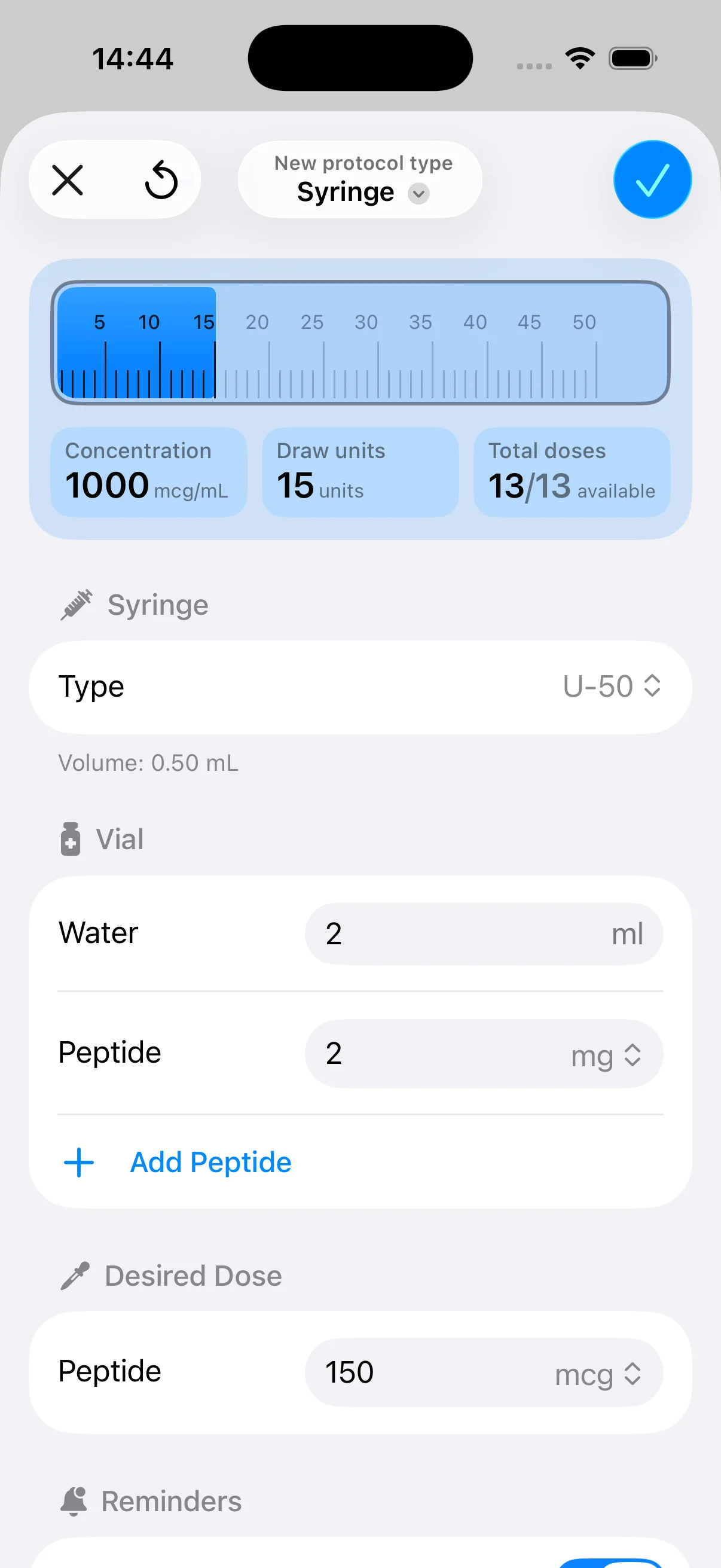
The first step is converting the desired microgram amount into a practical injection volume by entering the vial concentration. That removes the guesswork that usually leads to off-by-a-little errors, especially when the label concentration and the intended dose are easy to confuse. PepFlow is designed to handle that calculation layer so users don’t have to do it by hand every time.
That matters because manual math gets repeated under pressure, often when someone is tired or in a hurry. A small calculation mistake at the start can ripple through the entire routine.
Enter the cycle structure once
If the protocol has a start date, dosing frequency, and pause period, those should be defined up front. PepFlow supports cycled protocols with flexible start dates, which makes it easier to map a real schedule instead of forcing the protocol into a fixed calendar assumption. That’s the difference between a plan that works on paper and one that can be followed without rethinking it every week.
A cleaner build usually looks like this:
- Set the start date: anchor the protocol to the day you begin.
- Define the frequency: daily, split, or another repeating pattern.
- Add pause periods: make the off-phase explicit instead of informal.
- Confirm the dose math: lock the concentration and injection volume before the first reminder fires.
Let the reminders do the operational work
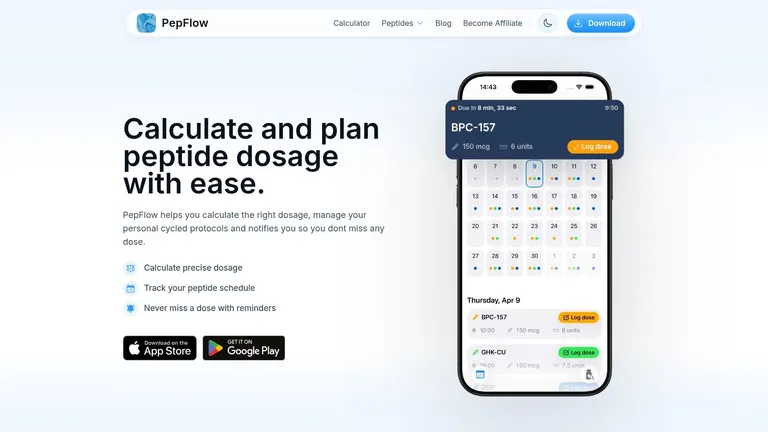
A schedule only helps if it reaches you at the right time. PepFlow uses push notifications, live activities, widgets, and real-time countdowns to keep the next dose visible, which reduces the chance that a dose gets lost in the background of the day. That support matters most when the schedule has more than one moving part.
For people who want a broader look at routine design in app form, this routine schedule app guide is a useful companion. The main point is simple. Once the schedule is entered, the app should do the remembering, not your short-term memory.
If you’re still doing dosage math in your head, you’re leaving too much room for error.
Adherence, Missed Doses, and What to Do Next
The hardest part of any dosing schedule is not writing it. It is what happens after a missed window, a delayed dose, or a week that no longer matches the plan. Many protocols fail there because the original schedule never said how to recover.
Missed-dose logic has to be written in advance
If someone misses a dose and has to improvise, the protocol is already too vague. The schedule should say whether a late dose is taken, skipped, or rolled into the next cycle, and whether the answer changes after travel or a long interruption. Without that rule, every exception becomes a fresh judgment call.
Research on real-time monitoring shows that scheduled SMS reminders can improve adherence and reduce long lapses, but the benefit depends on timing logic, missed-dose triggers, and real-time follow-up rather than simple alarm alerts (PMC review). A reminder that only rings is not the same as a system that helps someone recover from a missed event.
The best schedule is not always the simplest one
Simplification helps on average, but the hardest failures are usually about exceptions, pauses, and restarts. A schedule that matches a person’s actual routine often holds up better, especially for older adults, recently hospitalized patients, and people managing multi-step regimens, where regimen complexity still matters even when average adherence correlations are weak.
The practical move is to design for friction points:
- Travel: decide what counts as a valid dose window when the day changes.
- Missed doses: define the recovery rule before the miss happens.
- Paused cycles: write the restart date or condition in the same place every time.
- Pattern tracking: use history to see where the routine breaks down repeatedly.
Track What Happens
History tracking is underrated because it turns vague memory into a pattern. If the same dose keeps slipping on training days, the schedule needs adjustment. If the issue is weekends, the time anchor is probably wrong. If the issue is a pause period, the restart rule needs to be clearer.
A dosing schedule should feel rigid where pharmacology demands precision and flexible where daily life demands realism. That balance is what makes a protocol sustainable instead of theoretical.
Safety Guidance and Getting Started with Confidence
A good dosing schedule starts with the compound, the half-life, and the interval that fits the way the body clears it. Then it narrows to what you can repeat, day after day, without turning the plan into a burden. That sequence matters more than chasing a complicated routine that looks advanced but falls apart under normal life.
PepFlow is a planning and organization tool, not a substitute for professional medical advice. Any dosing schedule should be reviewed with a qualified healthcare provider who understands the specific peptide and your health context. That’s especially important when the protocol includes pauses, restart rules, or more than one timing decision.
The cleanest way to begin is usually the simplest. Start with a straightforward schedule, enter the vial concentration and dose math once, set the reminders, and log your doses for two weeks before making changes. If the schedule breaks, adjust the timing or structure instead of assuming you need a completely new protocol.
You don’t need a perfect routine on day one. You need one that’s precise enough to be safe, simple enough to follow, and visible enough to keep you honest.
If you want a cleaner way to build and follow a peptide routine, visit PepFlow and map your dosing schedule into a system that handles the math, reminders, and cycle structure for you. It’s built for people who want fewer manual mistakes and a clearer daily rhythm.