You might have landed here because you’re trying to be precise about something that doesn’t give you much room for error. Maybe you’re studying chemistry and the term keeps showing up in class. Maybe you’re working through a lab report and the words analyte, titrant, and endpoint still feel slippery. Or maybe your interest is more practical: you care about exact measurements because precision matters in health, recovery, or wellness routines.
That’s why what is a titration is such a useful question. Titration sounds like a formal lab technique, but at its heart it’s a method for answering one simple question: how much of something is really in a solution? Chemists solve that question by reacting an unknown solution with a known one, carefully, until the chemistry balances.
Table of Contents
- What Titration Means for Precision
- The Core Concept of Titration Explained
- Visualizing the Process with Titration Curves
- How to Perform a Titration in the Lab
- Calculating the Results from Your Titration
- Titration in the Real World From Medicine to Your Kitchen
- Common Errors and Safety Precautions
What Titration Means for Precision
Precision matters most when a rough estimate isn’t good enough. If you’re checking the concentration of an acid in a flask, “close enough” can ruin the result. If you’re thinking about concentration and dose in a health context, the same mindset applies. The whole point is to convert uncertainty into something measured.
That’s what titration does. It’s a chemical method for finding the concentration of an unknown solution by adding a solution of known concentration until the reaction reaches the right balance. Instead of guessing, you measure.
The idea has deep roots. The word behind titration traces back to 1543, when the French word tiltre referred to the proportion of gold or silver in coins, and by 1828 Joseph Louis Gay-Lussac used titrer to mean determining the concentration of a substance, a key step in modern volumetric analysis, as described in the history of titration on Wikipedia.
That history matters because it shows the same problem has been around for centuries: people need a trustworthy way to determine purity, strength, or concentration.
Why this idea still feels modern
Titration isn’t just about classic chemistry benches and glass burettes. It represents a broader habit of thinking.
- You start with an unknown. You don’t assume you know the concentration.
- You use a known standard. The reference solution gives the process credibility.
- You measure carefully. The answer depends on small volume changes.
- You stop at the right moment. Precision comes from recognizing completion accurately.
Titration is really a discipline of controlled measurement. The chemistry is important, but the mindset is just as important.
That’s why the concept travels so well into modern life. In labs, it helps chemists determine concentration. In health and wellness settings, the same logic shows up whenever someone needs to translate a concentration into a usable dose without relying on rough mental math.
The Core Concept of Titration Explained
A good way to understand titration is to stop thinking about it as “adding drops until a color changes” and start thinking about it as balancing a chemical equation in real time.
A simple way to picture it
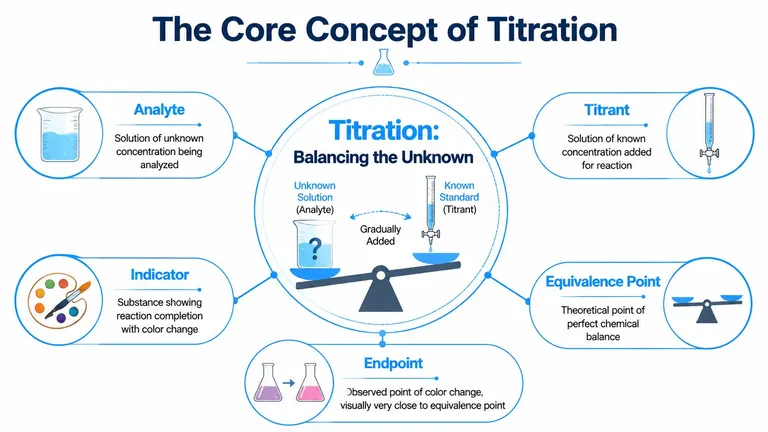
Think of a seesaw. On one side is a solution whose concentration you don’t know. On the other side is a solution whose concentration you do know. You add the known solution slowly until the reaction is exactly balanced.
That balancing point is the heart of titration.
The terms that matter most
A few definitions make the whole process much easier to follow:
| Term | Plain-language meaning |
|---|---|
| Analyte | The solution you’re trying to figure out |
| Titrant | The solution of known concentration that you add |
| Indicator | A substance that changes color near the reaction’s completion |
| Equivalence point | The theoretical point where the reaction is chemically complete |
| End point | The visible point where you decide to stop, often from a color change |
Here’s the part many students mix up: equivalence point and end point aren’t exactly the same thing.
The equivalence point is the true chemical balance point where the moles of titrant exactly equal the moles of analyte according to the reaction. The end point is what you observe, usually through an indicator’s color change. Ideally they line up closely, but they can differ slightly, and that mismatch can introduce a titration error of 0.1-1%, as explained in Britannica’s titration overview.
Practical rule: The equivalence point belongs to the chemistry. The end point belongs to the measurement method.
A simple acid-base example makes this clearer. Suppose you have hydrochloric acid in a flask and sodium hydroxide in a burette. You add the base to the acid. Molecule by molecule, the acid is being neutralized. At the equivalence point, the reacting amounts match the equation. If you’re using an indicator, the color shift helps you estimate when you’ve reached that moment.
That’s also why the procedure has to be slow near the end. Early in the titration, each added portion changes things gradually. Near the balance point, one extra drop can matter much more.
A lot of confusion disappears when you separate three ideas:
- What the chemistry is doing
- What your eyes can detect
- What the final calculation uses
The chemistry gives you the equivalence point. Your indicator helps you identify the end point. Your burette reading gives you the volume of titrant used. Put together, those pieces let you calculate the unknown concentration.
Visualizing the Process with Titration Curves
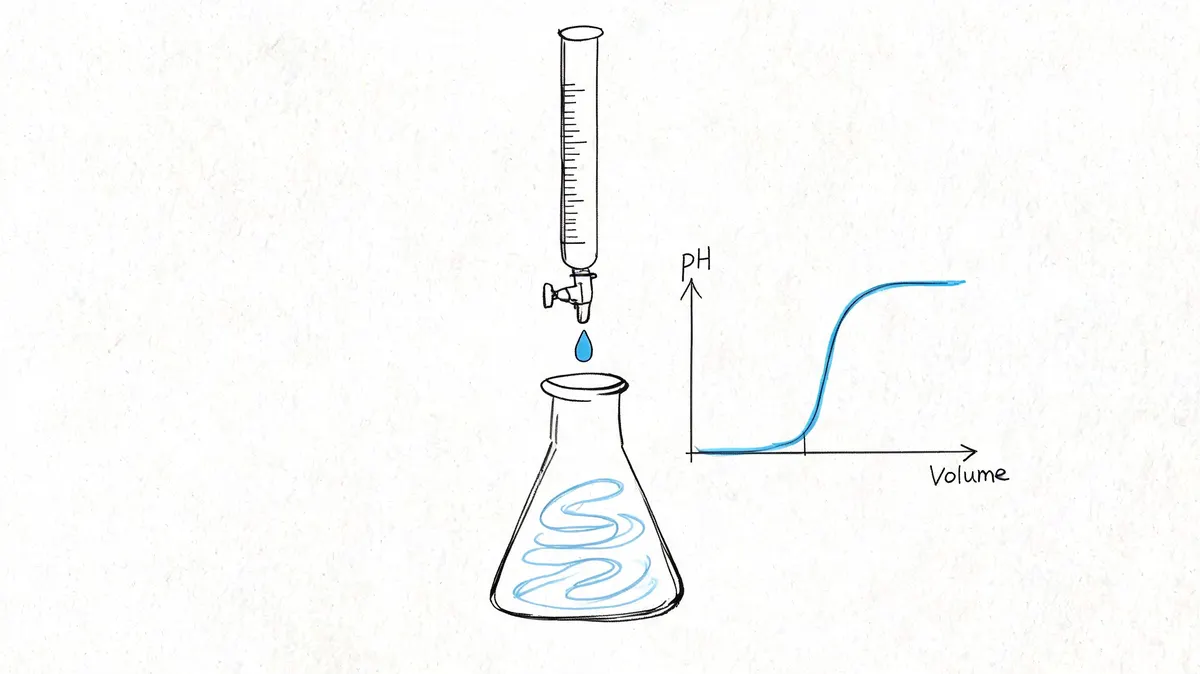
Some people don’t really “get” titration until they see it as a graph. A titration curve turns the experiment into a visual story. Instead of watching drops fall, you watch the solution’s behavior change over time.
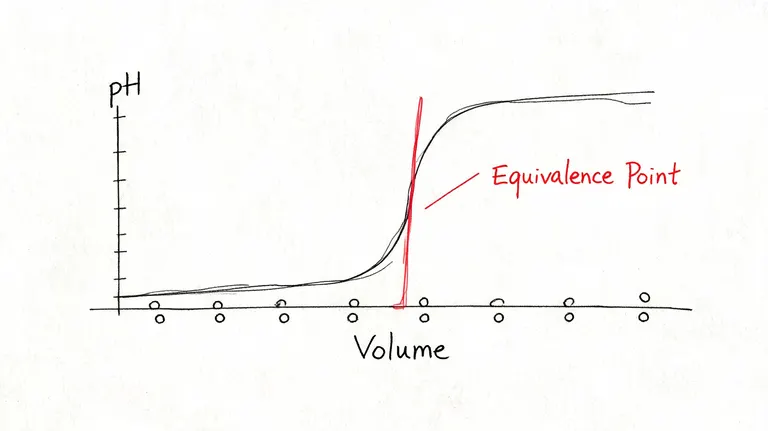
A typical acid-base titration curve plots pH on the vertical axis and volume of titrant added on the horizontal axis. As the titration progresses, the graph usually forms an S-like shape. That shape isn’t decorative. It tells you how the reaction responds as more titrant enters the flask.
How to read the shape
At the start, the graph is usually fairly flat. The solution still contains mostly the original analyte, so each small addition of titrant doesn’t change the pH dramatically.
Then the curve starts to bend. The solution is moving closer to chemical balance, and the pH begins changing faster.
Near the equivalence region, the line becomes very steep. That steep section is the most important part of the graph because it marks the point where a small added volume creates a large change in pH. At this stage, the reaction is tipping from excess analyte to excess titrant.
Why the steep region matters
After that sharp rise or drop, the graph levels off again into another flatter region. At that stage, the titrant is in excess, and the system’s behavior becomes more predictable again.
If you’re new to titration curves, focus on these three zones:
- Beginning region where the original solution dominates
- Transition region where the reaction rapidly approaches completion
- Final region where the added titrant dominates
A titration curve is less about memorizing a shape and more about recognizing where the chemistry becomes sensitive.
That sensitivity is why chemists care so much about the area around the equivalence point. It’s also why indicators are chosen carefully. The useful indicator is the one that changes color in the same general region where the curve shifts sharply.
Even if you never draw a curve by hand, the graph helps you think better. It shows that titration isn’t random dripping. It’s a controlled movement toward a mathematically meaningful point.
How to Perform a Titration in the Lab
Theory sounds neat on paper. Skill appears when you try to do the experiment cleanly, read the glassware correctly, and stop at the right moment.
Setting up the glassware
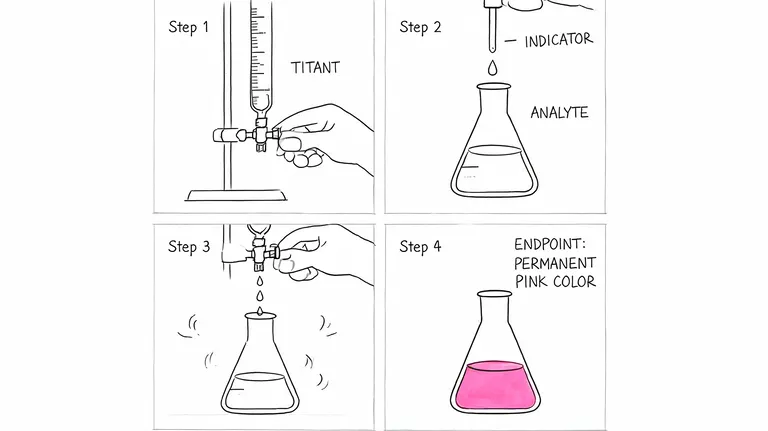
A basic titration usually uses a burette, a clamp stand, a flask, and an indicator. The analyte goes into the flask. The titrant goes into the burette.
Before filling the burette, rinse it with a small amount of the titrant. That step matters because leftover water inside the burette can dilute the solution you’re relying on as your known standard. Then mount the burette vertically and make sure the tip is filled properly.
When you read the burette, your eye has to be level with the meniscus. A Class A 50 mL burette offers ±0.05 mL accuracy, and a 0.1 mL volume error in a 25.0 mL titration can create a 0.4% concentration error, which is why careful reading matters, as shown in this burette technique demonstration.
For students building these skills, structured practice helps a lot more than memorizing definitions. A guided resource like AP Chemistry course prep can make the glassware, calculations, and stoichiometry feel much less abstract.
Running the titration
Once the analyte is in the flask, add a few drops of indicator. Then record the initial burette reading before any titrant is dispensed.
The first run is often a rough run. You can add titrant more quickly at the beginning because you’re still far from the end point. As the color starts to linger briefly, slow down. Near the end, go one drop at a time while swirling constantly.
That swirling is easy to underestimate. If the flask isn’t mixed well, one area may briefly contain a high concentration of titrant, and you can mistake that local change for the actual end point.
A lot of peptide users find this familiar in spirit. The chemistry is different, but the habit is the same: concentration, volume, and exact interpretation matter. If you’re looking for practical dose-prep context, these peptide reconstitution guidelines show why measurement discipline matters outside the classroom too.
Learning the skill
Watching someone perform a titration helps because the motion matters almost as much as the formula. Notice how the hand on the stopcock slows near the end, and how the flask is kept moving.
A clean manual titration often follows this rhythm:
- Prepare carefully. Rinse, fill, and check the burette before starting.
- Record clearly. Write down the initial reading immediately.
- Add fast, then slow. Early volume can go in quickly. Final volume should be dropwise.
- Watch for persistence. The true end point is usually a color change that remains after swirling.
Don’t chase a dramatic color. In most beginner titrations, the correct end point is subtler than students expect.
Calculating the Results from Your Titration
After the glassware is cleaned up, the whole experiment comes down to one question: what concentration did your titration reveal?
Start with the volume used
First find the volume of titrant delivered from the burette:
volume used = final burette reading - initial burette reading
That gives you the amount of known solution required to react with the analyte in the flask.
For many introductory problems, the math uses the idea behind M₁V₁ = M₂V₂ for a simple one-to-one reaction. In a broader form, concentration can be found from the relationship between the known titrant concentration, the titrant volume used, and the analyte volume.
If proportion setups tend to trip you up, it can help to review common algebra habits before doing chemistry math. This guide to common proportion word problem mistakes is useful because titration calculations often fail for arithmetic reasons, not chemistry reasons.
A worked example
Suppose your analyte volume is 25.0 mL. Your titrant has a known concentration of 0.1 M. You start the burette at 1.2 mL and finish at 26.2 mL.
So the titrant volume used is:
26.2 mL - 1.2 mL = 25.0 mL
If the reaction is one-to-one, then the analyte concentration matches the titrant concentration when the volumes are equal. In that case, the analyte concentration is 0.1 M.
Here’s the logic in a compact table:
| Quantity | Value |
|---|---|
| Analyte volume | 25.0 mL |
| Titrant concentration | 0.1 M |
| Initial burette reading | 1.2 mL |
| Final burette reading | 26.2 mL |
| Titrant volume used | 25.0 mL |
| Analyte concentration | 0.1 M |
That’s the key mental move. You’re not using the color change as the answer. You’re using it to identify the stopping point, then using the measured volume to do the calculation.
For readers interested in concentration-to-dose conversions outside the lab, a peptide calculator reflects the same basic need for disciplined math: start with known concentration information, define the desired amount, and convert that into a usable measurement without guessing.
Titration in the Real World From Medicine to Your Kitchen
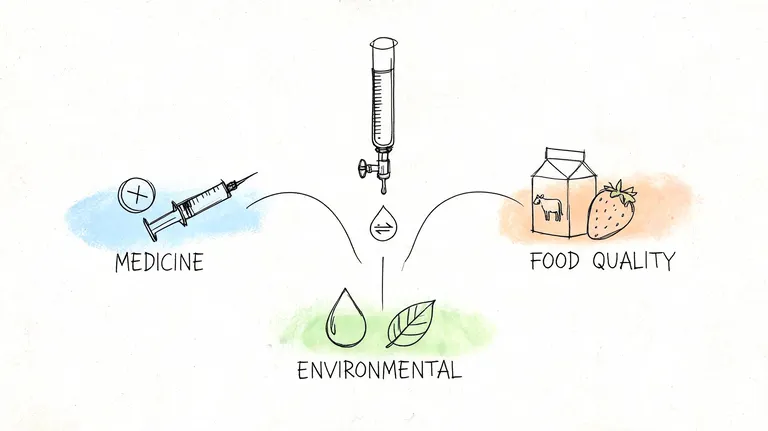
A lot of students assume titration lives only in chemistry classes. It doesn’t. It shows up anywhere people need to verify concentration, acidity, purity, or potency.
Where titration shows up
One familiar use is in pharmaceutical testing. Titration is critical in the $1.5 trillion pharmaceutical market, where it’s involved in 90% of assays to verify drug potency, according to this overview of titration’s industrial role.
It also appears in food work. Acidity matters in products like vinegar, wine, and dairy because flavor, stability, and shelf behavior all depend on chemistry that can be measured rather than guessed.
In environmental work, titration helps chemists analyze water quality. In educational labs, it teaches students how careful measurement turns invisible chemistry into visible evidence.
Here’s a useful way to think about its reach:
- Medicine uses it to confirm that chemical strength matches what’s expected.
- Food production uses it to monitor acidity and consistency.
- Water testing uses it to evaluate chemical properties that affect safety and quality.
- Teaching labs use it because it trains both chemical reasoning and hand skills.
Titration matters because concentration is rarely something you can judge by sight alone.
Why this matters for dosing
The concept becomes especially relevant for readers interested in wellness protocols and peptides. In chemistry, titration answers, “What concentration is in this flask?” In dosing, the practical version becomes, “What volume corresponds to the amount I intend to take?”
Those aren’t identical problems, but they share the same core demand: translate concentration into action with precision.
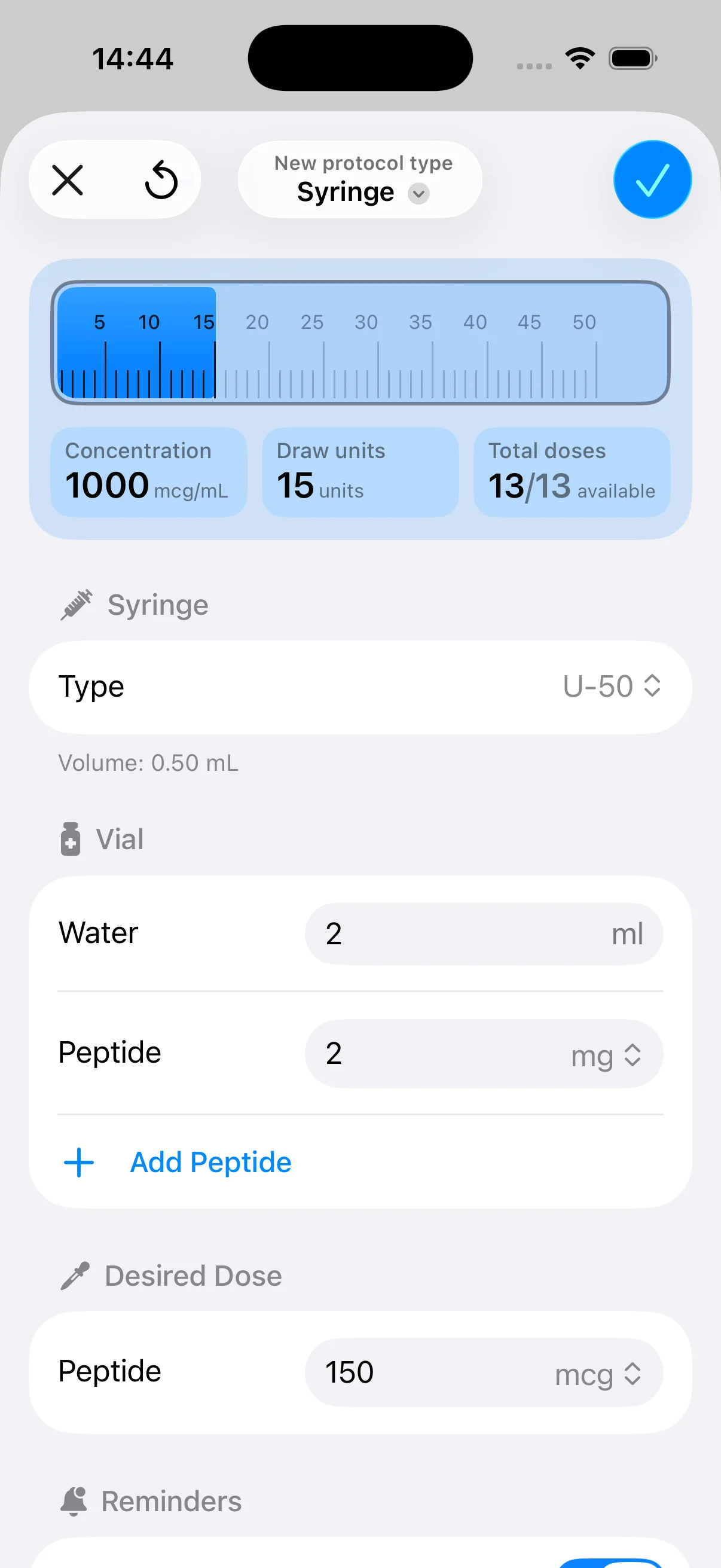
When someone reconstitutes a vial, they’re working with a concentration relationship. When they decide on a target amount, they need a clean conversion into a practical volume or unit measurement. Manual math can be error-prone, especially when the values are small and the consequences of a mistake aren’t trivial.
That’s why the logic behind titration still feels so current. It trains you to respect the relationship between known concentration, measured volume, and intended amount. In peptide dosing, that same discipline helps people avoid sloppy approximations and stick to repeatable, trackable numbers.
The broader lesson is simple. Titration isn’t just a lab ritual from an old chemistry textbook. It’s one of the clearest examples of how science handles uncertainty: not by guessing better, but by measuring better.
Common Errors and Safety Precautions
Titration is straightforward in principle, but small mistakes can shift the result enough to matter. Most errors come from rushing, reading the glassware badly, or treating the endpoint like a dramatic event instead of a subtle one.
Mistakes that change the result
A common beginner mistake is overshooting the end point. You’re waiting for a faint color to persist, but you add one drop too many and the solution becomes more intensely colored than it should. That means you recorded too much titrant and pushed the calculated concentration off target.
Air bubbles in the burette tip can also cause trouble. If the tip isn’t filled properly at the start, part of the “delivered” volume may be filling the tip rather than entering the flask.
Another issue is poor reading technique. If you don’t align your eye with the meniscus, parallax can distort the reading. And if you forget to swirl after each addition near the end, you may misread a temporary local color change as the actual endpoint.
Useful habits to reduce error:
- Run a rough trial first. It helps you know where the endpoint will likely occur.
- Slow down near the finish. Early speed is fine. Final precision isn’t.
- Check the tip before starting. No bubbles, no leaks.
- Record immediately. Don’t trust memory for initial or final readings.
Good titration results usually come from restraint. Most poor ones come from impatience.
Safety habits that matter
Even simple acid-base titrations deserve basic lab discipline. Wear splash goggles, keep solutions labeled, and treat acids and bases as chemicals that can irritate skin and eyes. If something spills, clean it according to lab instructions instead of improvising.
You should also avoid eating or drinking in the lab, and wash your hands after handling reagents. If you’re working from a protocol, follow the written procedure exactly rather than substituting containers or indicator amounts casually.
The same caution applies outside formal lab work when people prepare or mix wellness-related compounds. Precision and cleanliness go together. If you want a practical reference focused on handling and preparation, this guide on how to mix peptides with bacteriostatic water is a helpful companion to the measurement mindset behind titration.
If you care about getting peptide math right without doing repeated manual conversions, PepFlow is built for that job. It helps turn concentration and dose plans into clear unit measurements, supports protocol scheduling, and reduces the kind of calculation mistakes that happen when you’re tired, rushed, or juggling too many variables.