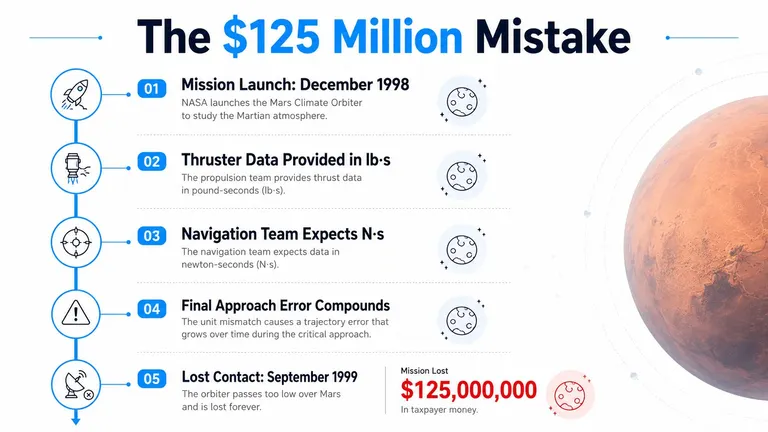
A navigation team watched the Mars Climate Orbiter disappear after engineers discovered that two groups had used different force units. The arithmetic in each group was consistent, but the shared system never confirmed that pound-force-seconds and newton-seconds meant the same thing.
Table of Contents
- Why Unit Conversion Errors Cause Real-World Disasters
- Mastering Dimensional Analysis for Any Conversion
- Common Conversion Mistakes and How They Happen
- Worked Examples for Mass Volume and Concentration
- How to Catch Conversion Errors Before They Matter
- Practice Problems with Step-by-Step Solutions
- Building Reliable Conversion Habits
Why Unit Conversion Errors Cause Real-World Disasters
A spacecraft can be lost even when every individual calculation looks correct. In 1999, the Mars Climate Orbiter was lost after one team supplied thruster data in pound-force-seconds while another interpreted it as newton-seconds. The failure began at the boundary between teams, where nobody verified that the units followed the same convention. NIST uses the incident to show how mixed measurement systems can create costly engineering failures. The mission’s loss was later associated with about $327.6 million, measured in 1998 dollars, a historical cost estimate rather than a figure stated in later-year currency (NIST’s account of metrication errors).
A similar weakness appeared in aviation. During the 1983 Air Canada Flight 143 emergency, a mismatch between pounds-per-liter and kilograms-per-liter contributed to fuel exhaustion. The aircraft landed safely with no fatalities, yet the event shows how a unit assumption can affect flight operations. In 1999, Korean Air Cargo Flight 6316 involved confusion between feet and meters and contributed to a fatal crash that killed 8 people (historical examples summarized with NIST’s metrication guidance).
The failure usually happens before the arithmetic
The professionals involved could perform the mathematics. The breakdown came earlier: a unit convention went unconfirmed, an explicit conversion was skipped, or software and teams used different assumptions.
Medical calculations expose the same weakness at a smaller scale. A dosage in milligrams cannot be handled as micrograms, and a concentration per milliliter cannot be treated as though it were per liter. A missing unit label may pass through a calculation and reach a syringe or treatment decision before anyone notices.
Practical rule: A conversion is complete only when the units cancel correctly, the final label answers the question, and the magnitude is reasonable.
Reliable work treats unit conversion problems as error-detection problems, not only formula exercises. Dimensional analysis, written unit labels, exponent checks, and a brief verification routine help in chemistry, engineering, nursing, aviation, and everyday measurements.
Mastering Dimensional Analysis for Any Conversion
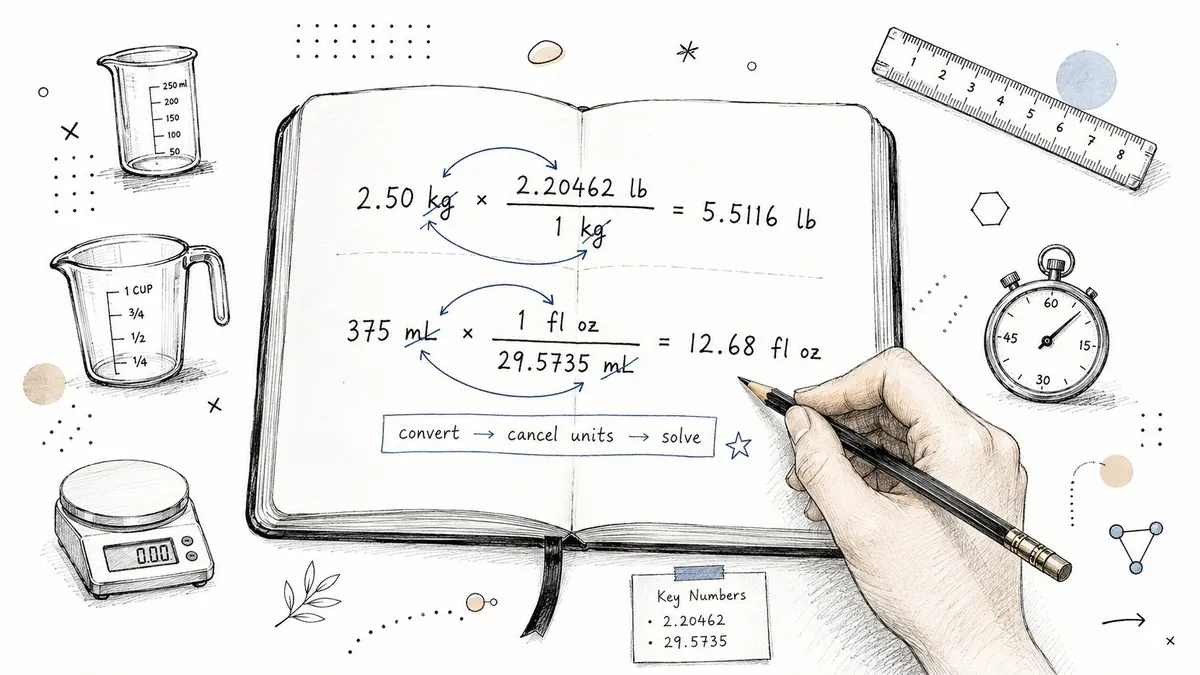
Dimensional analysis gives you a dependable structure for conversions. Instead of memorizing a separate rule for every pair of units, write each conversion relationship as a fraction equal to one. For example, because 1 foot equals 12 inches, both (12\text{ in}/1\text{ ft}) and (1\text{ ft}/12\text{ in}) represent one.
You choose the fraction that cancels the unit you already have. If you start with feet and want inches, feet must appear in the denominator of the factor:
[ 8\text{ ft}\times\frac{12\text{ in}}{1\text{ ft}}=96\text{ in} ]
The feet cancel, leaving inches. This is the central habit explained in this guide to unit conversion.
A complete rate conversion
Convert 65 miles per hour to meters per second. The starting unit is miles per hour, and the target is meters per second. Use the relationships 1 mile = 5,280 feet, 1 foot = 12 inches, 1 inch = 2.54 centimeters, 100 centimeters = 1 meter, and 1 hour = 3,600 seconds.
[ 65\frac{\text{mi}}{\text{hr}} \times\frac{5,280\text{ ft}}{1\text{ mi}} \times\frac{12\text{ in}}{1\text{ ft}} \times\frac{2.54\text{ cm}}{1\text{ in}} \times\frac{1\text{ m}}{100\text{ cm}} \times\frac{1\text{ hr}}{3,600\text{ s}} ]
Now inspect the units before touching the calculator:
- miles cancel with miles
- feet cancel with feet
- inches cancel with inches
- centimeters cancel with centimeters
- hours cancel with hours
- meters and seconds remain
The numerical result is approximately 29.1 m/s. The setup matters more than the decimal. If the final unit were miles per second, feet per hour, or another leftover unit, the expression would reveal the error immediately.
Why the method scales
The same arrangement works for length, mass, rates, area, volume, and concentration. For a clinical measurement, you might first convert the ordered amount into the same mass unit shown on a vial, then calculate the volume. That sequence helps prevent mismatches such as mg versus mcg or g versus mg, which are common sources of skipped-step and tenfold errors (dosage calculation guidance using dimensional analysis).
For work involving small volumes, careful measurement also matters. A resource on EU lab supply syringe compliance can help readers understand why syringe markings and stated units must be read together.
Write the starting value, place the target unit where you want it, and let cancellation determine whether you multiply or divide. You won’t need to trust a vague memory such as “larger to smaller means multiply” when the units show the direction directly.
Common Conversion Mistakes and How They Happen
A student once converted kilograms to pounds, got a smaller number, and assumed the arithmetic had failed. The problem was the conversion factor: the starting unit had not been arranged to cancel. Similar slips appear when exponents are ignored or prefixes are read as if they described the same scale. A review of common unit-conversion errors identifies missing units, incorrect factors, weak dimensional checks, and treating units like ordinary numbers (research on common unit-conversion errors).
| Mistake Type | Incorrect Approach | Correct Method |
|---|---|---|
| Wrong direction | Multiply by a factor that leaves the starting unit in place or makes the magnitude implausible | Write the factor so the starting unit cancels |
| Missed exponent | Treat (1\text{ m}^2) as though it converted like (1\text{ m}) | Square the entire linear conversion factor |
| Prefix confusion | Read milli, micro, or nano as interchangeable labels | Expand the prefix, write the units, and compare the powers of ten |
Wrong direction
Suppose the starting value is in kilograms and the target is pounds. The factor (0.454\text{ kg}/1\text{ lb}) fits a calculation that begins with pounds. For kilograms to pounds, reverse the arrangement so pounds are in the numerator and kilograms are in the denominator, using the stated relationship.
Ask, “Which unit must disappear?” If kg begins in the numerator, kg must occur in the denominator of the conversion factor. This cancellation check is more dependable than memorizing whether a particular conversion requires multiplication or division.
Area and volume punish shortcuts
A length relationship cannot be copied unchanged into an area or volume problem. If the linear factor is (100\text{ cm}/1\text{ m}), an area conversion requires:
[ \left(\frac{100\text{ cm}}{1\text{ m}}\right)^2 ]
The result has square centimeters per square meter. For volume, cube the entire factor. The exponent applies to both the numerical relationship and its units. Research on area and volume conversion difficulty shows that squared and cubed units create particular trouble for students, so checking the final unit is an important error-detection habit.
Prefixes can hide a serious mismatch
The labels milli, micro, and nano mark different powers of ten. Expand each prefix before calculating, then compare the units and scale. In clinical work, confusing mcg with another abbreviation can produce a mismatch between the prescribed amount and the measuring device. A nursing education study reported that 40.6% of second-year students made unit-conversion mistakes in clinical exercises, including confusion between mcg and microdrops (nursing education study).
The common cause is calculating before writing the units. Keep the units beside every value, require them to cancel visibly, and question any answer whose unit or magnitude does not fit the original measurement.
Worked Examples for Mass Volume and Concentration
A good worked example has two tracks: the arithmetic and the unit path. Keep both visible. If you erase the units too early, you lose the quickest way to detect an inverted factor.
Patient mass from pounds to kilograms
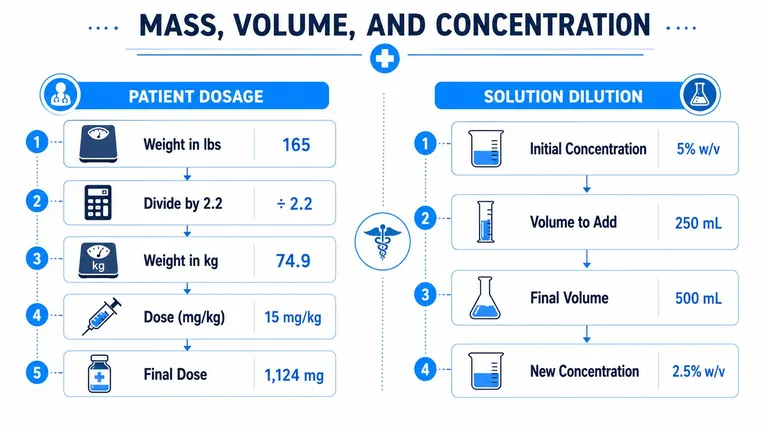
Assume a patient weighs 165 lb and the conversion supplied for the calculation is (1\text{ kg}=2.2\text{ lb}).
[ 165\text{ lb}\times\frac{1\text{ kg}}{2.2\text{ lb}} ]
The lb labels cancel:
[ 165\div2.2=75\text{ kg} ]
The answer is 75 kg. The direction is sensible because kilograms are a larger mass unit than pounds, so the numerical value becomes smaller. In a dosage workflow, convert the ordered patient weight into the same mass unit used by the dose instruction before calculating the amount.
Gallons to milliliters
Use the chain (1\text{ gal}=4\text{ qt}), (1\text{ qt}=2\text{ pt}), (1\text{ pt}=2\text{ cups}), and (1\text{ cup}=240\text{ mL}). Convert 3 gallons:
[ 3\text{ gal} \times\frac{4\text{ qt}}{1\text{ gal}} \times\frac{2\text{ pt}}{1\text{ qt}} \times\frac{2\text{ cups}}{1\text{ pt}} \times\frac{240\text{ mL}}{1\text{ cup}} ]
Every intermediate unit cancels, leaving mL:
[ 3\times4\times2\times2\times240=11,520\text{ mL} ]
The result is 11,520 mL. The large numerical value is expected because a milliliter is much smaller than a gallon.
Milligrams per milliliter to micrograms per liter
Convert 2 mg/mL to mcg/L. Handle the numerator and denominator deliberately:
[ 2\frac{\text{mg}}{\text{mL}} \times\frac{1,000\text{ mcg}}{1\text{ mg}} \times\frac{1,000\text{ mL}}{1\text{ L}} ]
The mg and mL labels cancel:
[ 2\times1,000\times1,000 =2,000,000\frac{\text{mcg}}{\text{L}} ]
The answer is 2,000,000 mcg/L. Students often convert mg to mcg but forget that changing “per milliliter” to “per liter” also changes the denominator. Resources on measuring small volumes accurately are useful when the written concentration must ultimately guide a physical measurement.
For related concentration work, see this final concentration calculation guide. In every example, the factor’s orientation comes from cancellation, not from a memorized slogan.
How to Catch Conversion Errors Before They Matter
A finished calculation deserves a check before anyone uses it. The check doesn’t need to repeat the entire problem. It needs to attack the kinds of mistakes that survive ordinary arithmetic.
Layer one is the unit sanity check
Read the question’s requested unit, then read your final label. If the problem asks for kilograms and your answer says pounds, the calculation isn’t finished. Also look for stray units that failed to cancel, duplicated units, or a denominator that disappeared.
Write the conversion factors in full at least once. A bare number such as 2.2 hides whether it means pounds per kilogram or kilograms per pound.
Layer two is the scale check
Estimate before accepting the exact result. A kilogram is about two pounds, and a liter is roughly a quart, so a pound-to-kilogram conversion should produce a smaller numerical value, while a liter-to-milliliter conversion should produce a much larger one.
Red flags include:
- A factor-of-ten jump: Recheck milli, micro, and centi prefixes.
- An inverted ratio: Ask whether the result should grow or shrink.
- An implausible scale: Compare the result with a familiar benchmark.
- Premature rounding: Keep precision until the final step when the conversion requires it.
Layer three is the logical check
Reverse the conversion. If 165 lb became 75 kg, multiply 75 kg by the same relationship in the opposite direction. You should return to approximately 165 lb.
This reverse calculation is especially useful for compound units. You can also compare the original and final expressions side by side, confirming that each unwanted unit appears once above and once below.
A correct-looking number with the wrong unit is still wrong.
Use this percent dilution calculator resource when a percentage-strength problem adds another layer of interpretation. A calculator can verify multiplication, but it can’t decide whether you entered the right unit relationship.
Practice Problems with Step-by-Step Solutions
Try each problem before reading its solution. Write every unit, arrange the factors, and apply the three checks from the previous section.
| Problem | Conversion Type | Key Skill Tested |
|---|---|---|
| 1 | Ounces to grams | Linear factor orientation |
| 2 | Gallons to milliliters | Chained conversions |
| 3 | Square feet to square meters | Squaring a factor |
| 4 | Cubic centimeters to liters | Cubing and prefix handling |
| 5 | mg/kg dose from pounds | Mass conversion before dosage |
| 6 | Percentage strength to mg/mL | Interpreting concentration units |
Problem one
Convert 8 oz to grams using (1\text{ oz}=28.35\text{ g}).
[ 8\text{ oz}\times\frac{28.35\text{ g}}{1\text{ oz}} =226.8\text{ g} ]
The verified answer is 226.8 g. The number should be larger because grams are the smaller unit in this relationship.
Problem two
Convert 2 gallons to milliliters using the chain from the worked example.
[ 2\text{ gal}\times\frac{4\text{ qt}}{1\text{ gal}} \times\frac{2\text{ pt}}{1\text{ qt}} \times\frac{2\text{ cups}}{1\text{ pt}} \times\frac{240\text{ mL}}{1\text{ cup}} =7,680\text{ mL} ]
All intermediate labels cancel, leaving 7,680 mL.
Problem three
Convert 10 ft² to square meters using (1\text{ ft}=0.3048\text{ m}).
[ 10\text{ ft}^2 \times\left(\frac{0.3048\text{ m}}{1\text{ ft}}\right)^2 ]
[ 10\times0.3048^2=0.9290304\text{ m}^2 ]
The answer is 0.9290304 m². Squaring the factor is essential because the original unit measures area.
Problem four
Convert 5,000 cm³ to liters using (1\text{ L}=1,000\text{ cm}^3).
[ 5,000\text{ cm}^3\times\frac{1\text{ L}}{1,000\text{ cm}^3} =5\text{ L} ]
The result is 5 L. Since a liter is much larger than a cubic centimeter, the numerical value should decrease.
Problem five
A prescription calls for 4 mg/kg for a patient weighing 110 lb. Use (1\text{ kg}=2.2\text{ lb}).
[ 110\text{ lb}\times\frac{1\text{ kg}}{2.2\text{ lb}} =50\text{ kg} ]
Then:
[ 50\text{ kg}\times\frac{4\text{ mg}}{1\text{ kg}} =200\text{ mg} ]
The verified dose is 200 mg. The kg unit cancels only after the converted weight is multiplied by mg/kg.
Problem six
Convert 1% w/v to mg/mL. Interpret 1% w/v as 1 g per 100 mL, then convert grams to milligrams:
[ \frac{1\text{ g}}{100\text{ mL}} \times\frac{1,000\text{ mg}}{1\text{ g}} =10\frac{\text{mg}}{\text{mL}} ]
The result is 10 mg/mL. Check both the mass unit and the volume unit before accepting it.
Building Reliable Conversion Habits
A reliable conversion routine works like a preflight check. Use the same sequence every time:
- Write the given value and unit.
- Write the target unit.
- Orient each factor so unwanted units cancel.
- Check whether the unit is squared or cubed.
- Convert prefixes explicitly when the scale changes.
- Calculate only after the units balance.
- Estimate the expected size.
- Reverse-check the result when accuracy is critical.
The cancellation pattern should remain visible. If a unit fails to cancel, stop before calculating. If the answer’s size conflicts with the starting measurement, inspect the conversion direction, prefix, or exponent.
Healthcare, engineering, aviation, and laboratory teams use similar checks when measurements pass between people, instruments, and software. Apply factors correctly, keep appropriate significant digits, and round only at the end, as noted in NIST conversion guidance.
Practice makes this routine faster without hiding its warning signs.
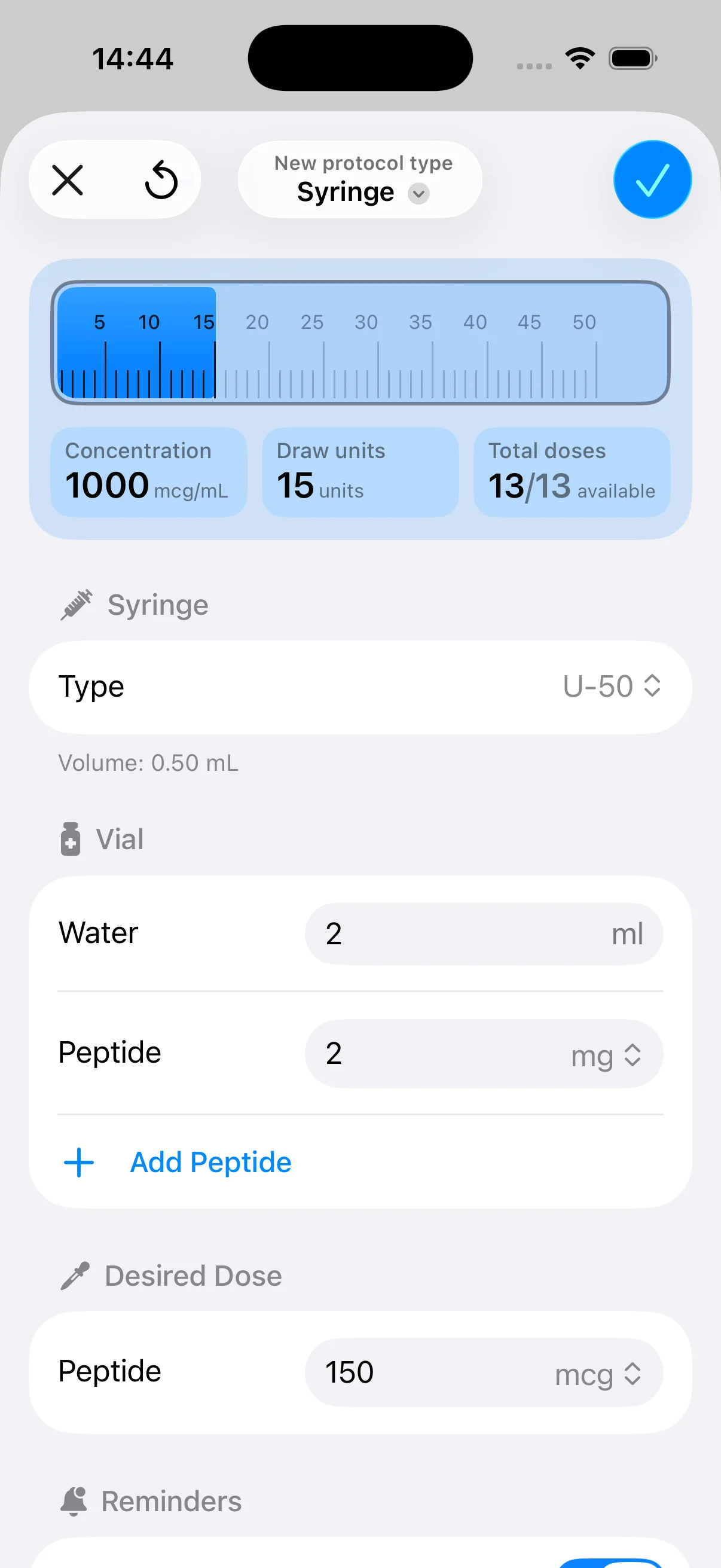
If you want a practical way to organize peptide dose calculations and schedules, visit PepFlow. Its calculator works with mg, mcg, mL, and IU, and helps translate vial concentrations into syringe measurements while keeping dosing routines organized.