You’ve got a vial on the bench, a syringe in hand, and a dose that looks small enough to trust your memory. That’s exactly where unit conversion volume stops being a classroom topic and becomes a safety step, because the hard part isn’t the arithmetic, it’s making sure the number you calculate matches the unit you’re holding. A milliliter, a microliter, and a syringe mark can all look familiar, but they’re not interchangeable unless you’ve already done the conversion cleanly.
Table of Contents
- Why Volume Conversion Trips People Up
- The Metric Volume Hierarchy from Cubic Meter to Microliter
- Choosing Between Liter and Cubic Meter as Your Anchor
- Mapping Household and Regional Volume Units to Metric
- Concentration and Dilution Formulas Step by Step
- Calculating Injection Volume from Micrograms
- Rounding Hygiene and Double-Check Routines
- Quick Reference Conversion Table
- Putting It All Together in a Dosing Workflow
Why Volume Conversion Trips People Up
The usual mistake starts before the math even begins. Someone reads a target dose in micrograms, glances at a reconstituted vial in milliliters, then reaches for a syringe that speaks in marks, not math. By the time the numbers move from paper to plastic, the unit context has already shifted once or twice, and that’s where the error slips in.
A peptide researcher can know the formula and still miss the draw. A 5 mg vial might be reconstituted with 5 mL, then the next step gets handled as if 0.5 mL were the correct draw when the actual intended volume was 0.05 mL. The arithmetic may be simple, but the unit selection wasn’t.
If you want the cleanest way to think about it, treat every calculation as a translation problem first and a math problem second. The point is to keep the dose unit, the stock concentration unit, and the delivery unit aligned before you touch the syringe.
What unit conversion means in practical use is helpful background, but the habit is more specific. Always ask which system the source is using, which unit the syringe shows, and whether you’re still inside the same measurement type.
Practical rule: most dosing errors happen because the wrong unit basis gets selected, not because the multiplication is difficult.
The Metric Volume Hierarchy from Cubic Meter to Microliter
The metric ladder works because every step is a clean factor of 1,000. That’s why a conversion from liters to milliliters feels easier than almost any other volume system. Once you know where you are on the ladder, moving up or down becomes mechanical.
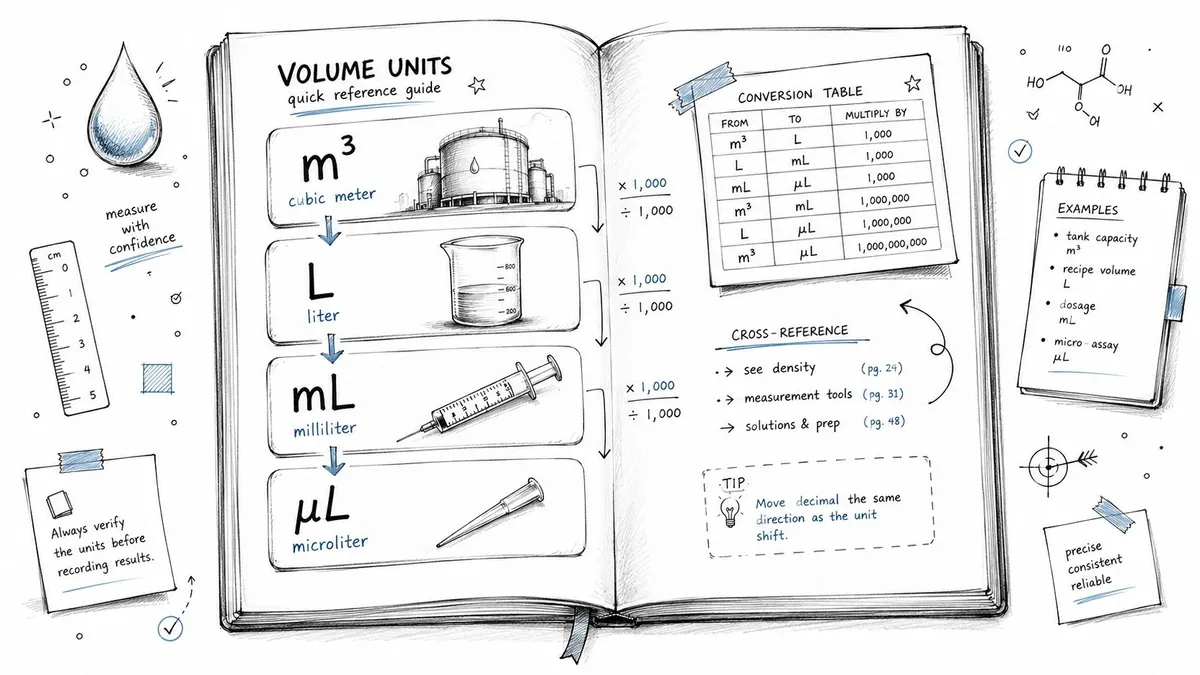
At the top of the practical SI hierarchy sits the cubic meter (m³), the SI unit of volume. NIST states the core equivalences plainly, 1,000 L = 1 m³, 1 L = 1,000 mL, and 1 mL = 1 cm³ (NIST SI units of volume). That same structure is why metric work stays predictable in labs, filling lines, and dosing workflows.
The metric staircase
- 1 m³ = 1,000 L, useful when volume starts from physical dimensions or bulk systems.
- 1 L = 1 dm³, the practical bench-level anchor for liquids.
- 1 L = 1,000 mL, the everyday conversion used in bottles, vials, and recipes.
- 1 mL = 1 cm³, the bridge between volume and geometric measurement.
- 1 mL = 1,000 µL, the unit shift that matters for pipettes and low-volume dosing.
- 1 µL = 1,000 nL, common in microfluidics and analytical workflows.
- 1 nL = 1,000 pL, where HPLC-adjacent and highly miniaturized work begins to live.
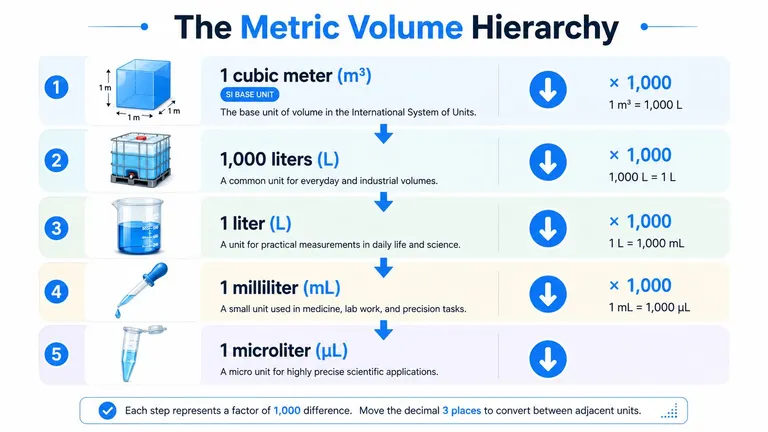
The reason this hierarchy matters in practice is that you can move from a bench bottle to a pipette without changing systems. A 1 L media bottle becomes 1,000 mL, then a 100 µL transfer is just another step down the same ladder. That continuity is why the metric system stays so forgiving when people keep the unit chain intact.
A useful way to read the ladder is simple, every step down multiplies by 1,000, every step up divides by 1,000. If that rule feels too abstract, keep the visual anchor in mind. A liter is the working bottle unit, a milliliter is the syringe and vial unit, and a microliter is the pipette and microdose unit.
Choosing Between Liter and Cubic Meter as Your Anchor
The anchor unit should match the scale of the work, not the elegance of the formula. In a bench environment, liter usually wins because it lines up with vials, syringes, and dilution math without forcing extra decimal shifts. In facility-scale or geometry-based calculations, cubic meter stays cleaner because it ties directly to physical dimensions and bulk volume.
Here’s the conversion both ways, 1 m³ = 1,000 L and 1 L = 0.001 m³. That relationship is straightforward, but the wrong anchor can still introduce a thousand-fold mistake if the protocol and the calculation don’t use the same basis. A recipe written in liters is not interchangeable with a concentration written per cubic meter unless you convert first.
| Criterion | Liter (L) | Cubic Meter (m³) |
|---|---|---|
| Best use | Bench prep, vials, syringes, everyday liquids | Bulk systems, room-scale calculations, engineering volumes |
| Practical subunits | mL, µL | L, then smaller metric units after conversion |
| Mental overhead | Low for dosing work | Low for facility and geometry work |
| Common mistake | Treating liter values as if they were already in syringe units | Forgetting that 1 m³ is 1,000 L |
| Precision comfort | Strong at small liquid volumes | Strong when volume comes from dimensions |
The clean rule is this, if the smallest thing you measure is in milliliters, anchor in liters. If the whole problem starts in meters, stay in cubic meters until you’re ready to enter bench scale.
Mapping Household and Regional Volume Units to Metric
A lot of dosing mistakes begin with a familiar label. Teaspoon, tablespoon, cup, fluid ounce, quart, and gallon all feel concrete in the hand, but they’re only safe when you convert them to the same system before doing any concentration math. The danger isn’t the kitchen label itself, it’s assuming every region means the same thing by that label.
The clearest example is the fluid ounce. US and Imperial fluid ounces are close, but they’re not the same, and that difference is enough to skew a small-volume preparation. If a formula or label uses a household measure, convert it immediately to milliliters and stop thinking in mixed systems.
For a broader walk-through of how household measures are handled in practical prep, How to calculate water volume is a useful companion reference.
| Unit | System | Exact Metric Equivalent |
|---|---|---|
| Fluid ounce | US customary | 29.5735 mL |
| Tablespoon | US customary | 14.7868 mL |
| Teaspoon | US customary | 4.92892 mL |
| Cup | US customary | 236.588 mL |
| Pint | US customary | 473.176 mL |
| Quart | US customary | 946.353 mL |
| Gallon | US customary | 3.78541 L |
| Fluid ounce | UK Imperial | 28.4131 mL |
| Gallon | UK Imperial | 4.54609 L |
| Cup | Metric recipe measure | 250 mL |
Keep the unit type consistent before you calculate. Volume conversions stay reliable when you convert within the same measurement family, and they break down when mass, length, and volume get mixed together.
The practical move is blunt. If a label says “cup,” “oz,” or “tbsp,” translate it into mL first, then work the rest of the math in metric. That habit removes the regional ambiguity before it can touch the dose.
Concentration and Dilution Formulas Step by Step
The core dilution identity is C1V1 = C2V2. It works because the amount of substance stays constant while the volume changes, which means concentration moves in the opposite direction of draw volume. When both sides use compatible units, the formula stays simple and the unit cancellations stay visible.
Define the variables clearly before you calculate. C1 is the stock concentration, V1 is the stock volume you need to draw, C2 is the final concentration you want, and V2 is the final volume after dilution. If you blur those roles, the formula still looks right but the answer won’t be.
A realistic peptide example helps. Start with a 10 mg vial and add 2 mL bacteriostatic water. The stock concentration becomes 5 mg/mL, which is also 5,000 µg/mL because milligrams and micrograms are just different mass scales inside the same volume ratio.
If you then make a 1:10 dilution from that stock, you can mix 0.1 mL stock with 0.9 mL diluent to get 1.0 mL final volume at 0.5 mg/mL. The algebra is straightforward, 5 mg/mL × 0.1 mL = 0.5 mg, and 0.5 mg ÷ 1.0 mL = 0.5 mg/mL. The unit trail matters more than the line of numbers.
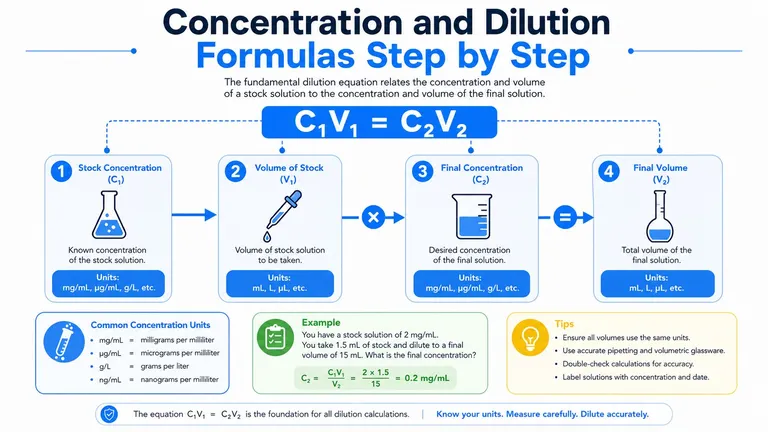
The same logic works whether you express concentration as mg/mL or µg/mL. Concentration is a ratio, so any mass unit can pair with any volume unit as long as both sides of the equation use the same basis. That’s why the formula feels almost too simple once the units are clean.
Calculating Injection Volume from Micrograms
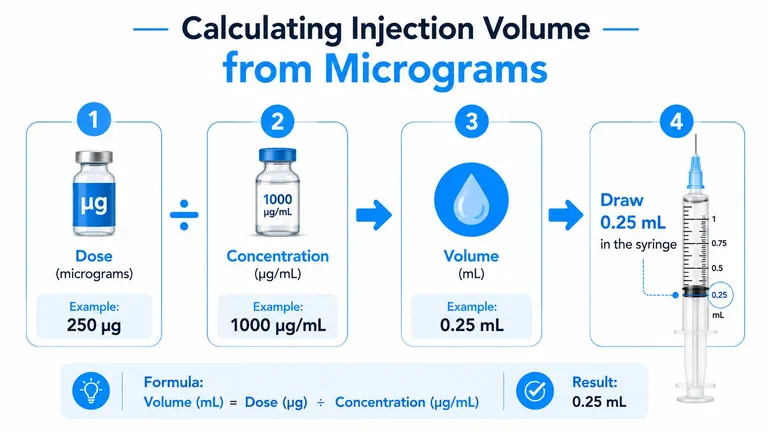
Dosing usually starts in micrograms and ends at a syringe mark. The useful formula is Injection Volume (mL) = Dose (µg) ÷ Concentration (µg/mL). Once the concentration is in micrograms per milliliter, the syringe draw falls out directly.
Take a 100 µg target dose from a vial reconstituted at 5 mg/mL. First convert the concentration, 5 mg/mL = 5,000 µg/mL. Then divide, 100 µg ÷ 5,000 µg/mL = 0.02 mL, which is 20 µL.
That draw fits a small insulin syringe cleanly. On a U-100 scale, 0.02 mL corresponds to the 2-unit mark when the syringe is being used for volume markings, not insulin units. If you’re using a syringe that isn’t meant to read that fine, the math may be correct while the draw still becomes impractical.
The hardware matters just as much as the formula. A standard 1 mL syringe can have dead space in the hub that exceeds a tiny draw, which is why low-volume work belongs in low-dead-space tools whenever possible. That isn’t a math issue, it’s a delivery issue.
If you want another practical explanation of how small-volume math gets translated into real syringe marks, the guide on DIY serum precision tips is a useful analogy even though it comes from cosmetic prep rather than peptide dosing. The same discipline applies, measure the liquid you have, not the one you wish the tool displayed.
For a more dose-specific walkthrough, How to convert mcg to mL covers the same unit bridge from a different angle.
Rounding Hygiene and Double-Check Routines
Most conversion errors don’t come from not knowing the formula. They come from rounding too early, then carrying the rounded number through the rest of the prep as if it were exact. That habit is harmless in casual math, but it can distort a tiny draw volume fast.
The safer approach is simple. Keep extra decimal places until the final syringe-readable result, then round once to match the tool you’re using. A 1 mL insulin syringe needs a different rounding mindset than a 3 mL syringe, and droppers calibrated in coarse increments need even more restraint.
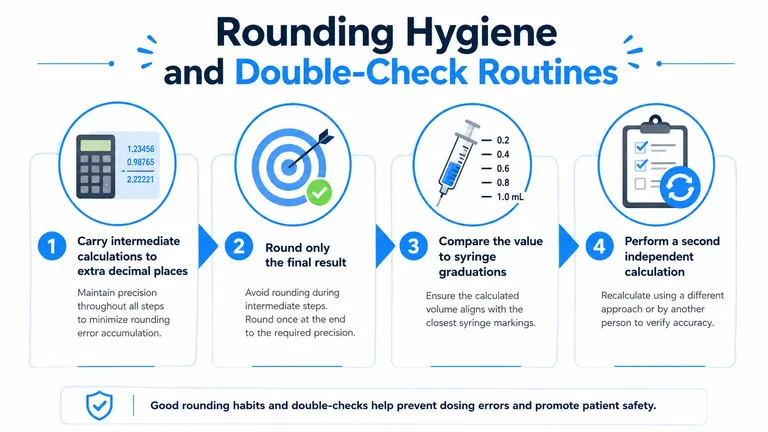
A good double-check routine is mechanical, not emotional.
- Carry the full value: keep intermediate steps unrounded until the end.
- Match the device: only round to what the syringe can show.
- Reverse the math: convert the draw back into dose and confirm it lands where you expected.
- Record the setup: note vial concentration, diluent volume, and final draw volume on the label.
The 2026 guide on common volume calculation mistakes emphasizes traceability, cross-checking, and avoiding premature rounding, and that matches what holds up in real prep work (common volume calculation mistakes). The practical insight is that a second calculation catches more bad inputs than it does bad arithmetic.
Write the concentration and the final draw on the vial or log before you move on. A clean paper trail makes the next check faster than memory.
Quick Reference Conversion Table
Use this as the fast lookup sheet when the label, protocol, or syringe needs a translation. The point is not to re-derive anything at the bench. The point is to spot the correct unit immediately and move on with the same basis through the whole calculation.
| Unit | Exact Metric Equivalent | Syringe-Friendly Read |
|---|---|---|
| 1 m³ | 1,000 L | Facility scale |
| 1 L | 1,000 mL | Large bottle or bulk prep |
| 1 mL | 1,000 µL | Standard syringe and vial scale |
| 1 µL | 0.001 mL | Microdose and pipette scale |
| 1 cm³ | 1 mL | Same physical volume |
| 1 L | 1,000,000 µL | Useful for large-to-small translation |
| 1 US fl oz | 29.5735 mL | Convert immediately before dosing |
| 1 US tsp | 4.92892 mL | Household label only |
| 1 US tbsp | 14.7868 mL | Household label only |
| 1 US cup | 236.588 mL | Recipe volume |
| 1 US pint | 473.176 mL | Larger kitchen measure |
| 1 US quart | 946.353 mL | Near a liter, but not one |
| 1 US gallon | 3.78541 L | Bulk liquid label |
| 1 UK fl oz | 28.4131 mL | Not the same as US fluid ounce |
| 1 UK gallon | 4.54609 L | Imperial system |
The fastest way to use the table is to convert every non-metric label into mL first, then stay in metric until the final syringe readout. If a unit isn’t on the sheet, treat it as a reminder to recalculate instead of estimating.
Putting It All Together in a Dosing Workflow
A reliable dosing workflow starts with one question, what unit is the vial written in, and what unit will the syringe show? Once the vial concentration is clear, convert it to the smallest practical metric unit, usually µg/mL, so every downstream step stays consistent. That keeps the math tight when the dose gets small.
From there, calculate the injection volume in mL or µL, then convert that volume to the syringe marking you’ll physically draw. If you’re using a 1 mL insulin syringe, the useful habit is to think in draw volume first and syringe units second, because the syringe doesn’t care how elegant the formula looked on paper.
A check against the total prepared volume helps catch bad assumptions. If the daily draw volumes obviously exceed the liquid you added, the error is in the setup, not in the syringe. That is usually the moment to stop, re-read the vial, and replay the conversion chain from the start.
The cleanest record keeps the next prep reproducible.
- Vial lot and concentration: write the actual label value.
- Diluent volume: note exactly what was added.
- Prescribed dose: keep the target in µg.
- Draw volume: document the final syringe mark.
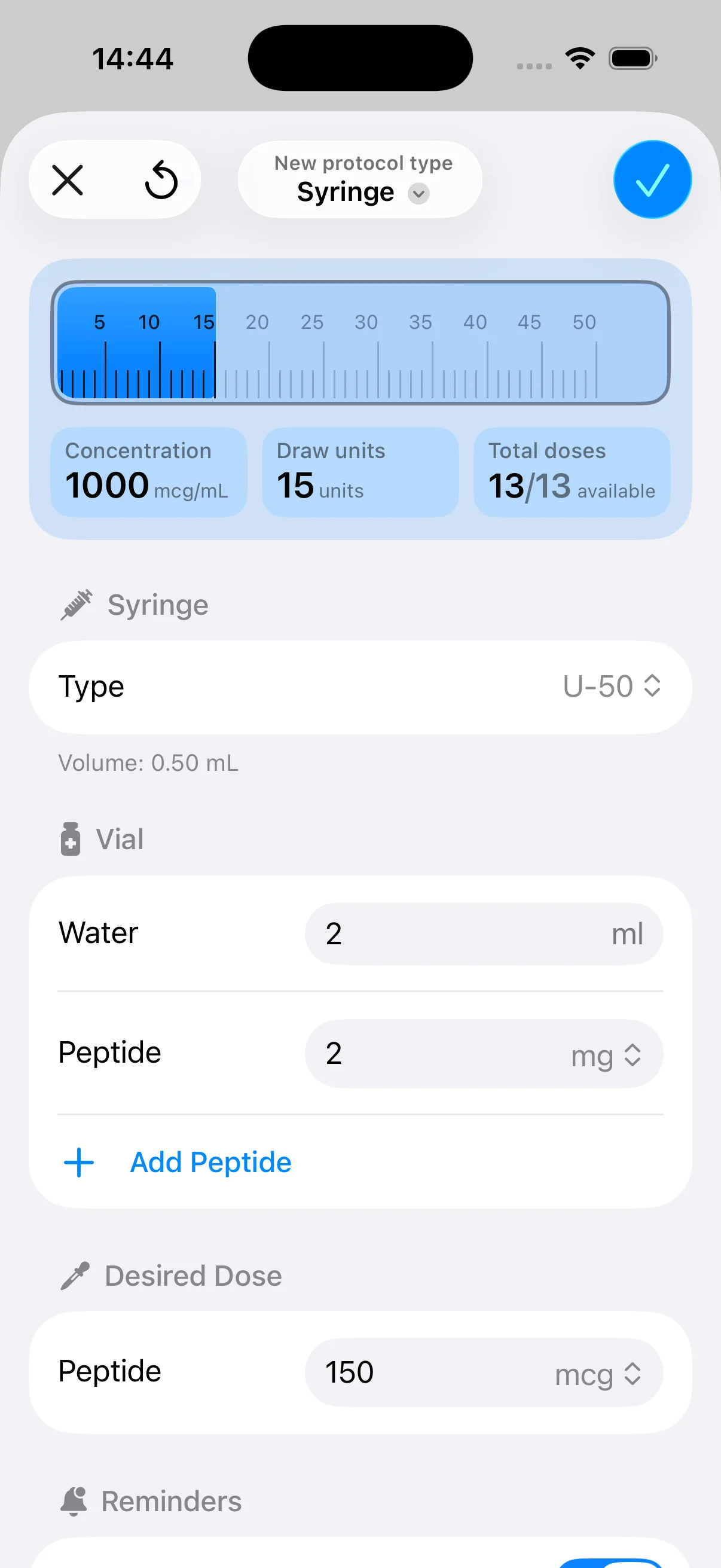
One app can fit into that workflow if you want the math and tracking kept together. PepFlow handles dose conversion and scheduling for peptide routines, so the same unit logic can stay attached to the plan instead of living in a separate note.
If you keep the unit basis stable, the whole process becomes repeatable. If you let the basis drift, the arithmetic can still look correct while the dose no longer matches the plan.
If you want a cleaner way to manage peptide dosing math, vial setup, and draw-volume tracking, visit PepFlow and use it as a planning companion for your next prep. It keeps the conversion logic tied to the routine, which makes the next dose easier to verify before you ever pick up a syringe.