
Most reconstituted peptides last 28 to 30 days when they’re refrigerated, and some can turn unreliable in hours if they sit at room temperature. If they’re frozen correctly in single-use aliquots and not thawed over and over, the usable window can stretch much longer.
You open the vial, the powder is gone, and the clock has already started. That’s where people get caught out, they plan a six-week run, use the same vial on day 45, and assume “still clear” means “still fine.” It usually doesn’t.
Table of Contents
- The Reality of Reconstituted Peptide Lifespans
- Understanding the Chemistry of Degradation
- Storage Conditions and Stability Windows
- Best Practices for Vial Handling and Preservation
- Identifying Spoilage and When to Discard
- Maximizing Longevity Through Smart Planning
The Reality of Reconstituted Peptide Lifespans
A vial that looked stable as dry powder changes the moment water goes in. One of the most common mistakes is treating reconstituted peptide like a slow-moving product when, in practice, it’s a short-window solution that needs active tracking.

A practical rule has emerged across lab guidance, refrigerate at 2–8°C and plan around one month. Neutral references repeatedly converge on a 28-day refrigeration rule for bacteriostatic-water mixtures, with some allowing 30 days and others stretching a little further depending on sequence and formulation. That doesn’t mean every peptide is identical, it means the default operating window is measured in weeks, not months, and the conservative side wins when dosing accuracy matters (temperature guide).
What that looks like in real use
The mistake usually happens with good intentions. A user starts with a full vial, uses it carefully, and then keeps the leftovers because they’re expensive. Day 45 comes around, the solution still looks clear, and the assumption is that the vial is “probably okay.”
Practical rule: if you’re counting on a vial for more than a month, you’re already outside the common handling window used in active protocols.
That’s the gap that matters, the difference between technically present and practically usable. The most reliable mindset is simple, once water is added, you’re managing a countdown, not a long-term stockpile. If the vial is going to outlive its clean, cold, low-handling window, it should be split earlier, not rescued later.
Understanding the Chemistry of Degradation
Reconstitution changes the molecule’s environment in a way that dry powder never has to deal with. In the lyophilized state, the peptide sits in a relatively protected form. Once dissolved, it’s exposed to water, oxygen, light, and handling, and that’s where stability starts to slip.
Why the dissolved state is fragile
Water isn’t just a carrier, it’s part of the problem. Reintroduced water becomes a reactant, which is why hydrolysis becomes a real concern, especially when the vial sits warm or gets handled repeatedly. At the same time, dissolved peptides move more freely, and that extra mobility makes them easier targets for oxidation and other chemical changes.
That’s also why contamination risk goes up. Every puncture, every warm-up cycle, and every non-sterile touch gives microbes and particles more chances to enter the vial. A sealed powder can sit undisturbed for a long time, but a dissolved solution needs discipline from the first draw onward (Sigma Aldrich handling and storage guidance).
Chemistry matters more than the label
Not every peptide breaks down at the same speed. Sequence, structure, and solvent all matter, which is why there isn’t a universal timeline that fits every vial. Some peptides are more vulnerable to oxidation, others tolerate cold storage better, and some need stricter handling because their chemistry is less forgiving (peptide reconstitution overview).
Cold storage slows degradation, but it doesn’t erase it.
That’s the point many miss. Refrigeration is a control measure, not a reset button. It buys time, it doesn’t make the vial immortal.
Storage Conditions and Stability Windows
Temperature is the biggest driver of whether a reconstituted peptide stays useful or starts drifting off target. Room temperature, refrigeration, and freezing are not interchangeable choices, they create very different stability outcomes.
Room temperature versus refrigeration
At room temperature, the practical shelf life can shrink to hours or days depending on the peptide and the solvent. That’s why leaving a vial on the counter for a full workday is a very different event from taking it out briefly to draw a dose. The solution may still look normal, but stability is already being stressed.
Refrigeration at 2–8°C is the standard working range. That’s the zone most guidance uses for active storage, and it’s the reason the common answer to how long do reconstituted peptides last stays anchored around the one-month mark. Even then, the exact window depends on sequence and handling, which is why a single blanket answer always oversimplifies practical realities (28-day refrigeration rule).
Freezing and the trade-off most people ignore
Freezing can help only when it’s done in a way that avoids repeated thawing. The practical logic is to protect single-use aliquots, not to keep cycling the same vial in and out of the freezer. Once thawing repeats, the storage gain starts getting eaten up by handling damage.
For people moving vials between locations, proper transport products matter more than most realize. A simple insulated setup can help preserve the cold chain during short transfers, and if you need to find lab transport products, the goal is temperature stability, not convenience for its own sake.
A usable decision rule
If you draw often, refrigeration is usually the safest default. If you need longer storage, aliquoting before freezing makes more sense than freezing a main vial and opening it repeatedly. And if your handling is sloppy, colder storage won’t fully compensate for the loss.
For a practical storage checklist, the earlier PepFlow guide on how to store reconstituted peptides fits neatly alongside this rule set. It’s the same basic idea, protect the vial from warmth, light, and unnecessary movement.
Best Practices for Vial Handling and Preservation
Handling habits decide whether a vial gets close to its expected window or falls short of it. A peptide can be stored correctly and still degrade early if the user keeps warming it, shaking it, or puncturing it carelessly.

The handling habits that matter most
Wipe the rubber stopper before every entry. Use a fresh sterile needle for each draw. Those two steps sound basic because they are, but they prevent the kind of contamination that shortens a vial’s life for no visible reason.
Bacteriostatic water is used for a reason, it includes benzyl alcohol, which is why the standard handling window lines up with the roughly 28-day use pattern many protocols follow. That preservative doesn’t make poor technique safe, but it does support multi-dose use better than plain sterile water when the vial will be entered repeatedly.
Practical rule: if you’re using a multi-dose vial, every extra puncture should be treated as a risk, not a routine.
Mixing without damaging the solution
When powder first dissolves, don’t shake the vial hard. Gently swirl or roll it instead. Aggressive shaking can create foam and stress the solution unnecessarily, while slow mixing gets the job done without rough handling.
The small stuff matters too. Keep the vial upright, return it to the refrigerator quickly after use, and don’t leave it sitting out while you get distracted. A few careless minutes won’t always ruin a vial, but a pattern of casual handling will shorten its useful life.
For people who want a structured dosing workflow, PepFlow’s freeze-dried peptides guide sits naturally next to this handling process. It’s useful when you’re planning the move from powder to solution and want fewer avoidable mistakes.
Identifying Spoilage and When to Discard
A clear vial isn’t always a healthy vial, but visual changes are still the first warning sign most users can spot. Cloudiness, particles, and unexpected color shifts all deserve attention, especially if the peptide should normally remain clear.
What to look for before drawing
Inspect the solution under good light. If you see haze, floating debris, or separation, treat that as a stop sign rather than a question mark. Degradation and contamination don’t always announce themselves dramatically, so any obvious change should push you toward disposal.
A faint medicinal smell can be normal in some handling contexts, but any sour, unusual, or off odor is a reason to stop. The same goes for a vial that has been stored poorly or left out too long. When in doubt, the safest answer is to discard it rather than chase one more dose.
The best discard rule is the boring one
The simplest decision rule is the hardest one for people to follow: if the vial has clearly crossed its intended storage window, let it go. That sounds wasteful until you compare it with the cost of using a compromised solution.
The point isn’t to turn every minor handling issue into panic. It’s to recognize that clarity alone doesn’t guarantee potency, and stability problems can sit below the surface. If you’re tracking multiple vials, an organized log helps, and PepFlow’s expiration date tracking workflow is the kind of system that keeps dates from turning into guesswork.
Discarding on time is cheaper than discovering too late that a vial had already drifted past usable condition.
Maximizing Longevity Through Smart Planning
The best way to extend a vial’s practical life is to stop treating it like a single block of supply. If your dosing schedule doesn’t match the vial size, you’re already creating avoidable waste.

Planning beats rescuing
Aliquoting is the cleanest way to reduce repeated freeze-thaw stress when longer storage is needed. Instead of opening the same vial again and again, you portion it into smaller single-use units so the rest stays undisturbed. That’s the version of long storage that makes sense.
The chemistry still sets the ceiling. Some peptides tolerate refrigeration better than others, and some are more sensitive to oxidation or handling than the average user expects. That’s why a universal expiration date is a myth, even though the 28-day rule is a useful default for many bacteriostatic-water vials (practical stability discussion).
What works in real routines
A good routine starts before reconstitution. Match vial size to likely use, keep the number of entries low, and label the date the moment the peptide is mixed. If the protocol spans weeks, schedule around the vial’s stability window instead of hoping it will stretch.
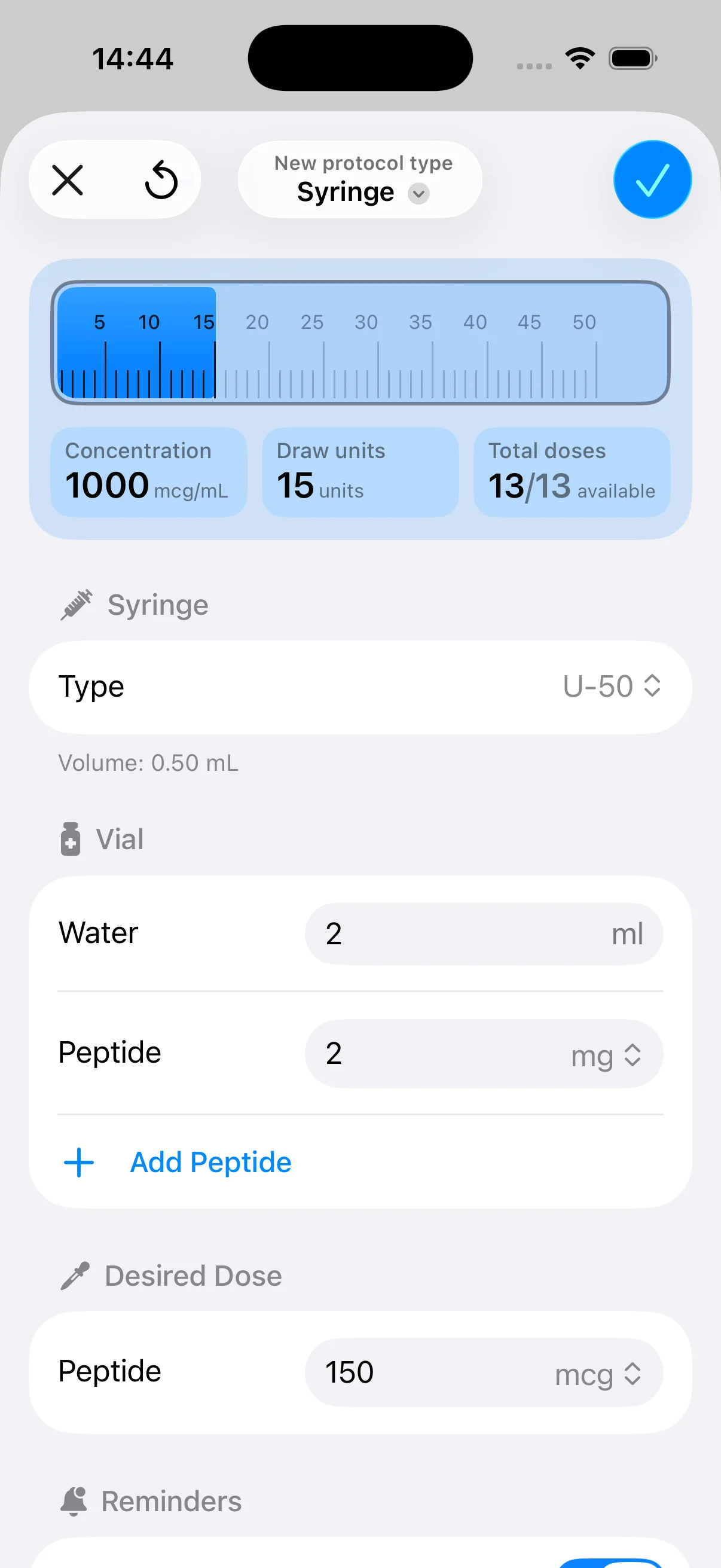
PepFlow fits naturally here because it handles the planning layer, dosage calculation, protocol timing, and reminders. That doesn’t replace sterile handling or refrigeration, but it does reduce the math mistakes and missed-dose drift that make a stable vial harder to use well.
Bottom line: plan the vial around your schedule, not your schedule around a vial that’s already aging.
For anyone juggling reconstitution dates, dose timing, and storage discipline, PepFlow keeps the moving parts organized in one place. It helps you calculate doses, track protocols, and stay on schedule so your vial handling stays as precise as the peptide work itself.