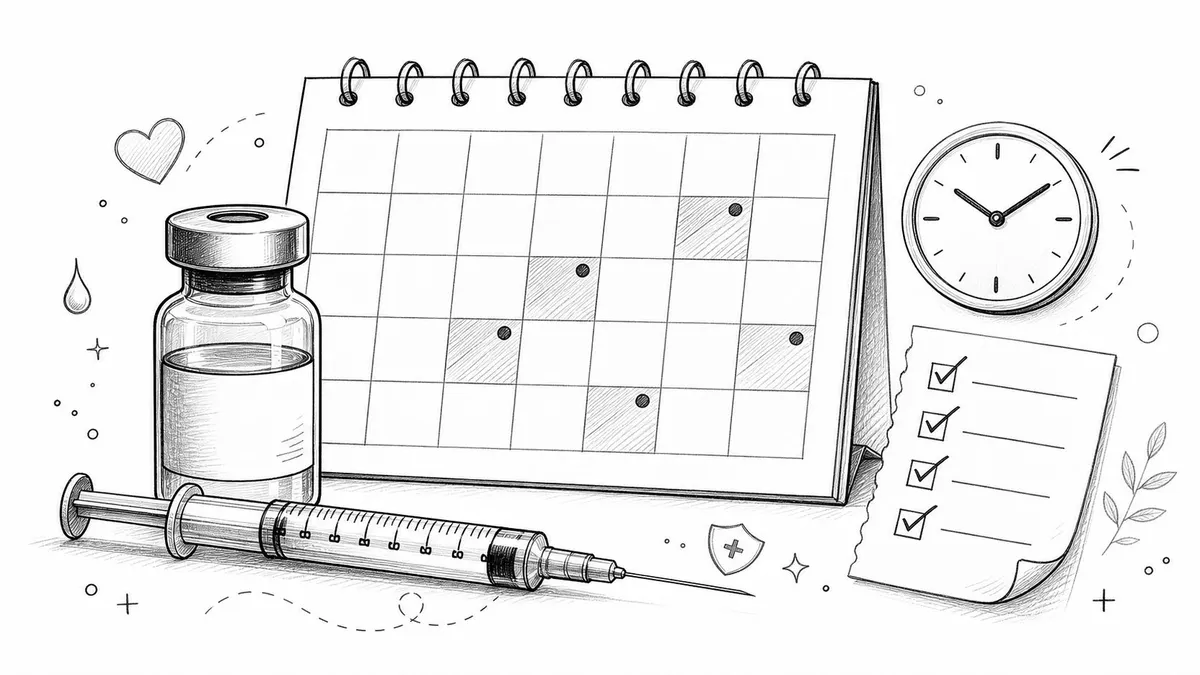
You’ve got the vial, the syringe, and a goal, but the schedule still feels fuzzy. That’s the point where many individuals get tripped up, because an HGH dosing schedule isn’t just a number on paper, it’s a rhythm of dose, timing, monitoring, and adjustment that has to fit real life.
If the dose feels too aggressive, the body tells you fast. If the timing is sloppy, meals and sleep can work against you. If you never build a way to track what happened yesterday, the next adjustment turns into guesswork.
Table of Contents
- What an HGH Dosing Schedule Really Means
- Core Principles Behind a Safe HGH Dosing Schedule
- Choosing the Right Time for Daily Injections
- Calculating Dose and Configuring Your Vial
- Monitoring and Adjusting the Schedule Over Time
- Running Your HGH Dosing Schedule in PepFlow
- Safety, Legal, and Final Checklist Before You Start
What an HGH Dosing Schedule Really Means
A lot of people start with the vial and hope the calendar sorts itself out. That usually leads to the wrong first move, because the schedule has four pieces that have to work together, dose amount, timing window, frequency, and monitoring cadence. If one of those is off, the rest of the plan becomes harder to read.
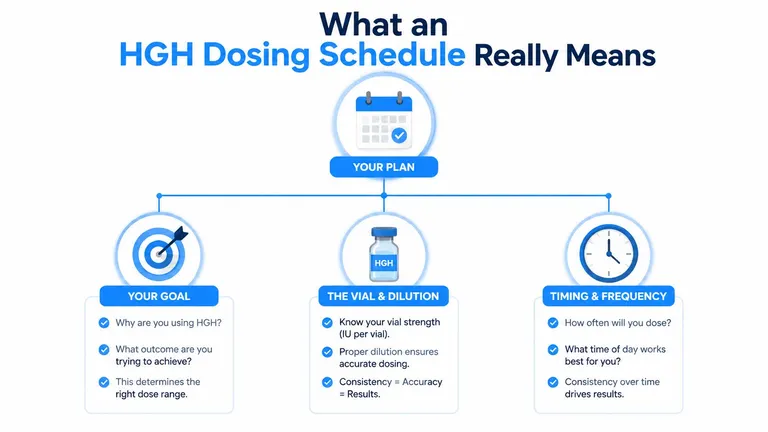
A practical HGH schedule starts with real-world constraints, not a target on paper. You have to match the dose to the vial setup, decide when the injection fits into the day, and leave room for symptom checks before the next adjustment. If the timing and the follow-up are improvised, the number on the syringe says less than people think.
The schedule is a system, not a single number
A practitioner reads an HGH schedule the same way they’d read a training block. The dose tells you how much is being delivered, but timing shows when it is least likely to clash with food, sleep, or glucose swings. Monitoring then tells you whether that setup is tolerable, effective, or too rough.
That is why the schedule has to be built around the full routine, not just the injection itself. Some protocols are simple on paper and still fail in practice because the person cannot keep the same timing, cannot track symptoms clearly, or cannot tell whether a change came from dose, meal timing, or sleep.
If you want a practical reference for how growth-factor style protocols are organized, the growth factor injections guide is a useful companion because it frames dosing as a sequence of decisions rather than a one-line chart. That mindset helps avoid the common mistake of starting too high and then trying to manage side effects after they have already shown up.
Practical rule: treat the calendar as part of the dose. If the time of day and the follow-up plan are not fixed, the dose number alone will not save the protocol.
For a closer look at how timing relates to clearance and spacing, see how HGH half-life affects dosing windows. In adult GH work, the schedule has historically meant daily subcutaneous injections plus serial review, especially of IGF-I and adverse effects, not intermittent replacement. That structure matters because the goal is controlled adaptation, not a short burst of hormone exposure.
Core Principles Behind a Safe HGH Dosing Schedule
A safe HGH schedule starts with restraint. Begin low, keep the dose changes small, hold the same daily rhythm, and review the response before changing anything else. That sounds straightforward, yet most schedule mistakes come from breaking one of those steps. People tend to move the dose faster than the body can show a clear response.
A common initiation strategy is 0.2 mg somatropin once daily, then a review every 2 to 4 weeks with adjustments at 4-week intervals until maintenance is reached. That approach is described in clinical literature and it works because it gives the protocol room to settle before the next decision, rather than forcing a quick reaction to the first few injections (PubMed). If you want a closer look at why repeat dosing matters, the half-life of HGH helps explain why the schedule is built around steady repetition instead of isolated injections.
Why slow titration beats a target-first mindset
A target dose can look clean on paper, but real patients do not adapt on a spreadsheet. Adults with insulin resistance, older adults, and people who are prone to fluid retention often do better with smaller increments and more time between changes. Slower titration is not hesitation, it is how you avoid chasing side effects after they appear.
Daily consistency matters just as much. Skipping days because of travel, soreness, or impatience makes it harder to tell whether the plan is working or whether the timing, meals, and dose all changed at once. A stable routine gives you usable signal.
Rule of thumb: if dose, timing, and food spacing all changed in the same week, the result is hard to interpret.
Monitoring belongs before the next adjustment, not after it. Symptoms matter, but they matter most when they are paired with lab context and a clear log of what happened across the full routine. A cleaner schedule means fewer surprises, and that is the point.
Choosing the Right Time for Daily Injections
Timing is where the schedule becomes practical instead of theoretical. Most adults can make morning or evening work, but the choice should match sleep, meals, and how tightly they want to mimic a natural release pattern. Split dosing sounds flexible, but it usually adds complexity faster than it adds value.
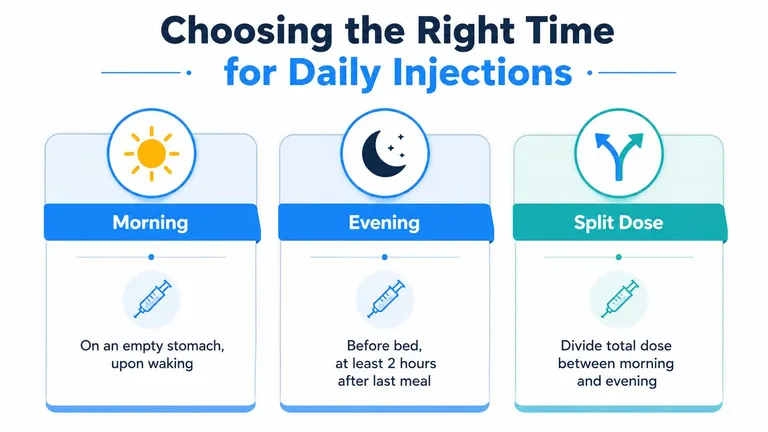
Standard adult GH treatment is daily subcutaneous injection, often in the evening to better mimic physiologic nocturnal GH secretion, with food delayed 30–60 minutes after injection to avoid blunting GH effects (Ageless Forever). That practical detail matters because meals and insulin aren’t background noise, they can change how cleanly the protocol feels day to day.
Morning, evening, and split dosing side by side
Morning on an empty stomach is the cleanest choice for people who want a consistent routine right after waking. It’s easy to remember, and for some adults it fits better with training later in the day. The downside is that breakfast timing has to be controlled.
Evening before bed usually feels more natural for people who want the injection tucked away at day’s end. It also aligns with the common clinical preference for nightly use. The trade-off is that late meals can interfere if the timing gets sloppy.
Split dosing is the most complicated option. Some people like the idea of dividing the total dose, but in practice it tends to increase adherence errors, make tracking harder, and blur the read on side effects.
The embedded video below is worth watching if you’re trying to see how timing gets handled in a real-world workflow.
For most adults, the best answer is the one that can be repeated without friction. If bedtime is stable, evening works well. If mornings are calmer and meals are predictable, a morning window can be just as disciplined.
Calculating Dose and Configuring Your Vial
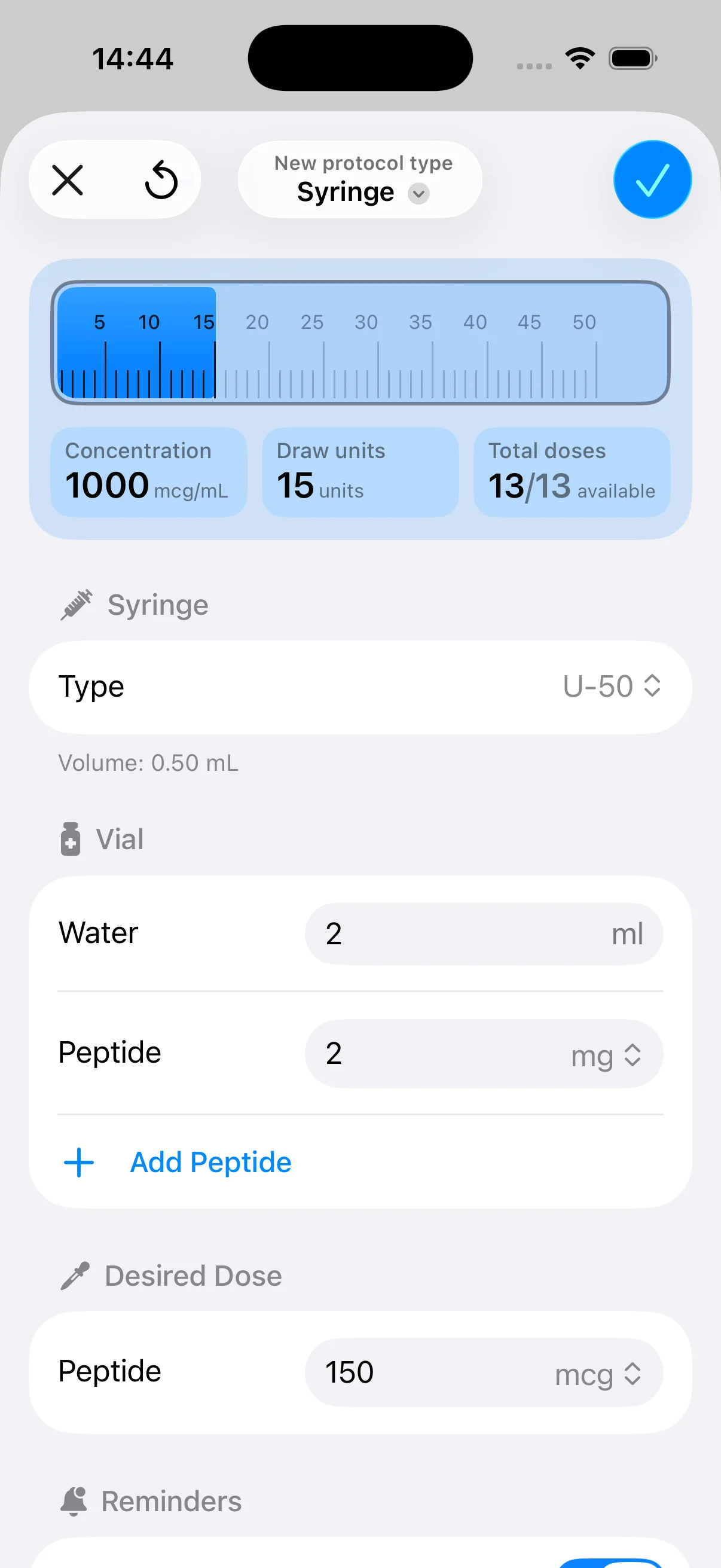
Once the dose is chosen, the schedule still isn’t usable until the math is translated into syringe markings. A lot of people lose precision here, because they know the target amount but haven’t mapped it to their specific vial, concentration, and insulin syringe. The schedule becomes real only when the conversion is simple enough to repeat without hesitation.
A large adult GH replacement study found that the median time to reach maintenance dose differed by sex, 4 weeks in males versus 9 weeks in females, and maintenance dose was 1.2 IU/day in females versus 0.8 IU/day in males (JCEM). That’s another reminder that the schedule isn’t fixed. Two people can start from the same place and still arrive at different maintenance points.
Make the vial math boring on purpose
The safest setup is the one you don’t have to rethink every morning. Write down the reconstitution amount, the final concentration, and the syringe mark that matches the daily dose, then keep that note with your supplies. If you ever have to pause and recalculate in a rush, mistakes get more likely.
A clean workflow usually looks like this:
- Confirm the vial concentration: Read the label before you mix anything, because the syringe mark changes with concentration.
- Match the daily dose to a unit mark: Convert once, then keep the same reference until the plan changes.
- Keep the reference visible: A phone note or printed card beats mental math when you’re tired.
- Check the plan after each adjustment: If the dose changes, the unit mark changes with it.
For people who want a deeper breakdown of the reconstitution and unit math, the internal guide on HGH frag dosage is a useful companion because it focuses on turning a target into a usable injection volume. That’s the step that keeps the schedule from becoming a guessing game.
Practical rule: if you can’t explain your vial setup in one sentence, the setup isn’t ready yet.
Some people try to wing the math from memory after a few days. That usually works right up until the first vial change, then the whole routine gets fragile. A written reference fixes that problem before it starts.
Monitoring and Adjusting the Schedule Over Time
The first injection is usually the easy part. The harder work starts after a few weeks, when the schedule has to prove it can hold up in real life. If the dose is too high, fluid retention, sleep disruption, joint discomfort, or glucose drift can show up. If the dose is too low, the plan may feel flat and invite unnecessary adjustments.
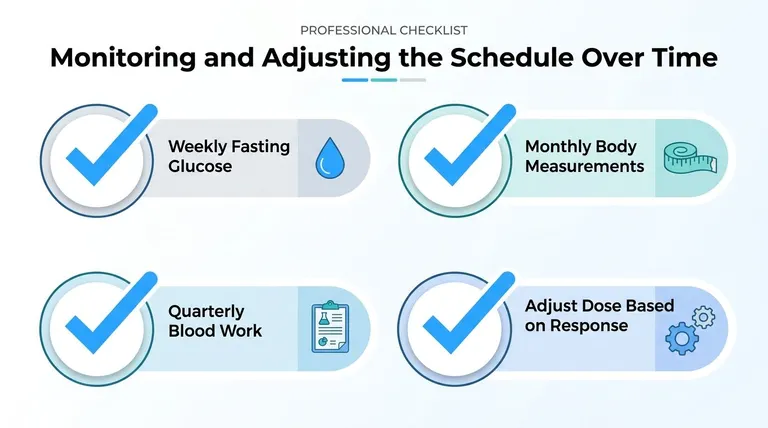
Fasting glucose should be checked weekly for the first 8 weeks because insulin resistance is more likely at doses ≥2 IU/day, with a common escalation pattern starting at 1 IU/day for 2–4 weeks then moving to 2 IU/day if no edema, carpal-tunnel symptoms, or glucose drift appear (Peptide Initiative). I treat that as a practical checkpoint, not just a lab reminder. If glucose starts trending in the wrong direction, the schedule needs attention before the next increase.
What to watch before changing the dose
A tracking system does not need a long checklist. It needs the same small set of fields every week so change is easy to see. IGF-1, fasting glucose, swelling, hand tingling, sleep quality, and morning recovery are usually enough to show whether the plan is staying steady.
For a more structured way to log those signals, the internal roundup of best peptide tracker apps is useful because it focuses on adherence, reminders, and history rather than raw numbers alone. If you want a broader monitoring setup, Lila’s best HRT tracking features page gives a practical view of the kind of logging that makes dose decisions easier to review later.
A simple adjustment ladder usually works better than improvising:
- Hold the dose if symptoms stay mild and the labs remain steady.
- Step up carefully if the current dose is tolerated and the plan calls for a move.
- Pause and reassess if edema, numbness, or glucose drift appears.
- Step back if side effects are building faster than benefits.
Best practice: do not change the dose because one day feels different. Look for a pattern in the log, then decide.
A good schedule is the one that changes slowly. Fewer adjustments make it easier to read the trend, easier to follow the plan, and easier to correct if the routine starts drifting.
Running Your HGH Dosing Schedule in PepFlow
A schedule only works if you don’t have to remember it in your head. PepFlow is one way to turn the plan into a repeatable workflow, because it lets you set the vial setup, record the daily dose, choose a start date, and define the cycle length and pause periods in one place. That matters when the protocol has more than one phase.
The cleanest setup starts with the dose you already decided on, then maps that to the calendar. Add the injection time, choose reminders that match the window you’ll use, and log each dose as you go so missed days don’t disappear into memory. A history view is especially helpful once the vial changes or the dose gets adjusted, because you can see the pattern without rebuilding it from scratch.
A simple workflow that holds up
The most useful routine is the one you can repeat with almost no friction.
- Enter the protocol once: Put the start date, daily dose, and any planned pause period into the schedule.
- Set reminders to match your timing window: Morning or evening reminders should mirror the routine, not fight it.
- Log doses immediately: Waiting until later usually leads to missing entries.
- Review the history before adjusting: The log should inform the next step, not the other way around.
PepFlow’s dosing calendar, countdowns, reminders, and log-dose actions are built around that kind of routine, which is why it works better than a spreadsheet when the schedule gets busy. You’re not trying to memorize the protocol, you’re trying to make the protocol visible.
A good app doesn’t replace judgment, but it does reduce avoidable errors. That includes forgetting whether a dose was taken, mixing up the next change date, or losing track of a pause period after a weekend.
Safety, Legal, and Final Checklist Before You Start
Start with the legal and clinical reality. Adult GH use belongs in a medically supervised setting, and adult GH deficiency remains uncommon. For the prevalence figure, the older endocrine literature describes it as a relatively rare diagnosis, and dosing is usually individualized with smaller changes and longer spacing in older adults or in people with insulin resistance so you can balance benefit against adverse effects. The practical takeaway is simple. A schedule should be built from prescription oversight, not copied from someone else’s protocol.
If you are already discussing injectable regimens with a clinician, the injectable treatments page from Ideal Face & Body shows the same kind of structure that works here, follow-up after the first dose matters as much as the dose itself. In real use, the schedule has to sit inside a monitoring plan, because timing alone does not tell you whether the regimen is fitting the person.
Before the first injection, confirm four things.
- Prescription status: You know whether the product and the use case are medically supervised.
- Baseline labs: You have a starting point for the markers you plan to follow.
- Monitoring plan: You know when glucose, IGF-1, and symptoms will be checked.
- Side-effect plan: You know what to do if swelling, numbness, or glucose drift shows up.
I also tell people to sort out the day-to-day logistics before they begin. Where the vial will be stored, what reminder they will use, and how they will record a missed dose all affect adherence more than most charts admit. A careful schedule is not about chasing the perfect number. It is about choosing a dose you can repeat, a timing window you can keep, and a way to catch problems early enough to change course.
If you want a schedule that is easier to run day after day, PepFlow gives you a place to set the dose, organize the cycle, and keep the history in one spot. Visit PepFlow to build a more reliable HGH dosing routine and keep your timing, reminders, and dose log aligned from the start.