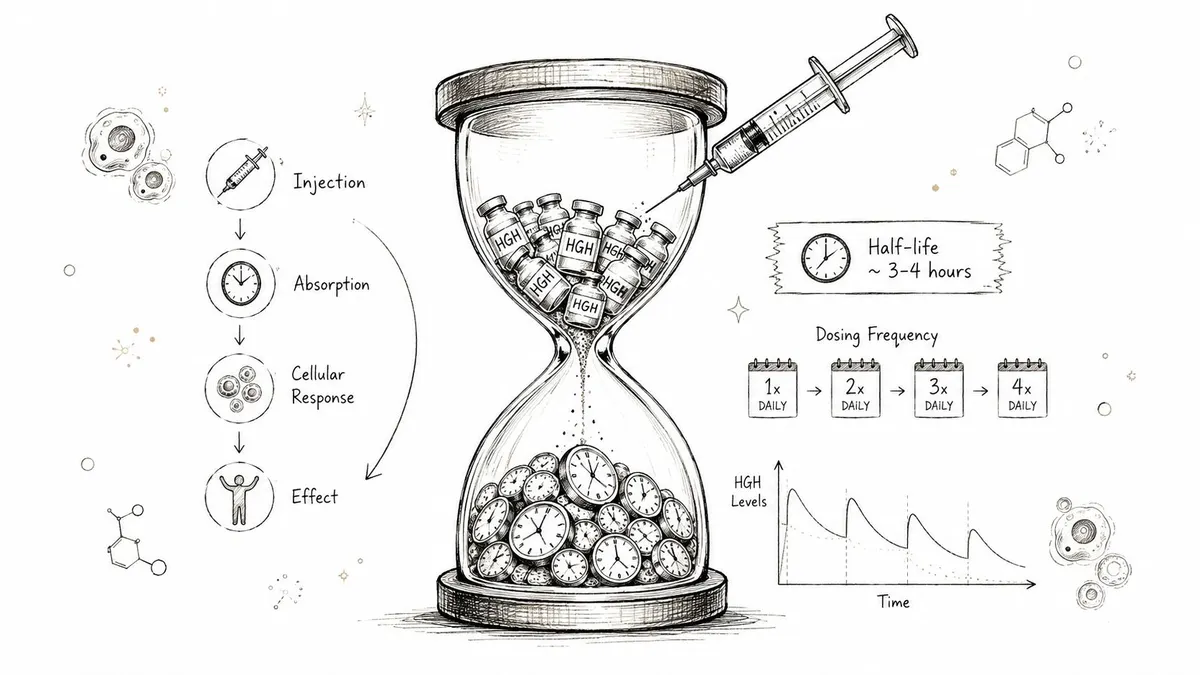
The circulating half life of HGH is roughly 20 to 30 minutes after intravenous exposure, but its biological effects can persist for 9 to 17 hours. That’s why most protocols rely on once-daily subcutaneous injections instead of multiple daily doses.
What trips people up is that the number they hear first is usually the wrong number for dosing decisions. A hormone can leave the bloodstream quickly and still keep signaling inside the body for hours, so the actual question is not just how fast HGH clears, but how long its downstream effects continue to matter.
Table of Contents
- What the Half Life of HGH Means
- The Numbers Behind HGH Clearance Rates
- How Route and Formulation Change the Timeline
- Why Daily Subcutaneous Injections Became Standard
- Tracking Your Dosing Schedule with Precision
- Common Misconceptions About HGH Half Life
- Building a Consistent and Safe Peptide Routine
What the Half Life of HGH Means
Half life sounds technical, but the idea is simple. It is the amount of time it takes for half of a substance to leave circulation or lose measurable presence in the body. With HGH, that number depends on whether you are talking about what is in the blood right now, or what the body is still doing in response to it.
That difference matters a lot. The DEA notes that circulating hGH clears quickly, while its biological half life is much longer, about 9 to 17 hours (DEA PDF). In plain English, the hormone can disappear from serum within a short window, yet its signaling cascade keeps moving much longer.
Circulating half life versus biological half life
HGH works like a messenger that drops off a package and leaves. The messenger is gone fast, but the recipient can spend hours unpacking, building, and responding to what was delivered. That is why a short blood half life does not mean the hormone stops working the moment it leaves the bloodstream.
For readers comparing home monitoring options, at-home hormone testing can be useful when you want a practical picture of how a protocol is interacting with real-world biology, not just the dosing calendar. A resource like at-home hormone testing can help frame why timing and consistency matter, even when the lab number you are tracking is only one part of the story.
Practical rule: do not confuse detectability in blood with duration of effect. They are related, but they are not the same thing.
The split also explains why route and schedule matter so much. A peptide protocol is not just about how much is injected, it is about how the body receives it, absorbs it, and keeps responding after the visible serum level falls. If you want a companion concept, the PepFlow peptide timing guide helps connect timing windows to routine planning without overcomplicating the basics.
The Numbers Behind HGH Clearance Rates
What do the numbers behind HGH clearance rates really mean for dosing? The answer depends on which part of the timeline you are measuring. Native human growth hormone clears from blood quickly, while recombinant somatropin follows a different path depending on how it enters the body. Those differences explain why the same hormone can look short-lived in one setting and far steadier in another.
What the measured values show
Controlled human work measured a mono-exponential mean circulating half life of 13.6 minutes, with a range of 11.9 to 19.4 minutes, and a bi-exponential decay with a rapid distribution phase of 3.1 minutes followed by a circulation decay phase of 13.8 minutes (PubMed). Another study after intravenous administration found an apparent elimination half life of 18 minutes (PubMed). A review of pharmacokinetics places the circulating half life in the broader 20 to 30 minute range and separates that from the longer biological half life (DEA PDF).
This seems contradictory until you recognize the measurements are not all describing the same thing. Some are tracking circulating decay, some use different models, and some summarize practical clinical behavior. What they agree on is the main point. HGH does not stay in the bloodstream for long.
Why the post-injection curve matters
After subcutaneous dosing, recombinant HGH or somatropin shows a much longer apparent plasma half life, commonly about 3 to 4 hours, with one review citing 3.4 hours and another study reporting 248 ± 55 minutes (PMC review). The same source notes that after a subcutaneous dose, plasma GH follows first-order elimination and can drop to less than 3% of peak by 15 to 20 hours after about 5 half lives (Halflife Labs review).
That number is the practical bridge between lab data and a daily routine. If a dose is meant to hold levels across a full day, a fast-clearing blood hormone needs either a delivery method that slows absorption or a schedule that replaces it before levels drift too far. That is why half life is not trivia, it is the data point that determines whether a once-daily injection schedule can maintain stable levels.
A short plasma half life does not automatically mean the protocol is unstable. It means the schedule has to follow the curve instead of fighting it.
How Route and Formulation Change the Timeline
Does the same HGH dose behave the same way no matter how it is given? No, because the route changes how fast the hormone enters circulation and how long it stays there before the body clears it. Intravenous HGH moves in as a sharp spike and then falls quickly, while subcutaneous HGH sits in a small depot under the skin and releases more slowly. That depot is the reason the apparent half life looks longer after an injection into fat tissue than after direct entry into the bloodstream.
Comparing the two routes
| Route | Circulating Half Life | Apparent Half Life | Practical Implication |
|---|---|---|---|
| Intravenous | 20 to 30 minutes | Very short, close to direct clearance | Best for seeing how fast native hormone clears, not for stable day-long coverage |
| Subcutaneous | Not the same as IV, because absorption slows the curve | 2 to 4 hours, with a review example at 3.4 hours | More practical for routine dosing because the body receives it gradually |
The main point is simple. The number you quote depends on the delivery route. An IV half life reflects intrinsic clearance. A subcutaneous half life reflects absorption plus clearance, which is the number that matters for real-world dosing decisions.
That is the practical gap many readers miss. Circulating half life tells you how quickly the hormone leaves the blood, while biological effect lasts through a different window because tissues respond after the blood level has already started to fall. For a protocol to work cleanly, you have to respect both timelines, not just the blood measurement. That is also why tracking tools matter. They help you see whether a dose was given inside the intended window, instead of guessing after the fact.
Why formulation details matter too
Somatropin is not just HGH in a vial. Its behavior depends on how the molecule is presented to tissue, how quickly it leaves the injection site, and how the body distributes it afterward. A clinician or researcher cannot look at one half life value and assume it applies to every protocol.
The practical rule stays straightforward. If you change the route, you change the curve. If you change the curve, you change the timing. For readers comparing different peptide classes, the guide on the difference between DAC and non-DAC peptides explains why timing rules vary from one compound family to another, and that same logic helps make sense of HGH dosing windows as well. If you want a broader clinical perspective, you can also browse expert advice on hormone replacement.
Why Daily Subcutaneous Injections Became Standard
Why did daily subcutaneous HGH injections become the standard? Because the useful window in the blood is much shorter than the time the body keeps responding. That gap matters in real dosing, since a level can fall quickly while tissues are still working through the downstream signal. Once researchers saw that plasma levels can drop to less than 3% of peak by 15 to 20 hours after a subcutaneous dose, daily replacement made practical sense.
Why older schedules fell behind
Older protocols sometimes used thrice-weekly intramuscular injections, but spacing doses that far apart fits poorly with a hormone that clears fast and depends on repeated exposure. The body doesn’t care whether a plan sounds convenient. It responds to exposure windows.
The daily subcutaneous model became standard because it sits between two problems. Repeated direct blood delivery can create sharper peaks, while wide spacing can let levels fall too far before the next dose. Daily injections keep the curve steadier, which is why they fit so many HGH protocols better than older schedules.
Timing is part of the protocol, not an afterthought
If you use any HGH-related routine, the clock matters as much as the dose. Missing the intended window once or twice usually does not create chaos, but repeated drift can turn a careful plan into guesswork. A reminder system helps here, especially for people who manage more than one protocol step.
For readers who want a closer look at protocol design and replacement strategies, browse expert advice on hormone replacement offers a useful perspective to read alongside timing fundamentals. The same timing logic also helps explain why different peptide families follow different schedules, which is laid out in the difference between DAC and non-DAC peptides.
Practical rule: if a compound depends on a narrow timing window, your calendar is part of the treatment plan.
Tracking Your Dosing Schedule with Precision
What keeps a daily protocol on track after the first few days? Usually it is not the injection itself. It is the habit system around it, because work, travel, sleep, and training all keep shifting the day. People who stay consistent usually do not trust memory alone, they build a simple routine that catches mistakes before they become habits.
What a reliable routine looks like
Start by tying the dose to the same part of the day. That cuts down on decision fatigue. Then use reminders, history logs, and a running record of what you did, not what you meant to do.
A few habits help more than people expect:
- Set one anchor time: Pick a daily window that fits your life and keep it steady.
- Log every dose immediately: Do not wait until later, because later gets fuzzy fast.
- Review missed days weekly: Patterns matter more than isolated mistakes.
- Plan pauses before you need them: If your protocol cycles, mark the pause dates in advance.
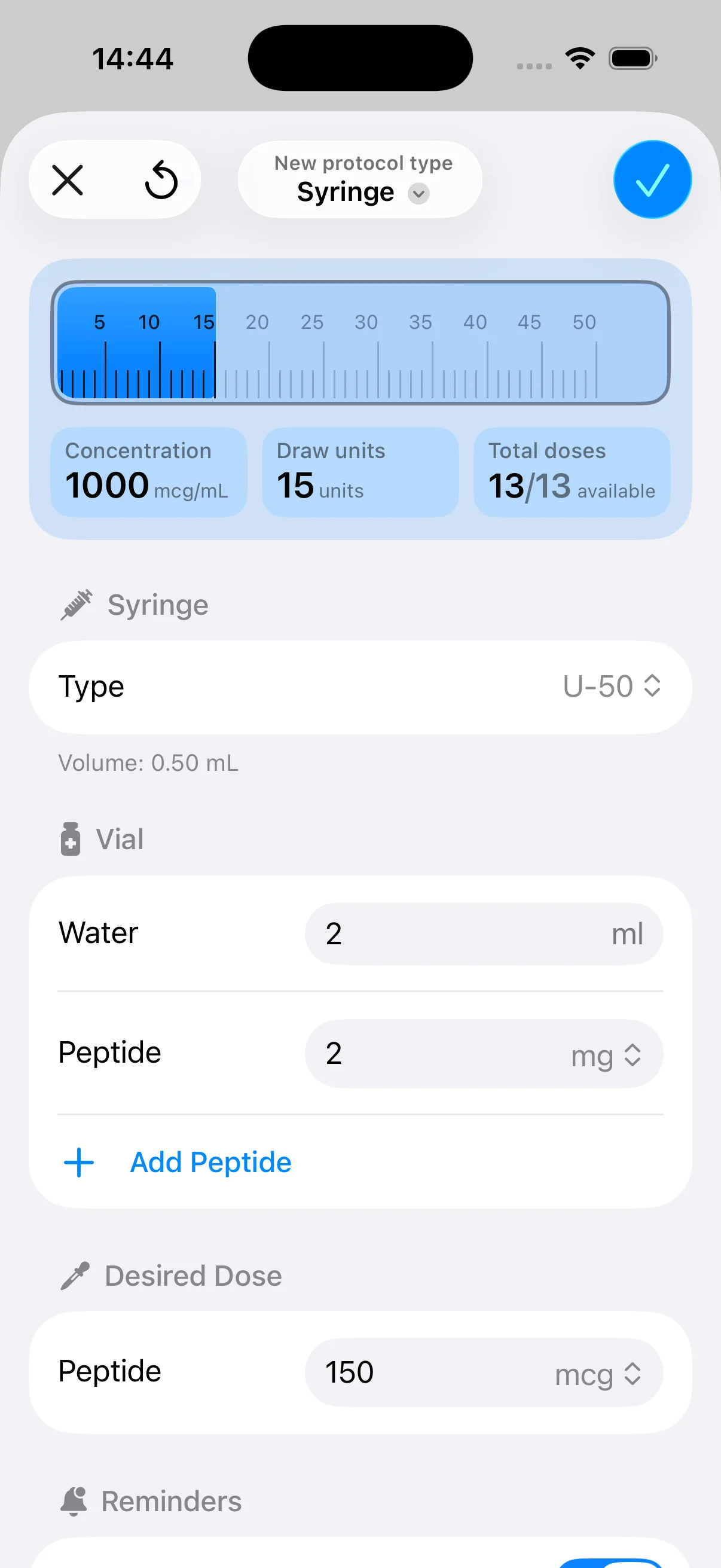
- Check concentration before you inject: Unit confusion creates preventable dosing errors.
A tool can help if it reduces arithmetic and removes guesswork. PepFlow can combine a dosage calculator, cycle management, reminders, and history tracking for peptide schedules, which is useful when the goal is consistency rather than improvisation. For context on how timing logic varies across compounds, see the HGH frag dosage guide.
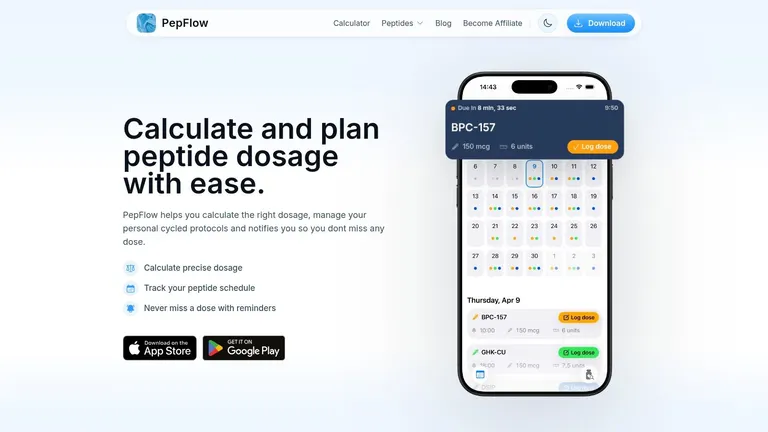
The point of tracking is not obsession. It is clarity. When your schedule is visible, you can tell the difference between a protocol problem and a missed reminder, which matters when half-life knowledge has to translate into real dosing decisions. For readers who want a broader example of routine tracking beyond peptides, it can also help to find award winning plant based serums that fit a consistent daily care plan.
Common Misconceptions About HGH Half Life
One of the most common mistakes is treating a short circulating half life as a signal to inject constantly. HGH does not work that way. The blood level drops fast, but the downstream biology does not disappear on the same schedule.
What people get wrong
A short half life does not mean a hormone is useless a few hours later. The distinction between circulating half life and biological half life is the reason that assumption breaks down. The body can still be responding after the serum level has already fallen.
Another mistake is assuming the half life stays the same no matter how the compound is delivered. It does not. The same hormone can behave very differently when given intravenously versus subcutaneously, because the depot under the skin changes absorption before elimination even begins.
The cleanest way to think about it
People often picture a simple fade-out. HGH is more layered than that, with a blood phase, an absorption phase, and a tissue response phase. Those layers are why daily dosing can make sense without requiring multiple injections a day.
If you have ever browsed wellness or skin-care content and seen claims that the newest formula always wins, the logic is similar here. Longer duration does not automatically mean better results, and a longer-acting product is not automatically the right fit. For a different example of how people can focus on the wrong feature first, even a page like find award winning plant based serums shows how marketing can pull attention away from the underlying mechanism.
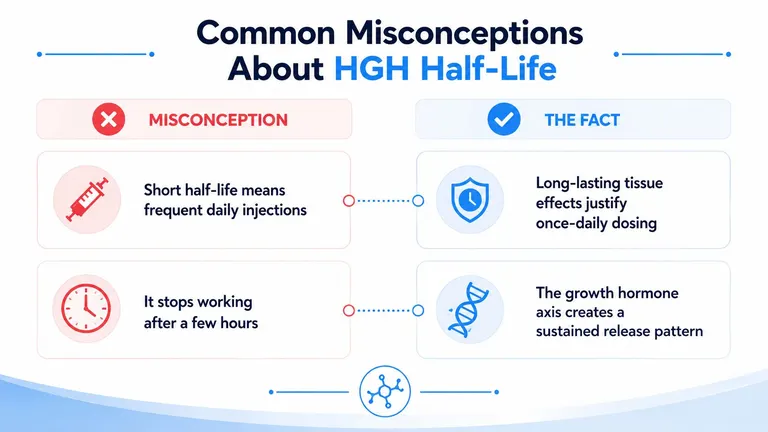
The useful correction is simple. Short blood half life means the dose needs a sensible schedule, not frantic redosing. Once that is clear, the protocol becomes easier to follow and much harder to overcomplicate.
Building a Consistent and Safe Peptide Routine
A good routine starts with the right mental model, but the practical question is simpler. Your dosing schedule has to fit HGH’s biological timeline well enough that you can repeat it without guessing. Circulating half life explains how fast the hormone leaves the blood, biological half life explains how long the downstream effect can last, and route of administration shapes how that dose reaches the body.
Safety comes from consistency, not from constant adjustment. Log each injection, review the pattern, and look for the reasons timing slips, maybe the plan is too complicated, or maybe the schedule does not match your day-to-day life. A routine you can repeat is usually better than one you keep redesigning.
Missed windows often happen for a simple reason, people rely on memory alone. Keep the dose time fixed, keep your records clean, and use reminders so the schedule does not depend on recall when work, travel, or fatigue gets in the way. PepFlow can support that kind of routine by handling the math and the timing, but it doesn’t replace medical judgment or professional guidance.
For many people, the most practical next step is straightforward organization. A tracking tool can show when a dose was taken, when the next one is due, and whether the pattern is starting to drift. That kind of structure helps the schedule stay aligned with the hormone’s real timeline, which is the part that matters when consistency is the goal.